Self-Hosted Gateway Architecture
The self-hosted gateway runs in a customer-managed private data plane while connecting to the API Platform Control Plane hosted in the cloud. This architecture allows organizations to manage APIs centrally while keeping API traffic, runtime execution, and backend connectivity within their own environment.
Cloud Control Plane
The API Platform Control Plane is hosted in the cloud and provides centralized API management capabilities. It is used to configure, publish, and manage APIs and policies.
The self-hosted gateway establishes an outbound WebSocket connection to the cloud control plane over port 443. This connection is used to receive API and policy configuration updates from the control plane. Since the connection is initiated from the private data plane, customers do not need to expose internal gateway management services to the public internet.
Private Data Plane
The Private Data Plane runs within the customer’s infrastructure. It handles API traffic, applies runtime policies, and communicates with backend services. API requests from consumers are processed entirely within this private environment.
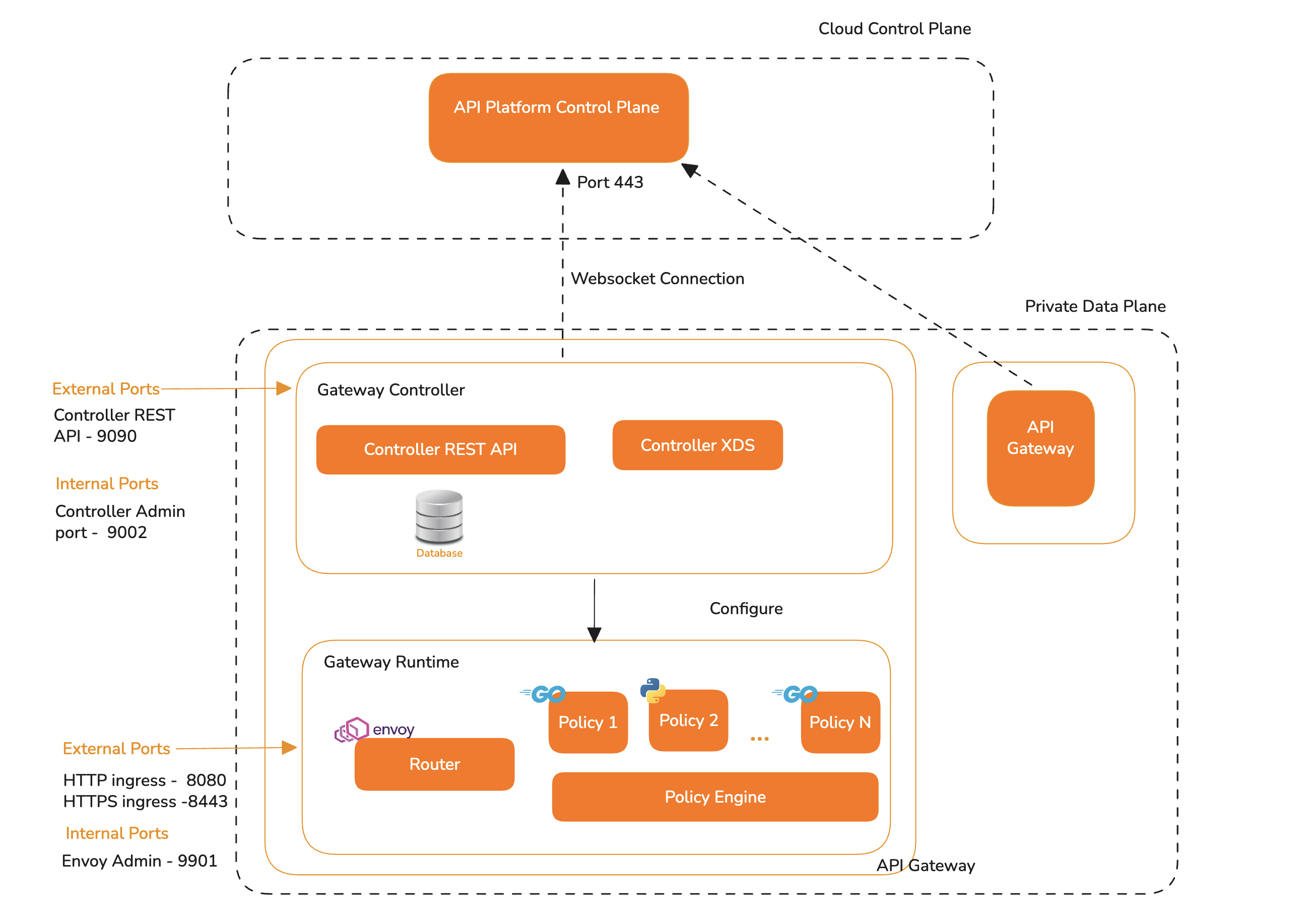
The Gateway includes the following components:
Gateway Controller
The Gateway Controller is responsible for receiving API and policy configurations from the cloud control plane and configuring the gateway runtime accordingly.
It contains the following services:
| Component | Description |
|---|---|
| Controller REST API | Exposes management APIs used by the control plane and internal gateway components. |
| Controller XDS | Provides runtime configuration to the gateway router using xDS. |
| Database | Stores gateway configuration and runtime metadata required by the controller. |
Gateway Controller Ports
| Port | Type | Description |
|---|---|---|
| 9090 | External | Controller REST API port. |
| 9002 | Internal | Controller admin port. |
Gateway Runtime
The Gateway Runtime is responsible for handling API traffic. It includes the router and the policy engine.
The router receives incoming API requests over HTTP or HTTPS and routes them to the relevant backend services. During request and response processing, the router communicates with the policy engine to execute configured policies such as authentication, authorization, rate limiting, transformation, analytics, or custom policies.
Gateway Runtime Ports
| Port | Type | Description |
|---|---|---|
| 8080 | External | HTTP ingress port for API traffic. |
| 8443 | External | HTTPS ingress port for API traffic. |
| 9901 | Internal | Envoy admin port. |
Configuration Flow
When an API or policy is created or updated in the cloud control plane, the configuration is sent to the Gateway Controller through the outbound WebSocket connection.
The Gateway Controller stores the configuration and converts it into runtime configuration required by the Gateway Runtime. The Controller XDS service then configures the router. Once configured, the Gateway Runtime starts serving API traffic according to the policies and routing rules defined in the control plane.
Runtime Traffic Flow
API consumers send requests to the Gateway Runtime through the exposed HTTP or HTTPS ingress ports.
The router receives the request and identifies the matching API route. It then applies the configured policy chain using the policy engine. After successful policy execution, the request is forwarded to the backend service. Responses from the backend follow the same path back through the gateway, allowing response policies to be applied before the response is returned to the client.
Key Benefits
This architecture provides centralized API management while keeping runtime execution close to backend services. It helps organizations maintain control over API traffic, reduce exposure of internal systems, and apply consistent policies across APIs managed through the cloud control plane.