Type Panel
The Type Panel is the side panel you open whenever you create or change a custom type in WSO2 Agent Builder. It gives you one form to define records, enums, unions, arrays, and service classes, configure each member or field, and toggle advanced options such as additional fields and read-only types. Every change you save in the panel updates the type's Ballerina source and the type card on the Type Canvas.
For a canvas-level view of how all the types in your project relate to each other, see the Type Canvas.
Open the panel
You can open the Type Panel from two places, depending on where you are working.
-
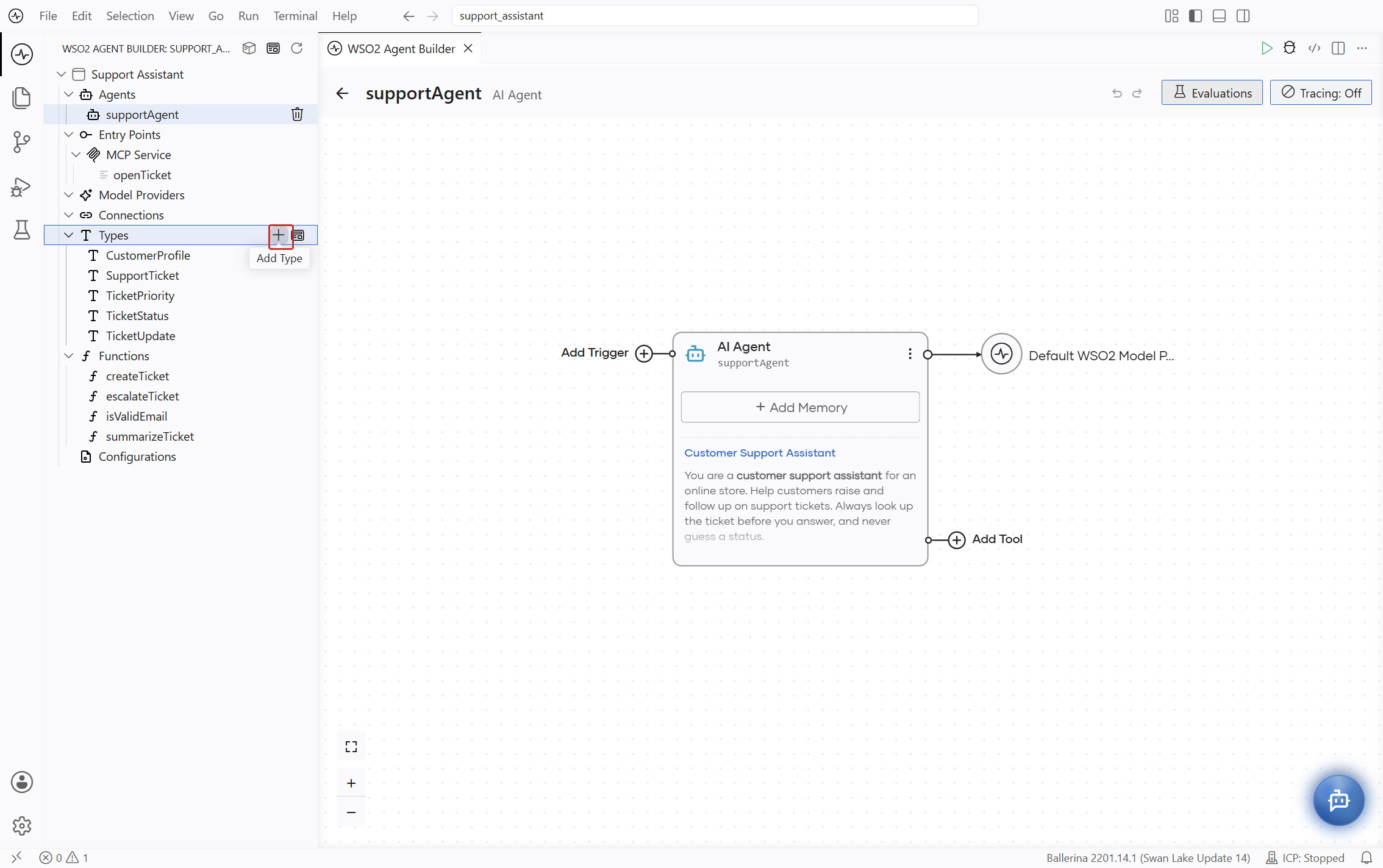
From the project explorer. Select + next to Types to add a new type, or select an existing type name to edit it.
-
From the Type Canvas. Select + Add Type in the header to add a new type, or select Edit from the three-dot menu on a type card to edit an existing one.
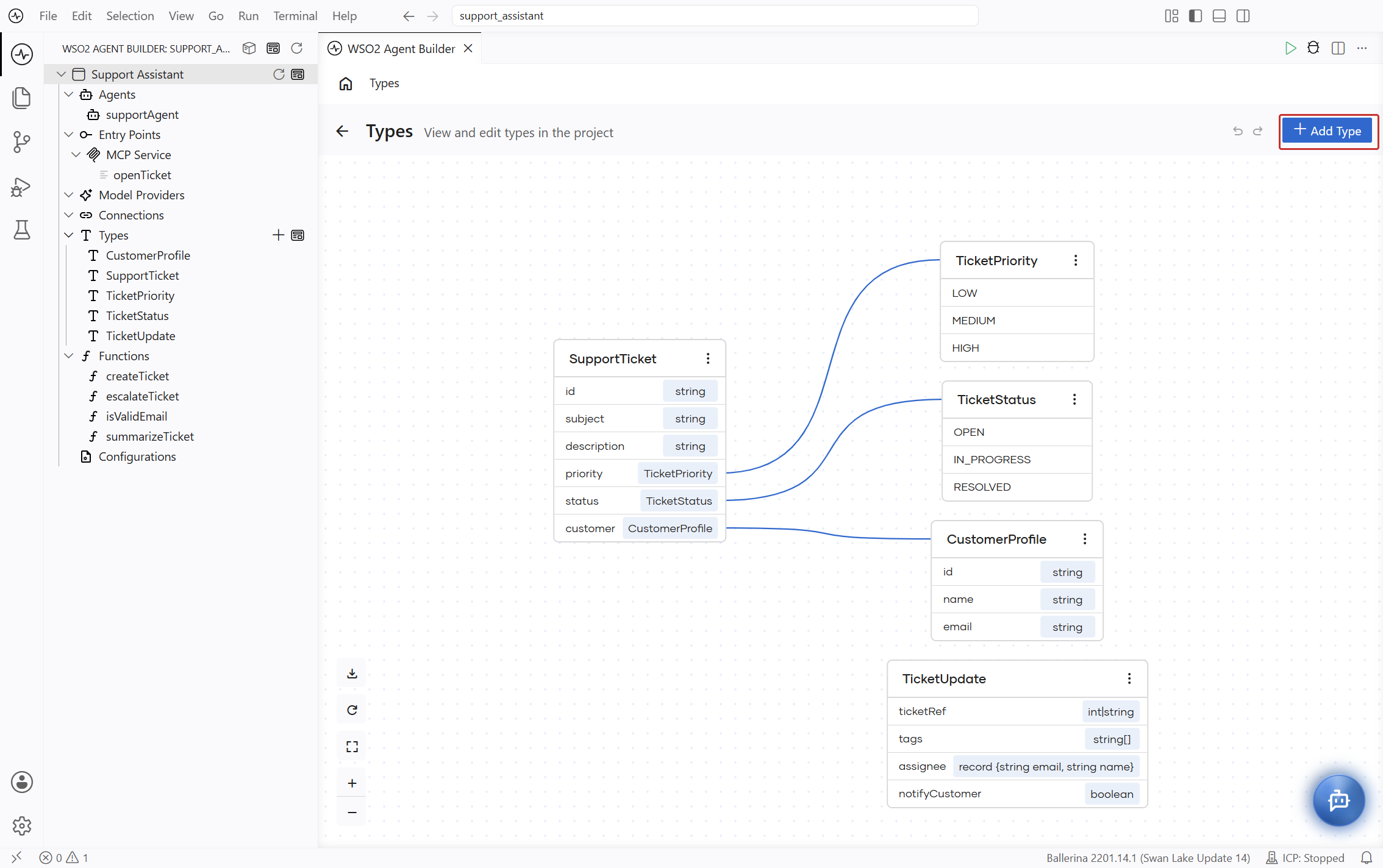
The panel opens the new-type form when you add a type, and reopens populated with the current definition when you edit one.
Supported types
The Type Panel supports the following kinds of types. Pick the kind from the Kind field at the top of the form.
| Kind | Use it for |
|---|---|
| Record | A structured value with named fields and a type per field, similar to a struct or DTO. |
| Enum | A fixed set of named string members, useful for status codes and choices. |
| Union | A value that can be one of several types, including primitives and other custom types. |
| Array | A list of values of the same type, with an optional fixed size. |
| Service Class | A class that exposes resource methods, for a typed object that carries behavior alongside data. |
Every type form shares the same header fields:
| Field | Description |
|---|---|
| Kind | The kind of type to create (record, enum, union, array, or service class). |
| Name | A unique name to identify the type. Use PascalCase. |
Record
A record defines a structured value with named fields. Each field has a name, a type, and an optional flag, and the panel renders one row per field under the Fields section.
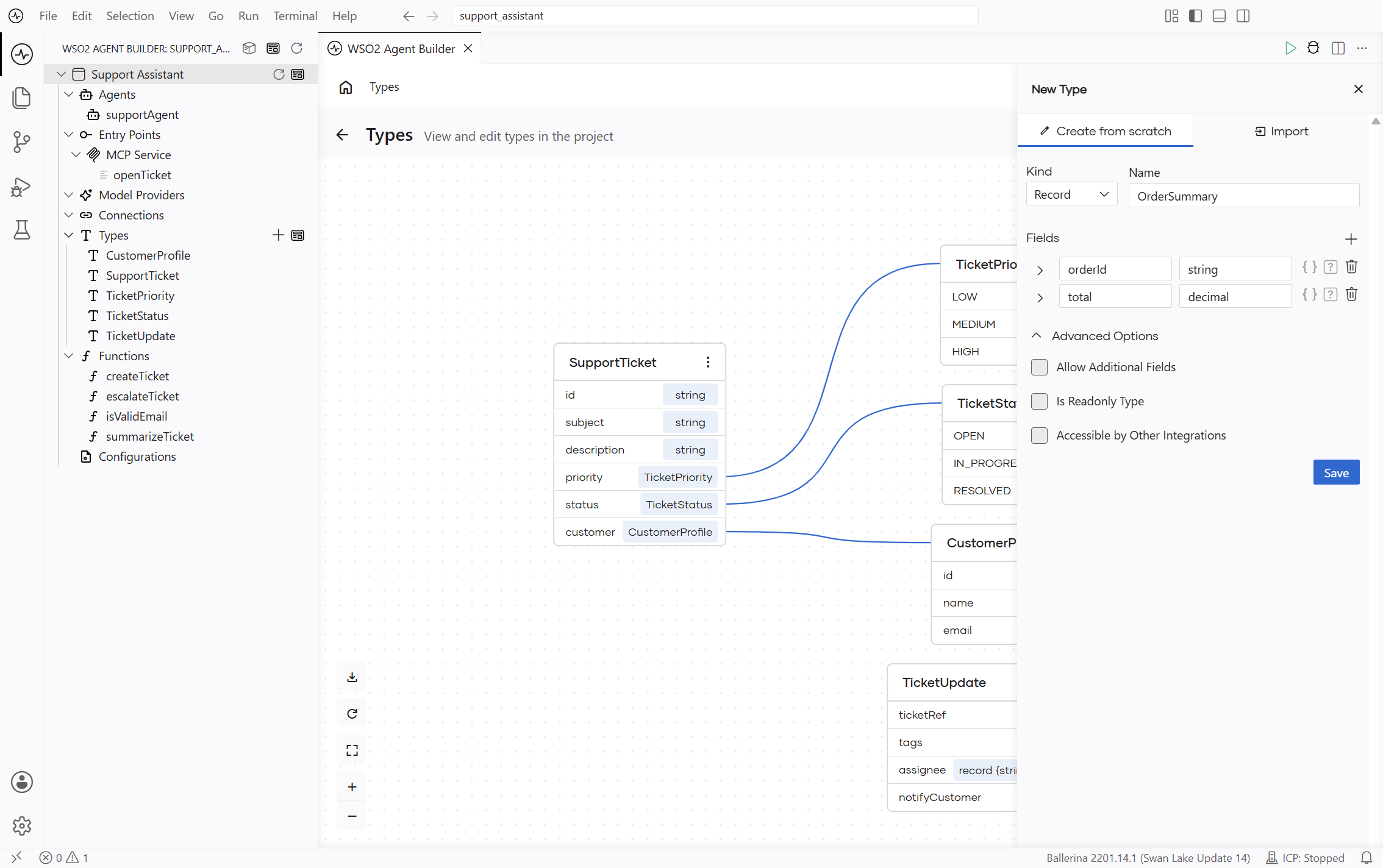
Select + next to Fields to add a new field. Each field row exposes the following options.
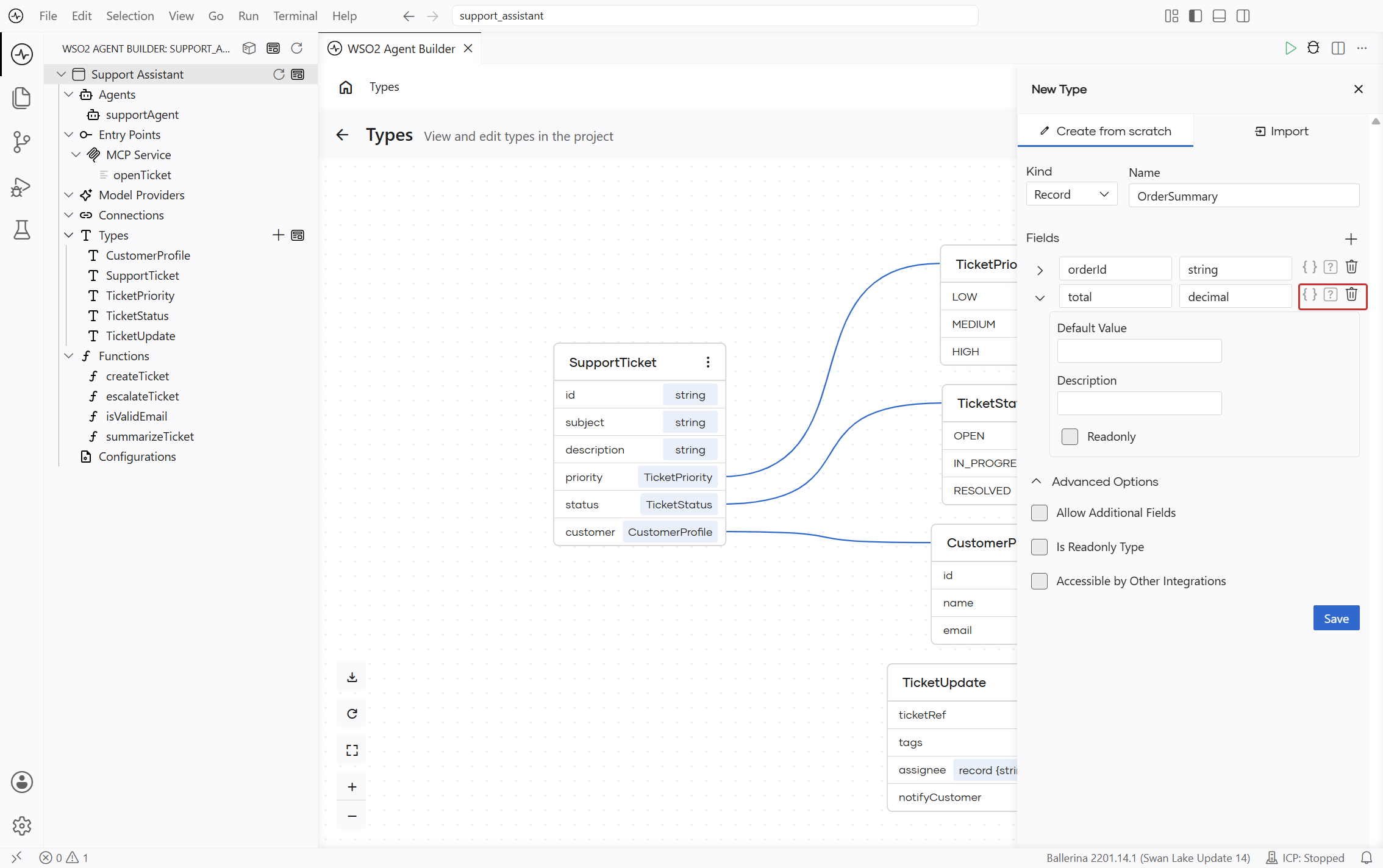
| Option | Description |
|---|---|
| Inline record | Define the field's type inline instead of pointing at a named type. Use this when the nested shape is only used by this field and you don't want to create a separate type for it. |
| ? (optional) | Mark the field as optional. An optional field is allowed to be missing or null when a value of the record is constructed. |
| Delete | Removes the field from the record. |
Select the arrow at the start of a field row to set the field's Default Value and Description, or to make the field Readonly.
To make a field reference another type in the project, set the field type to the name of that type. The Type Canvas draws the connecting line when you save.
Enum
An enum defines a fixed set of named members. Use it for closed sets of values such as status codes, channels, or roles.
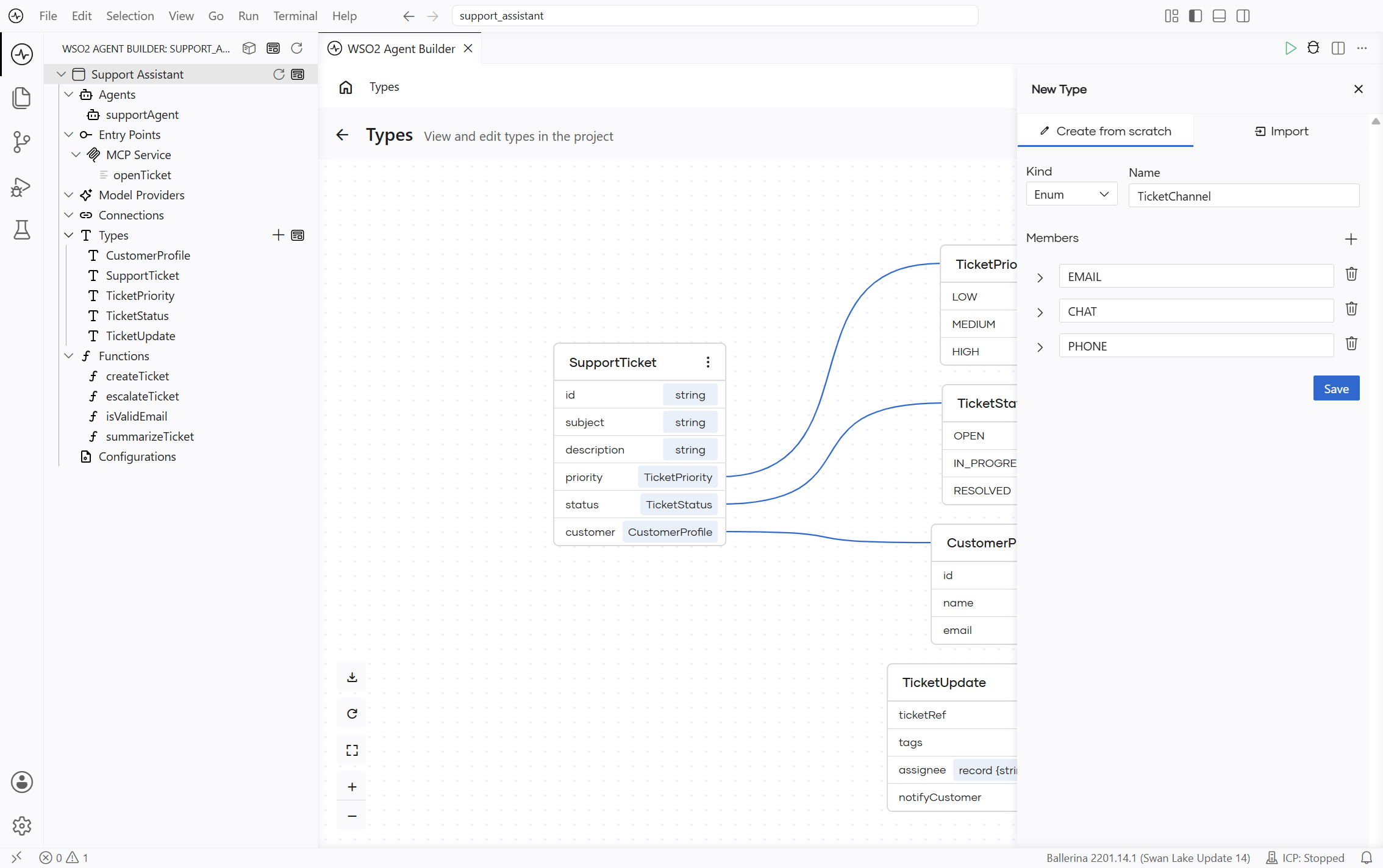
Select + next to Members to add a member, and the delete icon on a row to remove it. Each member has a single name (for example, EMAIL, CHAT, PHONE).
Union
A union defines a value that can be one of several types. Use it when a field or variable can legitimately hold more than one shape, for example, a ticket lookup that returns either the ticket or an error.
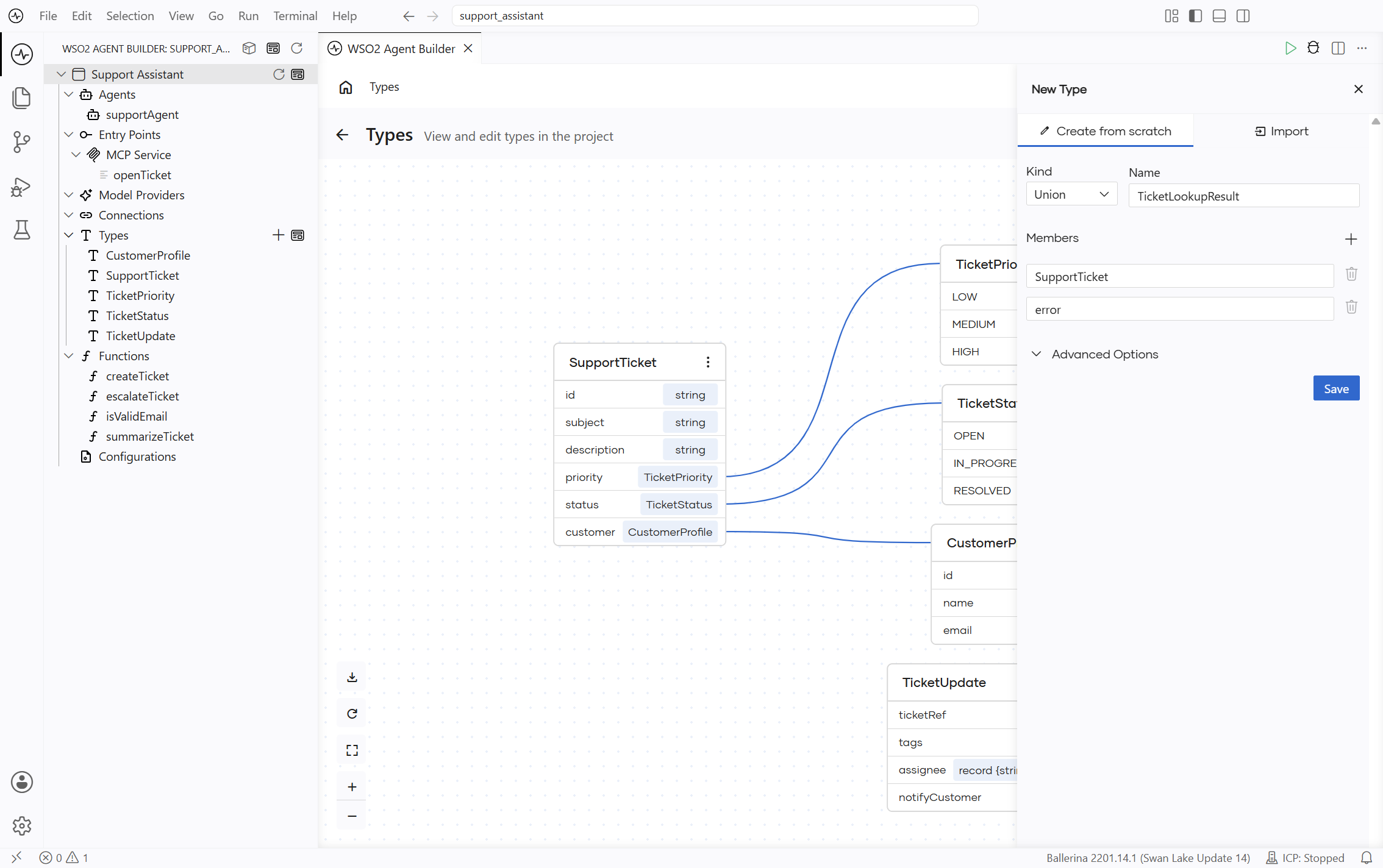
Select + next to Members to add a member type, and the delete icon to remove one. Each member can be a primitive (string, int, boolean, and so on) or another type you have already defined in the project.
Array
An array defines a list of values of the same type, with an optional fixed size.
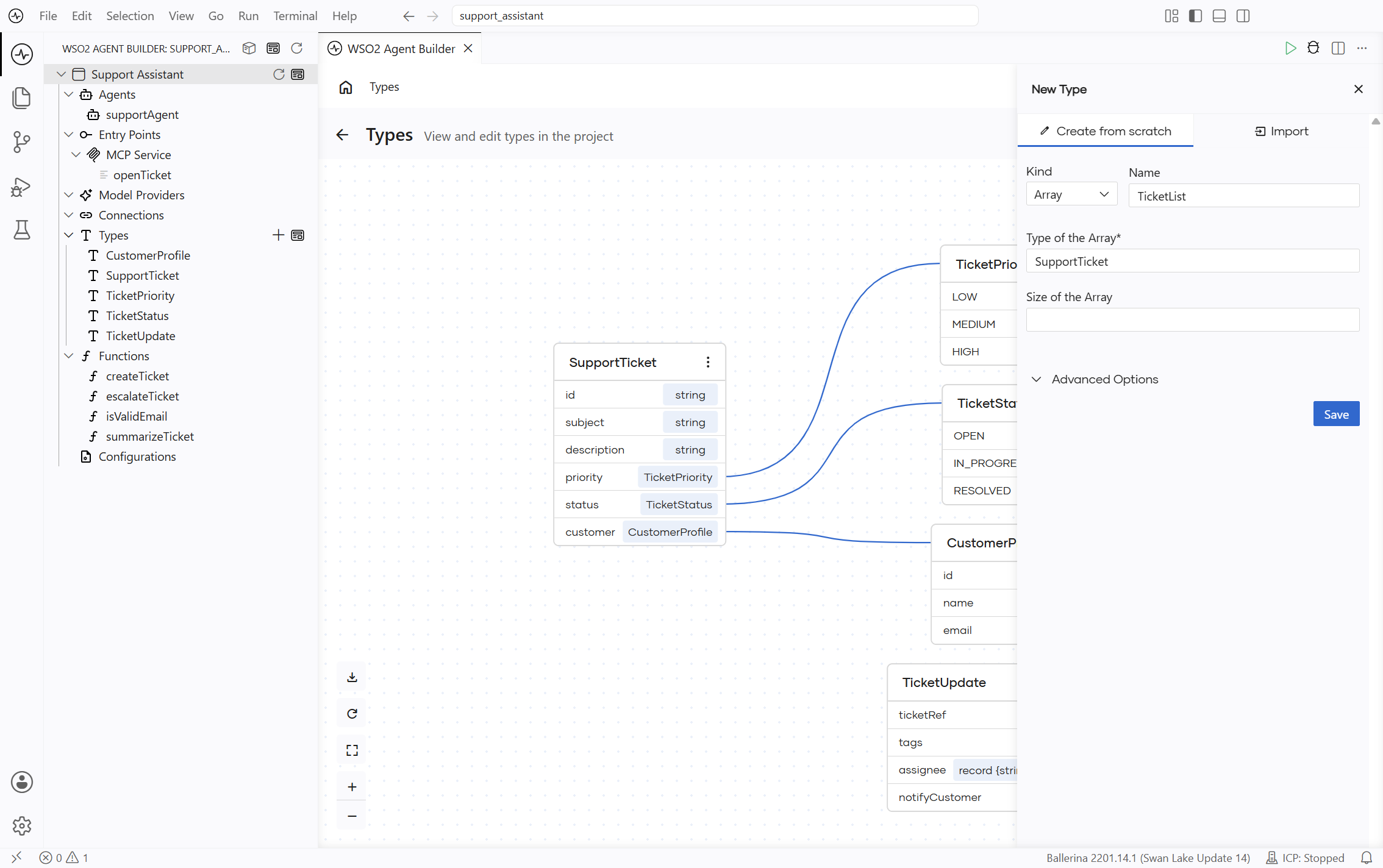
| Field | Description |
|---|---|
| Type of the Array | The type of each element in the array. Can be a primitive or a custom type defined in the project. |
| Size of the Array | Optional fixed size for the array. Leave empty for a dynamically sized array. |
Service class
A service class defines a class with one or more resource methods. Use it when you need a typed object that exposes behavior alongside data.
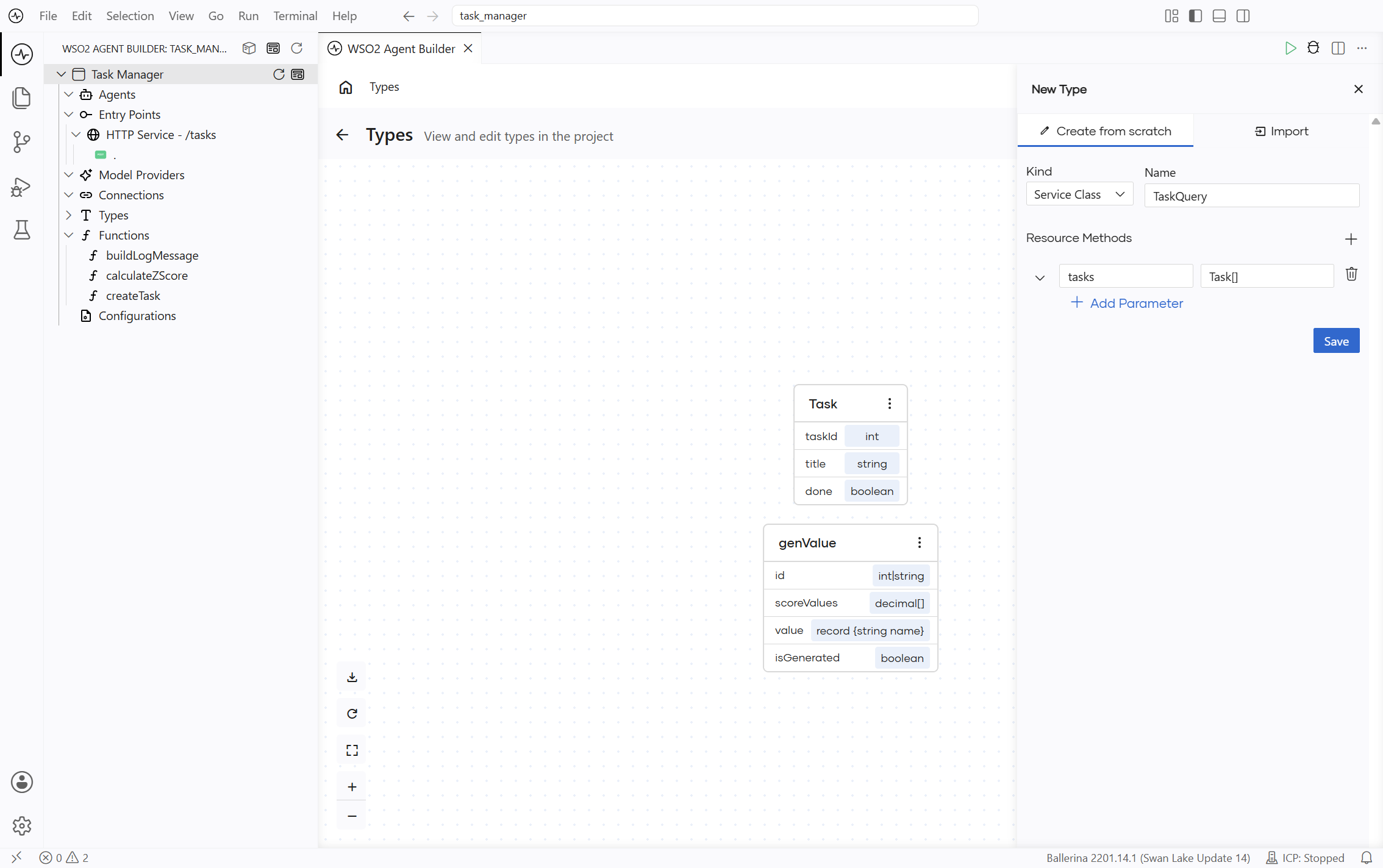
For each resource method, configure:
| Field | Description |
|---|---|
| Name | The resource method name. |
| Return Type | The type the resource method returns. |
| Parameters | Parameters the resource method accepts. Select Add Parameter to add one, and the delete icon to remove. |
Select + next to Resource Methods to add a new method, and the delete icon on a row to remove one. Select the arrow at the start of a method row to add its parameters.
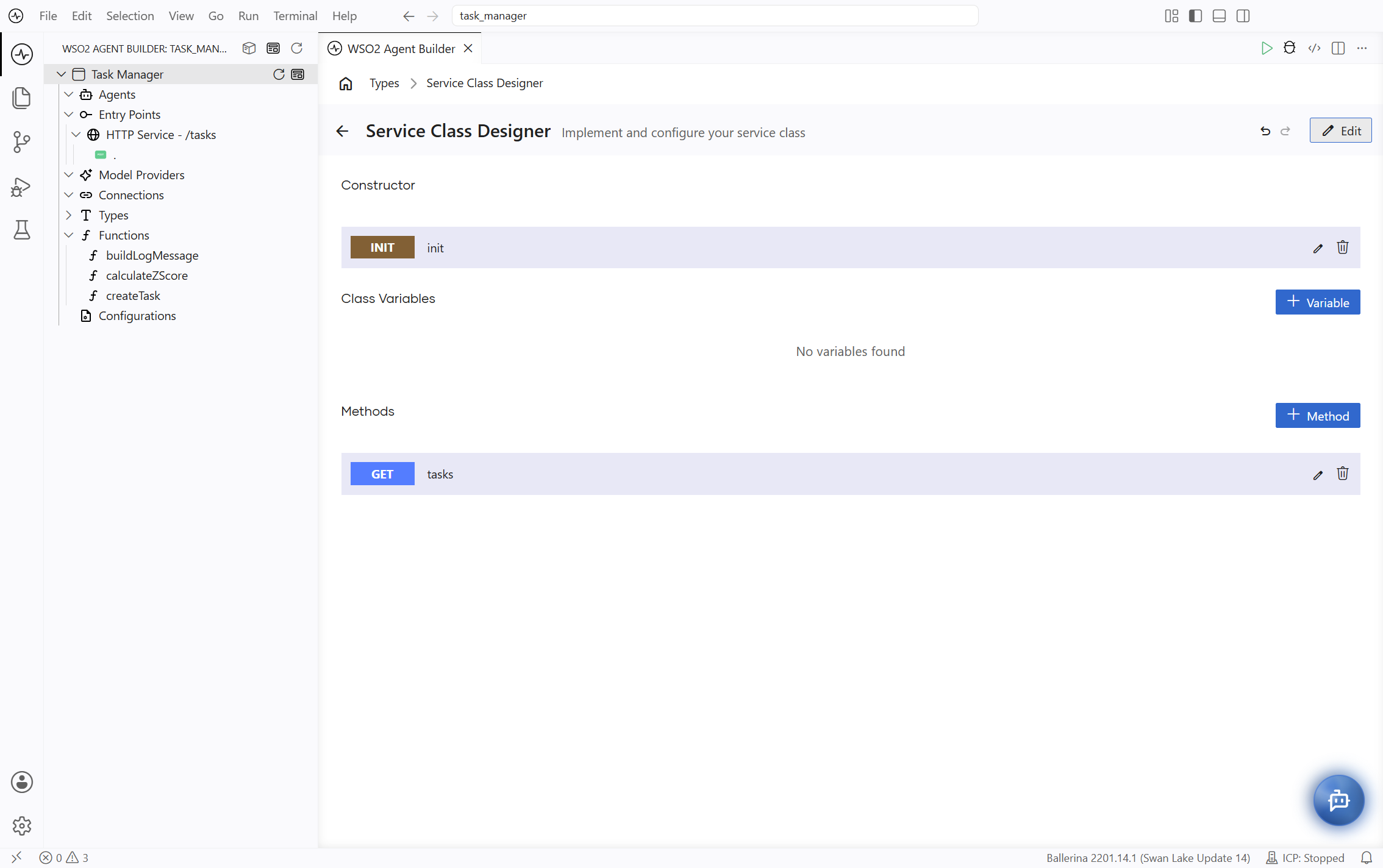
Once you save the service class, it appears as a card on the Type Canvas next to records and enums. Select the card to open the Service Class Designer, where you can edit the constructor, add class variables and methods, and implement each method.
Advanced options
The Advanced Options section at the bottom of the form exposes type-level toggles. The available options depend on the kind of type you are editing. Enums and service classes don't have this section.
| Option | Applies to | Description |
|---|---|---|
| Allow Additional Fields | Records | Generates an open record instead of a closed one. Open records accept extra fields at runtime; closed records reject them. Use this when the payload may carry keys you don't want to model explicitly. |
| Is Readonly Type | Records, unions, and arrays | Marks the type as read-only. Values of a read-only type cannot be modified after construction. |
| Accessible by Other Integrations | Records, unions, and arrays | Marks the type as public so other projects and libraries can import and reuse it. The generated Ballerina source uses the public qualifier. |
Import a type from JSON or XML
When you already have a sample payload, you can let the Type Panel generate the matching record types for you instead of defining each field by hand. The panel inspects the sample, infers a record for the top-level object, and adds nested records for any embedded objects or arrays. The generated records are added to the project and appear on the Type Canvas as soon as you select Import.
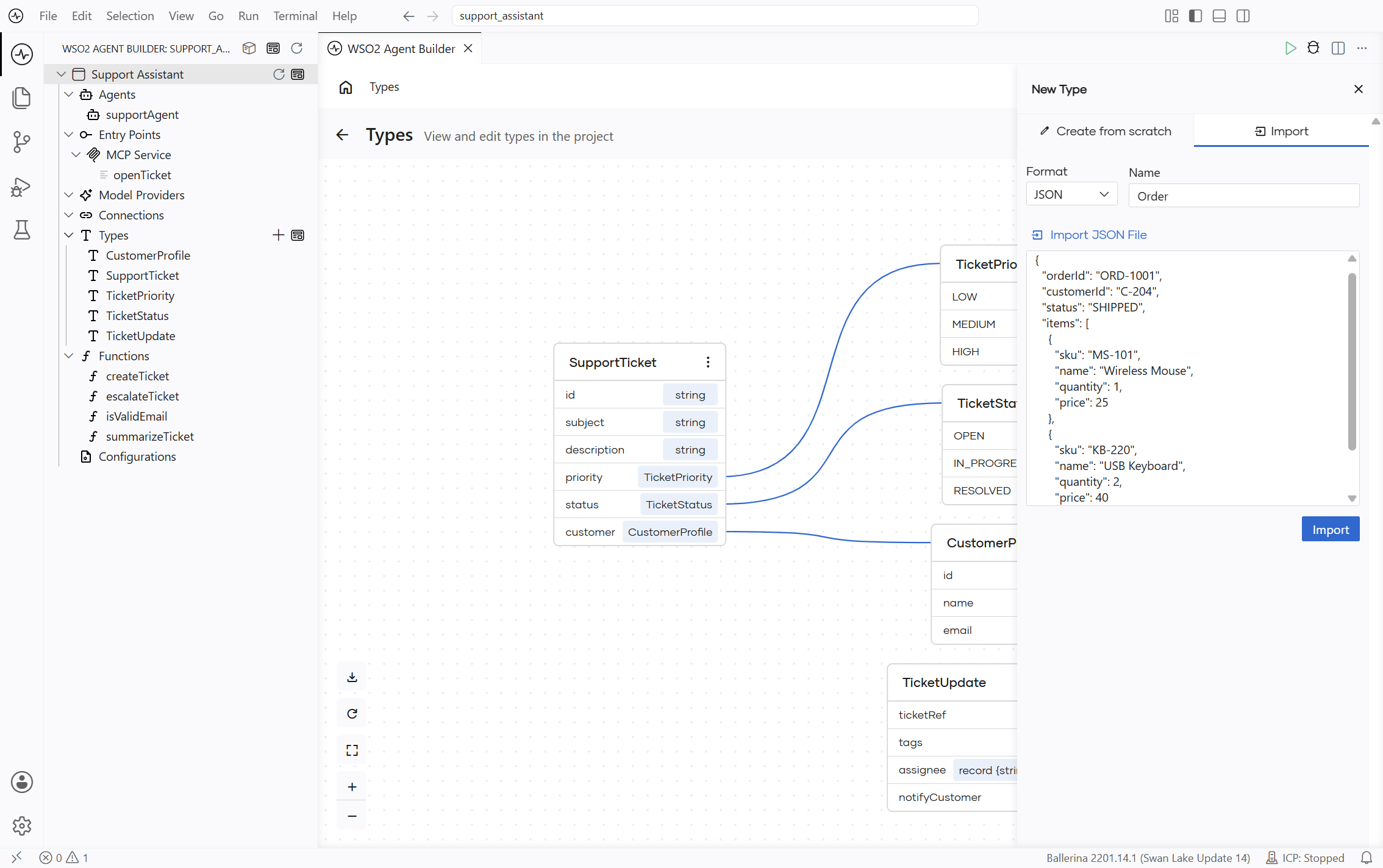
In the New Type panel, select the Import tab and set Format to JSON or XML. You then provide the sample in one of two ways:
- Paste a sample. Paste the JSON or XML into the sample area.
- Import from a file. Select Import JSON File or Import XML File to pick a file from disk. The panel reads the file and fills the sample area for you.
For JSON, give the root record a name in the Name field. For XML, there's no Name field; the records are named after the XML elements. Nested types are named automatically. Select Import to generate the types.
Import from JSON
For a JSON sample such as:
{
  "orderId": "ORD-1001",
  "customerId": "C-204",
  "status": "SHIPPED",
  "items": [
    {
      "sku": "MS-101",
      "name": "Wireless Mouse",
      "quantity": 1,
      "price": 25
    },
    {
      "sku": "KB-220",
      "name": "USB Keyboard",
      "quantity": 2,
      "price": 40
    }
  ]
}
With Name set to Order, the panel generates an Order record with orderId, customerId, status, and items fields, an Items array type for the items field, and an ItemsItem record for each item entry. Field types are inferred from the sample values, so sku and name become string fields, and quantity and price become int fields.
Import from XML
For an XML sample such as:
<order>
  <orderId>ORD-1001</orderId>
  <status>SHIPPED</status>
  <item>
    <sku>MS-101</sku>
    <name>Wireless Mouse</name>
    <quantity>1</quantity>
  </item>
  <item>
    <sku>KB-220</sku>
    <name>USB Keyboard</name>
    <quantity>2</quantity>
  </item>
</order>
The panel generates a root record for the <order> element with orderId, status, and item fields, where item is of type Item[], and an Item record with one field per child element. Field types are inferred from the sample values, so quantity becomes an int field. If the project already has a type with the same name, the panel adds a suffix such as _01 to the new type.
The new types are added to the project and become available everywhere a custom type can be used.
- Use the generated record as a request or response payload in the Service Designer.
- Map fields from the imported record onto another type in the Data Mapper.
What's next
- Type Canvas: visualize every type in the project and the relationships between them.
- Service Designer: use the types you defined as request and response payloads for a service.
- Data Mapper: map fields between the types you defined here.
- Flow Canvas: use the types as variables and parameters in a flow.