Salesforce Events
Salesforce event integrations subscribe to Change Data Capture (CDC) channels and trigger handler functions as records are created, updated, deleted, or restored in your Salesforce organization. Use them for real-time CRM synchronization, audit logging, and event-driven workflows that react to Salesforce record changes without polling.
Creating a Salesforce events service
- Visual Designer
- Ballerina Code
-
Click + Add Artifact in the canvas or click + next to Entry Points in the sidebar.
-
In the Artifacts panel, select Salesforce under Event Integration.
-
In the creation form, fill in the following fields:
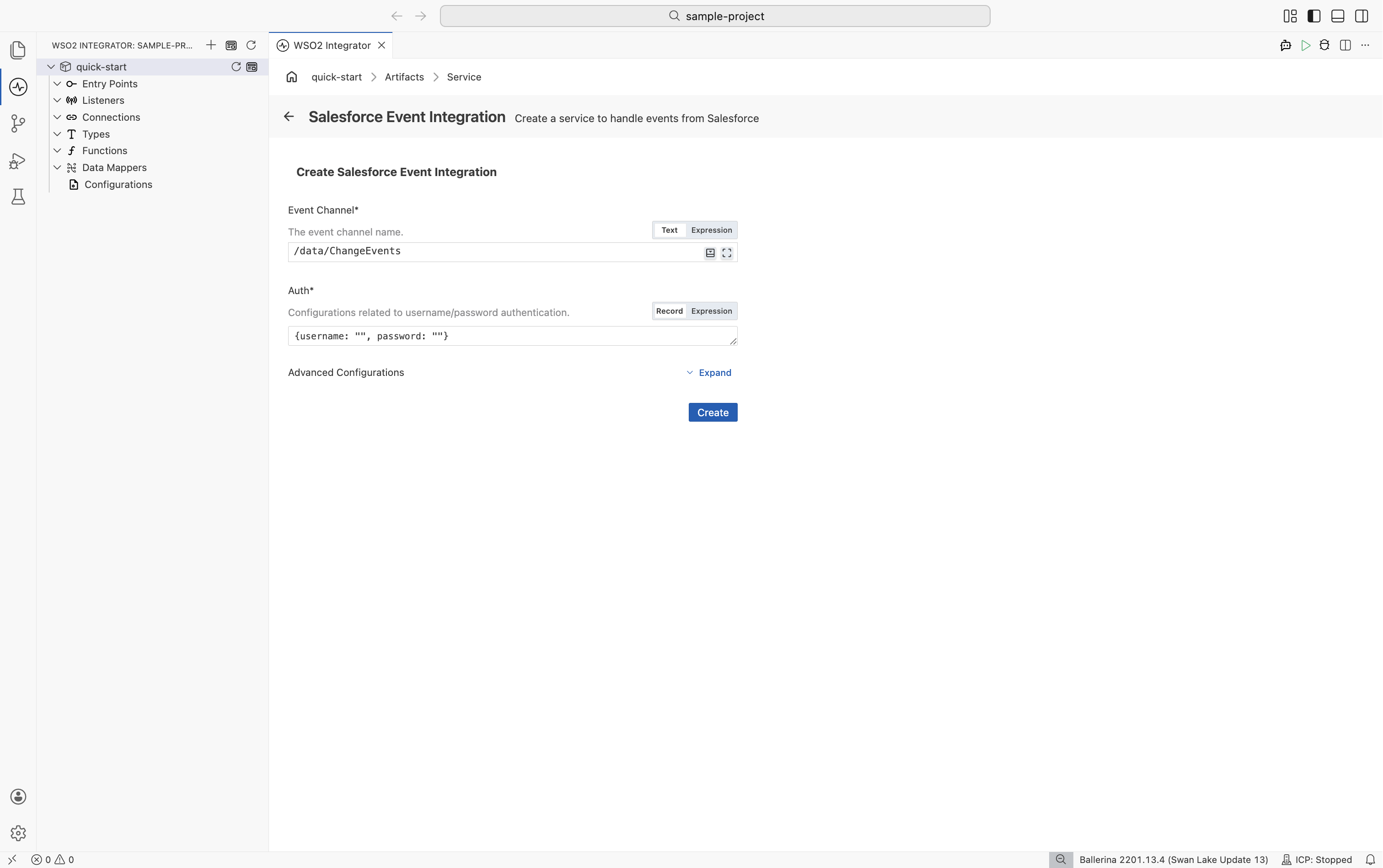
Field Description Auth Credentials for connecting to Salesforce. Accepts a record expression with usernameandpasswordfields. Required. By default, the listener uses SOAP-based authentication. You can change the auth type after creation under Listener Configuration.Expand Advanced Configurations to set the listener name.
Field Description Default Listener Name Identifier for the listener created with this service. salesforceListener -
Click Create.
-
WSO2 Integrator opens the service in the Service Designer. The canvas shows the attached listener pill and the Event Handlers section with all four handlers pre-added.
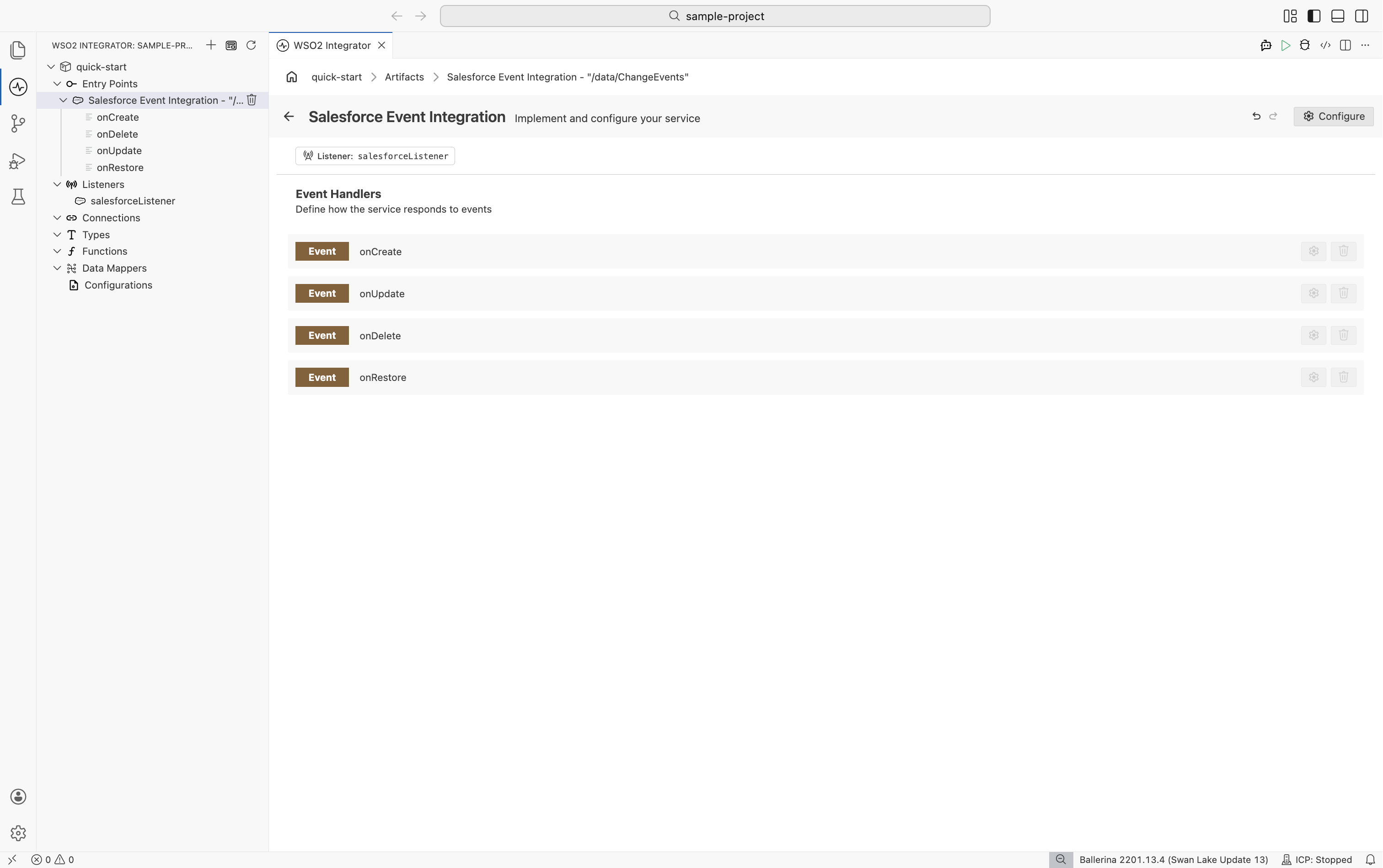
The four event handlers -
onCreate,onUpdate,onDelete, andonRestore- are added automatically when the service is created. Click any handler to open it in the flow diagram view and implement the logic.
import ballerinax/salesforce;
import ballerina/log;

configurable string username = ?;
configurable string password = ?;

listener salesforce:Listener salesforceListener = new ({
    auth: {
        username: username,
        password: password // password concatenated with security token
    }
});

service salesforce:CdcService on salesforceListener {

    remote function onCreate(salesforce:EventData event) returns error? {
        log:printInfo("Record created",
                      entity = event.metadata?.entityName,
                      id = event.metadata?.recordId);
    }

    remote function onUpdate(salesforce:EventData event) returns error? {
        log:printInfo("Record updated",
                      id = event.metadata?.recordId,
                      fields = event.changedData.keys());
    }

    remote function onDelete(salesforce:EventData event) returns error? {
        log:printInfo("Record deleted",
                      id = event.metadata?.recordId);
    }

    remote function onRestore(salesforce:EventData event) returns error? {
        log:printInfo("Record restored",
                      id = event.metadata?.recordId);
    }
}
Listener configuration
- Visual Designer
- Ballerina Code
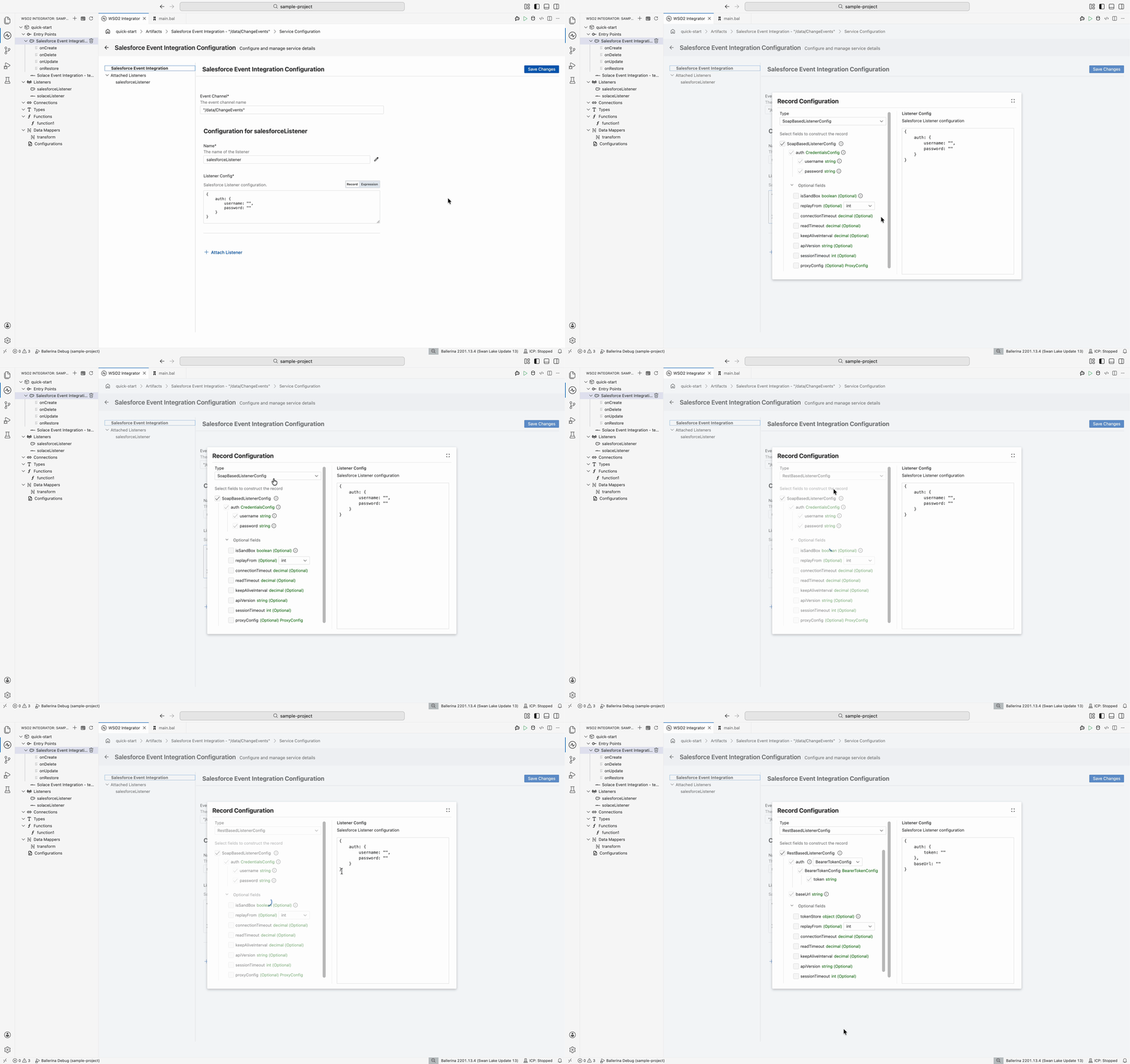
In the Configure panel, set Auth to a record expression with relevant fields with optional values to set any of the values below. Click Save Changes to apply.
listener salesforce:Listener salesforceListener = new ({
    auth: {
        username: username,
        password: password    // password concatenated with security token
    }
});
The listener supports two authentication modes: SOAP-based (username and password) and REST-based (OAuth 2.0). The same fields apply whether you configure the listener through the visual designer or directly in Ballerina code.
SOAP-based authentication
salesforce:SoapBasedListenerConfig fields:
| Field | Type | Default | Description |
|---|---|---|---|
auth | CredentialsConfig | Required | Authentication credentials. Contains username (Salesforce username / email) and password. The password value must be the user password concatenated with the user's security token (<password><securityToken>, no separator). |
isSandBox | boolean | false | Set to true if connecting to a Salesforce sandbox environment. |
REST-based authentication
salesforce:RestBasedListenerConfig fields:
| Field | Type | Default | Description |
|---|---|---|---|
baseUrl | string | Required | Salesforce instance URL. |
auth | OAuth2Config | Required | OAuth 2.0 configuration. Pick one of BearerTokenConfig, OAuth2PasswordGrantConfig, OAuth2RefreshTokenGrantConfig, or OAuth2ClientCredentialsGrantConfig - see OAuth 2.0 auth variants below. |
tokenStore | TokenStore | InMemoryTokenStore | Token store for coordinating refresh token rotation (RTR) across replicas. The default InMemoryTokenStore handles RTR automatically for single-replica deployments. For multi-replica deployments (e.g., multiple Kubernetes pods), provide a distributed implementation (e.g., Redis-backed) to prevent token replay conflicts. |
Token Store and Refresh Token Rotation(RTR) only apply when using OAuth2RefreshTokenGrantConfig. RTR must also be enabled on the Salesforce side, in your Connected App settings, enable Refresh Token Rotation under OAuth policies. The other grant types bypass the TokenManager entirely.
Common optional fields
These fields apply to both SOAP and REST-based listener configurations:
| Field | Type | Description |
|---|---|---|
replayFrom | int | ReplayOptions | Replay option: REPLAY_FROM_TIP, REPLAY_FROM_EARLIEST, or a specific replay ID. |
connectionTimeout | decimal | Connection timeout in seconds. |
readTimeout | decimal | Read timeout in seconds. |
keepAliveInterval | decimal | Keep-alive interval in seconds. |
apiVersion | string | Salesforce Streaming API version. |
sessionTimeout | int | Session timeout in seconds. |
proxyConfig | ProxyConfig | Optional HTTP proxy configuration. |
OAuth 2.0 auth variants
The Record Configuration panel's auth drop-down (and the corresponding Ballerina record types) exposes four grant configurations. Pick the one that matches how your Connected App is set up.
| Config type | Required fields | Use when |
|---|---|---|
BearerTokenConfig | token | You already have a short-lived access token and refresh it out-of-band. |
OAuth2PasswordGrantConfig | tokenUrl, username, password | You authenticate as a Salesforce user with username + password (the password value must be <password><securityToken>, as for SOAP). |
OAuth2RefreshTokenGrantConfig | refreshUrl, refreshToken, clientId, clientSecret | You have a long-lived refresh token from a Connected App authorization-code flow. Recommended for production. |
OAuth2ClientCredentialsGrantConfig | tokenUrl, clientId, clientSecret | The Connected App authenticates as itself (machine-to-machine), without a user context. |
All three grant configs additionally accept these optional fields: scopes, defaultTokenExpTime, clockSkew, optionalParams, credentialBearer, clientConfig. OAuth2PasswordGrantConfig also accepts clientId, clientSecret, and refreshConfig as optional.
Event handlers
When a Salesforce Events service is created, WSO2 Integrator adds all four handlers automatically. Click any handler in the Service Designer to open the flow diagram view and implement the processing logic.
Handler types
| Handler | Triggered when | Use when |
|---|---|---|
onCreate | A record is created in Salesforce | Syncing new records to downstream systems |
onUpdate | A record is updated in Salesforce | Propagating field changes or triggering workflows |
onDelete | A record is deleted in Salesforce | Cleaning up related data or auditing deletions |
onRestore | A deleted record is restored (undeleted) | Recovering soft-deleted records in downstream systems |
You do not need to implement logic in all four handlers. Leave empty any handlers that are not relevant to your use case.
Event data type
Each handler receives a salesforce:EventData parameter with the change payload and metadata.
salesforce:EventData fields:
| Field | Type | Description |
|---|---|---|
changedData | map<json> | Map of changed field names to their new values. |
metadata | salesforce:ChangeEventMetadata? | Metadata about the change event. |
salesforce:ChangeEventMetadata fields:
| Field | Type | Description |
|---|---|---|
entityName | string? | API name of the sObject that changed (e.g., "Account"). |
changeType | string? | Type of change: CREATE, UPDATE, DELETE, or UNDELETE. |
changeOrigin | string? | Source of the change (e.g., "com/salesforce/api/rest/57.0"). |
transactionKey | string? | Unique key identifying the transaction. |
sequenceNumber | int? | Sequence number of the event within the transaction. |
commitTimestamp | int? | Unix timestamp in milliseconds when the change was committed. |
commitNumber | int? | Transaction commit number. |
commitUser | string? | ID of the user who initiated the change. |
recordId | string? | The record ID affected by the change. |
Supported event channels
The CDC channel the service subscribes to is determined by the service path in Ballerina code.
| Channel type | Channel pattern | Use case |
|---|---|---|
| Object-specific CDC | /data/<ObjectName>ChangeEvent | React to changes on a specific sObject (e.g., /data/AccountChangeEvent) |
| All CDC events | /data/ChangeEvents | Capture change events across all CDC-enabled objects |
What's next
- Kafka - consume messages from Apache Kafka topics
- Azure Service Bus - consume messages from Azure Service Bus queues
- Connections - reuse Salesforce credentials across services
- Salesforce connector reference - full connector API reference and trigger reference