Agent Orchestration Patterns for Reliable Multi-Agent Workflows
A single AI agent with a big prompt and a number of tools works fine in a demo. Then it hits production, the task gets longer, the tool list grows, and the agent starts forgetting steps, calling the wrong function, or looping on itself. That failure mode is why teams reach for orchestration: instead of one overloaded agent, you coordinate several focused ones. This guide walks through the three orchestration patterns that show up in almost every production multi-agent system, the trade-offs that decide which one fits, and the engineering work that separates a reliable multi-agent workflow from a flaky one.
What Are Agent Orchestration Patterns?
Agent orchestration patterns are the repeatable structures that define how multiple AI agents coordinate, share context, and hand work to each other while executing a multi-step task. Each pattern answers three questions: who decides what happens next, how state moves between agents, and what happens when a step fails. Pick the wrong structure and you get either a rigid pipeline that can't adapt or a web of complexities that's impossible to debug.
A quick example makes the idea concrete. Consider an agent tasked with resolving a customer support ticket: it must classify the issue, retrieve order history from a CRM, verify stock in an inventory system, draft a response, and finally log the resolution. Assigning all five steps to a single agent is risky. If the initial classification is incorrect, every subsequent action inherits that error—and because there are no built-in validation gates, there's no opportunity to catch it. By decomposing these tasks and distributing them across specialized, coordinated agents, you gain the ability to enforce validation at each step, significantly improving both control and fault recovery.
Why Orchestration Matters for Reliable Multi-Agent Workflows
The reason orchestration matters isn't elegance. It's that long tasks fail in compounding ways, and structure is what contains the damage. A single agent handling a ten-step process has ten chances to drift off course, and no natural checkpoint where you can validate progress before continuing. When one agent owns everything, a hallucinated field in step three silently corrupts steps four through ten.
Orchestration buys you three things that map directly to reliability. First, isolation: a focused agent with three tools makes better tool-calling decisions than one agent with thirty, because the model isn't choosing from an overwhelming menu on every turn. Second, checkpoints: boundaries between agents are natural places to validate output, retry, or escalate to a human before a bad result propagates. Third, observability: when each step is a discrete unit, you can trace exactly where a workflow went wrong instead of reading one giant transcript and guessing.
Before exploring the individual patterns, it is worth highlighting a central trade-off that resurfaces throughout these discussions. Every layer of coordination you add spends more model calls, more latency, and more tokens. A supervisor that delegates to three workers and then synthesizes their output has made at least five LLM calls where a single agent made one. Reliability and cost pull in opposite directions, and choosing a pattern is really choosing where you want to sit on that curve. Integration also becomes the quiet bottleneck: an agent is only as reliable as its access to the systems it needs to act on, which is why teams increasingly treat integration as the foundation of the agentic enterprise rather than an afterthought.
The 3 Core Agent Orchestration Patterns
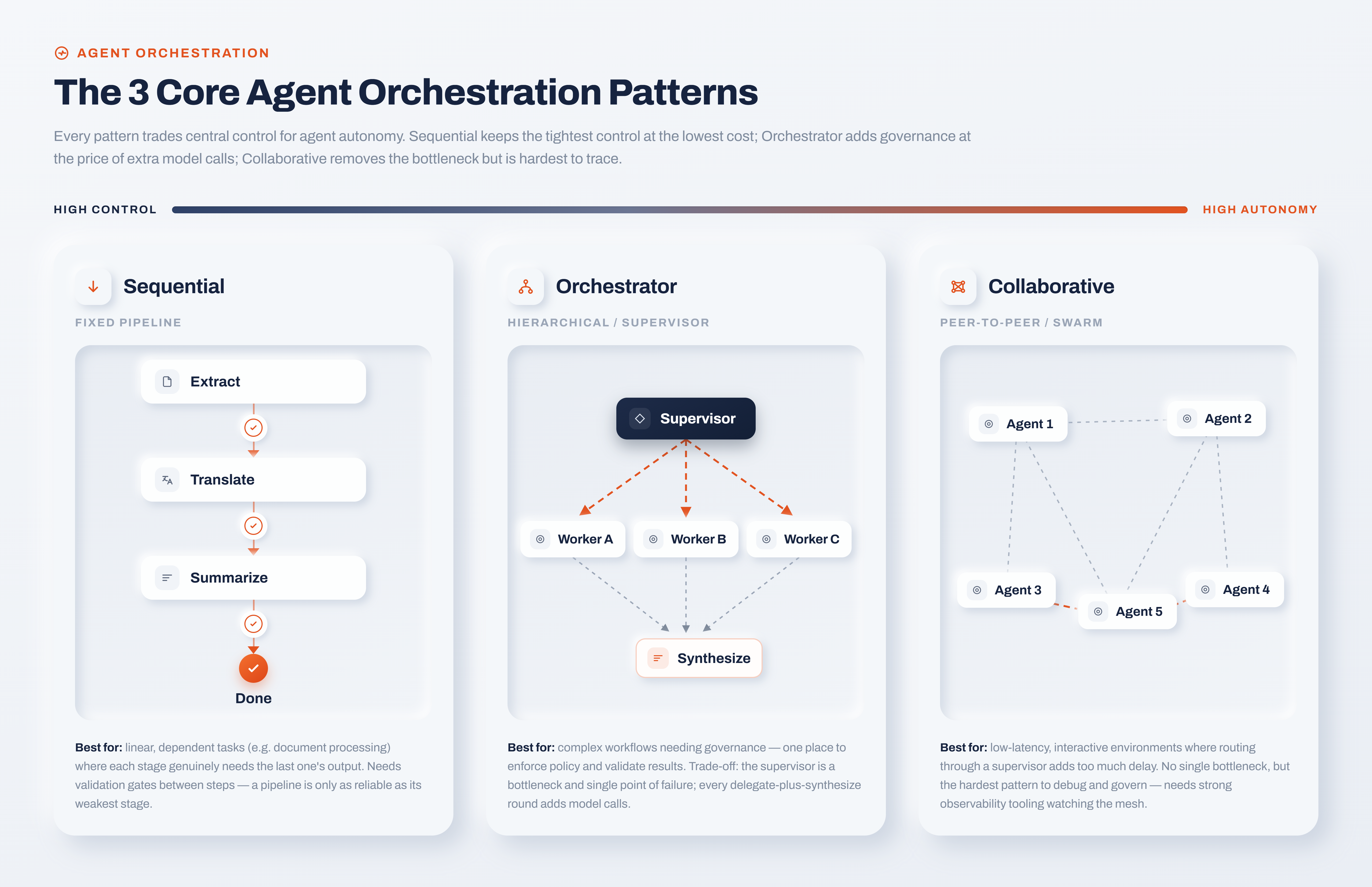
Almost every production multi-agent system maps to one of three patterns. The core distinction among these patterns lies in the balance between central control and agent autonomy: specifically, how much authority resides in a centralized coordinator versus how freely individual agents can manage their own routing. The following breakdown explores these patterns, ordered from those with the highest degree of central coordination to the most autonomous.
Sequential
In a sequential pattern, agents run in a fixed order and the output of one becomes the input of the next. It's the assembly line of orchestration. A document-processing flow that extracts text, then summarizes it, then translates the summary is a natural fit, because each stage genuinely depends on the one before it.
The strength is predictability. You know exactly what runs and in what order, which makes the flow easy to reason about and easy to test. The weakness is fragility: a pipeline is only as reliable as its weakest stage, and without explicit checkpoints between steps, one bad output flows straight downstream. Sequential flows want validation gates between stages, so a malformed hand-off gets caught at the boundary rather than three agents later.
Orchestrator (Hierarchical)
Here a supervisor agent breaks a request into subtasks, delegates each to a specialized worker, tracks progress, and synthesizes the final answer. The supervisor never does the detailed work itself; it manages. This is the pattern most people picture when they hear "multi-agent system," and it's the workhorse for complex workflows that need coordination and validation.
The upside is strong governance. A single agent owns the plan, which gives you one place to enforce policy, validate intermediate results, and decide when a task is actually done. The downside is that the supervisor is both a bottleneck and a single point of failure, and every delegation-plus-synthesis round adds model calls. If the supervisor's plan is wrong, the whole workflow inherits that error, so the planning step deserves the most scrutiny and the tightest validation.
Collaborative
The collaborative pattern drops the central coordinator entirely. Agents pass messages or tasks directly to each other based on local context, peer to peer. This suits low-latency, highly interactive environments where routing everything through a supervisor would add too much delay.
The benefit is flexibility and no single bottleneck. The cost is that decentralized systems are the hardest to debug and govern, precisely because no one component has the full picture. Emergent behavior is a feature when it solves problems you didn't script, and a liability when it produces outcomes you can't explain to a compliance team. Most enterprises reach for a swarm only after they've outgrown the more governable patterns, and even then they usually keep observability tooling watching the mesh.
Choosing the Right Orchestration Pattern
There's no universally best pattern, and any vendor who tells you otherwise is selling something. The right choice falls out of your constraints: how much you value predictability over adaptability, how tight your latency and token budgets are, and how strict your governance requirements need to be. The table below summarizes the trade-offs that matter most in production.
| Pattern | Control vs. autonomy | Token cost & latency | Failure handling | Best for |
|---|---|---|---|---|
| Sequential | High control | Low (one pass) | Needs validation gates between steps | Linear, dependent tasks like document processing |
| Orchestrator | Highest control | High (delegate + synthesize) | Central checkpoints, plan validation | Complex workflows needing governance |
| Collaborative | High autonomy | Variable | Hardest to trace; needs strong observability | Low-latency, interactive, adaptive systems |
A useful default: start with the lowest level of complexity that reliably meets your requirements, and only add coordination when a simpler structure demonstrably fails. A well-scoped single agent beats a five-agent swarm that nobody can debug. If a sequential pipeline handles the job, you don't need a supervisor. Complexity is a cost you pay on every request, so make the system earn it.
Building for Reliability: Failure Handling, State, and Observability
Choosing a pattern is the easy part. Making it reliable in production is where most of the engineering goes, and it comes down to three concerns that cut across every pattern above.
Failure handling. Multi-step workflows need a plan for partial failure, because a five-step task that dies on step four shouldn't leave your systems half-updated. Drawing inspiration from distributed systems, a popular technique uses the saga pattern: every step pairs its primary execution with a compensating action designed to undo it, ensuring any downstream failure allows earlier side effects to be safely rolled back. Sequential and hierarchical flows especially need explicit checkpoints and rollback logic, or one failure cascades into an inconsistent state that's painful to unwind.
State and memory. Agents that lose track of what they've done repeat work or contradict themselves. Reliable orchestration means agents maintain conversation state across turns and carry that context through hand-offs. WSO2 Integrator treats AI agents as modular components capable of reasoning against a system prompt, triggering tools, and preserving conversation state over multiple interactions. Additionally, its guides on developing agents with persistent memory show how to keep extended workflows from resetting state with every iteration. Persistent memory is what turns a stateless prompt-response loop into something that can actually complete a multi-step job.
Governed access and observability. An agent that can't reach your CRM, order system, or inventory database reliably can't complete a real workflow, no matter how clever its reasoning. This is where the integration layer earns its keep. Putting a governed integration layer in front of enterprise systems lets agents reach what they need safely and in real time, with authentication, rate limiting, and audit logging handled outside the agent's reasoning loop.
Try it hands-on: WSO2's Build a Hotel Finder Agent quickstart walks through an agent with two custom tools and session-scoped memory, which is a small but honest example of the state-and-tools plumbing every pattern above depends on.
Agent Orchestration Frameworks and Implementation Considerations
When you move from whiteboard to code, the pattern is only half the decision. The other half is how agents connect to tools and to each other. A few implementation realities are worth flagging before you commit.
Tool access is usually where reliability breaks first. The Model Context Protocol (MCP) has emerged as an open standard for connecting agents to tools and data sources through a consistent interface, which reduces the custom glue you'd otherwise write for every integration. You can find the specification at modelcontextprotocol.io. WSO2 Integrator, for instance, can expose existing integrations as MCP tools for AI assistants or let agents consume external MCP tools, so the same governed connectors that power traditional integrations become available to agents without a rewrite.
Model choice matters too, and locking your orchestration to a single provider is a risk. Workflows that route different subtasks to different models, a cheaper model for classification and a stronger one for synthesis, need a consistent interface across providers like OpenAI, Anthropic, Azure OpenAI, Google Vertex, and Mistral rather than provider-specific code paths. And retrieval-heavy steps often pair orchestration with RAG, where grounding an agent's answer in your own enterprise knowledge at query time cuts hallucination on the steps that touch factual data. The point isn't to adopt every capability at once. It's to pick a foundation that won't force a rewrite when your workflow grows from one agent to five.
Conclusion
Agent orchestration patterns give you a vocabulary for a decision you're making whether you name it or not: how much control to centralize, and how much autonomy to grant. Sequential and concurrent flows keep things predictable, hierarchical and handoff patterns balance control with adaptability, and decentralized swarms trade governance for flexibility. But the pattern is the starting line, not the finish. Reliable multi-step workflows come from disciplined failure handling, persistent state, and a governed integration layer that lets agents reach real systems safely and observably.
If you're moving agents from demo to production, the practical next step is to get the plumbing right before you scale the topology. WSO2 Integrator's AI agent documentation is a concrete place to see how agents, tools, memory, and MCP fit together in a governed integration platform, so the pattern you choose has a reliable foundation underneath it.
Frequently Asked Questions
What is an orchestration pattern?
An orchestration pattern is a repeatable structure for coordinating multiple AI agents on a shared task, defining who decides what runs next, how context passes between agents, and how the system recovers from failure. The three core patterns are sequential, concurrent, hierarchical, handoff, and decentralized.
What are agent patterns?
"Agent patterns" usually refers to the reusable designs for how agents are structured and how they collaborate, from single-agent tool use up to multi-agent orchestration structures like supervisor-worker and swarm. Orchestration patterns are the subset concerned specifically with coordinating multiple agents.
What are agent orchestration frameworks?
Agent orchestration frameworks are the libraries and platforms that implement these coordination patterns so you don't build them from scratch, handling tool calling, state, and message passing between agents. Standards like the Model Context Protocol (MCP) complement them by standardizing how agents connect to external tools.
Which orchestration pattern is best for reliability?
No single pattern is most reliable in the abstract. Hierarchical orchestration offers the strongest central governance and checkpointing, which suits high-stakes workflows, but reliability depends far more on failure handling, state management, and governed tool access than on the pattern label itself.

