AI Orchestration: How to Coordinate Agents, Models, and Tools
Most teams no longer struggle with AI adoption; the real issue they face today is AI coordination. A support team might run a sentiment model, a summarization model, three LLM-backed chatbots, and a retrieval pipeline, yet none of them share context, memory, or a single point of control. Each piece works on its own, behaving like a room full of specialists who do not communicate with one another.
AI orchestration is the solution to this isolation. This guide breaks down what orchestration actually is, how it coordinates agents, models, and tools at the architectural level, how it differs from adjacent concepts people confuse it with, and how to implement it without ending up with a fragile collection of glue code. To keep things practical, we will ground these ideas in concrete integration patterns rather than abstract theory.
What is AI orchestration?
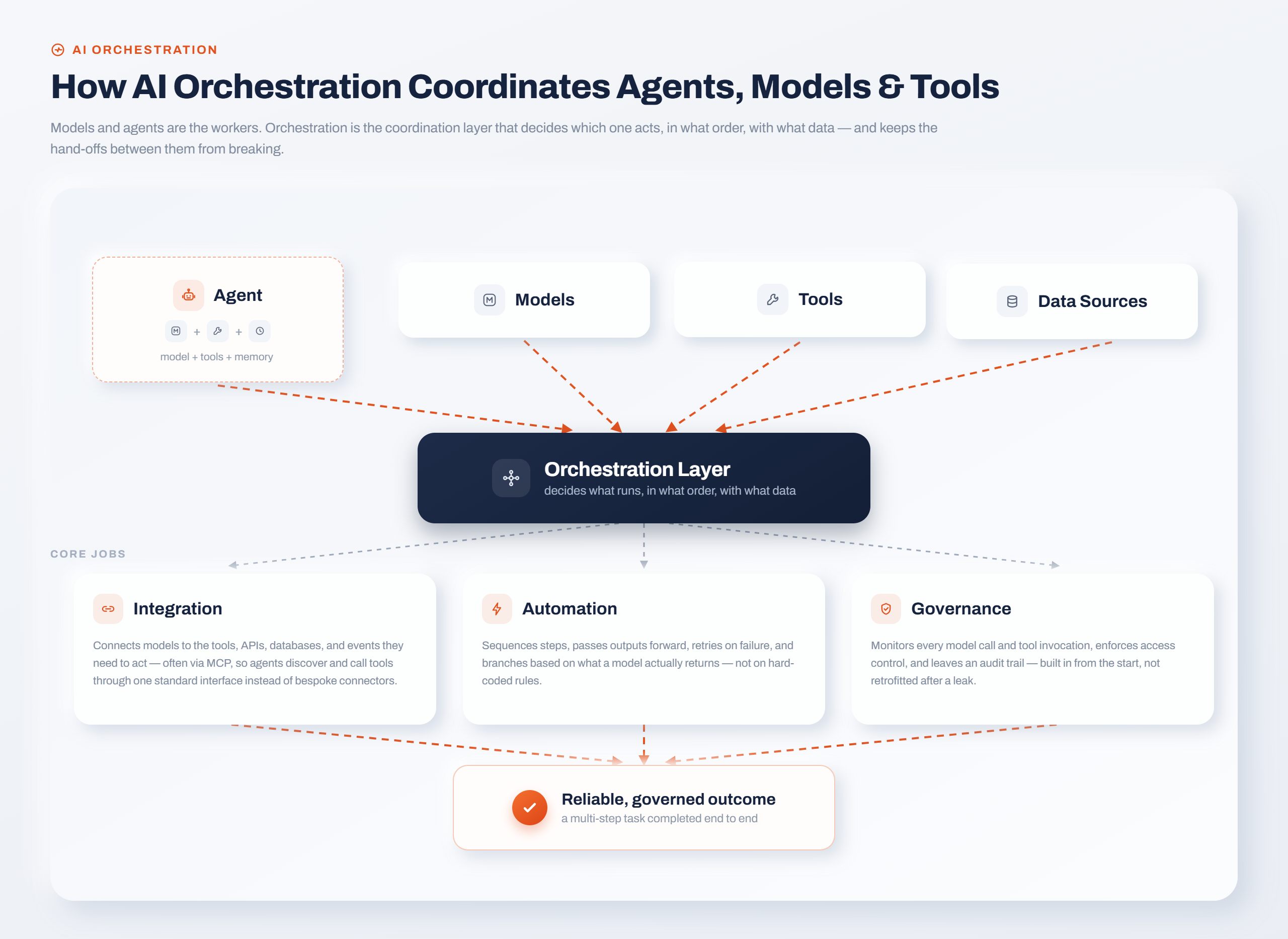
AI orchestration is the coordination and management layer that makes multiple AI components (models, agents, tools, and data sources) work together as a single system. It decides which component acts, in what order, with what data, and under what controls, so a multi-step task completes reliably instead of falling apart between the pieces.
That's the textbook part. Here's what it looks like in practice. Say a customer emails a refund request. An orchestrated flow might route the message to a classification model to detect intent, pull the customer's order history from an ERP through an API, ask an LLM to draft a context-aware reply, and then either resolve the case automatically or hand it to a human with the draft attached. No single model does all of that. The orchestration layer is what strings them together and keeps the handoffs from breaking.
The distinction worth holding onto: individual models and agents are the workers, and orchestration is the coordination. You can have excellent workers and still ship a system that fails, because the failures usually happen in the gaps between components, not inside them.
Why AI orchestration matters
The reason orchestration has become urgent is that enterprises stopped running one model and started running dozens. It's now common for a single organization to run several AI vendors at once to spread risk and match each model to the job it's best at, which means the average enterprise AI footprint is no longer one system but many. When every team wires up its own model against its own data with its own ad hoc scripts, you get silos that duplicate work and can't be governed centrally.
Consider a mid-sized company that added AI piecemeal over a year. Marketing built a content generator, support stood up a chatbot, and the data team shipped a churn-prediction model. Three wins in isolation. But the chatbot can't see what the churn model knows, the content generator has no access to product data, and nobody can answer a basic governance question like "which of our AI systems touched this customer's data last week?" That last question is where the absence of orchestration starts to cost real money, in audit risk and rework.
Orchestration matters because it turns those isolated wins into a system you can actually scale, secure, and reason about. It is the distinction between managing a collection of individual systems, and handling a unified controller that manages the entire system.
How AI orchestration works: coordinating agents, models, and tools
Under the hood, orchestration breaks into three jobs that run continuously: integration, automation, and governance. Miss any one of them and the system either can't connect to anything useful, can't run without a human overseeing it, or can't be trusted in production.
Integration: connecting models to tools and data
Integration is the plumbing. It's how models reach the tools, APIs, databases, and events they need to do anything beyond generating text. This is where most orchestration effort actually goes, because an agent that can't act on your systems is just a chatbot with extra steps.
The emerging standard for this connective tissue is the Model Context Protocol (MCP), an open-source standard for connecting AI applications to external systems like data sources, tools, and workflows. Think of it as a common port: instead of hand-coding a bespoke connector for every model-to-tool pairing, MCP gives agents a standardized way to discover and call tools. This is exactly the layer where an integration platform earns its keep. With WSO2 Integrator's MCP support, you can expose your existing integrations as MCP tools that AI assistants call, or let your own agents consume external MCP tools, without rewriting the underlying services.
Integration also covers the model side. A practical orchestration layer lets you connect to OpenAI, Anthropic, Azure OpenAI, Google Vertex, and Mistral through one consistent interface, so swapping a model provider doesn't mean rebuilding the workflow around it.
Automation: running multi-step tasks without a babysitter
Automation is the execution engine. Once components are connected, something has to sequence them, pass outputs from one step into the next, retry on failure, and make branching decisions when the data calls for it. Unlike rigid "if-this-then-that" rules, orchestrated automation adapts based on what a model returns at each step. If a sentiment model scores an incoming message as angry and high-value, the flow can escalate it straight to a senior rep; if it's a routine question, the same flow lets an agent resolve it and never touches a human. The branch isn't hard-coded to a keyword. It reacts to what the model actually inferred.
This is also where agents come in. An AI agent reasons over a system prompt, calls tools, and maintains conversation state across turns, which makes it the natural unit of autonomous work inside an orchestrated flow. For example, a customer care agent running on WSO2 Integrator can hold session-scoped memory across a multi-turn conversation, calling out to order-lookup and refund tools exactly as the dialogue demands.
Governance: monitoring, security, and control
Governance is the part teams skip until it is too late. It covers real-time monitoring of what each component is doing, version control for models and workflows, access controls, audit logging, and the observability you need to debug a flow that spans five services. Retrofitting this after a system leaks data is far more painful than building it in from the start.
The strongest orchestration setups treat governance as a first-class layer, not an afterthought bolted on at the end. That means every model call is observable, every tool invocation is authorized, and every decision leaves a trace you can audit later. Go back to that earlier governance question, "which of our AI systems touched this customer's data last week?" With a proper control layer, that's a query against an audit log rather than a week-long scramble across five teams. When a regulator or a security review asks, you have an answer instead of an apology.
AI orchestration vs. related concepts
It is easy to confuse AI orchestration with other popular AI buzzwords, as the concepts frequently overlap. Questions like, "How is this different from an AI agent?" or "Isn't this just a data pipeline?" come up constantly. The differences between these terms are very real, however, and they are worth pinning down before you start selecting your tools.
| Concept | Scope | Primary goal | Example |
|---|---|---|---|
| AI orchestration | Broad: coordinates entire AI systems | Automate complex, multi-system workflows | Route a support ticket through classification, retrieval, and drafting models |
| Single AI agent | Narrow: one autonomous unit | Complete a specific task | A chatbot that answers billing questions |
| Multi-agent orchestration | Coordinating several agents | Decompose and delegate work across specialized agents | A "researcher" agent handing findings to a "writer" agent |
| Workflow orchestration | Business processes, often no AI | Run tasks in the right order across systems | Route an approval through finance, then legal |
| MLOps | ML model lifecycle | Train, deploy, and monitor individual models | Retrain a fraud model on fresh data |
The clearest way to explain it: While a single AI agent operates autonomously, multi-agent orchestration coordinates several of them. Workflow orchestration has existed for years and may involve no AI at all, and MLOps manages the inner life of a single model. Tying it all together is AI orchestration, the broader layer that coordinates these models, agents, and non-AI systems.
Benefits of AI orchestration
Wiring your AI components together with an orchestration layer pays off in a few concrete ways:
- Scalability. When the coordination framework already exists, adding a new model or handling a traffic spike becomes a configuration change rather than a rebuild.
- Efficiency. Orchestration removes the repetitive glue work of manually shuttling data between systems, which is where a lot of engineering time quietly disappears.
- Better decisions. Because multiple models can share context and hand off to each other, you get analysis that no single model could produce alone.
- Governance and compliance. A single point of control makes it far easier to prove that every AI system meets your regulatory and internal-policy requirements.
- Reliability. Built-in retries, error handling, and observability keep a multi-step flow from silently failing halfway through.
Asymmetric weight belongs on governance and reliability here, because those are the two benefits that decide whether a proof of concept ever becomes something you'll run in production. A demo that impresses in a sandbox but can't be audited or debugged never ships.
AI orchestration tools and frameworks
The tooling landscape splits roughly into two groups: agent frameworks that help you build the reasoning units, and integration platforms that connect and govern them across your enterprise systems. Most real deployments use both.
On the framework side, the common options each take a different angle. LangChain focuses on chaining LLM calls, data sources, and tools into workflows. LangGraph models those workflows as graphs to manage branching and state. CrewAI structures teams of specialized agents that delegate tasks to each other. Microsoft AutoGen orchestrates multi-agent conversations. These are developer-facing building blocks, and they're where the agent logic tends to live.
While these frameworks are excellent for building agent logic, they stop short of the enterprise integration and governance layer. Building an AI that can reason is a fundamentally different problem than giving that AI governed, observable access to your CRM, ERP, and internal APIs. That gap is exactly what integration platforms fill.
WSO2 Integrator sits in the middle. It not only provides a framework for writing agent logic, but also lets you build AI-powered integrations that include direct LLM calls, RAG pipelines, AI agents, and MCP servers on top of an integration runtime with decades of API and connector heritage behind it. Practically, this means your agents can use pre-built connectors to talk to your existing business software, entirely replacing the need to hand-code custom API clients. Adding further value, every one of those interactions runs through an infrastructure designed for enterprise-grade security and observability.
For grounding responses in your own data, retrieval-augmented generation is usually the first pattern teams reach for. A RAG pipeline retrieves relevant content from a knowledge base at query time and injects it into the prompt, which keeps answers tied to your documents instead of the model's training data.
How to implement AI orchestration: best practices
The teams that succeed with orchestration tend to follow the same handful of principles. The ones that fail usually violate the first and last.
- Start with one well-scoped workflow. Resist the urge to orchestrate everything at once. Pick a single flow with clear boundaries and a measurable outcome, like lead qualification or first-line ticket triage, and ensure it is reliable before you expand. A working proof of concept with two integrated systems and reliable logging beats a complex design you can't debug.
- Fix your data before you add intelligence. Bad data makes bad AI, and no orchestration layer rescues you from inconsistent records or inaccessible sources. Clean and standardize the data your models will read before you wire them together.
- Go modular. Build self-contained components with clear interfaces so you can swap or update one without disturbing the rest. A connector, an agent, and a retrieval step should each be replaceable in isolation.
- Invest in observability early. Track both system metrics (latency, error rates, resource use) and functional metrics (accuracy, business outcomes). You want to catch a misbehaving flow before your users do. Using a platform where every model call, tool invocation, and integration step is observable out of the box saves you from stitching together telemetry by hand after the fact.
- Govern from day one. Access controls, audit logging, encryption, and cost controls on model APIs are far cheaper to design in than to retrofit. This is doubly true once agents can take actions on your systems, because an ungoverned agent with tool access is a liability, not a feature.
- Iterate toward autonomy. Establish stable, rule-based flows first, then layer agentic decision-making on top once the foundation is trustworthy. Handing full autonomy to a flow built on a shaky base is how you end up retraining on corrupted data.
AI orchestration use cases
The pattern shows up anywhere a task spans multiple systems and multiple decisions:
- Customer support. Classify an incoming ticket, retrieve the customer's history, draft a context-aware response, and escalate only the cases that genuinely need a human.
- IT help desk. Let an agent with persistent memory resolve common requests like password resets while routing complex tickets to staff and learning from each interaction.
- Sales enablement. Pull contact data, account history, and recent activity from several tools, then have a model assemble a briefing before each call.
- Knowledge access. Use a RAG pipeline over internal documents so employees can ask questions in plain language and get answers grounded in company data rather than guesses.
What these share is that the value comes from coordination, not from any single model. The classification model alone doesn't resolve the ticket. The orchestration around it does.
Coordinating agents, models, and tools, reliably
AI orchestration is what separates a collection of impressive demos from a system you can run, scale, and defend in an audit. The models and agents are the workers; orchestration is the coordination that keeps their handoffs from breaking, and getting the integration and governance layer right is what makes the difference in production.
If you're moving from isolated AI experiments toward a coordinated system, the fastest way to see the pattern in action is to build one small, governed flow end to end. WSO2 Integrator's AI integrations documentation walks through building your first agent, RAG pipeline, and MCP integration, so you can wire agents, models, and tools together on infrastructure designed for production from the start.
Frequently asked questions
What is orchestration in AI?
Orchestration in AI is the practice of coordinating multiple AI components, such as models, agents, tools, and data sources, so they operate as one connected system. It manages the sequence of tasks, the flow of data between components, and the controls that keep the whole thing reliable and governable.
What is an example of AI orchestration?
A support workflow is a classic example: an incoming ticket is classified by one model, enriched with order data pulled from an API, drafted into a reply by an LLM, and then either resolved automatically or routed to a human. Each step uses a different component, and the orchestration layer connects them end to end.
What is the best AI orchestration tool?
There's no single best tool, because the right choice depends on the job. Agent frameworks like LangChain, LangGraph, CrewAI, and Microsoft AutoGen are strong for building agent reasoning, while integration platforms like WSO2 Integrator provide an agent framework as well as support to connect and govern AI across enterprise systems. Most production systems require a framework for agent logic along with governed access to data and tools.
How is AI orchestration different from a single AI agent?
A single AI agent is one autonomous unit that completes a specific task. AI orchestration is the broader layer that coordinates many components, which may include several agents, models, and non-AI systems, toward a larger goal.

