Enterprise AI Platforms Compared: What to Look For in 2026
Creating an initial AI agent prototype is rarely the primary hurdle, the real difficulty arises when expanding to dozens or hundreds of agents that require strict governance, complete observability, and seamless integration with enterprise infrastructure. Proofs of concept often perform impressively in isolated demos, but implementations frequently stall when attempting to run governed, observable agents against live CRM, ERP, and ticketing environments. Bridging this operational gap is the core mandate of an enterprise AI platform. The market in 2026 has grown sufficiently crowded that distinguishing true platform capabilities demands careful evaluation.
This guide does two things. First, it lays out the criteria that actually separate an enterprise-grade platform from a clever demo. Then it applies those criteria to the current landscape so you can match a platform to the way your organization plans to use AI over the next two to three years, not just this quarter.
What is an enterprise AI platform?
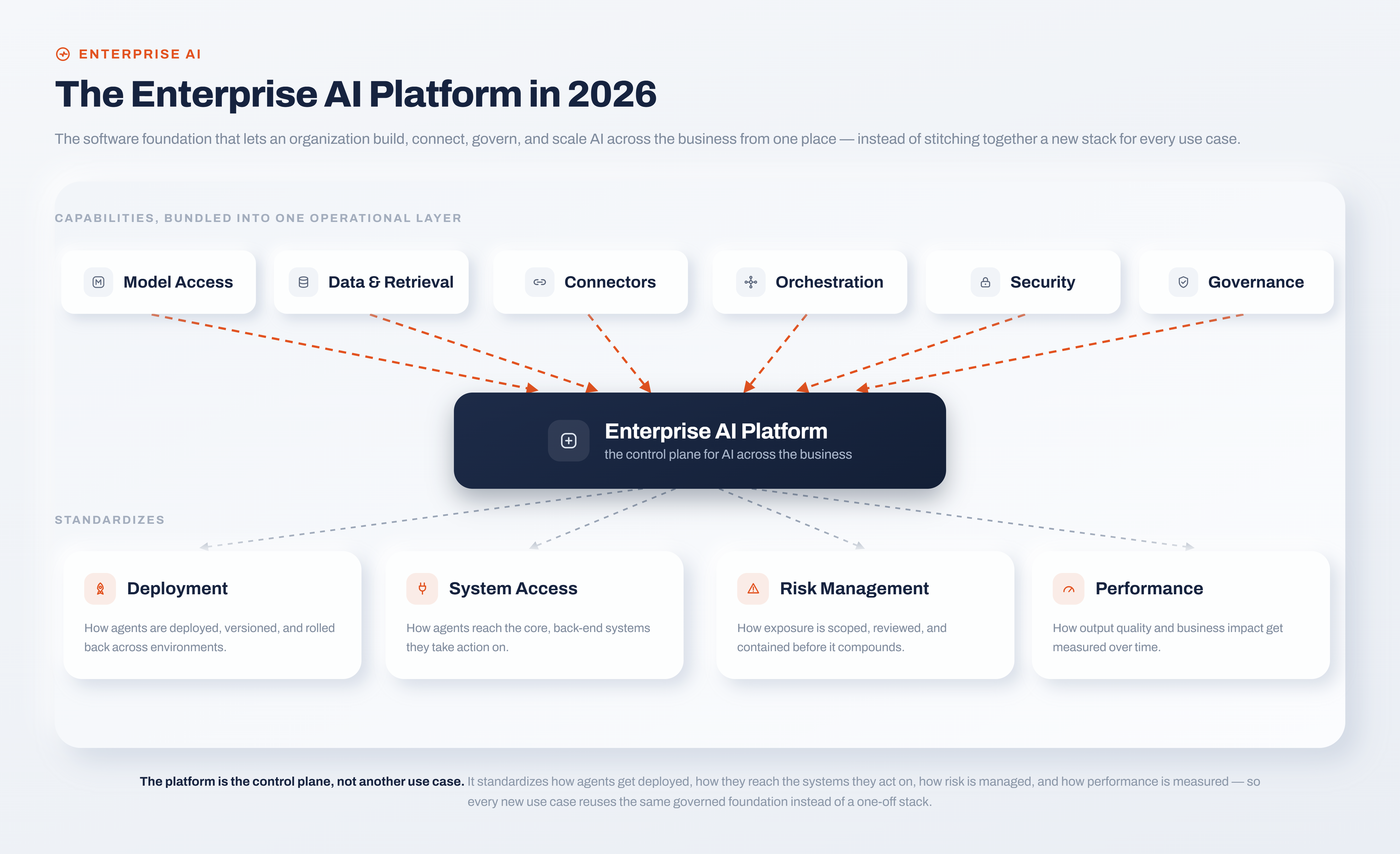
An enterprise AI platform is the software foundation that lets an organization build, connect, govern, and scale AI across the business from one place, instead of stitching together a new stack for every use case. It typically bundles model access, data and knowledge retrieval, connectors to core systems, workflow orchestration, security controls, and governance into a single operational layer.
Think of it as the control plane for enterprise AI. It standardizes how agents are deployed, how they reach the systems they act on, how risk is managed, and how performance is measured. The reason this matters more in 2026 than it did two years ago is that AI stopped being a chatbot bolted onto a website and became something that reads a policy, validates a case, and then triggers a workflow across three back-end systems. The moment AI takes actions rather than just answering questions, the platform underneath it has to behave like enterprise software: audited, permissioned, and observable.
A concrete example makes the distinction clear. Using an enterprise integration platform such as WSO2 Integration Platform, an agent reaches your systems through the same connectors and governed interfaces as every other integration, so what an agent is allowed to interact with stays inside the access controls you already run. That is the difference between a platform and a point tool: the platform treats an autonomous agent as one more governed workload, not an exception that lives outside your existing policies.
Why enterprises need a platform, not point tools
Buying a standalone AI assistant for IT tickets and a separate one for customer chat feels efficient until you count the cost. Each tool brings its own connectors, its own audit trail, its own security posture, and its own place to break. Six months in, you have a wide collection of AI tools that can't share context, can't be governed centrally, and can't be reasoned about as a system.
The pilot-to-production ceiling is real and predictable. Building one solution can be a weekend hackathon, but supporting many solutions at high volume, across regions and regulatory regimes, is an engineering program. Platforms exist to absorb that weight through shared infrastructure for integration, governance, scaling, and operations.
There's also a data problem that point tools quietly ignore. An AI agent is only as useful as the systems it can safely act on, and most of an enterprise's value is locked inside applications that were never designed to talk to an autonomous agent. This is why integration keeps surfacing as the deciding factor: the role of integration in the agentic enterprise is to give agents structured, governed access to APIs, data, and events so they can do real work without becoming a new class of security incident. A platform that treats integration as an afterthought gives you agents that can communicate, but can't act.
What to look for in an enterprise AI platform
All vendors will claim every capability below, but the useful question to ask is how deeply each one is actually implemented. Here are the eight criteria that separate platforms built for scale from platforms built for demos.
1. Integration depth with your real systems
An agent that can't reach Salesforce, SAP, ServiceNow, or your data warehouse is not going to be successful in production. Look for a broad library of pre-built connectors plus a clean path to build custom ones against your own APIs. The depth of this layer, rather than an elegant chat interface, usually decides whether a project reaches production.
Why it matters: An agent is only as strong as the systems it can act on.
2. Governance, observability, and auditability
Enterprise-grade governance is non-negotiable once agents start taking actions. You want role-based access control, audit logs, policy enforcement on every call, and the ability to trace exactly why an agent did what it did. The strongest platforms enforce these controls at the interface level. By transforming an API into a Model Context Protocol (MCP) server for agents to consume, the platform ensures every request passes through existing policy and access controls, exposing only the specific tools an agent needs without providing direct exposure to the underlying system.
Why it matters: Governance is what makes AI safe to run in a regulated environment, not just safe to demo.
3. Security and compliance
Agents routinely handle customer records, financial data, and internal documents, making encryption, data isolation, and compliance certifications important aspects to consider. Pay particular attention to where your data lives. A platform you can self-host on Kubernetes, Docker, VMs, or bare metal, keeps sensitive data inside your perimeter in a way a cloud-only service cannot match.
Why it matters: Data residency and isolation requirements remain with AI.
4. Multi-agent orchestration
The interesting enterprise use cases involve several agents and several systems cooperating: one retrieves, one validates, one executes, with hand-offs and context passed between them. A platform should let you compose these flows and run them under a single operational view rather than as disconnected scripts. A robust platform handles a scheduled job, an event stream, a file drop, an API, and an AI-driven flow in one runtime, so an agent embedded in a workflow is orchestrated with the same tooling as everything else around it.
Why it matters: Real business value comes from completing multi-step work, not from generating a single good response.
5. Model flexibility and open standards
Model quality and pricing shift every few months, so hard-wiring your platform to one provider can become a liability. Favor platforms that let you connect the models, knowledge bases, and tools of your choice, and that support open standards like MCP so your agents aren't locked to a single vendor's ecosystem. A 100% open source platform like WSO2 Integration Platform adds a further guarantee that your integrations keep running with or without a commercial subscription.
Why it matters: Single-model, single-vendor architectures lock you in, and put business continuity at risk.
6. Deployment flexibility
Your compliance team, not your AI vendor, should decide where workloads run. The best platforms give you the same product as self-hosted software or as a managed service, letting you keep both the control plane and the data plane on your own infrastructure when regulation demands it, or offload operations to a SaaS when it doesn't. That "run it your way" flexibility is a genuine differentiator against platforms whose strengths are welded to their own cloud.
Why it matters: Strict deployment limitations frequently disqualify platforms that are otherwise well-suited.
7. Developer experience across skill levels
Adoption stalls when only a handful of specialists can build. Look for a platform where a low-code canvas and full pro-code share the same project, so integration specialists and application developers aren't working in separate tools that drift out of sync. The shift toward AI-assisted development, where natural-language prompts are converted into functional and verifiable integration logic, is rapidly transitioning from a competitive edge to a baseline expectation for modern platforms.
Why it matters: A platform achieves enterprise-wide scalability only when development capabilities extend beyond the dedicated platform team.
8. Scalable, observable architecture
A pilot today should ideally be a global rollout in the near future, and the platform has to survive the transition without a re-platforming project. Check for centralized monitoring across every environment and support for the observability tools you already run. A truly scalable platform plugs into any OpenTelemetry backend, so AI workloads show up in the same dashboards as the rest of your estate.
Why it matters: Scalability and observability are how you avoid re-buying your platform in two years.
Enterprise AI platforms compared: the 2026 landscape
No single platform wins every category, and the honest way to read the market is by archetype. Broad agentic and integration platforms aim to be the foundation everything else runs on. Ecosystem-native platforms are excellent inside their own cloud and narrower outside it. Function-specific platforms go deep on one job, such as customer service or IT support, and are a poor fit when your ambitions span departments.
The table below compares the main archetypes against the criteria that matter for enterprise-wide adoption. It's deliberately category-level: specific vendors move fast, and the archetype tells you more about long-term fit than this quarter's feature list.
| Archetype | Best for | Integration & orchestration | Deployment | Watch-outs |
|---|---|---|---|---|
| Open integration + agent platform (e.g., WSO2 Integration Platform) | Enterprise-wide AI built on a governed integration foundation | Broad connectors, five integration styles in one runtime, MCP-based tool access | Self-hosted, hybrid or SaaS | Foundation layer, not a turnkey vertical bot |
| Cloud-native agent builders (e.g., Microsoft Copilot Studio, Google Vertex AI Agent Builder, AWS Bedrock Agents) | Teams standardized on one hyperscaler | Deep inside the home cloud, thinner outside it | Tied to the provider's cloud | Value narrows once you leave the ecosystem |
| CX / service-desk platforms | A single, deep use case (customer or employee support) | Strong for their domain, limited beyond it | Usually vendor-hosted | Rarely extend cleanly across departments |
| Knowledge / enterprise-search tools | Information discovery across scattered content | Read-oriented; lighter on action and orchestration | Usually SaaS | Search-first, not full workflow automation |
Think of this table as a starting point to help you filter your options, not as a final verdict. A hyperscaler-native builder can be the right call for a team that lives entirely in one cloud, and a service-desk platform can be perfect if support is your only target. The archetype simply tells you the limitations of each option.
How to match a platform to your use case
Start with an honest answer to one question: are you solving a single, well-bounded problem, or laying a foundation for AI across the business? If it's genuinely one problem, say deflecting IT tickets, a focused, function-specific platform may get you to value fastest, and that's a legitimate choice.
But most enterprises discover a second and third use case within a year of the first, and that's where the foundation question decides everything. If you expect AI to spread across customer experience, employee experience, and operations, optimize for breadth of use cases, integration depth, and governance rather than for the slickest single-purpose experience. Choosing a narrow tool for a broad ambition is how organizations end up re-platforming eighteen months in.
Two practical tie-breakers tend to settle close calls:
- Deployment: if any workload has to run in a data-sovereign environment, that requirement alone eliminates most cloud-only options before you compare features.
- Ownership: an open-source foundation means the platform keeps running on your terms, which matters more than any feature checklist when you're betting core operations on it.
Where WSO2 fits: an open, governed foundation for the agentic enterprise
WSO2 sits in the first archetype, and it's worth being precise about what that means. It isn't a pre-packaged customer-service bot, and it doesn't pretend to be. It's the open, integration-first foundation the other pieces run on, which is a different and, for many enterprises, more durable bet.
The WSO2 Integration Platform serves as the unifying layer for AI agents, APIs, data, and events across hybrid, on-prem, and cloud architectures. By consolidating five distinct integration styles including event-driven, file-driven, task automation, integration-as-APIs, and AI-driven flows into a single runtime, it eliminates the need for a fragmented stack. This architectural convergence ensures that autonomous agents are governed and observed using the same enterprise-grade tooling as a standard scheduled data sync. This robust foundation is validated by a global user base, including over 100 financial institutions and 75 government entities, collectively managing more than 60 trillion annual transactions.
Three core characteristics establish WSO2 as a uniquely durable foundation for the agentic enterprise:
- Open standards and continuity: A 100% open source architecture prevents vendor lock-in and ensures your operations remain independent of a commercial subscription.
- Total deployment freedom: Whether running on a managed iPaaS or self-hosted environment, the platform keeps the control and data planes within your perimeter to satisfy strict data sovereignty requirements.
- Governed agentic access: By utilizing MCP servers and over 600 connectors, autonomous agents are treated as governed workloads that interact only with the systems your existing policies permit.
If you want to see the mechanics, the WSO2 Integration Platform documentation walks through building your first integration in under ten minutes. The honest caveat: if you need a turnkey vertical assistant with zero assembly, a function-specific vendor will feel faster out of the gate. If you're building a foundation meant to carry many use cases safely, that's where an open integration platform earns its place.
Choosing a platform that scales with you
The right enterprise AI platform is the one you won't have to replace when your ambitions grow. Run every option through the same checklist: integration depth, governance and observability, security, orchestration, model flexibility, deployment freedom, developer experience, and scalability, and weigh those criteria by how far you actually plan to take AI over the next two to three years.
For a single narrow use case, a focused tool can be the pragmatic answer. For a foundation meant to carry many use cases across the business without a re-platforming project down the line, an open, integration-first platform is the more defensible bet. If that's the direction you're heading, exploring the WSO2 Integration Platform is a concrete next step toward building an agentic enterprise on infrastructure you own and govern.
Frequently asked questions
What is an enterprise AI platform?
It's the software foundation for building, deploying, securing, and scaling AI across an organization. It combines integrations, orchestration, governance, observability, and model access so teams can move AI from isolated pilots to production across customer, employee, and operational use cases.
How do I choose the right enterprise AI platform?
Decide first whether your need is function-specific or enterprise-wide. Then weigh integration depth, governance and observability, security and compliance, model flexibility, deployment options, developer experience, and scalability. Whichever way costs and control tilt as usage grows should tilt your decision too.
What's the difference between an enterprise AI platform and a single AI tool?
A single tool solves one use case with its own connectors, governance, and security. A platform provides shared infrastructure so every AI workload is built, governed, and observed the same way, which is what makes scaling across departments manageable rather than chaotic.
Why is integration so important for enterprise AI?
Agents create value by acting on real systems, and they can only do that through governed access to APIs, data, and events. Without a strong integration layer, agents can converse but can't complete work, and every new connection becomes a fresh security and maintenance burden.
Can an enterprise AI platform run on-premises?
Some can, many can't. Platforms available as self-hostable open-source software, such as WSO2 Integration Platform, can be deployed locally on Kubernetes, Docker, VMs, or bare metal, ensuring data remains entirely within your own perimeter. Cloud-only platforms generally cannot meet these strict data-sovereignty requirements.

