Send an Agent Data Event
A running agent instance waits on the data event channels registered on it. A Send Agent Data Event step delivers one turn on one of those channels, so it usually lives in the entry point the sender calls, such as the resource a user chats through. The step also hands back a correlation token, which is how you read the answer to that particular turn later.
Expose a channel with a trigger
The quickest way to let callers send to a channel is to give the data event a trigger:
-
On the agent canvas, select Add Trigger next to the data event,
chathere. -
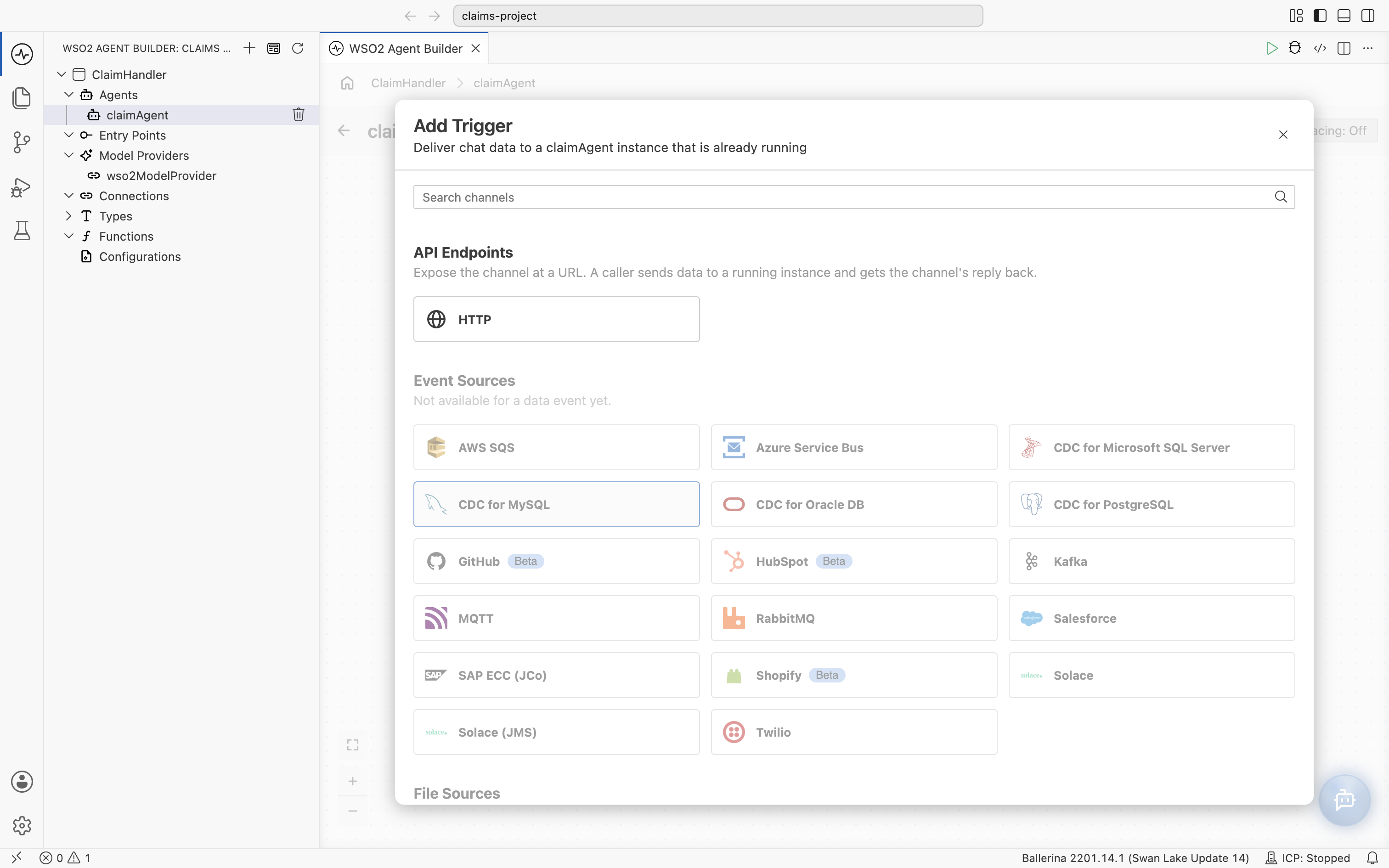
Under API Endpoints, select HTTP. Event and file sources aren't available for a data event yet.
-
Keep or change the generated Endpoint Path, HTTP Method, and Resource Path (
[string instanceId]/chat), then select Create.
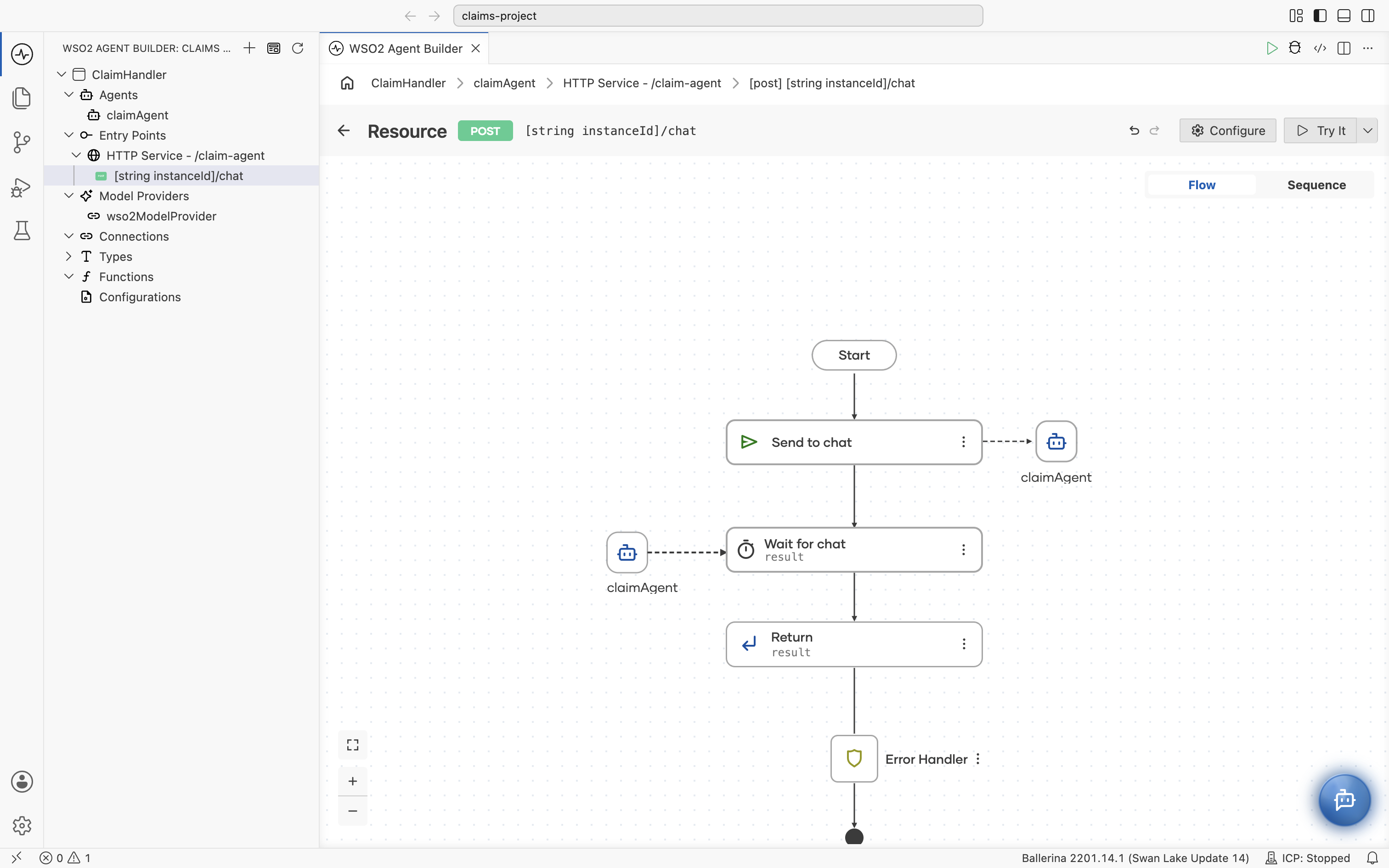
The generated resource takes the instance ID from its path and the message from its payload. It contains a Send to chat step, a Wait for chat step that reads the agent's answer, and a Return of that answer, as the diagram above shows.
Add the step to a flow
To send a data event from a flow you build yourself, add the step from the node panel. The steps below follow the same example: a POST [string instanceId]/chat resource that forwards each message to the claimAgent instance named in its path.
-
On the flow diagram, select + where the event should be sent.
-
In the node panel, under Workflow, select Send Agent Data Event. The Send Agent Data Event form opens.
-
Fill in the form:
Field Required Description Durable Agentic Workflow Yes The durable agent to send the data event to, claimAgenthere.Instance Id Yes The running agent's instance ID, the value Run Durable Agent bound. Here it is the resource's instanceIdpath parameter, so the caller names the instance it is talking to.Data Event Yes The channel to send on. The list shows the channels declared on the selected agent, chathere.Data Yes The payload sent on the channel, which must match the channel's request type. Here it is the resource's payload.Result No The variable that receives the correlation token for this turn. A one-way channel has no response to read, so you can leave it unused. -
Select Save.
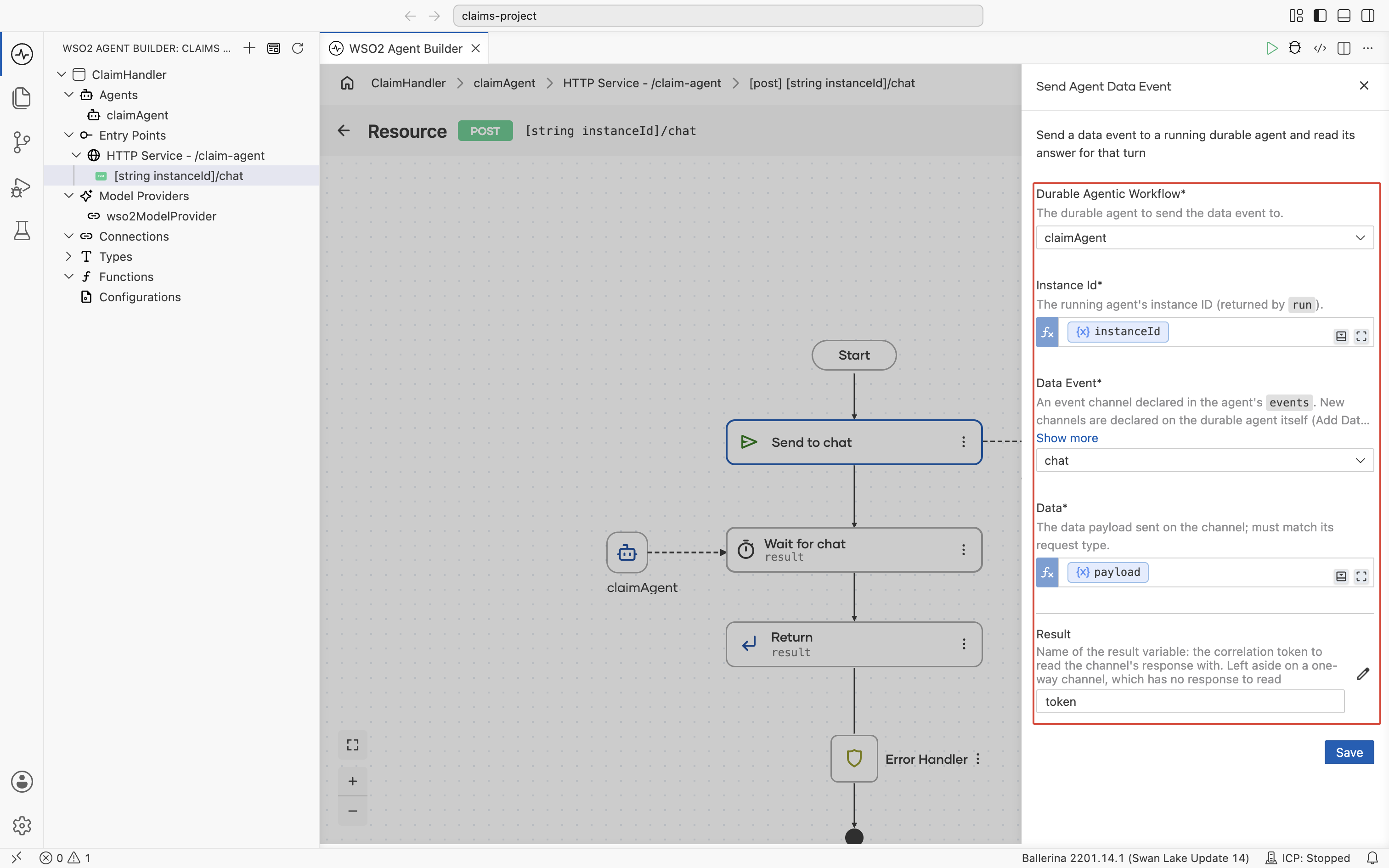
The saved step is drawn as Send to chat, named for the channel it sends on, with a dashed connector to the claimAgent it delivers into. Instance Id takes an expression, so the ID can come from a path parameter as it does here, from a variable, or from a configurable.
New channels belong to the agent
The Data Event list offers only the channels the agent already declares. You add a channel on the agent's own canvas with Add Data Event, not from this form, because the channel and its request and response types are part of the agent. See Data events.
Keep the token
The token in Result identifies this turn, not the instance. An agent instance can be sent many turns, on one channel or several, and the token is what tells them apart when the answers come back. Pass it to a Get Data Event Result step to read the answer this turn produced.
A channel that declares no response type is one-way, so there is no answer to read and nothing to do with the token.
What's next
- Get a Data Event Result: Read the answer this turn produced.
- Run a Durable Agent: Start the instance and bind the ID this step needs.
- Create a Durable Agent: Declare the channels this step can send on.