

How Federated API Management Unifies Government e-Services Without Sacrificing Agency Autonomy

- Dev Wijewardane
- Senior Director / Field CTO, WSO2
Executive summary
Citizens experience government as a single entity, but the underlying reality is dozens of independent agencies with separate systems, credentials, and legal accountabilities. Past attempts to fix this through centralization, forcing agencies onto shared platforms, have mostly failed, because agencies won’t surrender control of systems they remain legally responsible for, and because a single security model can’t accommodate divergent departmental requirements.
The article’s central argument is that the fix is architectural, not organizational: federation, not centralization. A federated API management layer separates the control plane (governance, policy, standards, trust) from the data plane (each agency’s own gateway, executing its own traffic). Agencies keep sovereignty over their systems and data; citizens get a single, coherent experience. This post defines federation, maps its capabilities to government use cases, and lays out a reference architecture, a security model, a governance model, and a phased implementation path.
This distills that argument for a technology leadership audience: what federation actually means at the gateway level, what capabilities it unlocks, how the reference architecture and its trust boundaries are structured, how governance is meant to avoid both centralization and gridlock, and what a realistic multi-year rollout and its success metrics look like.
The government e-services paradox
A citizen renewing a license shouldn’t have to prove an address the government already has on file. A business applying for a permit shouldn’t have to resubmit financials a revenue authority already verified. These frictions aren’t funding or willpower problems, they are structural: agencies were designed for accountability through separation, not for interoperability.
Centralization has been the default fix, and it mostly hasn’t worked. Agencies resist relinquishing authority over systems they are legally accountable for, and a one-size-fits-all security model can’t reconcile the varied mandates across departments. The result is a patchwork of costly, brittle point-to-point integrations. Federation resolves the paradox by embracing agency independence rather than overriding it, an architecture, not a re-organization.
Federation in an API management context
Federation is a governance and deployment model in which a shared control plane coordinates many independently operated API gateways. Each agency keeps its own gateway, traffic, and runtime policy enforcement (the data plane); the federation layer above provides unified API discovery, cross-node trust, aggregated observability, and consistent policy standards (the control plane). Governance is centralized; execution stays distributed.
Federation is distinct from three adjacent patterns this post is careful to rule out. It is not replication (duplicated gateways still need one configuration authority and one point of political accountability). It is not a service mesh (which governs internal, “east-west” microservice traffic, not the crossagency “north-south” traffic federation addresses). And it is not point-to-point integration (bespoke bilateral deals that are fragile, undiscoverable and unauditable). By adopting multilateral standards instead of bilateral agreements, any agency that meets the baseline becomes instantly interoperable with every other participant.
Core federation capabilities
Federated identity
A citizen authenticated once (e.g., via a national identity provider using OIDC) shouldn’t need to reauthenticate at every agency. A federated gateway validates the incoming token against the issuer’s public key, translates it into a format downstream systems understand, and propagates only the claims each system needs, a pattern called token exchange. In practice, this lets a citizen who logs into a social services portal go on to consume an address-verification API from the civil registry and a benefit-eligibility check from the revenue authority in the same session, without re-entering credentials at either. Backend systems never see raw external credentials, which enforces data minimization by design.
Policy federation
Mandating a policy (data handling, security, rate limits, AI-governance rules) is easy; enforcing it consistently across dozens of independently run gateways is not. Policy federation lets a control plane author a baseline that every gateway must enforce. Agencies may add stricter local policy on top, but may never weaken the baseline and automated governance gates check every API against it before it can be promoted to production.
Federated API catalogue and discovery
Without a shared way to discover and trust existing APIs, agencies keep rebuilding the same capabilities (address verification is the paper’s recurring example). A federated catalogue aggregates each agency’s local API listings into one government-wide, searchable marketplace, turning high-value capabilities, identity, address, payments, notifications, document verification, into shared platform services instead of duplicated builds.
Federated developer portals
A single, governed entry point lets internal and external developers discover, test and onboard against APIs from every agency with one set of credentials and consistent documentation, even where agencies keep their own branded portal instances underneath.
Observability federation
Every transaction is a record that oversight bodies, courts, FOI requests or citizens may scrutinize,at a scale where manual auditing is impossible. Each gateway emits telemetry to a shared observability layer (without routing live traffic through a central point, which would recreate a bottleneck), giving operators end-to-end visibility across agency boundaries without needing access to each agency’s internal monitoring.
Reference architecture
The reference architecture has five layers, each with a distinct owner and a defined relationship to its neighbors, built on the principle: governance is centralized, execution is distributed.
- Citizen and business access: portals, mobile apps and third-party apps present a single unified front, hiding agency complexity from the user.
- National identity: a national identity provider issues signed tokens carrying identity, attributes and level-of-assurance claims; gateways validate these locally against cached public keys, with no runtime dependency on the identity provider for every call.
- Federation control plane: the governance layer: policy baseline, federated catalogue, certificate authority hierarchy, aggregated observability, and audit records. It carries configuration and governance traffic only, never live API traffic, which would reintroduce a central bottleneck.
- Federated gateway layer: each agency’s independently deployed, scaled and maintained gateway, where token validation, rate limiting, routing and audit logging actually happen, secured node-to-node with mutual TLS.
- Agency backend and shared services: systems of record sit behind their own gateway, shielded from direct external access; shared platform services (payments, notifications, document verification, address lookup) are exposed through the federated layer without duplication.
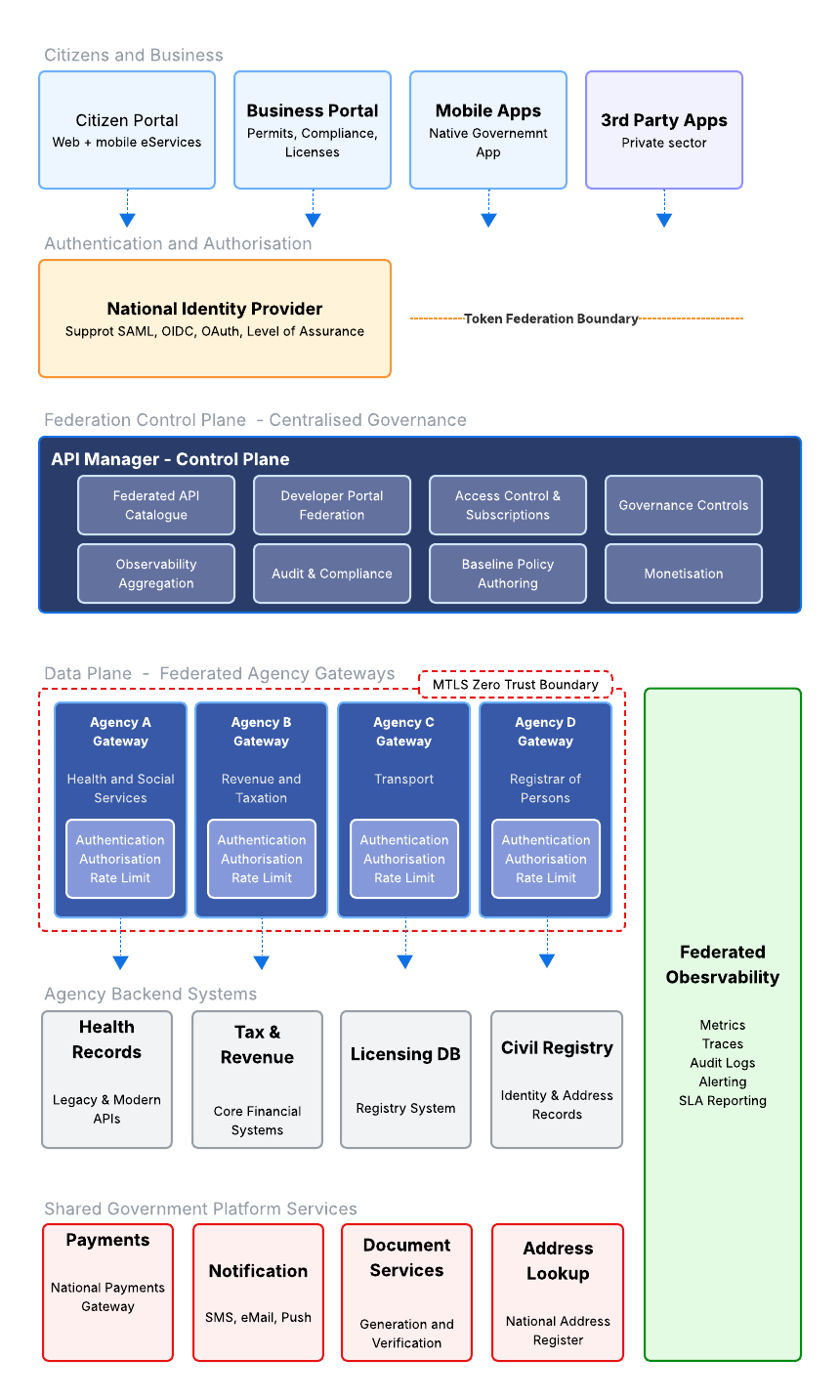
Figure 1: Reference architecture for federated API management in a government context
Three trust boundaries run through this architecture: TLS with certificate validation between citizens and gateways; mutual TLS with federation-issued certificates between agency gateways; and network-level isolation between gateways and backend systems. No external credential ever reaches a backend directly, the gateway is always the trust termination point, and by enforcing data-classification rules at that boundary, backend systems are freed from needing their own classification-aware authentication logic.
Practically, this design lets a government onboard a new agency without touching any existing agency’s infrastructure, guarantees that every published API meets a common security mandate, and lets a private-sector developer reach a curated set of government APIs through a single governed gateway tier, without exposing internal systems or negotiating with each agency individually. It also gives auditors an unbroken chain of accountability from any API call back to the citizen who initiated it.
Security and trust federation boundaries
A federated model has no single perimeter, agency gateways are peers calling each other across differing security classifications and risk appetites, so the design has to avoid collapsing to the weakest member’s posture. Four mechanisms do this work.
- Zero trust: no request is trusted based on network location or shared infrastructure; every token and claim is authenticated and validated against the policy baseline on every call.
- Mutual TLS at gateway boundaries: a federation-operated PKI hierarchy is the root of trust; a compromised node can be revoked centrally and instantly loses the ability to make interagency calls.
- Token validation without central dependency: gateways validate JWTs locally against cached JWKS keys, so an identity-provider outage doesn’t take down the federation.
- Audit as a security control: every transaction produces an immutable, centrally transmitted audit record (identity, claims, API called, policy applied, outcome), and maintaining this trail is a mandatory condition of federation membership, enabling detection of anomalous crossagency patterns even if a single agency’s own monitoring misses them.
Governance without gridlock
Heavy, consensus-driven governance has sunk prior cross-agency programs; the paper argues for just enough authority to enforce standards and just enough agility to evolve them. A governing body, representing all agencies plus a secretariat for day-to-day administration, sets and enforces the policy baseline, resolves disputes, and authorizes onboarding. It needs a clear decision-making split: matters requiring full board consultation versus operational decisions the secretariat can make under delegated authority, so routine standards work doesn’t stall waiting for a full agency vote. Its authority also needs to sit in legislation or formal policy, not a political champion, since losing that champion is a common cause of collapse for cross-agency governance.
The policy baseline acts as a constitution: it governs only what crosses the perimeter (authentication, rate limits, data classification, API design, versioning, audit logging) and leaves each agency’s internal architecture untouched. Agencies may exceed the baseline but never fall below it, a gateway configuration that falls short of the baseline simply cannot be promoted to production.
Agency onboarding
Onboarding is a defined, published process applied consistently to every joining agency, not a negotiated one-off. The paper sets four conditions an agency must satisfy before its gateway goes live in the federation.
- Validate policy compliance: prove conformance against the control plane’s validation suite; self-attestation is explicitly not sufficient.
- Secure a trust framework: establishes a formal certificate chain with the federation’s central certificate authority.
- Appoint an accountability leader: a named official who owns the agency’s API catalogue and ongoing compliance.
- Consent to shared oversight: formally accept that the federation secretariat can review cross-agency audit data tied to the agency’s APIs.
API standards and versioning
The baseline also covers four practical areas, design, documentation, versioning and deprecation, so that developers can move between agency APIs without hitting structural inconsistencies, and so that no agency can introduce a breaking change without advance notice and an approved transition plan for dependent consumers. This becomes commercially and legally material once Phase 3 opens the platform to external developers.
Implementation sequencing
The paper insists on strict, gated sequencing rather than parallel workstreams; each phase must be stable in production before the next begins.
Phase1: Federation backbone and identity layer
Stands up the control plane, certificate authority, baseline policy, identity layer and onboarding process, with 2–3 founding agencies onboarded to validate the mechanics. No citizen-facing service goes live in this phase, it is infrastructure only, and rushing it undermines everything built on top.
Phase 2: High value shared APIs and cross-agency services
Publishes shared platform APIs (identity, address, payments, notifications, document verification), onboards 8–10 more agencies, and launches 2–3 real cross-agency citizen services chosen for visible impact (e.g., replacing repeated document uploads with one authenticated session). This Federated by Design phase doubles as a stress test for governance, policy disputes, version conflicts and certificate rotation under live load surface for the first time
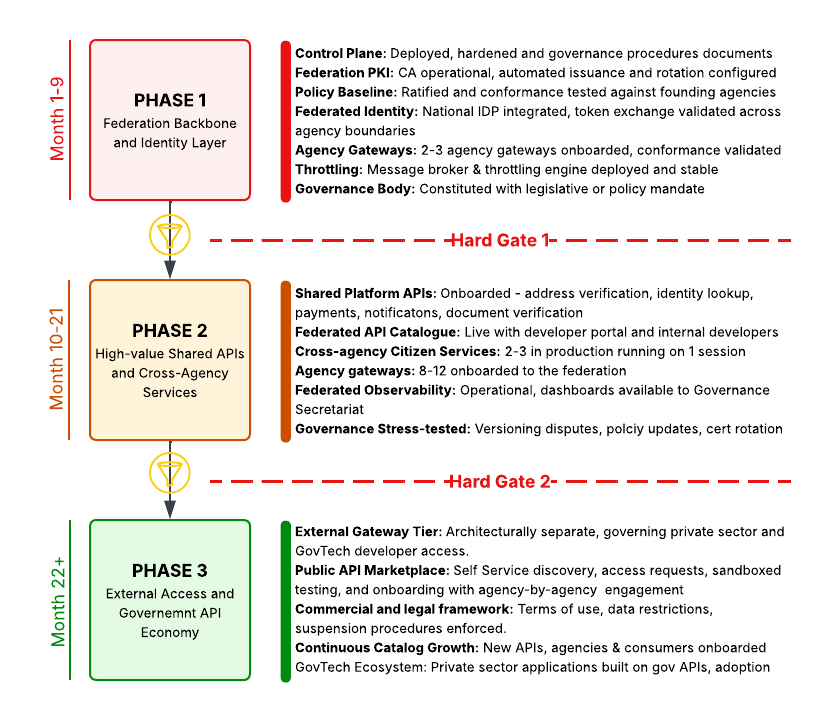 Figure 2: High level implementation roadmap
Phase 3: External Access and Government API Economy
Opens a governed external gateway tier so private-sector and GovTech developers can consume curated APIs under published terms. This phase is ongoing by design and raises commercial and legal questions, terms of use, liability, data-use restrictions, that must be settled as policy before external access begins, since the versioning and deprecation commitments made earlier now carry contractual weight.
Measuring what federation delivers
- API reuse rate: consumption events per unique API implementation; a rising rate shows agencies are consuming shared APIs instead of rebuilding them.
- Reduction in point-to-point integrations: the clearest structural measure of declining integration debt as federation matures.
- Citizen authentication friction: drop-off at login in cross-agency journeys, benchmarked against the pre-federation baseline.
- External developer adoption: whether the external gateway tier is genuinely lowering the cost of building on government data and services.
The framing is deliberate: none of these are output metrics like “number of APIs published” or “number of agencies onboarded.” Each ties back to an outcome, cost avoided, friction removed, or adoption earned, which is what sustains funding and executive sponsorship once the initial program budget is spent.
Key takeaways for technology leaders
- Treat federation as an architectural decision, not a procurement exercise. The failure mode the paper repeatedly returns to is centralization dressed up as collaboration, a shared platform that still asks agencies to give up control they are legally required to keep.
- Separate governance from execution early and keep it separate. The moment live traffic starts flowing through the control plane, the federation has quietly become a centralized bottleneck under a different name.
- Sequence deliberately. Standing up backbone infrastructure (Phase 1) before any citizen sees a benefit will feel slow and will be questioned, but skipping it to show early wins is the more common and more expensive failure.
- Fund and legislate the governance body before the technology, not after. A federation whose authority depends on one sponsor or one budget cycle is architecturally sound but organizationally fragile.
- Pick the first cross-agency services for visible citizen impact, not technical convenience, the credibility of the entire program rests on Phase 2 proving the model under real load.
Conclusion: Federated by design, not by accident
Government technology fragmentation isn’t a symptom of bad tooling; it’s what happens when there is no governed model for how systems connect, and each agency’s locally rational integration choices aggregate into a collectively costly, fragile, opaque result. Federation doesn’t override agency autonomy, it makes autonomy and interoperability simultaneously viable by requiring agencies to connect at a governed, well-defined boundary under common terms.
The paper’s closing claim is that the enabling technology is already mature, federated API management platforms, CI/CD policy enforcement, and standards like OIDC and OAuth 2.0 token exchange are production-ready. What is missing in most governments is the deliberate architectural decision: treating the federation as sovereign infrastructure, giving a governance body real authority anchored in legislation, and executing a disciplined, phased build. Governments that make that decision now, rather than continuing to patch fragmentation with bilateral integrations, will be the ones able to offer citizens a genuinely unified digital government.
Without that decision, fragmentation persists by default: the paper points to citizen journeys today that span six agencies and six separate logins as the visible cost of leaving the architecture question unanswered. The governments that address it will be judged less by the size of their technology budgets than by the coherence of the digital experience they hand to citizens and businesses in the next decade.
WSO2 API Platform's Gateway Federation brings centralized control across independently operated gateways, no rip-and-replace required. See how it works.