

Why Every Enterprise Deploying AI Agents Needs a Control Plane

- Tori Jeffcoat
- Director, Product Marketing - AI, WSO2
Ask a CIO how many employees can access customer financial data, and they can pull that report in minutes. Ask how many AI agents can access the same data, and most can't answer at all.
That gap is the real story in enterprise AI right now. Agent sprawl introduces more and more risk to what agents can (but shouldn’t) access and act on. Between shadow agents and retrofitted controls it’s no wonder Gartner notes that only 13% of organizations think they have the right AI agent governance in place.
The challenge for most is that agents showed up faster than anyone built the controls for them. AI and IT leaders are struggling to catch up fast enough, and it starts with having the right tooling in place to handle autonomous, probabilistic systems with infrastructure built for agents, not applications.
That’s why we built WSO2 Agent Manager, with version 1.0 going live today.
The Agent Control Plane Category
The control plane category is still an emergent one, and analysts haven't yet settled on what to call it. Forrester calls it the agent control plane. Gartner calls it the AI Agent Management Platform (AMP). You’ll likely hear both as the category continues to evolve.
What the analysts do agree on is the definition underneath the label. Forrester describes the agent control plane as a governance layer that sits above a mixed estate of agents and applies one consistent set of controls, so the portfolio can be managed across platforms, vendors, and use cases regardless of which team built which agent in which framework. Gartner defines the AMP as centralized software that manages AI agents, regardless of where they're deployed. The core function is giving organizations one unified view for two things at once: agent cost and ROI, and governance and security controls.
Line those two definitions up and they're describing the same three things in different words: identity, policy, and visibility (to cost, ROI, and activity), applied consistently no matter what agents an enterprise already has running.
Forrester’s Q2 2026 Agent Control Planes Solution Landscape examines vendors in this emerging space, including WSO2 Agent Manager. Most of the other vendors included arrived at the category from an adjacent starting point: traffic management, identity, or observability, rather than being built for the full agent lifecycle from the start.
WSO2 Agent Manager 1.0 is Live
We built WSO2 Agent Manager to cover the full agent lifecycle in a single system:
- It gives every agent its own verifiable identity, separate from any human or service credential it might otherwise borrow, with delegated authorization and token exchange built in, so which agent acted, on whose behalf, and with what authority is always answerable.
- It enforces guardrails at the agent, MCP, and LLM level, instead of leaving every team to rebuild policy from scratch for each agent.
- It provides end-to-end tracing and a built-in evaluation framework, so what an agent actually did is visible at the span level, not just in a summary dashboard.
- And it runs on a Kubernetes-native runtime with lifecycle controls, including the ability to suspend a live agent immediately if something goes wrong.
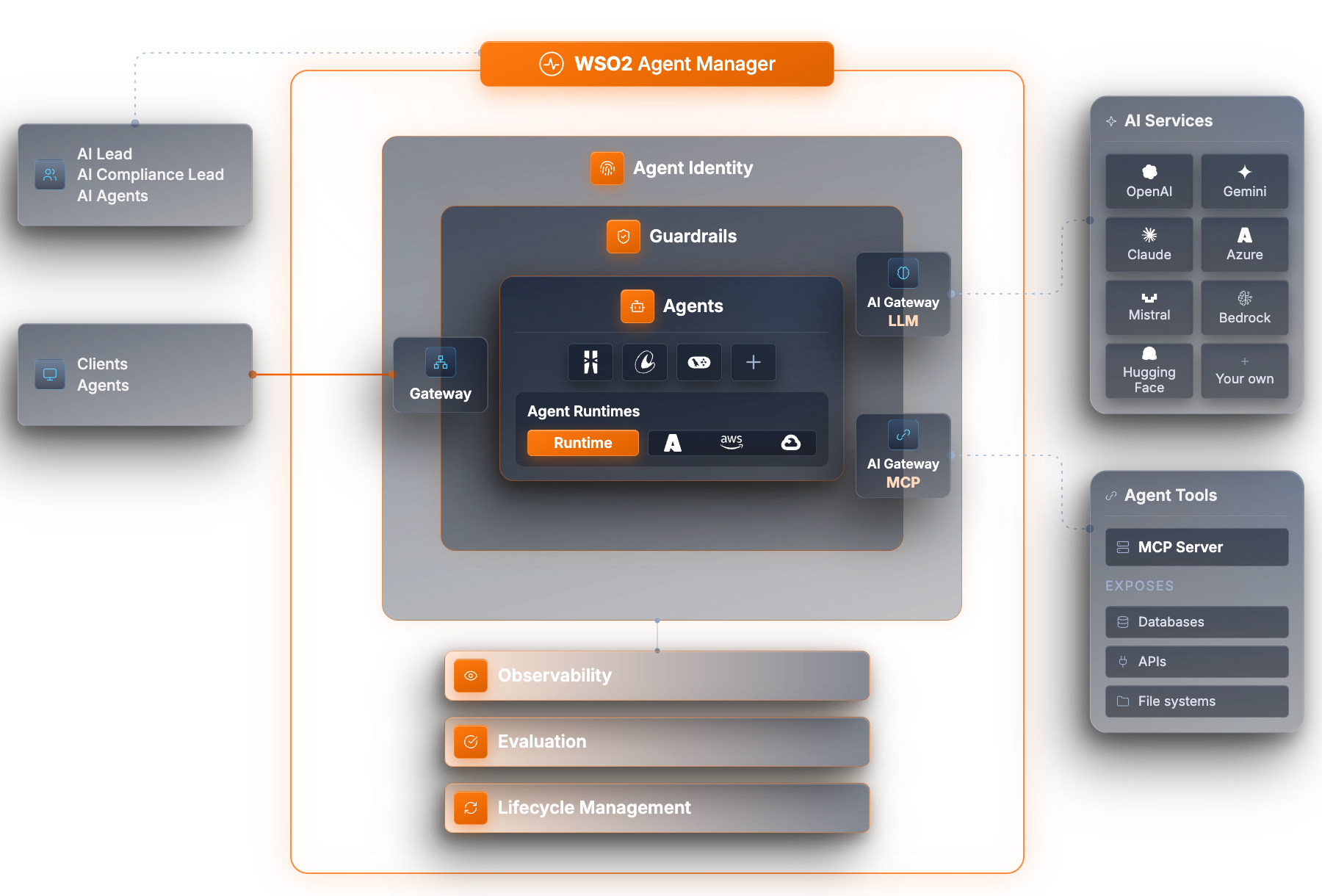
None of this requires standardizing your organization onto one framework, one cloud, or one model provider first. WSO2 Agent Manager is built on open standards, including OpenTelemetry, MCP, and OAuth 2 extensions, and works across LangChain, CrewAI, Bedrock, Azure, Ballerina, or custom agents. It's released under the Apache 2.0 license and built on WSO2's existing integration, identity, and API infrastructure, already running in production at 950+ enterprise customers, so adopting it is an extension of infrastructure you likely already run, not a new stack to stand up.
Four places this shows up in practice
Getting agents out of pilot
Most agent programs stall because there's no consistent bar for "ready." One team's launch decision is a subjective debate between developers, IT, and security; the next team's is a different debate with a different outcome.
In Agent Manager, an agent gets tracked from day one of development, not after a launch review gets scheduled. Instrumentation starts the moment a team adds an agent, so observability exists before anyone has to ask for it. Teams then create an Evaluation Monitor against past traces, using evaluators like accuracy, safety, and latency, and get a score instead of a debate. The same monitor flips to continuous mode after launch, so the bar that got an agent into production keeps checking it afterward.
Closing the trust gap
Ask most enterprises which agents exist, who built them, and what they can touch, and the honest answer is that nobody has a single list. Agents often run on borrowed human or service credentials because there was never a proper identity type built for them.
Agent Manager pulls every agent, whether it runs natively in the platform or in an external framework, into one inventory with a named owner and a defined access scope. Compliance teams can manage guardrails and agent roles at the organization level, instead of applying them team by team only at the agent level. Every invocation can be traced, and every evaluation run is timestamped and re-runnable, evidence a compliance lead can hand an auditor. If containment is needed, an agent can be suspended immediately.
Innovating without a rebuild
Governance for agents has typically lived in silos: when teams need a new framework, it means rebuilding authentication, guardrails, and logging from scratch.
In Agent Manager, agents built in different stacks (a Python agent and a Ballerina agent, for example) get identical instrumentation and sit behind the same AI gateway policy layer. And changes as your agents, requirements or policies evolve doesn’t mean rewiring everything: a guardrail change at the LLM level, rather than per agent, covers every agent using that provider in one change. Swapping an agent's model provider through the platform's LLM provider configuration changes the model; it doesn't touch the agent's identity, credentials, or trace history.
Managing performance and cost
Runaway agent spend is not a hypothetical. Enterprises have reported agents stuck in loops running up tens of thousands of dollars overnight, and a majority of surveyed organizations report having already had a real financial or operational control failure from autonomous AI.
A continuous monitor scoring accuracy, token efficiency, content safety, and latency connects a quality dip to the exact token spike or latency spend that caused it, in one dashboard, instead of stitched together across separate gateway, observability, and identity tools. Optimizing performance, even testing different models to find the best fit for each agent, becomes possible with continuous visibility.
Sovereign, Trusted AI Governance
Agent Manager delivers each of these use cases with the same governance, whether it runs in your own infrastructure or ours.
That choice exists because Agent Manager is Apache 2.0 and Kubernetes-native. Deploy it in your own data center or private cloud, and agent identity, policy enforcement, and trace data stay inside your environment. Deploy it as a managed service, and the same control plane runs on our infrastructure instead. Either way, the agent inventory, the audit trail, and the guardrails work the same.
For organizations under data residency requirements, like the EU AI Act or a financial regulator's rules, this removes a tradeoff that usually forces a choice between adopting agent governance quickly and keeping agent data where it has to stay. You get both.
Sovereignty here isn't only about where a workload runs. It extends to identity: the credentials an agent uses, and the record of what it did with them, stay under your control rather than a vendor's.
It extends to the model, too. Swapping an agent's model provider through Agent Manager's LLM provider configuration changes the model; it doesn't touch the agent's identity, credentials, or trace history. If a provider becomes restricted, too costly, or simply the wrong fit, that switch doesn't force you to rebuild your governance layer. Sovereignty includes reducing dependency on any single provider and keeping operational control over the technology stack itself. Model portability without rebuilding governance is that same principle, applied at the model layer.
Learn more about agent control planes
While the category name may be in flux, it’s not up for debate that agents need an identity, a policy that applies consistently, and a record of what they did. That's what WSO2 Agent Manager is built to provide.
Read the press release, watch the short demo, or explore WSO2 Agent Manager directly.