Guardrail execution order
The AI Gateway routes every request through two policy chains in sequence: the LLM Proxy chain and the LLM Provider chain. Each chain runs the same four execution phases, but the order in which the two chains execute differs between the request and response paths.
This document covers the dual-hop execution model. For foundational concepts — within-chain policy ordering, streaming mode, and short-circuit behavior — see Policy execution order. The same rules apply to each chain individually.
The two chains
- LLM Proxy chain: Guardrails attached to the LLM Proxy. These run on every request before it reaches any LLM provider, making them the right place for organization-wide content policies.
- LLM Provider chain: Policies attached to a specific LLM Provider. These run after the Proxy chain and include provider-level transformations, upstream authentication, and any provider-scoped guardrails.
Request path
On the request path, the LLM Proxy chain runs first, followed by the LLM Provider chain.
Headers phase:
Client
  │
  ▼  OnRequestHeaders (forward order: Policy 1 → ... → Policy N)
[LLM Proxy chain]
  │  (internal hop to LLM Provider)
  ▼  OnRequestHeaders (forward order: Policy 1 → ... → Policy M)
[LLM Provider chain]
  │
  ▼
 LLM
Body phase:
After the headers phase completes for both chains, the request body is processed in the same order.
Client
  │
  ▼  OnRequestBody / OnRequestBodyChunk (forward order)
[LLM Proxy chain]
  │
  ▼  OnRequestBody (forward order)
[LLM Provider chain]
  │
  ▼
 LLM
Response path
On the response path, the order is reversed at the chain level. The LLM Provider chain processes the response first, then the LLM Proxy chain.
 LLM
  │
  ▼  OnResponseHeaders / OnResponseBody (reverse order: Policy M → ... → Policy 1)
[LLM Provider chain]
  │  (internal hop back to LLM Proxy)
  ▼  OnResponseHeaders / OnResponseBody (reverse order: Policy N → ... → Policy 1)
[LLM Proxy chain]
  │
  ▼
Client
The following diagram shows how requests pass through the LLM Proxy chain and LLM Provider chain in sequence, and how responses return through both chains in reverse order:
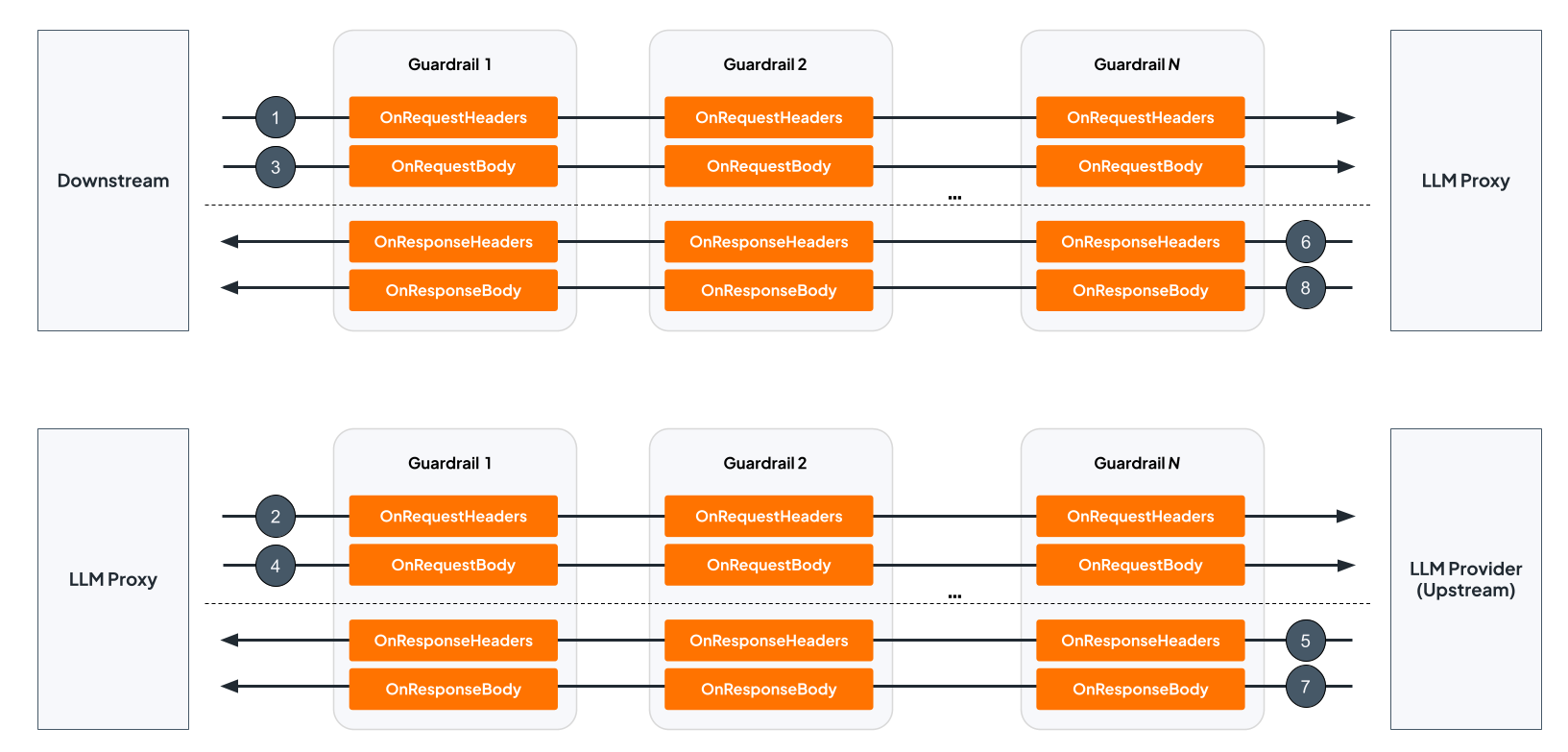
This mirrors the request wrapping at the chain level: the LLM Proxy wraps the LLM Provider on the way in, so on the way back the inner chain (Provider) unwinds first, then the outer chain (Proxy).
Summary
| Path | Chain execution order | Within-chain policy order |
|---|---|---|
| Request headers | LLM Proxy → LLM Provider → LLM | Forward (Policy 1 first) |
| Request body | LLM Proxy → LLM Provider → LLM | Forward (Policy 1 first) |
| Response | LLM → LLM Provider → LLM Proxy → Client | Reverse (last policy first) |
Streaming mode
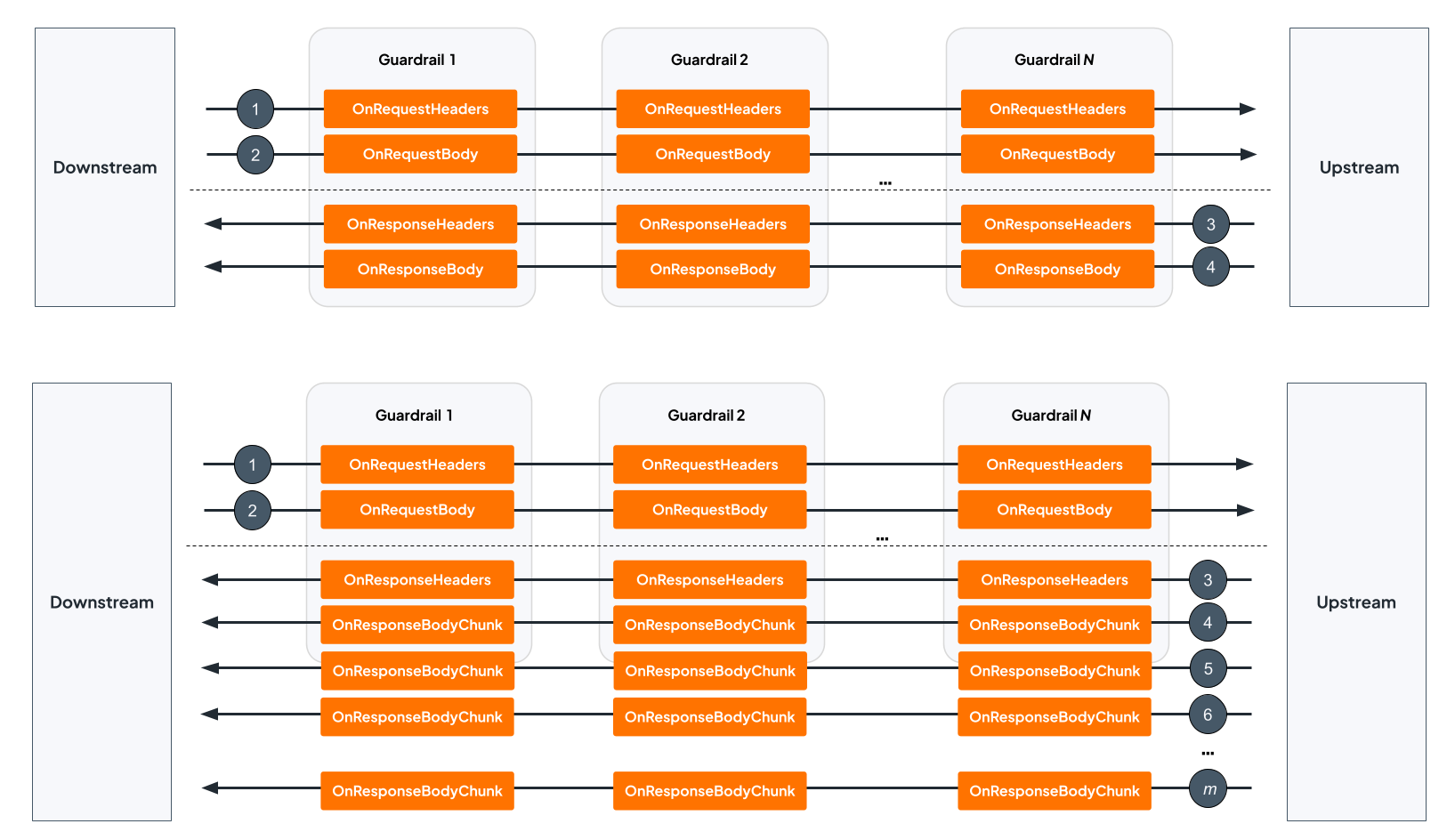
When an LLM returns a streaming response (such as SSE from a chat completion endpoint), body chunks flow through both chains independently — the LLM Proxy chain processes each chunk first, then the LLM Provider chain, following the same request-path order.
The following diagram shows how streaming body chunks flow through the policy chain at each hop:
Related topics
- Guardrails overview
- Policy execution order — within-chain ordering, streaming, and short-circuit rules that apply to each chain individually