

Beyond Autonomy: Why the Agentic Enterprise Needs Durable Agents

- Anupama Pathirage
- Director & Head of Product Management - Integration, WSO2
In the previous article, Long-Running Workflows: Connecting Business Processes That Unfold Over Time, we looked at why many enterprise processes cannot be completed in a single, uninterrupted execution. They may need to wait for external events, involve people at different stages, cross multiple systems, and recover from failures while preserving the work already completed. Those requirements make durability an important part of building reliable long-running business processes.
The same challenge becomes even more interesting as AI agents become participants in those processes. AI agents are expanding the possibilities for enterprise automation. Unlike traditional applications that follow a predefined sequence of instructions, agents can reason about a goal, decide what actions to take, use tools, interact with enterprise systems, and adapt their behavior as new information becomes available.
This ability to act with greater autonomy is important as it helps accelerate processes, but autonomy alone is not enough for many enterprise processes.
Much of today's agent experience is built around relatively short-lived interactions. A request is received, the agent reasons about it, invokes one or more tools, and produces an outcome. Real business processes rarely fit so neatly within a single execution. They may continue for hours or days, wait for information from customers or partners, require human approval before important actions can proceed, and encounter failures after significant work has already been completed.
Consider an AI agent assisting with an insurance claim. The agent could retrieve policy information, analyze the submitted claim, check supporting information, and determine that additional documentation is required. The customer may not provide all the necessary documents at the same time. Some documents might be shared days later. Once all the documents are shared, the process should continue with the context of what has already happened. Later in the process, a human employee may need to review a settlement recommended by an agent before the payment can be processed. If the payment service then becomes temporarily unavailable, the process needs to recover from that point without unnecessarily repeating all the work that came before.
From the business’ perspective, this is one continuous claim process, regardless of whether it takes five minutes or five days, and regardless of whether individual activities are performed by applications, people, or AI agents.
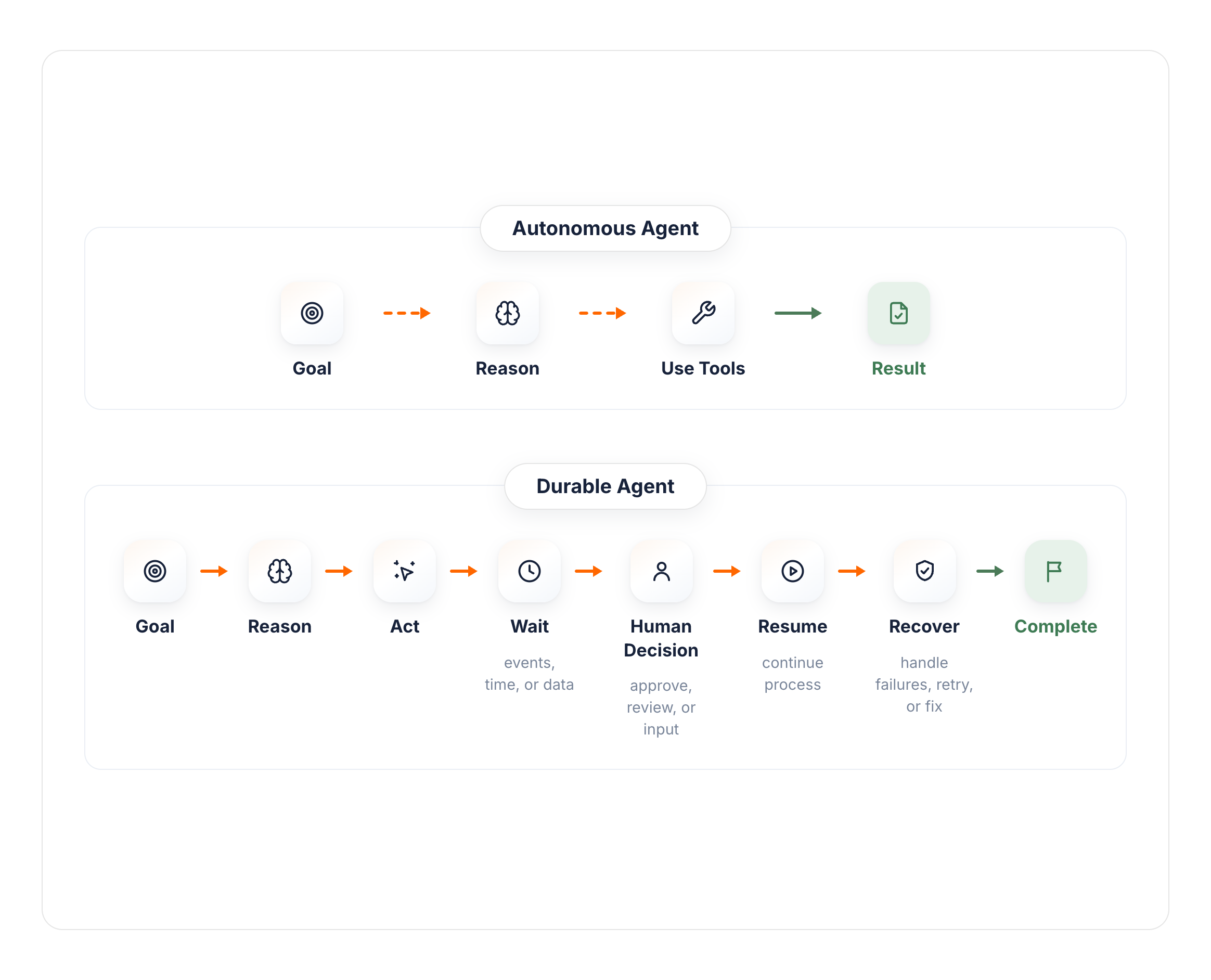
For agents to become dependable participants in processes like these, they need more than the ability to reason and act. They need the agent to be durable.
What is a durable agent?
A durable agent is not simply an agent that runs for a long time. In fact, much of a long-running business process may involve no active execution at all.
The important characteristic is continuity.
A durable agent can participate in a process that pauses and resumes, waits for external events, involves people when necessary, operates within defined control points, and recovers from failures without losing the progress already made.
This introduces a different way of thinking about enterprise agents. Instead of treating an agent invocation as the boundary of the work, the broader business process becomes the boundary. Agent reasoning and actions happen within that process, alongside other activities that may occur at different times and through different participants.
The importance of durable agents
Business processes need to wait. Waiting is a normal part of enterprise operations, and can be for a number of reasons: a customer may need to submit additional information; a supplier may need to confirm availability; another system may need to complete a process; and an approval may need to be obtained before work can continue.
For an agent operating within such a process, waiting should not mean keeping the agent continuously active, nor should it mean abandoning the current process and reconstructing it when something eventually happens.
A durable process can pause at the appropriate point while preserving its progress. When the expected external event occurs, execution can resume, and the agent can continue working toward the original business outcome.
This ability is particularly important as agents move from conversational assistance toward operational roles. An agent processing a customer request, investigating an incident, coordinating an onboarding process, or working with external partners may routinely encounter activities separated by hours or days.
The lifetime of the business process and the lifetime of an individual agent execution therefore need to be treated differently.
Autonomy needs control points
One of the main attractions of AI agents is their ability to determine what to do next without every action being explicitly defined in advance. In an enterprise environment, however, the appropriate level of autonomy often depends on the action being performed.
An agent might be permitted to retrieve customer information, analyze a document, or prepare a recommendation independently. The same organization may require explicit authorization before the agent issues a large refund, changes an employee's access privileges, commits to a financial transaction, or performs another consequential action.
The answer does not have to be choosing between a completely autonomous agent and a tightly scripted process. Gated execution provides a middle ground. Agents can operate autonomously where appropriate while particular actions are placed behind explicit control points. When the agent reaches such an action, the broader process can pause until the required authorization or condition has been satisfied. This allows organizations to expand the scope of agent automation while retaining control over the decisions that matter most.
Keeping humans in the loop
Some control points require more than authorization. They require human judgment.
An agent may be able to gather information from multiple systems, analyze a situation, and recommend an action, while a person remains responsible for the final decision. This pattern is likely to remain common in areas involving financial risk, compliance, unusual exceptions, customer impact, or organizational accountability.
A durable agent needs to accommodate these human interactions without treating them as something outside the process. For example, an agent investigating a claim could perform most of the initial work before referring an exceptional case to a specialist. A human task can be created for the appropriate role, remain available until the specialist reviews it, and return the decision to the same process. The agent can then continue based on that outcome.
The process may look like below.
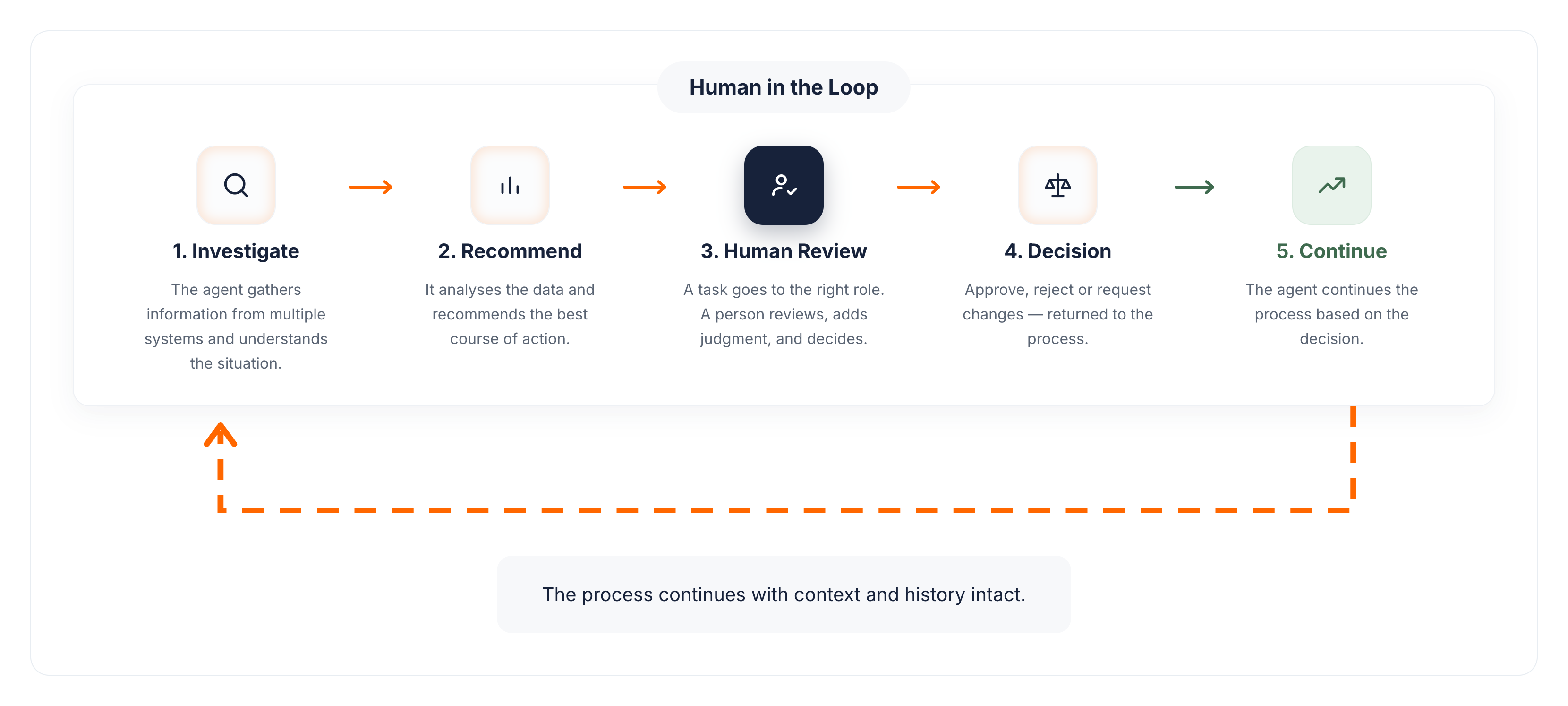
This model allows organizations to automate a greater proportion of a business process without removing human judgment where it provides value. The agent performs the work it is suited for, while people remain involved at meaningful decision points.
Failures should not erase progress
Agents operating in the enterprise ultimately depend on other systems. They call APIs, query databases, interact with SaaS applications, invoke enterprise services, and communicate with systems outside the organization's control.
Those interactions will sometimes fail.
Consider an agent that has gathered information from several systems, performed an analysis, requested and received human approval, and is now attempting the final business action. If that final interaction fails, restarting the entire agent process may be both inefficient and incorrect, as previously completed steps may have produced real-world changes, and the human decision may already have been recorded.
Durability changes the recovery model.
The process can retain the work that was successfully completed and focus recovery on the point where the failure occurred. A temporary problem may simply require a retry. Another failure may require investigation before processing continues. If incorrect information caused the problem, an operator may need to correct the relevant data and retry the affected activity.
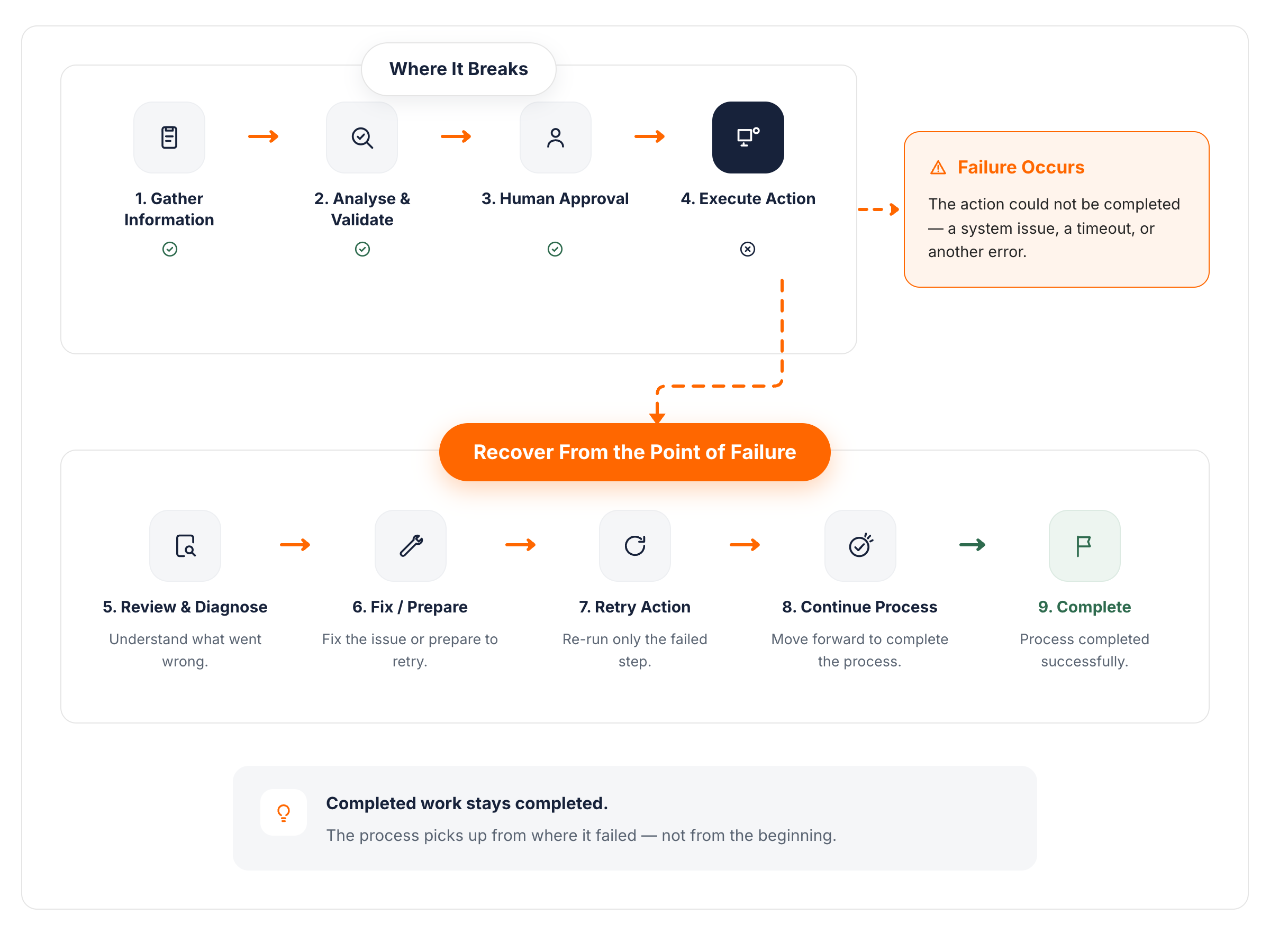
Figure 2: Durable execution preserves completed work and enables recovery from the point where intervention is required.
This becomes increasingly important as agents perform longer and more consequential processes. The more work that has already happened, the less acceptable it becomes to treat every failure as a reason to start again.
Durability and memory solve different problems
It is also useful to distinguish durability from agent memory.
Memory helps an agent retain or retrieve information that may be useful for reasoning. An agent might remember previous interactions, user preferences, facts learned during earlier conversations, or knowledge relevant to a task.
Durability addresses a different set of questions: what is the stage and status of this business process, and what should happen next?
A process may have completed three activities, be waiting for an external event, require approval before the next activity, and need to continue from that exact point tomorrow. Preserving that execution state is different from providing information to an LLM as context.
Both capabilities can be important for sophisticated enterprise agents, but they serve different purposes. Memory provides context for intelligence; durability provides continuity for execution.
Bringing agent intelligence and workflow durability together
Traditional workflows and AI agents approach automation from different directions. A workflow typically coordinates a known business process. It provides structure around activities, waiting, events, human interactions, failures, and the progression from one stage of a process to another.
An agent introduces dynamic reasoning. Rather than having every decision predetermined, the agent can evaluate the current situation, choose appropriate tools, and determine how to proceed.
For enterprise applications, these models become particularly powerful when used together. The agent can provide the intelligence to reason, decide, and act, while durable workflow capabilities provide the structure to wait, control, recover, and continue.
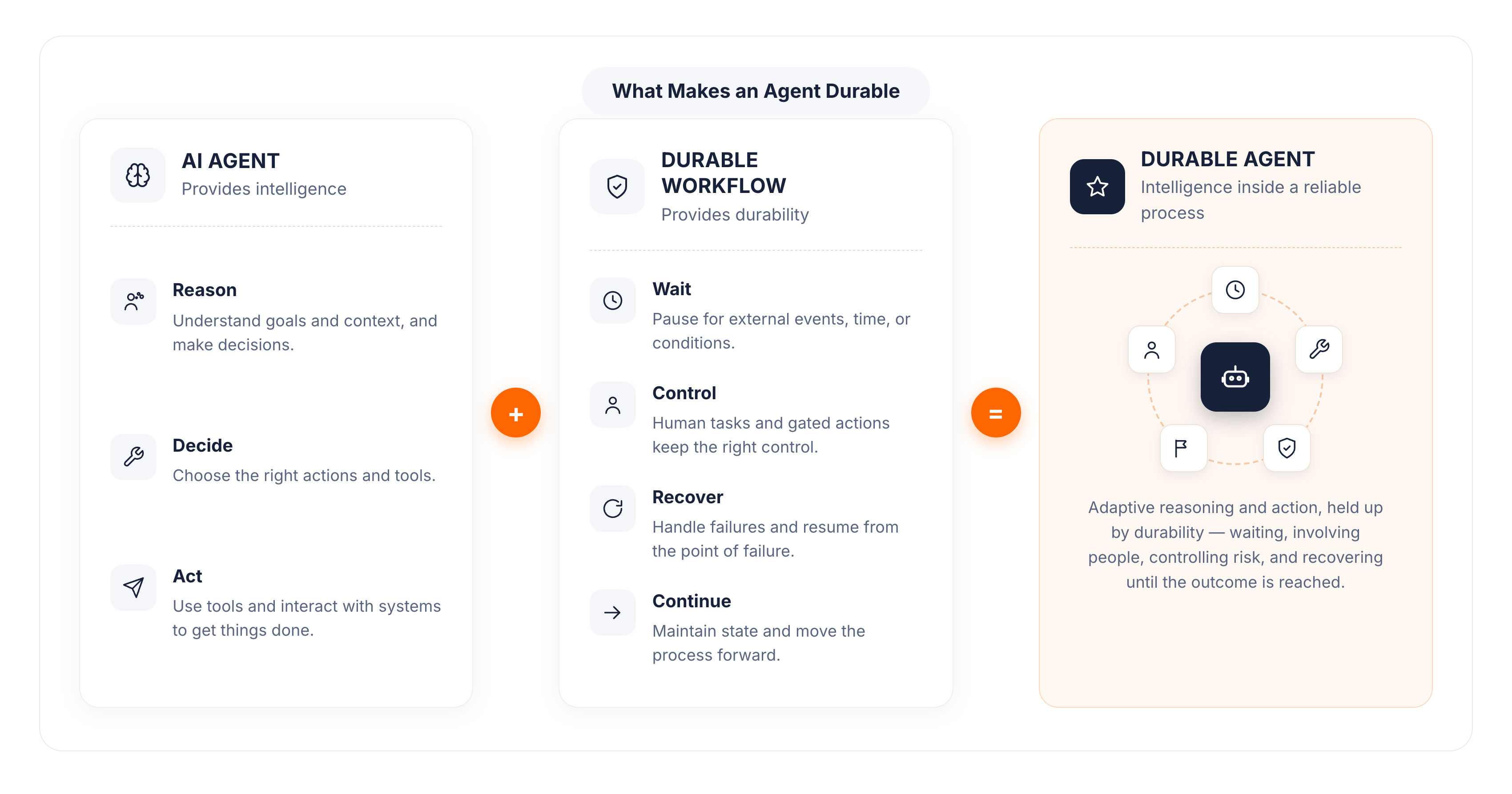
This does not mean that every agent action has to be placed inside a rigid predefined sequence. The agent can retain flexibility in how it achieves its goals while the broader process establishes the boundaries required by the business.
The result is an agent that can be autonomous where appropriate without requiring the entire business process to depend on one uninterrupted autonomous execution.
Durable agents as part of enterprise integration
Another reason durability becomes important in enterprise environments is that agents rarely operate alone. To perform useful work, they need to interact with the same applications, APIs, data sources, events, SaaS platforms, and enterprise systems that already participate in business processes. They may also need to coordinate with people and respond to events originating outside the organization.
The agent therefore becomes another participant in a distributed business process rather than an isolated AI component. This brings agentic AI and enterprise integration much closer together. Integration provides access to the systems where business actions occur, while durable orchestration maintains continuity as the process moves between agent reasoning, system interactions, external events, and human decisions.
From autonomous agents to dependable enterprise participants
The evolution of enterprise agents will not be determined only by how well they reason or how many tools they can use. It will also depend on whether organizations can rely on them as participants in real business processes.
Those processes cannot always be completed immediately. They pause,depend on events that happen later, cross system boundaries, require human judgment, encounter failures, and increasingly combine deterministic business activities with dynamic decisions made by AI agents.
Durable agents provide a way to accommodate these realities without giving up the benefits of agent autonomy. By combining reasoning and tool use with long-running execution, external events, human tasks, gated actions, and controlled recovery, agents can move beyond completing isolated tasks and participate reliably in end-to-end enterprise processes.
For enterprises, that represents an important shift: from building agents that can act autonomously to building agents that can be depended on to see a business process through to its outcome.
Building durable agents with WSO2 Integrator
WSO2 Integrator brings these capabilities together by combining agent development, enterprise integration, and long-running workflow orchestration within the same environment.
Agents can interact with enterprise systems and tools while participating in workflows that continue beyond an individual agent execution. When a process needs information that will arrive later, it can pause for an external event and resume when that event occurs. When human judgment is required, a role-based human task can become part of the process, and the agent can continue after the decision has been made.
For actions that should not be performed autonomously, gated execution provides explicit control points within the agentic process. This allows organizations to determine where agents can act independently and where additional authorization is required.
Durability also extends to failure handling. When an activity fails, the broader process does not need to be discarded. The failure can be investigated, the affected activity retried, or relevant information corrected before execution continues. This provides a controlled recovery path for agentic processes that interact with systems where failures and temporary interruptions are unavoidable.
Most importantly, these workflow capabilities sit alongside the integration capabilities required to make agents useful in the enterprise. Agents can work with APIs, applications, data, events, and other enterprise services while durable workflow orchestration maintains the process around those interactions.
What's Next
Durable agent capabilities are being introduced with the WSO2 Integrator 5.1 release in October 2026. An alpha version is curently available for early access to these capabilities, and we’ll continue to add documentation and samples as we move toward the 5.1 release. Contact us if you require any assistance with getting started.