

Building an Event-Driven Awareness Layer for Agentic Enterprises

- Anupama Pathirage
- Director & Head of Product Management - Integration, WSO2
In a previous article, we argued that one of the most overlooked requirements of an agentic enterprise is awareness. Before an AI agent can reason, make decisions, or take action, it must first understand what is happening around it. Intelligence without awareness has limited value.
So how do you actually build awareness into enterprise systems?
For years, enterprise architecture has focused on systems of record, APIs, databases, and workflows. More recently, AI architectures have introduced new concepts such as Retrieval-Augmented Generation (RAG), Model Context Protocol (MCP), and agent frameworks. Yet most architectural discussions still focus on how agents access information and perform actions.
Far less attention goes to how agents remain aware of a constantly changing business environment.
As you begin deploying increasing numbers of AI agents, awareness itself becomes an architectural concern. This is where an event-driven awareness layer becomes essential.
Why traditional architectures are not enough
Most enterprise systems today are built around request-response interactions. Applications expose APIs. Systems retrieve information when they need it. Workflows invoke services to perform specific tasks. This model works well when users, applications, or agents need answers to specific questions.
An AI agent might ask:
- What is the current status of an order?
- Which support tickets are assigned to this customer?
- What inventory is available in a specific warehouse?
APIs are extremely effective for these interactions. They provide structured access to enterprise capabilities and data. However, awareness is a different problem.
Knowing that an order exists is useful. Knowing that its status just changed may be far more important. Knowing a support ticket exists is useful. Knowing it was escalated five seconds ago may be what triggers action.
In many organizations today, awareness is often achieved through polling. Systems repeatedly query other systems looking for changes. This approach becomes increasingly inefficient as organizations introduce more applications, more automation, and more agents.
If hundreds or thousands of agents continuously poll enterprise systems looking for updates, awareness becomes expensive, delayed, and fragmented.
Architects need a better model.
Introducing the awareness layer
One way to think about enterprise architecture for the agentic era is through four distinct layers:
Reasoning Layer → Agents
Awareness Layer → Events
Action Layer → APIs and Tools
Knowledge Layer → Data, Documents, and RAG
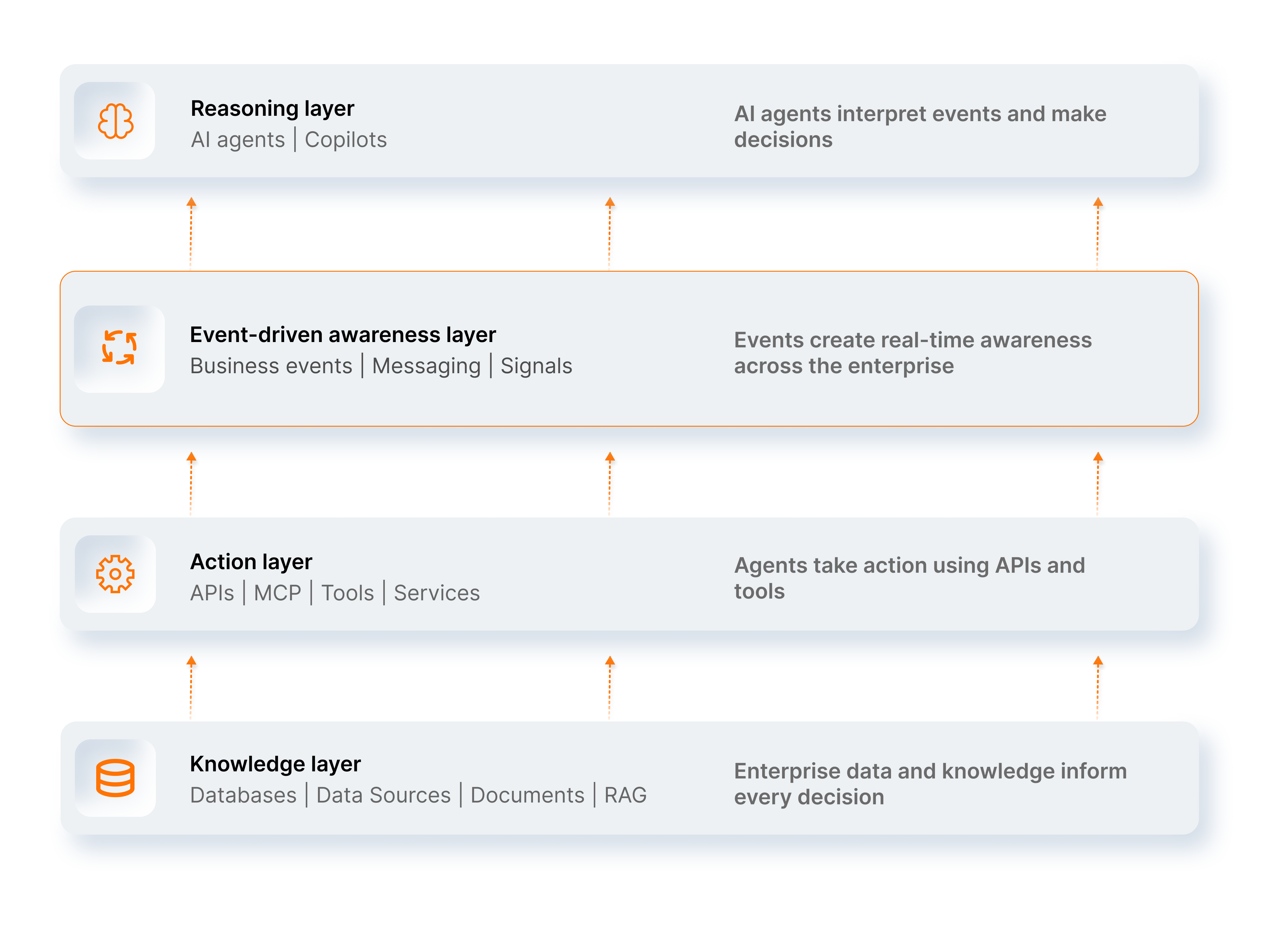
Figure 1: An agentic enterprise runs on four layers; awareness ties them together, telling every agent the moment something changes.
Most organizations are currently investing heavily in the knowledge and action layers, building knowledge bases, implementing RAG pipelines, exposing APIs, and adopting protocols such as MCP. The awareness layer often receives far less attention.
Its purpose is straightforward: ensure that meaningful business changes become visible to the systems and agents that need to know about them. Rather than continuously asking whether something has changed, consumers are informed when a change occurs. This transforms awareness from a collection of isolated polling mechanisms into a shared enterprise capability.
Events as business signals
To build an effective awareness layer, architects must first rethink how they view events.
Events are often discussed as technical artifacts: messages, payloads, topics, streams, or records. While these technical details matter, they are not the most important aspect of an event. An event is fundamentally a business signal. Consider the following examples:
- Customer Registered
- Order Created
- Payment Failed
- Shipment Delayed
- Contract Approved
- Inventory Below Threshold
- Support Ticket Escalated
These events represent meaningful changes in business state.
They are not notifications exchanged between systems. They communicate something important about the business itself. This distinction becomes increasingly important in an agentic enterprise because agents reason about business situations, not technical implementations.
For example, a customer success agent does not care that a database row was updated. It cares that a high-value customer escalated a support issue. An operations agent does not care that a message arrived on a queue. It cares that a critical service is experiencing degradation.
The awareness layer should therefore be built around business events rather than technical events.
Pattern 1:Publish business facts
One of the most important architectural principles is that systems should publish business facts rather than implementation details. Many organizations unintentionally expose low-level technical events such as:
- Record Updated
- Database Modified
- Status Changed
- Row Inserted
These events are difficult to interpret and tightly coupled to internal implementations. Instead, event producers should communicate business outcomes:
- Customer Registered
- Order Shipped
- Invoice Paid
- Contract Signed
- Subscription Renewed
Business facts remain meaningful regardless of how the underlying system evolves. This creates a more stable and reusable event model for both applications and agents.
Pattern 2: Subscribe instead of poll
Traditional architectures often force consumers to discover change through polling. An agent repeatedly checks whether a customer has opened a support ticket. Another repeatedly checks whether inventory levels have changed. As the number of agents grows, this approach scales poorly. An event-driven awareness layer reverses the model.
Instead of asking whether something happened, consumers subscribe to the events that matter.
- A customer success agent subscribes to customer escalation events.
- A logistics agent subscribes to shipment delay events.
- A procurement agent subscribes to inventory threshold events.
The result is faster reaction times, reduced system load, and significantly simpler architectures.
Pattern 3: Shared awareness
One of the most powerful aspects of event-driven systems is that a single business event can create awareness across many consumers simultaneously.
Consider an Order Created event. The same event may be relevant to:
- Billing systems
- Inventory systems
- Customer communication systems
- Analytics platforms
- Fraud detection services
- AI agents
The producer does not need to know who consumes the event. The event simply becomes part of the organization's shared awareness. This loose coupling allows new capabilities to be introduced without modifying existing systems.
As enterprises adopt more agents, this becomes increasingly valuable. New agents can participate in existing business conversations simply by subscribing to relevant business signals.
From workflows to coordination
Perhaps the most interesting shift introduced by agentic systems is the move from workflows to coordination. Traditional enterprise automation is typically built around predefined flows. A process moves from step A to step B to step C according to rules established in advance.
Agentic systems introduce greater autonomy. Multiple agents may observe the same event and respond independently based on their objectives and responsibilities.
A Shipment Delayed event might trigger actions from:
- A logistics agent
- A customer communication agent
- A supply chain optimization agent
- A reporting agent
No central workflow necessarily coordinates these actions. Instead, coordination emerges through shared awareness. Events become the mechanism through which intelligent actors maintain a common understanding of the business.
Pattern 4: Events for awareness, APIs for action
One mistake worth avoiding is treating events and APIs as competing approaches. They are not. They solve different problems.
Events create awareness. APIs enable action.
A logistics agent may receive a Shipment Delayed event. The event tells the agent that something important has happened. The agent then uses APIs to gather additional context, evaluate possible responses, and initiate corrective actions. In this model, events and APIs complement one another.
Events answer the question:
“What changed?”
APIs answer the question:
“What can I do about it?”
The most effective agentic architectures combine both.
The awareness layer as strategic infrastructure
Historically, messaging and event-driven architecture were viewed as integration concerns. They were important technical capabilities, but rarely discussed as strategic assets.
The rise of agentic systems changes that perspective.
As enterprises deploy more intelligent actors, awareness becomes foundational infrastructure. The ability to distribute business signals quickly and consistently directly impacts how effectively those agents can reason, collaborate, and respond.
In many ways, the awareness layer plays a role similar to that of APIs during the digital transformation era. APIs enabled organizations to expose business capabilities. Events enable organizations to expose business awareness.
Both matter. But as enterprises become increasingly autonomous, awareness may become one of the most important architectural capabilities of all.
Conclusion
The next generation of enterprise architecture will not be defined solely by AI models, agent frameworks, or reasoning engines. Those capabilities are important, but they represent only part of the picture.
Agentic enterprises require a shared understanding of what is happening across the business. They require a mechanism for distributing business signals, coordinating intelligent actors, and enabling real-time responses to change. This is the role of an event-driven awareness layer.
Architectural principles alone do not create an agentic enterprise. They must be translated into systems that connect applications, move information, orchestrate business processes, and enable AI agents to interact with enterprise software in a reliable and governed manner.
The four patterns covered here (publishing business facts, subscribing instead of polling, enabling shared awareness, and combining events with APIs) are not theoretical. WSO2 Integration Platform provides the runtime for all of them, connecting your applications, agents, and data systems within a single governed environment.
Take the next step
Events, APIs, agents, one platform. Build your awareness layer on WSO2.