

Replatforming On-Premises API Management Deployments to API SaaS

- tharindu dharmarathna
- Software Engineer, WSO2
API management deployment models are evolving
Organizations run API management in many forms, shaped by their infrastructure strategy, security posture, and team structure:
- On-premises, with complete ownership of bare-metal or virtualized environments
- Private cloud, hosted inside restricted virtual private clouds (VPCs)
- Self-managed Kubernetes, with cloud-native orchestration operated by internal DevOps teams
- Hybrid deployments, combining distributed gateways with a centralized control plane
Each of these models exists for good reasons: control, compliance, data residency, and existing infrastructure investments. But operational requirements evolve over time. Teams are asked to do more with less, traffic patterns shift, upgrade and patching cycles consume engineering capacity, and the rapid rise of AI-driven workloads and LLM integrations introduces demands that traditional deployments were never designed for.
API SaaS introduces another operating model organizations can consider: a fully managed API platform delivered as a service. This article looks at what replatforming to API SaaS involves, why organizations running self-managed deployments explore it, what changes along the way, and, just as importantly, how to decide whether it is the right move for your deployment.
What does replatforming mean?
It is important to be precise about the term, because replatforming is often confused with two things it is not:
- Replatforming is not upgrading. It is not an in-place version change or a routine product update within the same deployment model.
- Replatforming is not lift and shift. It is not taking existing virtual machine images or containers and re-hosting them on someone else’s infrastructure.
Replatforming is the move from a self-managed deployment model to a managed API SaaS. Your API ecosystem, including API definitions, applications, subscriptions, access controls, and security policies, is transformed and re-mapped onto a managed, cloud-native control plane. The APIs stay; the operating model underneath them changes.
Why organizations running on-prem deployments explore API SaaS
The motivation is rarely the infrastructure itself. It is the operational model around it. Common drivers include:
- A managed control plane. Patching, scaling, high availability, and security hardening of the platform shift to the provider. Internal teams stop maintaining API management software and focus on the APIs themselves.
- Simplified platform operations. No maintenance windows to schedule, no upgrade projects to plan, no infrastructure capacity to forecast. Operational effort concentrates on API design, governance, and developer experience.
- Faster feature availability. Managed platforms deliver new capabilities, performance improvements, and security patches continuously, often months before equivalent features can be packaged and rolled out in self-managed distributions.
- Evolving API + AI requirements. Modern workloads increasingly mix conventional APIs with LLM-backed services. Capabilities such as AI gateways with token-based rate limiting, semantic caching, guardrail policies, and AI-assisted governance are emerging fastest in managed platforms.
- A different operational ownership model. Some organizations conclude that running API infrastructure is not where their engineering talent creates the most value, and deliberately choose to delegate that layer.
What changes when moving from self-managed deployments to API SaaS
Replatforming changes several core operational and structural boundaries. Understanding these shifts up front is what separates a smooth transition from a surprising one.
| Area | Self-managed deployment | API SaaS |
|---|---|---|
| Infrastructure ownership | Customer-managed hardware, networking, VMs, or containers | Fully vendor-managed, cloud-native infrastructure |
| Operational responsibilities | Complete ownership of scaling, backups, patching, and uptime | Shared responsibility; platform scaling, uptime, and maintenance handled by the provider |
| Identity and security | Local key managers and internal user stores | Federation with cloud identity providers; existing identity setups may require adaptation |
| Customizations | Bespoke extension points such as custom handlers and mediators | SaaS-oriented extensibility models; existing extensions may require redesign |
| Runtime architecture | Locally controlled gateways and network topology | A managed, globally distributed control plane with new deployment patterns |
Two of these deserve emphasis. Identity and customizations are where self-managed deployments tend to have the most accumulated, organization-specific logic, and they are the areas most likely to require rethinking rather than simple migration.
Assessing existing deployments before replatforming
Organizations running self-managed API management platforms often have years of accumulated APIs, applications, customizations, integrations, and operational practices. Before any migration planning makes sense, you need an honest picture of what exists and how it maps to the target platform.
This is where a replatforming assessment tool helps. Rather than relying on manual audits, the assessment tool analyzes an existing deployment and evaluates how its artifacts align with API SaaS capabilities. Specifically, it helps you:
- Analyze the existing deployment: versions, topology, and configuration in use
- Evaluate APIs and applications: inventory what exists, including protocols and subscription relationships
- Assess customizations: identify custom policies, handlers, mediators, and extensions that need redesign
- Identify gaps: surface features and patterns that do not map one-to-one to the managed platform
- Understand required transformations: clarify how identity, policies, and configurations translate to the new model
- Produce inputs for planning: turn the findings into a concrete, evidence-based migration plan
The value of the assessment is not just the inventory. It is knowing, before committing to a timeline, which parts of your deployment move as-is, which need transformation, and which need a design decision.
A typical replatforming journey
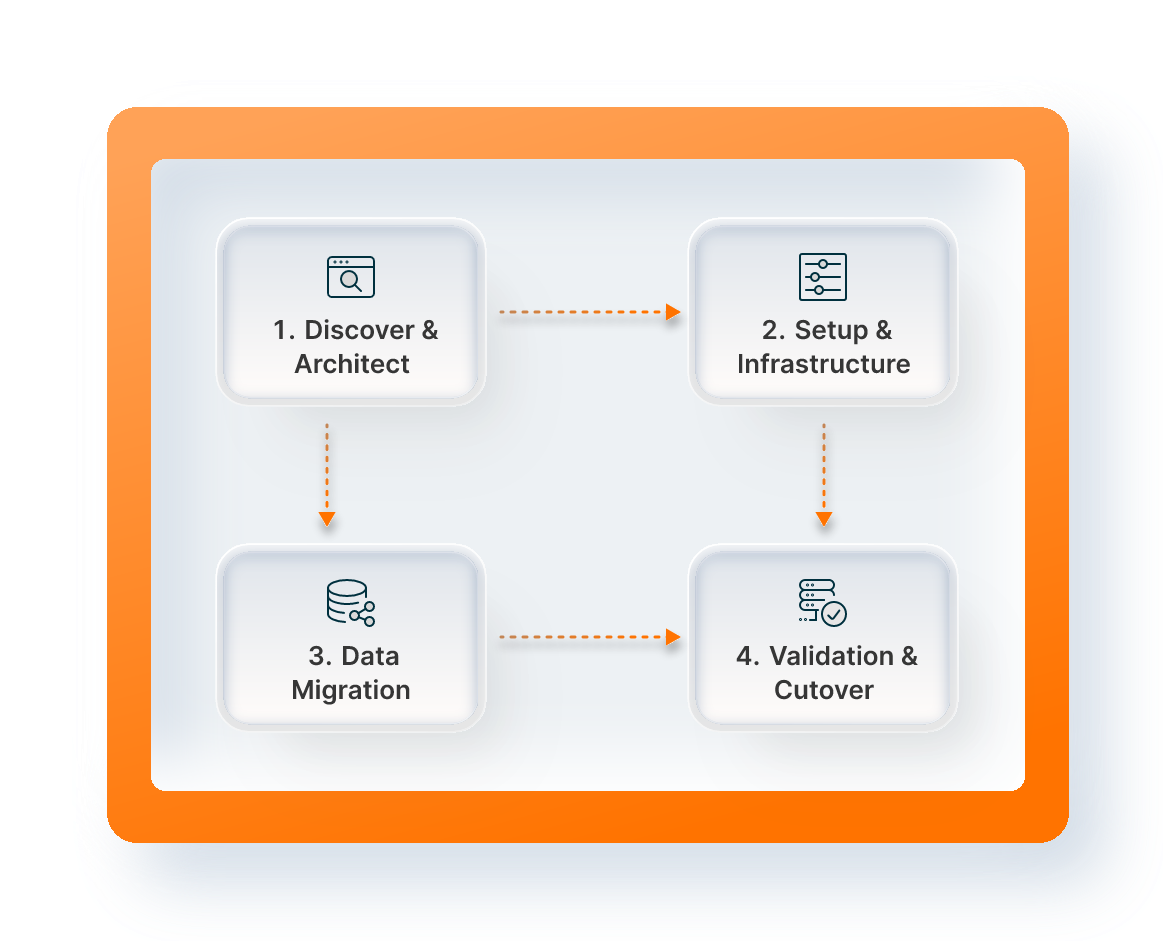
While every organization’s path differs in detail, replatforming journeys tend to follow four high-level stages:
- Discover. Establish the current state: run the assessment, evaluate active use cases, audit extensions and integrations, and define the target architecture, including how identity will map to the new platform.
- Prepare. Provision the target environment, configure identity federation, and establish secure connectivity between the managed platform and backend services.
- Transition. Move APIs, applications, and subscriptions using automated tooling, transforming them to fit the managed platform’s model. Re-implement customizations using the platform’s extensibility mechanisms.
- Validate. Execute functional, load, and security testing; verify consumer flows end to end; then switch production traffic through a controlled cutover such as DNS redirection or canary routing.
The key principle is that replatforming is a staged, verifiable process, not a single migration event.
Making replatforming easier
A common concern with replatforming is the sheer volume of existing assets: hundreds of APIs, thousands of applications and subscriptions, and the developer relationships behind them. Rebuilding these manually is neither realistic nor necessary.
We have invested in making this journey easier. We have built a set of purpose-built tools, and they are available to anyone who wants to replatform:
- The replatforming assessment tool (covered above) gives you the map before the journey: what moves cleanly, what needs transformation, and what needs redesign.
- The migration tool automates the heavy lifting. It programmatically extracts APIs, applications, and subscriptions from your existing deployment, transforms them into the managed platform’s schema, and imports them into the target organization.
- Subscription and key-mapping preservation keeps existing developer relationships intact, so API consumers experience continuity rather than a re-onboarding exercise.
- Standards-based identity federation allows your existing identity providers to connect to the platform, so users and roles adapt rather than start over.
Together, these tools turn what was historically a bespoke consulting project into a repeatable, tool-assisted process. If you are considering replatforming and want access to these tools or help planning your journey, reach out to us here.
Is replatforming right for every deployment?
No, and it is important to say this clearly.
- Not every deployment needs replatforming. If your current deployment is stable, meets your requirements, and your team is comfortable operating it, there may be no urgency to change.
- Self-managed deployments remain valid. Organizations with strict data residency requirements, air-gapped environments, deep dependence on legacy protocols, or heavily customized runtime behavior are often best served by continuing to run the platform themselves.
- Different operating models fit different organizations. A team with strong Kubernetes expertise and a need for deep engine-level customization gets real value from operating its own platform. A team that wants to redirect that effort toward API products and AI initiatives gets real value from a managed one.
- API SaaS provides another option, not a mandate. The right question is not “should everyone move?” but “which operating model matches how we want to work over the next several years?”
The assessment described earlier is useful precisely because it can also tell you when replatforming is not the right fit yet.
Closing thoughts
Replatforming is not simply moving infrastructure from one place to another. It is choosing an operational model: deciding who runs the platform, how fast new capabilities arrive, where engineering effort is spent, and how prepared the architecture is for what comes next, including AI-driven traffic.
For some organizations, the answer is to keep operating the platform themselves. For others, delegating the platform layer to a managed API SaaS frees their teams to focus on what actually differentiates them: the APIs, the developer experience, and the business capabilities behind them.
Either way, the decision deserves to be made deliberately, with a clear-eyed assessment of what you run today, what would change, and what you want your teams working on tomorrow.