

WSO2 Agentic Enterprise Fabric

- Asanka Abeysinghe
- Chief Technology Officer, WSO2
The shift from AI experimentation to agentic enterprise systems changes the conversation from building AI experiences to establishing the enterprise foundation required to run them safely at scale. In the first phase of enterprise AI adoption, most organizations focused on visible experiences: copilots, chat interfaces, workflow assistants, and task-specific agents. These experiences were useful because they helped teams understand what AI could do in a business context. However, once organizations move beyond isolated pilots, the core challenge becomes less about building an individual agent and more about creating the architectural foundation required to run agents safely, consistently, and at enterprise scale, which delivers outcomes and business value.
An enterprise agent is not just a user interface on top of a model. To be useful, an agent must understand intent, access context with institutional knowledge, call tools, interact with systems, trigger workflows, operate within policy, and leave a traceable record of its decisions and actions. In a real enterprise, those capabilities span many different architectural domains. They involve APIs, integration flows, identity systems, policy controls, observability, developer platforms, knowledge bases, and systems of record. This is why the agentic enterprise cannot be treated as an AI application problem alone. It is an enterprise architecture problem.
In enterprise systems, a fabric is a coordinated operating layer across distributed capabilities. It does not replace the systems underneath it, and it does not require every capability to be delivered by one product. Its role is to connect independent systems, provide shared control and visibility, and allow different parts of the enterprise to operate through a consistent model.
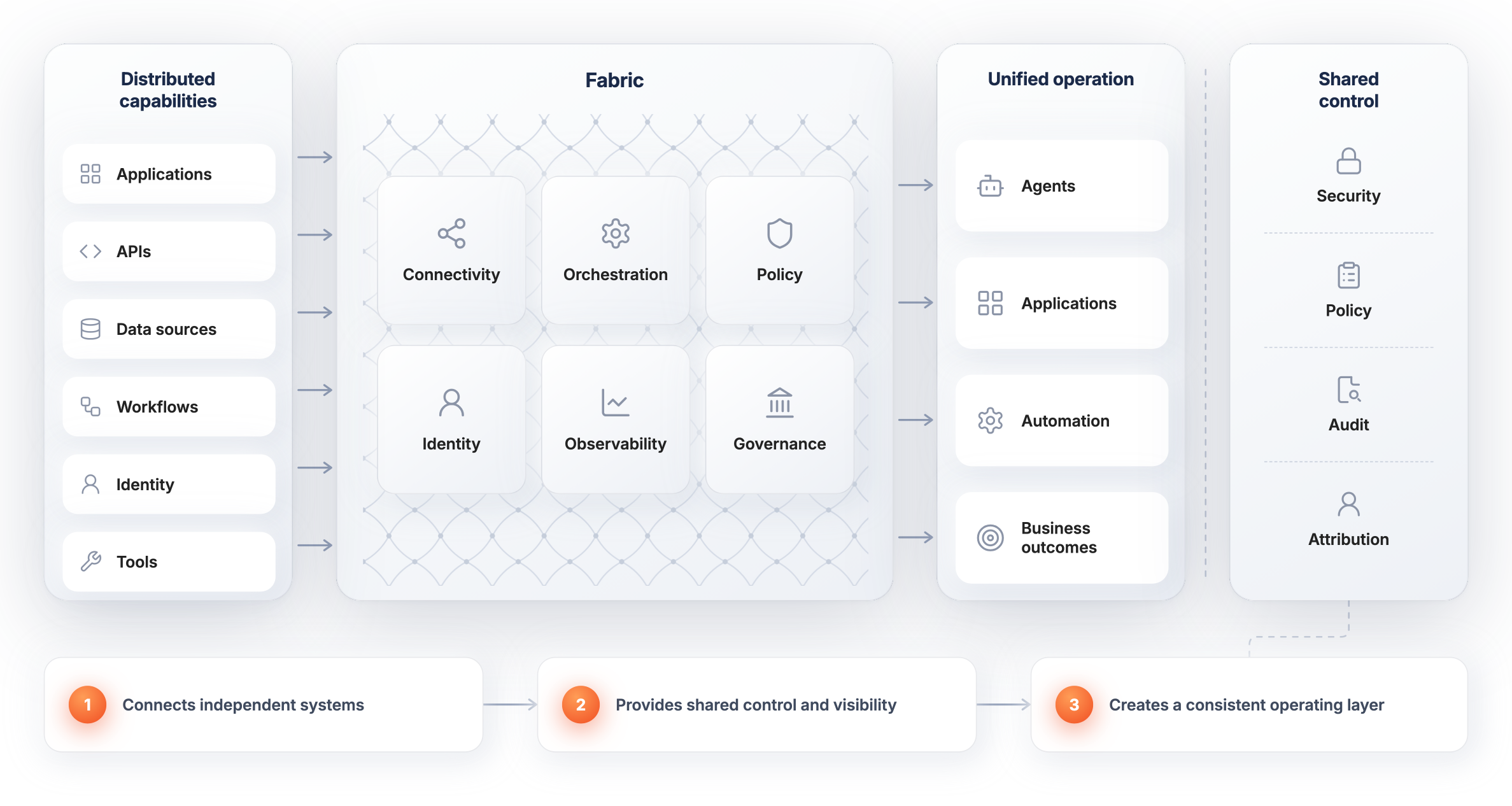 Figure1: Agentic Enterprise Fabric
A fabric becomes especially important when capabilities are distributed across teams, clouds, runtimes, APIs, applications, data sources, identity systems, and tools. In that environment, the value is not only in each individual component, but in how those components are connected, governed, observed, and made usable together.
WSO2 Agentic Enterprise Fabric (AEF) is the enterprise foundation model that brings these capabilities together. It is not a single product with a separate SKU, nor is it a new platform that replaces the existing ones. It is a way to describe the role of WSO2’s core platforms in the agentic enterprise and how they work together to support the full lifecycle of agentic systems. The fabric brings together the API platform, integration platform, identity platform, engineering platform, and agent platform into a coherent enterprise foundation for building, connecting, governing, observing, and operating agents.
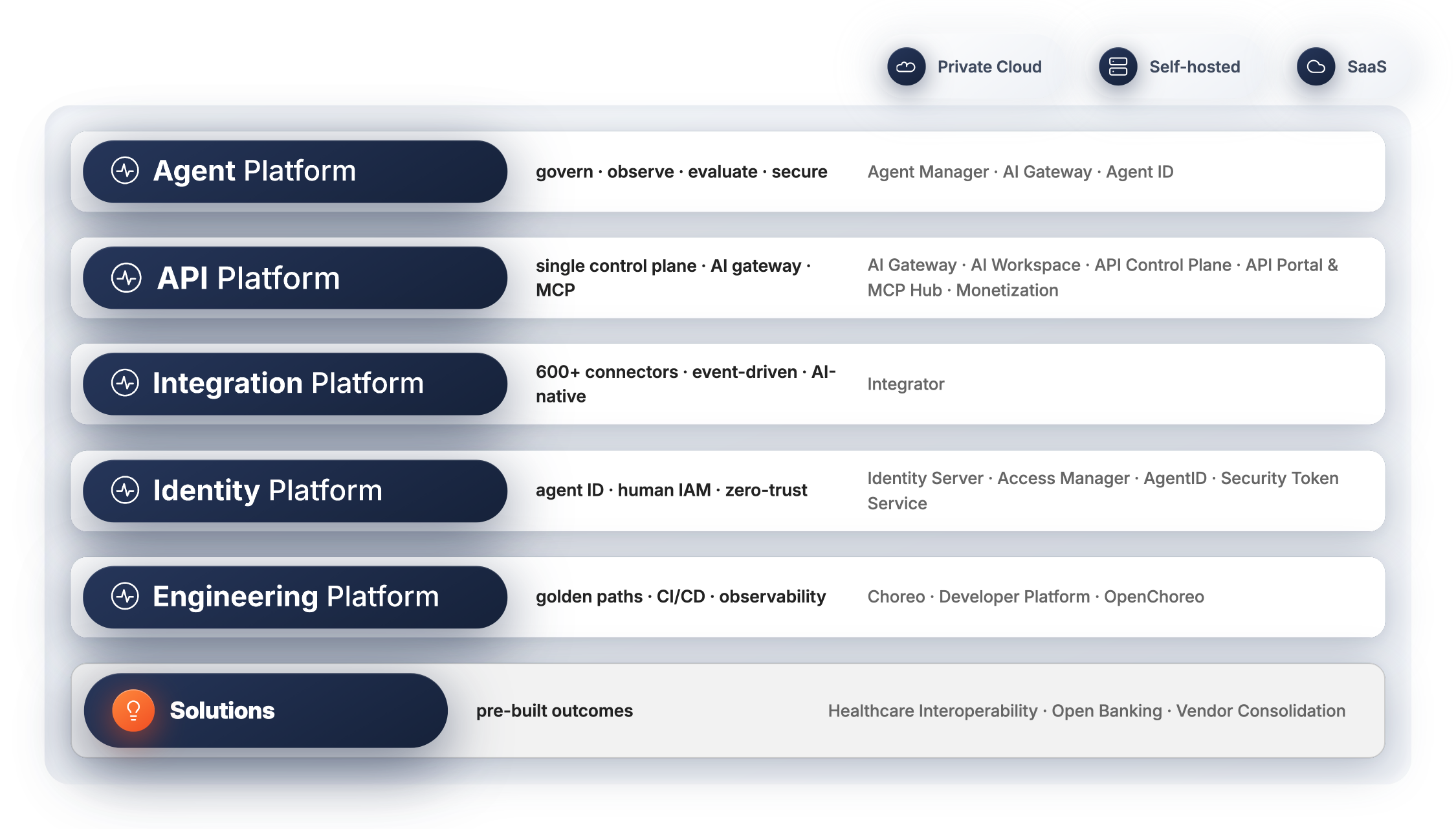 Figure 2: WSO2 Agentic Enterprise Fabric
The term “fabric” is important because the agentic enterprise is not created by one system. It emerges from the coordinated operation of multiple platform capabilities. An API platform exposes capabilities. An integration platform connects systems and workflows. An identity platform establishes trust and authorization. An engineering platform provides the discipline to build and operate software at scale. An agent platform manages the agent-specific lifecycle, governance, evaluation, and runtime controls. Each platform has a distinct role with overlaps, but the value comes from how they seamlessly work together.
A useful way to understand the fabric is through three layers: build, connect, and control.
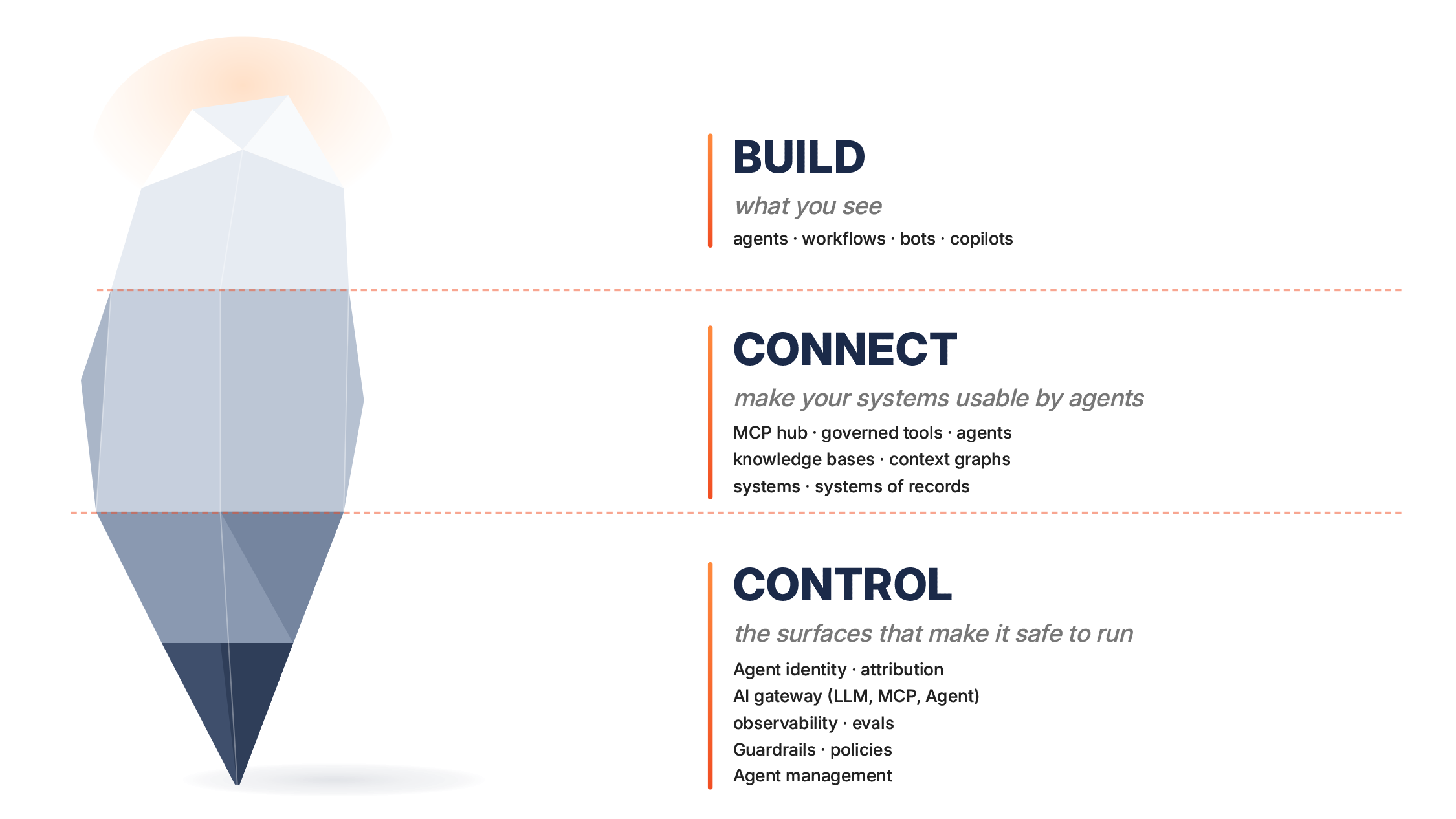 Figure 3: Three layered iceberg
The build layer represents what users and business teams typically see first: agents, copilots, bots, workflows, and AI-enabled applications. This is where new experiences are created and where the value of AI becomes visible to the organization. However, that visible experience is only the top layer. Beneath it, enterprises need a connect layer that makes systems, APIs, tools, knowledge bases, context graphs, and systems of record usable by agents. Beneath that, they need a control layer that makes agentic systems safe to run through identity, attribution, observability, evaluation, guardrails, policies, security, and lifecycle management.
The build layer alone is not enough. Many organizations can create a chatbot or an agent prototype quickly, but that does not mean they have built an agentic enterprise capability. A prototype can operate with limited context, hard-coded access, and manual oversight. A production agentic system cannot. It must run with clear ownership, controlled access, auditable behavior, predictable operational boundaries, and integration into enterprise delivery practices. This distinction between what is visible and what is foundational is central to the WSO2 AEF view.
WSO2 AEF is built on two product principles. The first is to think long term. Agentic systems will evolve quickly, but the enterprise foundation behind them cannot be designed only for the current wave of tools and frameworks. It must read the technology landscape with a longer horizon, rethink the role of middleware in an AI-native enterprise, and rethink how programming models, integration patterns, and control planes evolve when agents become active participants in business execution. The second principle is freedom through flexibility. Enterprises will adopt agentic systems across different operating models, regulatory environments, cloud strategies, and maturity levels. The fabric therefore needs to support open source commitments, self-hosted, private cloud, and SaaS deployment models, and flexibility across architecture and infrastructure choices. These principles matter because the agentic enterprise should not force customers into a single runtime, cloud, architecture, or adoption path. It should give them a consistent foundation while preserving control over how they build, deploy, govern, and evolve.
Deployment flexibility is a separate design requirement for AEF. Agentic systems will not run under a single operating model across all enterprises. Some customers need self-hosted deployments because they require direct control over infrastructure, data locality, network boundaries, and operational processes. Others need private cloud because they want a managed operating model while preserving stronger isolation and control. Others will adopt SaaS where speed, simplicity, and lower operational overhead matter more. AEF is designed to support all three models: self-hosted, private cloud, and SaaS. This matters because agentic enterprise adoption will be shaped by regulation, sovereignty, security posture, cloud strategy, and organizational maturity. The fabric has to fit those realities instead of forcing one deployment path.
The API platform plays a critical role because APIs become the primary way enterprise capabilities are exposed to agents. In traditional software architecture, APIs are consumed by applications through predefined interaction patterns. In agentic systems, agents may discover tools, reason over available actions, and decide when to invoke a capability. That creates a new governance requirement. Enterprises need to define which APIs and tools are available to agents, under what policies, with what authentication model, and with what level of observability and control. The API platform provides the control plane for API products, AI gateways, MCP exposure, developer portals, monetization models, access controls, and policy enforcement. The API platform defines what enterprise capabilities agents can use, and under what guardrails.
The integration platform is equally important because most enterprise processes are not contained within a single system. Real business outcomes usually require coordination across applications, SaaS systems, legacy platforms, partner systems, databases, events, and human workflows. Agents need to operate across that environment without forcing every backend system to become agent-aware. The integration platform provides this connective tissue. It enables event-driven flows, orchestration, transformation, connectivity, and controlled access to systems of record. It also helps convert enterprise complexity into capabilities agents can use. In the fabric, the integration platform answers the question: how do agents work across real enterprise systems rather than only clean demonstrations?
The identity platform provides the foundation of trust for the agentic enterprise. Agentic systems introduce identity questions that go beyond traditional user and application authentication. When an agent takes an action, the enterprise must know which agent acted, which user or system it represented, what authority it had, what policy applied, and how the action should be audited. This requires agent identity, human IAM, delegated authorization, token exchange, attribution, zero-trust access, and policy enforcement to work together. Without this foundation, agentic systems will face serious barriers in security, compliance, and operational governance. The identity platform determines who is acting, on whose behalf, with what authority, and under which policy by treating agents as first-class citizens.
The engineering platform provides the operational discipline required to move from AI experiments to enterprise-grade systems. Agents are still software systems. They need environments, deployment pipelines, configuration management, observability, rollback, ownership, quality gates, testing, and lifecycle management. They also need standardized paths that help development teams move faster without bypassing enterprise standards. This is the role of the engineering platform. It supports golden paths, CI/CD, internal developer platform capabilities, observability, and the broader developer experience needed to build and operate agentic systems reliably. The engineering platform connects teams and enables harness engineering with domain boundaries for teams to build, ship, and run agentic systems with enterprise discipline.
The agent platform brings together the capabilities that are specific to managing agents as first-class enterprise components. Agents introduce behaviors that traditional applications do not. They may reason over context, select tools, create plans, interact with models, produce variable outputs, and require evaluation before or after execution. Managing this behavior requires agent lifecycle management, agent observability, evaluation, guardrails, AI gateway capabilities, agent identity integration, security controls, and policy enforcement. The agent platform provides the runtime and management model for these agent-specific concerns. In the fabric, the agent platform fuels how we govern, observe, evaluate, and secure agents as operational enterprise assets.
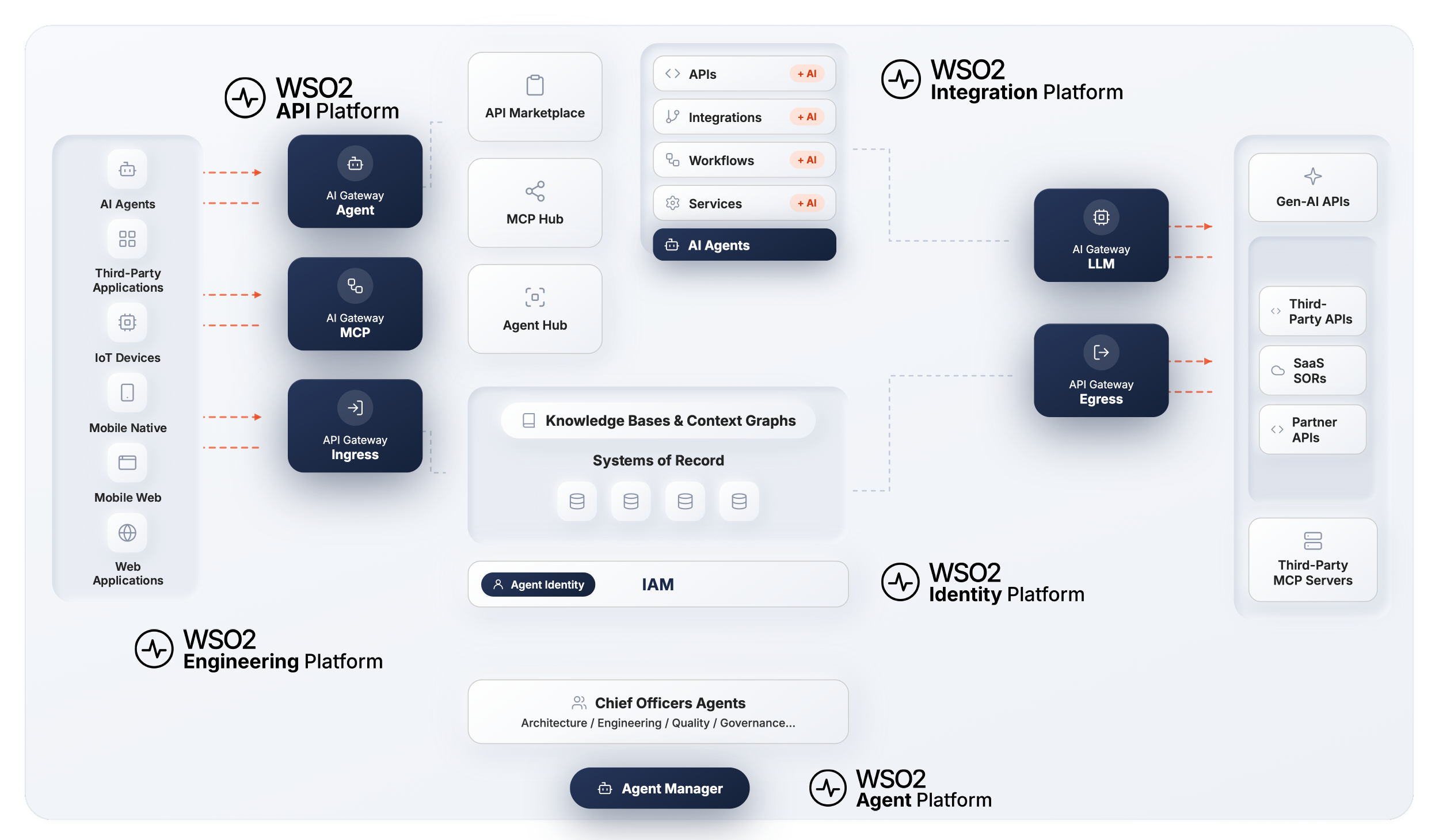 Figure 4: WSO2 AEF in the enterprise architecture
The fabric view matters because these platform roles are highly interdependent. An agent platform without identity cannot establish trust. An API platform without agent-aware governance cannot safely expose enterprise capabilities to autonomous systems. An integration platform without policy and observability can create uncontrolled automation. An engineering platform without agent-specific lifecycle practices cannot scale beyond experimentation. An identity platform without context from APIs, integrations, and agents cannot provide complete attribution. The agentic enterprise requires these capabilities to operate together, not as isolated technology domains.
It is also important to separate AEF from the way the platforms and products inside it are adopted. AEF itself is not a product. It is the umbrella model that explains how the capabilities come together. The platforms within AEF can be adopted as complete platform capabilities, while the products and components inside those platforms can also be adopted individually when that is the better fit. This is intentional. Enterprises do not all modernize in the same sequence, and many already have existing investments in parts of their architecture. Some enterprises may adopt the full API platform, integration platform, identity platform, engineering platform, or agent platform. Others may need a specific capability, such as an AI gateway, agent identity, API control plane, integration runtime, developer platform capability, or agent manager, and compose it into an existing enterprise architecture. The fabric model supports both paths: platform-level adoption when a complete capability is needed, and component-level adoption when a narrower building block is the right architectural choice.
In addition to platforms and individually adoptable products, AEF also includes solution-oriented capabilities. These solutions are not separate from the fabric. They are opinionated combinations of platform capabilities, product components, domain patterns, and implementation practices aimed at specific enterprise outcomes. Examples include healthcare interoperability, open banking, and vendor consolidation. The role of solutions is to reduce the distance between the foundation and a business problem. They help enterprises start from a proven pattern instead of assembling every capability from first principles, while still keeping the underlying architecture open, composable, and aligned with the broader agentic enterprise fabric.
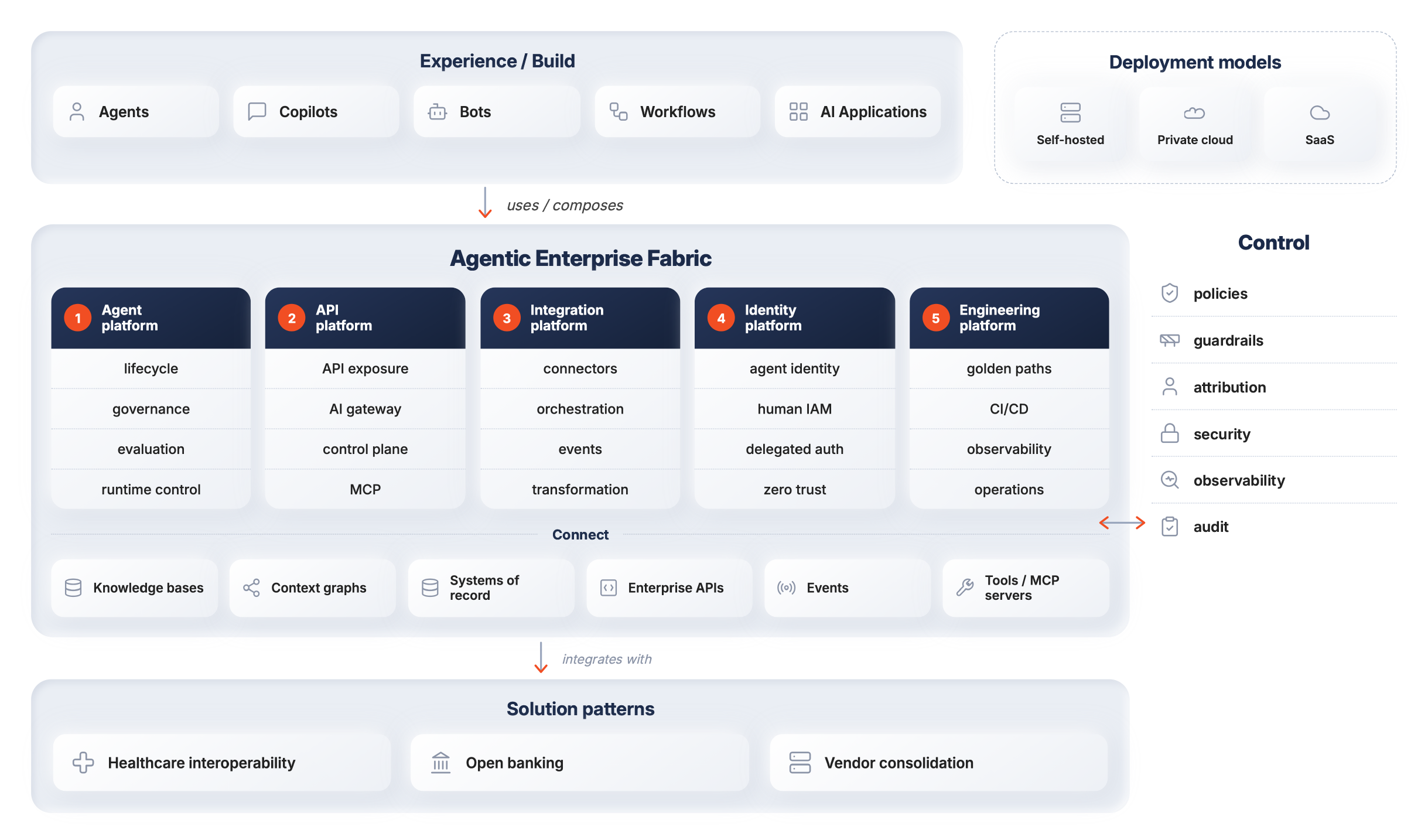 Figure 5: Enterprise foundation build
This also changes the way enterprises should think about modernization. In the past, modernization was often framed as moving from legacy systems to cloud native systems, or from monoliths to APIs and microservices. Those shifts still matter, but the agentic enterprise adds a new requirement. Systems must become usable by agents, governable through policy, observable across execution paths, and secure across human, application, service, and agent identities. The goal is not simply to modernize systems for human users or application developers. The goal is to modernize the enterprise so that intelligent systems can participate safely in business execution.
This is why WSO2 AEF should be understood as an architectural fabric rather than a product bundle. It is the way the core WSO2 platforms come together to support the agentic enterprise. The API platform exposes and governs capabilities. The integration platform connects agents to systems and workflows. The identity platform establishes trust, authority, and attribution. The engineering platform enables disciplined delivery and operations. The agent platform manages the lifecycle, evaluation, governance, and runtime control of agents. Together, these platforms provide the foundation for agentic enterprise operations.
A useful way to understand the differentiation of WSO2 AEF is through the design properties it brings to enterprise adoption. It is based on open source and open architecture, which gives users transparency, extensibility, and a broader ecosystem rather than a closed implementation model. It supports sovereignty by allowing deployment across regions, clouds, and operating environments while keeping local control over data, runtime, and governance. It is complete in the sense that it brings together agent, API, integration, identity, and engineering capabilities, but it remains composable so enterprises can adopt the full platform or selected components based on their architecture. It is designed to be extensible, so organizations can integrate existing systems, tools, policies, and delivery practices instead of replacing everything at once. It also reflects the operational requirements of enterprise systems: predictable cost, mission-critical reliability, and support that is close to the engineering teams building the core technology.
The agentic enterprise is not about placing agents everywhere. It is about making agents useful in the context of real enterprise systems. That requires more than models and interfaces. It requires a fabric that connects capabilities, protects boundaries, enforces policy, observes behavior, and supports disciplined engineering. WSO2 Agentic Enterprise Fabric is our cohesive offering for that foundation, bringing together the capabilities required to make agents useful, governed, observable, and safe across the enterprise.
Reference: https://wso2.com/library/blogs/agentic-enterprise-with-wso2/
Learn More: