

WSO2 at AGNTCon + MCPCon North America: Agent governance takes center stage

- Tori Jeffcoat
- Director, Product Marketing - AI, WSO2
AGNTCon + MCPCon North America brought the open agentic AI community to San Jose on October 22 and 23. The Agentic AI Foundation (AAIF) reported more than 4,300 registrations from over 1,500 organizations, its largest event to date.
The crowd ranged from startups reinventing legacy industries with agents to enterprises scaling AI programs already in production. Size didn't change the question many teams brought to our booth: now that agents work, how do we run them in a way the business can trust?
WSO2 joined as both a speaker and a sponsor.
The open agentic stack continues to seek standardization
AAIF used the event to announce four new projects, bringing it to 10 hosted projects. It launched with three in December 2025. The new announcements include:
- Agent Skills, contributed by Anthropic: an open format for packaging instructions, scripts, and resources that agents load on demand
- Open Responses, contributed by OpenAI: an open specification for interoperable LLM interfaces across model providers
- OpenEnv, contributed by Hugging Face: a framework and hub for building and sharing reinforcement learning environments
- OpenSandbox, contributed by Alibaba: a sandbox platform for running coding agents, GUI agents, and agent evaluations
They join the Agent2Agent (A2A) protocol, Agent Router, agentgateway, AGENTS.md, goose, and the Model Context Protocol (MCP).
For enterprise teams, the protocols agents use to reach tools and other agents are converging under neutral governance. We build on these open standards with our open source roots, so you can choose your own models and clouds with complete sovereignty over your AI and data.
Our take: govern the whole stack in one place
Across the expo hall and in many sessions, the focus was on a single element at a time, such as AI traffic controls or MCP server access. Each of those solves a real problem. But a team running agents across several frameworks can't stitch together a separate tool for every layer and still see what any one agent is doing.
At the WSO2 booth and in Chief AI Officer Dr. Rania Khalaf's talk, we focused on the next layer up: governing it all (AI traffic, MCP servers, APIs, and the agents themselves) in one cohesive solution.
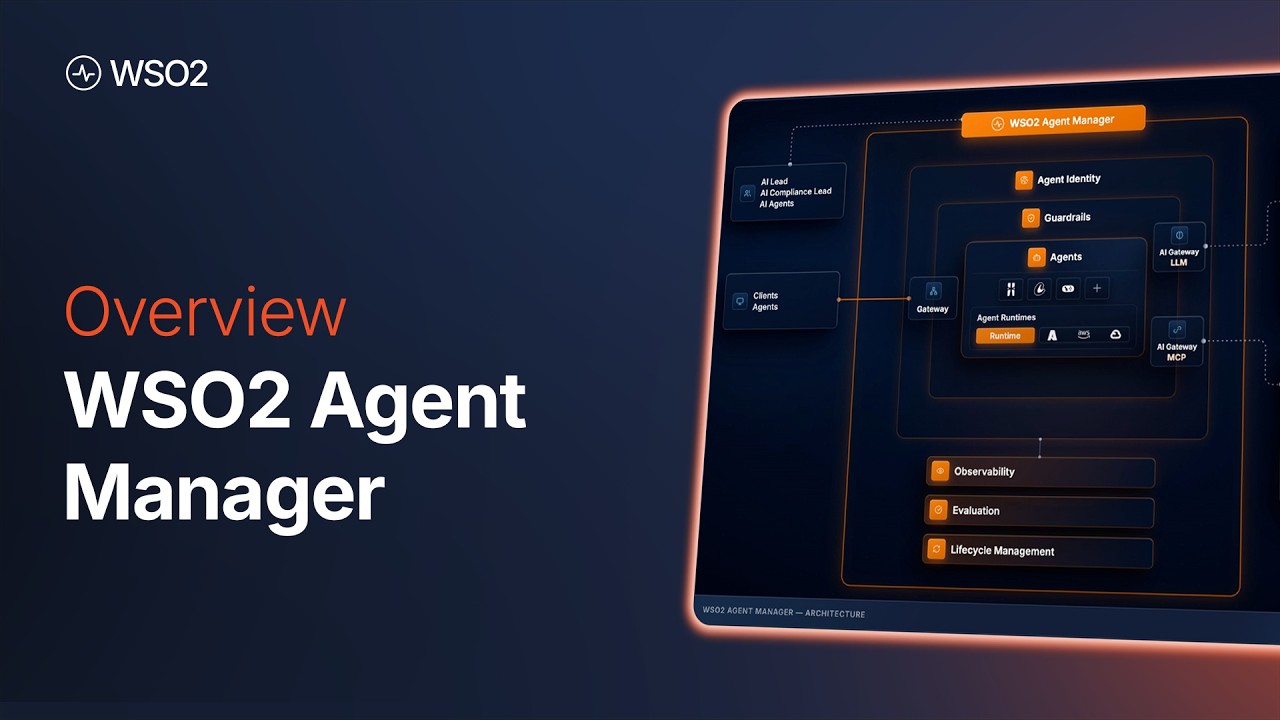
Attendees wanted to see the full picture of an agent in production. That starts with identity, so every agent has a verifiable Agent ID tied to the people and systems it acts for. It continues with guardrails, at the AI gateway and FinOps levels, so agents have a protected perimeter and spend remains in control. Finally, it includes traces and evaluations, so teams can see each step an agent took and score whether the outcome was right.
In the demo theater, our session "Prove It: Agent Governance in 10 Minutes" showed WSO2 Agent Manager live. In ten minutes, the demo walked through how teams can monitor what their agents are doing and prove they are working. It also showed how to shut an agent down when needed. You can see the recorded version here.
Everyone, across every industry, is rethinking work with agents
The range of use cases we heard was wide. One team is rebuilding the car wash business around AI agents to improve coaching and sales. Another is using AI glasses to give frontline workers real-time feedback as they carry out complex tasks.
On paper, those teams have little in common, yet they run into the same problem. The moment an agent serves a customer or guides a worker, the business has to trust it, and rebuilding controls in-house pulls time away from the use case itself. They want governance tooling that scales with them, so they can focus on agents, not infrastructure.
We heard the same from startups across verticals. Building successful agents and AI offerings means focusing deeply on their use case, and most were seeking controls that offer flexibility and resiliency as models, standards, and frameworks evolve over time.
We heard the same from startups across verticals. They want to stay focused on their use case, with controls flexible enough to keep up as models, standards, and frameworks change.
From connecting agents to governing them
The industry is converging on how agents connect. The next phase is about how they’re governed in production. We’re a silver member of AAIF and will keep contributing to the open standards that make governance possible.
If your team is working through agent controls and governance, book time with our team to see how WSO2 fits your stack.