

WSO2 Identity Server 7.3.0: Ambient Agent Access, Verifiable Credentials, and B2B Identity

- Sagara Gunathunga
- Head of IAM DevRel, WSO2
The latest release of WSO2 Identity Server introduces key capabilities to support modern identity use cases. These include enabling secure AI agents, integrating with digital wallets through verifiable credential issuance, enhancing B2B identity for multi-tenant SaaS and partner ecosystems, and extending API-based, app-native authentication to support the SAML protocol.
The previous release introduced Agent ID, establishing agents as a first-class identity type, distinct from users, service accounts, and applications. WSO2 Identity Server was among the first IAM providers to treat agents as distinct from applications and workloads, giving them their own lifecycle and permissions model. The industry is now moving in the same direction.
The latest WSO2 Identity Server 7.3.0 builds on this foundation by expanding support for delegated access for ambient agents. This marks an important shift from simply identifying agents to explicitly governing how they act within defined access boundaries.
Beyond agents, this release also expands core IAM capabilities in several areas. We introduce OpenID for Verifiable Credential Issuance, enabling applications to integrate with wallet infrastructure and use verifiable credentials, and the expansion of B2B identity capabilities to support more complex multi-tenant SaaS and partner identity models, where identity boundaries are not always straightforward.
In addition, configurable approval workflows allow organizations to align access decisions with internal policies, without hard-coding logic into applications. We also expand API-based app-native authentication for SAML applications.
Access control for ambient agents
Conversational agents are widely used, but they don't fit workflows where a human cannot initiate or stay present throughout the process. This is where ambient agents become useful.
Ambient agents operate continuously in the background, anticipating needs and taking action without waiting for explicit prompts. They observe, decide, and act when required, bringing humans into the loop only when necessary.
In practice, these are system-driven agents that monitor context and execute tasks at the right moment. They are not triggered by interaction; instead, they respond to conditions. They function as an always-on layer within the system, handling work in the background.
This introduces a key challenge: access control.
When an ambient agent acts on behalf of a user, the user is not always present to initiate the workflow or provide real-time consent. That does not justify granting broad or persistent access. If anything, it makes controlled access delegation more critical. Humans in the loop should still be enforced for any important decision-making, resource access, or task execution.
This is exactly what the Access Delegation for Non-Interactive AI Agents feature in WSO2 Identity Server addresses.
When an ambient agent initiates a workflow, it contacts the WSO2 Identity Server which acts as the authorization server with details about the user on whose behalf it is acting, along with the intended action or requested resource. The server responds with an authentication reference that the agent can use to track the request.
At the same time, the WSO2 Identity Server sends a backchannel notification such as an email or SMS notification to the user's device, including the details of the requested action. The user can then review and approve or reject the request.
Once approved, the WSO2 Identity Server issues a token representing that consent. The agent can then proceed with the task using this token.
This model ensures that even in non-interactive scenarios, critical actions remain user-controlled.
The Access Delegation for Non-Interactive AI Agents feature is based on the OpenID Client-Initiated Backchannel Authentication (CIBA) protocol, which is designed for secure, decoupled user authentication and authorization.
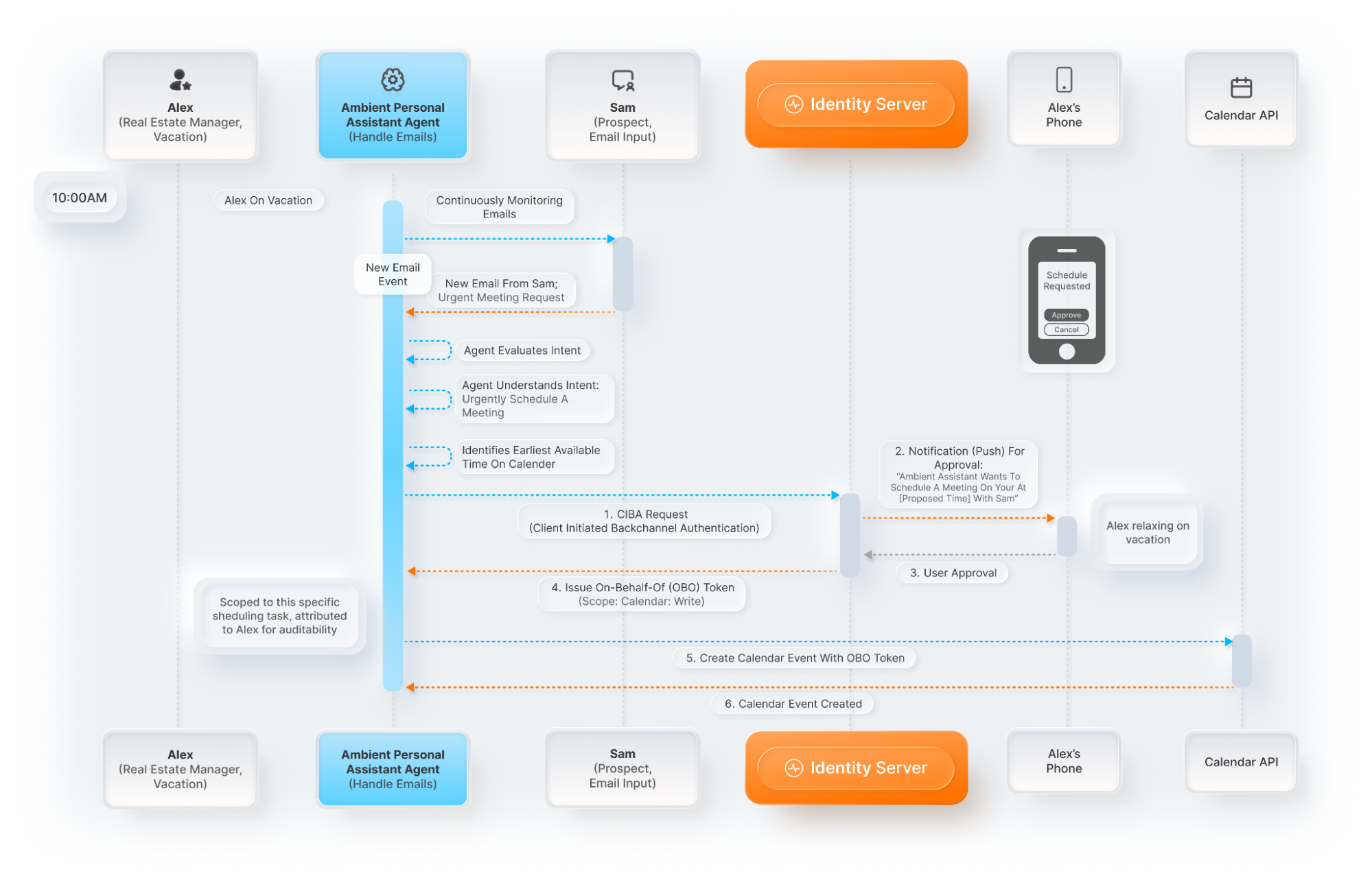
For instance, as shown in the diagram above, a real estate manager, Alex, goes on vacation and assigns an ambient personal assistant agent to handle urgent emails.
When a new email arrives from Sam, a prospect requesting an urgent meeting, the agent understands the intent. It determines that a meeting should be scheduled in Alex's calendar at the earliest available time.
In this case, the agent sends a request to WSO2 Identity Server. The WSO2 Identity Server then sends a push notification to Alex's mobile device asking for approval, clearly indicating that the assistant wants to schedule a meeting along with the proposed time.
Once Alex approves the request, WSO2 Identity Server issues a token with the necessary permissions to the agent. The agent can then proceed to create the calendar event via the calendar API. WSO2 Identity Server ensures that this token is scoped and can only be used for this specific task.
To learn more, refer to the guide and try out the tutorial.
Verifiable credentials for digital wallets
Modern identity systems combine centralized and decentralized models. In practice, most systems need to bridge both. Within decentralized identity, digital wallets are gaining wider adoption. With WSO2 Identity Server 7.3.0, you can issue Verifiable Credentials (VCs) to any digital wallet that supports the OpenID for Verifiable Credential Issuance (OID4VCI) standard.
In essence, verifiable credentials (VCs) are digitally signed credentials that represent claims about a user such as identity, qualifications, or affiliations. Instead of storing and sharing this data across multiple systems, credentials are issued once by a trusted authority, stored in a user-controlled wallet, and presented when needed. Since they are cryptographically verifiable, the receiving party can validate them without having to call back the issuer every time.
This model fits well with real-world scenarios. Organizations can issue employee or partner credentials that work across multiple systems without repeated onboarding. In customer-facing flows, users can prove attributes like age, residency, or membership without exposing unnecessary data. It also enables cross-organization trust, where credentials issued by one party can be verified and accepted by another without tight integration.
With WSO2 Identity Server, this model can be integrated into existing identity flows using OpenID-based standards. The WSO2 Identity Server can act as the source of user attributes and enable applications to issue verifiable credentials that users store in wallets and present when required. This allows you to move beyond login-based identity and build flows where access decisions are based on verifiable claims rather than just sessions or tokens.
The introduction of this feature enables WSO2 Identity Server to integrate with the digital wallet ecosystem, where claims stored in WSO2 Identity Server can be issued as verifiable credentials and stored in a user's digital wallet.
Administrators are provided with easy-to-use credential templates that define what each credential contains and how it is presented in the wallet, allowing credentials to be issued through a secure and controlled flow. As the credential formats, Selective Disclosure JWT-based verifiable credential (SD-JWT VC) and Standard JWT-based verifiable credential encoded as a JSON object (JWT VC JSON) are supported.
To try out issuing verifiable credentials to a digital wallet following the detailed guide here.
B2B identity capabilities for multi-tenant SaaS and partner apps
WSO2 Identity Server has pushed open-source B2B identity forward across recent releases and is recognized in the 2026 KuppingerCole B2B IAM Leadership Compass. The latest release expands this further with a set of major improvements, including:
- API-based app-native authentication for B2B applications: With the new release, API-based app-native authentication is now supported for applications created in any sub-organization, along with SSO across these applications. Previously, applications created at the sub-organization level were limited to redirect-based hosted login flows. With this update, application developers are no longer constrained to a single model. They can now either build fully custom authentication experiences directly into their applications or continue using redirect-based login flows with full rebranding support. This flexibility applies regardless of where the application is registered in the organizational hierarchy, giving teams consistent identity capabilities across the entire B2B structure.
- B2B User Sharing support in portal: Any organizational admin, not just the organization creator, can now share users with other organizations, assign roles, modify shared access, and unshare users directly via the console, in addition to the existing User Sharing API. Administrators are encouraged to use the console for easier management of these operations, while the User Sharing API remains useful for automated user sharing workflows.
- OAuth2 Token Exchange for B2B applications: The latest release introduces support for the OAuth2 Token Exchange grant for applications created in any sub-organization, in addition to the core OAuth2 grant types supported in previous releases. The OAuth 2.0 Token Exchange grant has recently gained attention as it enables exchanging an existing token for another with different access levels, as well as supporting on-behalf-of flows where an agent acts on behalf of a human user.
- Home Realm IDP Discovery for B2B applications: Home realm IdP discovery allows administrators to define unique, simple identifiers for each connected IdP and route users directly to the underlying IdP when the relevant identifier is included in the authentication request. With the latest release, Home realm discovery is enabled at the organization level, allowing admins to provide users with dedicated URLs that route them directly to the correct IdP bypassing the organization selection and multi-option SSO pages.
- Simplified organization-level APIs: When the organization parameter is available, it is now possible to obtain an access token to directly call sub-organization APIs without going through the organization switch grant introduced as a proprietary grant type.
- Organization-level TOTP enrollment management: This release streamlines multi-factor authentication by enabling TOTP enrollment at the organization level. TOTP enrollment in login flows can now be configured without relying on application-specific scripts, reducing complexity and administrative overhead, especially in environments with multiple applications. Administrators can enforce consistent security policies across all applications more easily, improving operational efficiency while strengthening the overall security management.
Brand new Vue.js and Nuxt SDKs
We have started revamping our SDK stack with a focus on providing framework-native components that application developers can use as high-level building blocks. The idea is to let developers work within their chosen framework while the SDK transparently handles authentication, session management, and token processing in the background.
The React and Next.js SDKs introduced in the latest release marked the beginning of this effort. The latest release further extends this direction with a new componentized SDK for Vue.js, and Nuxt.js.
These SDKs support both hosted UI and app-native API architectures, allowing authentication to be implemented either through redirections to the hosted pages or directly within the application using the same consistent set of UI components in both approaches. They are released under the unified Asgardeo brand and can be used with both WSO2 Identity Server and WSO2 cloud.
You can try this out using the new Vue.js Quickstart Guide and Nuxt.js Quickstart Guide.
Extending app-native authentication with SAML identity providers and device code
App-native authentication allows users to sign in directly within a mobile or custom application interface, rather than being redirected to an external login page. As developers move from hosted login flows to API-based app-native authentication, they can build login directly into the application UI instead of redirecting users to an external page. This trend is already visible with the introduction of API-based app-native authentication in WSO2 Identity Server based on OpenID Connect.
With WSO2 Identity Server 7.3.0, this capability is extended further by introducing API-based app-native authentication support for SAML identity providers as well.
The SAML login flow now runs entirely through the app's UI, no redirect to a hosted page, while policy enforcement stays centralized on the server. With this improvement, applications can support native authentication flows while still allowing users to sign in through enterprise SSO using SAML IdPs.
This release also extends app-native authentication to support device code flows, enabling smoother authentication for devices with limited input capabilities. Previously, users had to manually enter device codes through separate authentication endpoints, which introduced friction and made integration with native authentication frameworks more difficult.
This improvement simplifies the login process for smart devices and other constrained interfaces, such as smart TVs, where traditional login flows are not practical.
Rule-based approval workflows
This release introduces rule-based configuration for triggering approval workflows in user management operations. Previously, workflows could be configured but lacked flexible mechanisms to determine when they should be applied, making it difficult to enforce governance policies at scale.
With rule-based conditions, organizations can automatically trigger approval processes based on defined operational scenarios. This adds the flexibility to define workflow rules aligned with specific business use cases.
Conclusion
WSO2 Identity Server 7.3.0 reflects where modern identity is heading and makes these capabilities available to open-source users.
This release introduces the building blocks needed to secure AI agents, including delegated access for ambient agents with explicit agent identity. It also enables WSO2 Identity Server to act as a verifiable credential issuer, helping bridge the gap between centralized identity systems and digital wallet ecosystems.
In addition, the release strengthens B2B identity capabilities for building SaaS platforms and partner ecosystems. API-based app-native authentication is further expanded to support both OpenID Connect and SAML and can be used with applications created at sub-organizations as well.
Download WSO2 Identity Server 7.3.0 and spin it up to try the ambient agent flows, verifiable credential issuance, and new B2B capabilities for yourself. If you're upgrading from an earlier release, reach out to us for upgrade support.