

Transforming Customer Support with an AI-Powered Troubleshooting Agent

- Sasindu Alahakoon
- Associate Technical Lead, WSO2
A global leader in entertainment, gaming, and hospitality partnered with WSO2 to take the organization’s first step to becoming an agentic enterprise by building an intelligent solution that would transform how support teams operate. The solution, a virtual support engineer, automated a manual issue resolution process and reduced resolution times from 2 hours to 1 minute, helping to provide a better support experience for both customers and internal operations teams alike.
The challenge: Manual troubleshooting in a complex ecosystem
The organization’s customer care and business operations teams, in collaboration with the engineering team, handled account issues reported through multiple channels such as ServiceNow, direct emails, and collaboration platforms like Slack and WebEx. The investigation process when a customer reported a problem was entirely manual.
The key challenges included:
- Time-intensive investigations: Each issue, even seemingly simple ones, could take up to two hours of a customer care representative’s time for manual investigation and log analysis across multiple backend systems.
- Fragmented knowledge: There was no centralized knowledge base for issue resolution. Critical information was scattered across ServiceNow, Jira, and email threads with technical details often incomplete or missing entirely.
- High escalation rates: The complexity of the process meant that frontline customer care representatives had to frequently escalate issues to the engineering team, creating bottlenecks and extending resolution times.
- Multiple system dependencies: The engineering team needed to troubleshoot across four different backend systems: the customer loyalty platform, customer profile database, the WSO2 Identity Platform used for authentication, and Salesforce Marketing Cloud—making each investigation a complex, multi-system endeavor.
With approximately 10 issues per week spread across 15 rotating customer care representatives, the inefficiency was clear. The organization needed a smarter approach, one that could empower their frontline teams while reducing the burden on their engineering resources.
The solution: An AI-powered virtual support engineer
WSO2 and the organization developed an AI-driven Troubleshooting Agent, essentially a "virtual support engineer," that automates the investigation, diagnosis, and remediation of customer account issues.
How it works
Imagine a scenario where a customer care representative receives a call from a customer that can’t log into their account. Previously, this would trigger a lengthy manual investigation. Now, the representative simply opens the AI assistant and types the issue in plain English.
A conversational experience: The AI agent acts like a seasoned support engineer sitting right next to you. Customer care representatives interact with it through a simple chat interface, no special training required. They describe the problem naturally, just as they would explain it to a colleague:
"Customer John Smith, account 950010796, says he hasn't been able to log in for the past two days."
Instant, intelligent investigation: The AI agent immediately goes to work behind the scenes. Within seconds it:
- Pulls the customer's profile from all connected systems.
- Reviews recent login attempts and authentication history.
- Checks account status across the loyalty platform and identity systems.
- Analyzes system logs to identify any errors or anomalies.
- Cross-references findings against the organization’s documented troubleshooting procedures.
What used to take an engineer two hours of manual searching happens automatically. The agent also learns from the organization’s own knowledge base, applying the same expertise that senior engineers would use.
Clear findings, actionable solutions: The AI agent doesn't just dump raw data. It presents its findings in natural language that any customer care representative can understand:
"I found the issue. John's account was automatically locked after 5 failed login attempts on January 28th. The failed attempts came from an unrecognized device, which triggered our security protocols. The account is otherwise in good standing with an active membership.
Recommended action: Unlock the account and send a password reset email. Would you like me to proceed?"
Human-in-the-loop control: While the AI agent can diagnose and fix issues, customer care representatives still maintain full control. Before any action is taken, whether unlocking an account, updating profile information, or sending a password reset, the system requires explicit approval from the customer care representative. This ensures accountability while still delivering the speed benefits of automation.
One click to resolution: Once approved, the AI agent executes the fix across all relevant systems simultaneously. No more logging into multiple platforms or copying data between screens. The AI agent then verifies that the action was successful, and provides a complete summary for the support ticket.
The entire process, from initial query to verified resolution, takes approximately a minute instead of two hours.
High-level architecture
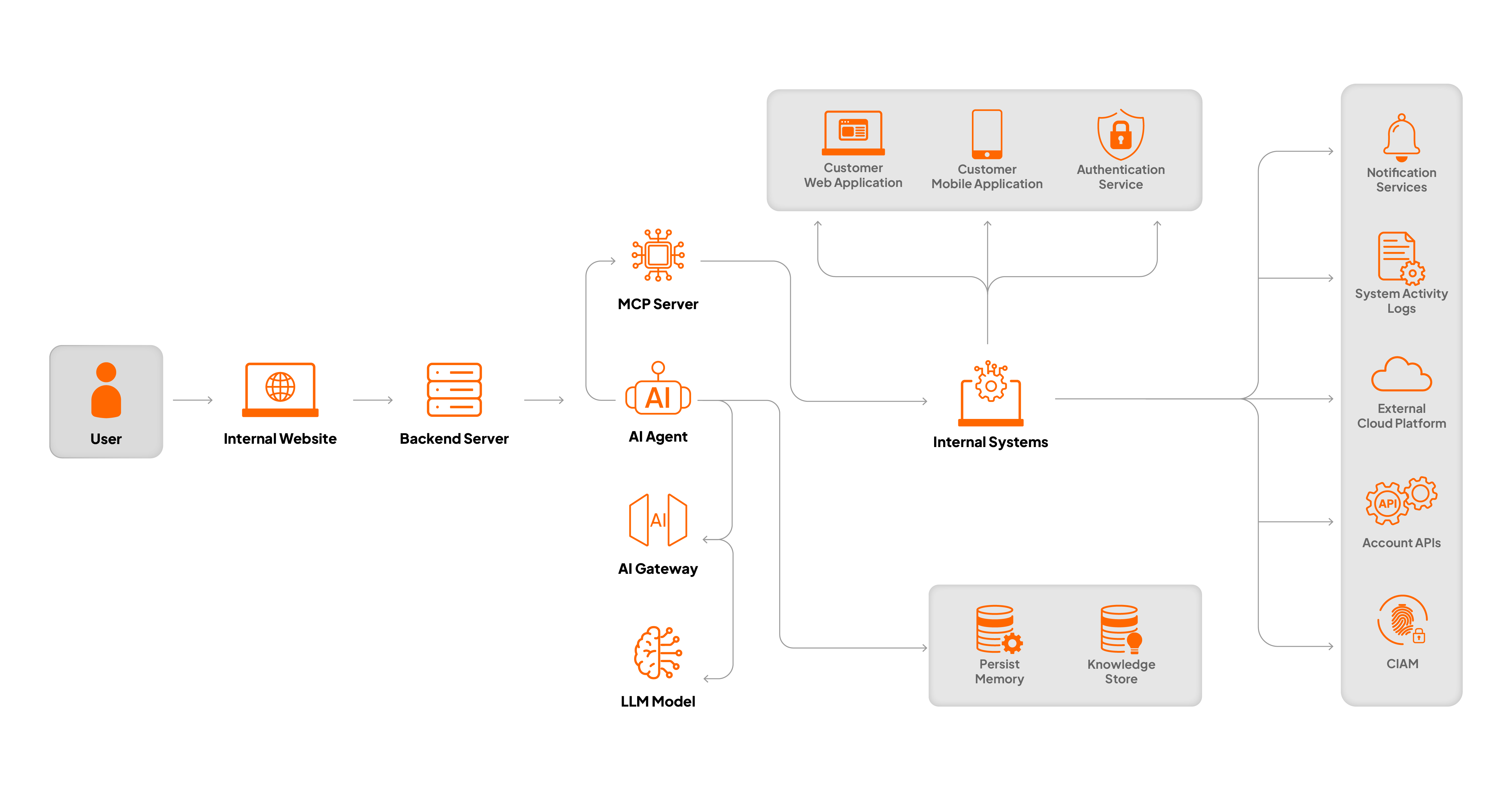
The solution architecture leverages several key components:
- WSO2 API Gateway serves as the secure entry point for all interactions, managing authentication, rate limiting, and request routing to backend systems.
- WSO2 Integrator powers the backend integration layer, orchestrating API calls across the organization’s complex ecosystem, and providing comprehensive logging for audit trails. It also enables the rapid development of AI agents with native support for HTTP, data transformation, and enterprise connectivity.
- The AI agent service built with WSO2 Integrator connects to Azure OpenAI for intelligent reasoning and decision-making, with persistent memory for multi-turn conversations.
- The MCP (Model Context Protocol) Server provides a standardized interface between the AI agent and the organization’s backend systems, exposing REST APIs as tools the agent can use.
- The knowledge store, powered by Azure AI Search, allows the agent to access documented resolution procedures and best practices.
- The Persistent Memory, powered by Azure SQL, maintains conversation history and context, enabling the AI agent to handle complex, multi-step troubleshooting scenarios.
Why WSO2 was chosen
WSO2 was chosen for this strategic AI initiative due to its strong alignment with the organization's requirements:
1. Proven integration expertise: WSO2's deep experience in integration and API management was critical. The solution required seamless connectivity to multiple backend systems, and WSO2's platform provided a robust integration layer needed to unify data from disparate sources.
2. Existing technology investment: The organization was already utilizing the WSO2 platform for integration, API management, and identity and access management as core components of their technology stack. Building on this existing foundation meant faster implementation, reduced complexity, and seamless integration with their current infrastructure.
3. Comprehensive platform capabilities: WSO2 offered a complete stack from an API gateway for API-level security, to an AI gateway for controlling LLM interactions to robust integration for backend orchestration, enabling the organization to build an enterprise-grade AI solution with a single vendor.
4. Security and governance: For a company handling sensitive customer data across global operations, WSO2's built-in security features for controlling LLM interactions in the AI Gateway, including PII masking capabilities and role-based access control, aligned with the organization’s data privacy requirements.
WSO2 products used
| Product | Role in the Solution |
| The WSO2 Integration Platform | AI agent development, backend system orchestration, and MCP server implementation with WSO2 Integrator. |
| The WSO2 API Platform | API-level security and traffic monitoring with the WSO2 API Gateway, and controlling LLM interactions with the WSO2 AI Gateway. |
| The WSO2 Identity Platform | Customer identity and access management (CIAM) with WSO2 Identity Server. |
Business outcomes: Transforming support operations
The implementation of the AI-powered Troubleshooting Agent delivered significant measurable outcomes:
- Reduction in resolution time from 2 hours to 1 minute: Issues that previously required up to two hours of manual investigation can now be diagnosed and resolved in one minute as the AI agent automates the tedious process of querying multiple systems and analyzing logs, and presents findings instantly.
- Empowered frontline teams: Customer care representatives can now resolve issues independently without escalating to the engineering team. This shift reduces bottlenecks and allows engineers to focus on higher-value work rather than routine troubleshooting.
- Reduced mean time to resolution (MTTR): By eliminating manual handoffs between customer care representatives and the engineering team, the solution significantly decreased the overall time customers needed to wait for issue resolution.
- Consistent, knowledge-driven decisions: The centralized knowledge base ensures that every issue is handled according to documented best practices, eliminating the inconsistency that came with fragmented information scattered across multiple systems.
- Foundation for AI-driven operations: Most importantly, this project represents the organization’s successful first step into AI-powered operations. The solution provides a proven foundation that can be expanded to handle additional use cases, including proactive issue monitoring and other operational workflows.
Looking ahead
The success of this initial implementation has opened the door for expanded AI capabilities at the organization. Future enhancements on the roadmap include:
- Enhanced security and governance: Integration of AI Gateway capabilities for advanced traffic monitoring and PII masking.
- Role-based access control: Restricting sensitive operations to authorized personnel.
- Expanded use cases: Broadening the agent's knowledge to handle more issue types.
- Proactive monitoring: Building agents that can preemptively identify and alert teams to potential issues before customers are impacted.
Conclusion
The entertainment, gaming, and hospitality giant’s journey into AI-powered operations demonstrates how enterprises can leverage intelligent automation to transform traditional manual processes. By partnering with WSO2 and building on a foundation of robust integration and API management capabilities, the organization created a solution that not only solves today's challenges but positions them for continued innovation.
The AI Troubleshooting Agent exemplifies the power of combining enterprise integration expertise with modern AI capabilities, delivering tangible business value while setting the stage for the future of intelligent operations.
Contact us to discuss how WSO2 can help your organization build your own AI-powered solutions, and enable your agentic enterprise.