

Escaping the Integration Tax: Why Your Partners Are Stuck in Limbo (and How to Onboard in Days, Not Months)

- Lalaji Sureshika
- Associate Director / Architect, WSO2
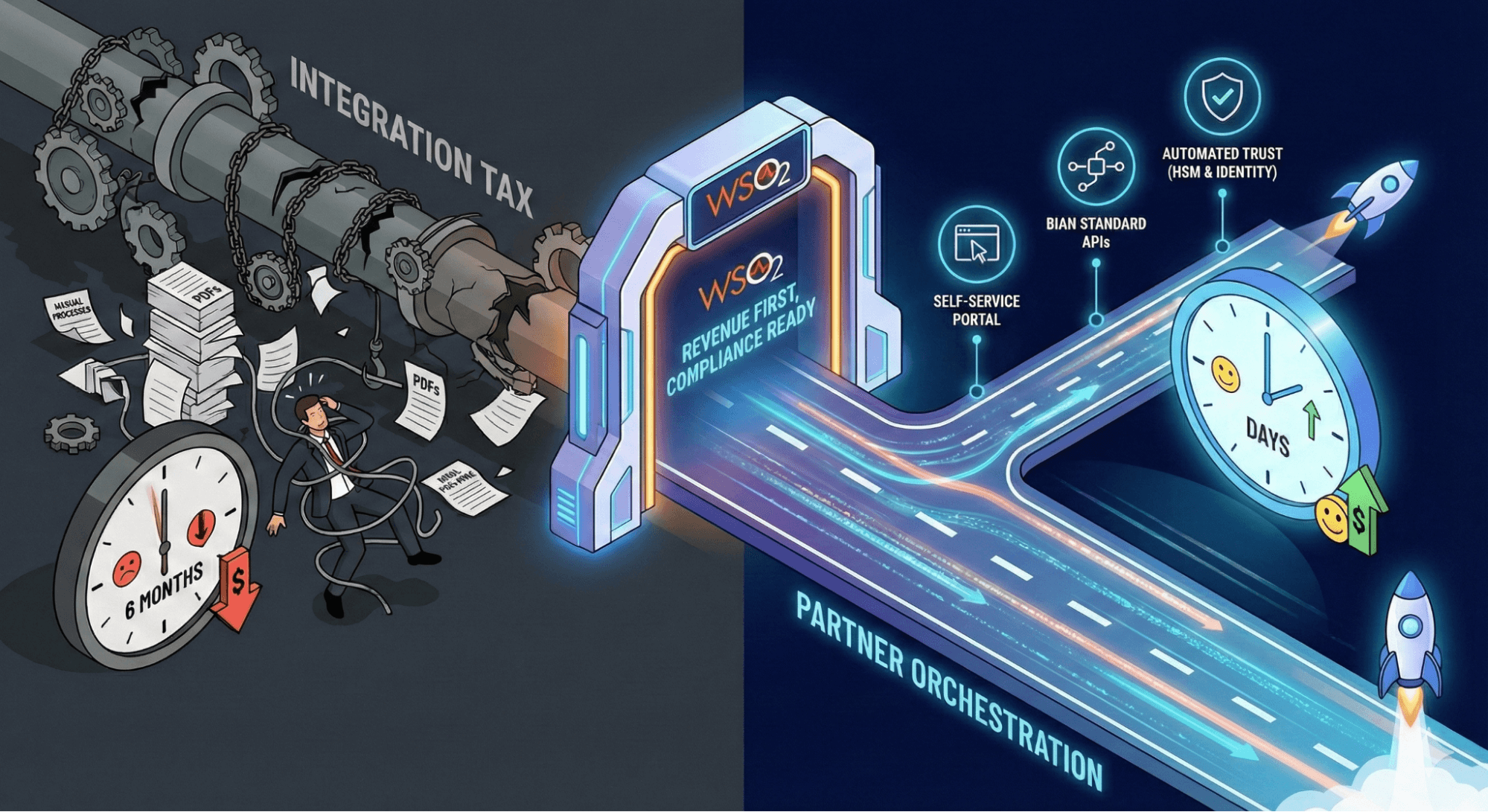
In a high-interest-rate environment, the most expensive asset a bank can hold is a signed partner contract that isn’t generating transaction revenue. For many regional banks, the 4–6 month gap between “contract signed” and “first transaction” is driven by manual compliance reviews, fragmented security processes, and custom integration work that delays go-live.
We call this the “Integration Tax.”
It is the cost of lost revenue incurred every day your partner isn't live because your team is stuck manually provisioning access. This bottleneck stalls ecosystem growth, delays ROI, and forces your high-cost engineering teams to act as a manual help-desk for external partners. It’s the gap between signing a deal and billing for it, leaving significant revenue on the table every month.
The solution: Partner orchestration
To escape this tax, leading banks are moving beyond simple API connectivity to true Partner Orchestration. Here are the three capabilities that make the difference:
1. The "Digital Front Door" (Self-Service Onboarding)
The biggest bottleneck is often the manual exchange of credentials.
- The Old Way: IT teams act as a "help desk," manually generating API keys and emailing documentation.
- The New Way: A Custom Onboarding Portal allows partners to self-register, manage their own team members, and access sandbox environments instantly. By giving partners a self-service "Digital Front Door," you remove your engineering team from the critical path.
2. Standardization via Banking Industry Architecture Network (BIAN) (plug-and-play)
The varying data formats introduced by each partner result in complex, difficult-to-maintain "spaghetti code" integrations. This also necessitates additional time to design custom APIs for each distinct partner format.
- The Capability: Instead of building custom pipes for every new partner, you expose Standard APIs (based on BIAN). This acts as a universal adapter—partners connect to a global industry standard, while your internal systems remain secure and faster. It turns integration from a custom project into a repeatable product.
3. Automated trust (identity and security)
Security reviews are critical but often slow down the process.
- The Capability: By integrating Hardware Security Modules (HSMs) and identity verification directly into the onboarding flow, you can automate the "messy middle" of vetting. Partners validate their own security tokens against your standards automatically, ensuring governance doesn't become a roadblock.
Revenue today, compliance tomorrow
WSO2 supports all these capabilities out of the box, providing a production-grade partner execution layer that sits on top of your existing core to deliver this automation immediately. To learn more, we encourage you to visit our page for WSO2 Financial Services solutions.
By significantly cutting onboarding times, banks accelerate their time-to-revenue immediately. Optimizing these onboarding journeys can dramatically improve process efficiency by 30% and significantly accelerate the 'time-to-yes' for complex deals, according to BCG’s 2025 Corporate Lending Report[1].
Crucially, this isn't just about speed. The same standardized governance framework that speeds up onboarding today creates the exact data lineage required for CFPB 1033 compliance tomorrow.
Don't wait for the rule to be finalized. Solve the revenue problem today, and you will be compliant by default.
[1] https://www.bcg.com/publications/2025/strategies-smarter-corporate-lending