

Achieve CMS Interoperability Fast
Ensure compliance with CMS regulations 0057-F and 9115-F by the January 1, 2027 deadline using pre-built templates. Streamline your systems to meet CMS interoperability standards quickly and efficiently, and enable seamless data sharing across payers, providers, and patients.
CMS-0057-F requires more than compliance-only tools
Beyond data exposure, CMS-0057-F mandates automated prior authorization, strict SLAs, and payer-to-payer exchange. These requirements outpace compliance-only FHIR® servers or point solutions. Success demands a production-grade interoperability platform engineered to operationalize regulated workflows at enterprise scale, providing a robust foundation for
future AI-driven automation.
Securely publish any API to partners and apps.
- Manage APIs across multiple environments and gateways with ease.
- Understand usage, adoption, and performance to optimize business impact.
- Manage LLMs, AI agents, and traditional APIs from one control plane.
- Avoid vendor lock-in and extend capabilities using open standards.
- Enforce fine-grained policies, rate limits, and AI guardrails.
SLA-enforced, observable API execution.
Rapidly connect EMRs, payers, and digital apps.
- AI-assisted low-code development.
- Seamless business and IT collaboration.
- Connectivity across any protocol.
- Simplified data mapping and transformation.
- Build AI-powered applications.
- Centralized monitoring and management.
Faster execution with lower integration cost.
Centralize identity, consent, and access control.
- Build a custom B2C, B2B, or G2C solution that delivers a frictionless experience.
- Secure, authorize, and govern AI agents and LLMs as first-class identities.
- Reduce developer dependency with an AI-enabled, no-code Flow Builder.
- Secure your APIs and microservices with centralized, policy-based access control.
Secure, compliant access at scale.
Scale your GenAI services securely and responsibly.
- Enforce safe, responsible AI use with built-in guardrails.
- Protect sensitive data by masking personally identifiable information (PII).
- Gain deep visibility into AI usage to track traffic patterns, oversee model performance.
- Guarantee structured, valid outputs by enforcing schemas and regex patterns.
- Govern costs and usage with token-based rate limiting and semantic caching.
Compliant automation as AI scales.
CMS-0057-F compliance
at a glance
CMS-0057-F, the final rule titled "Advancing Interoperability and Improving Prior Authorization Processes," outlines several key requirements aimed at improving transparency and reducing administrative burden, particularly around prior authorization.
Automate prior authorization workflows
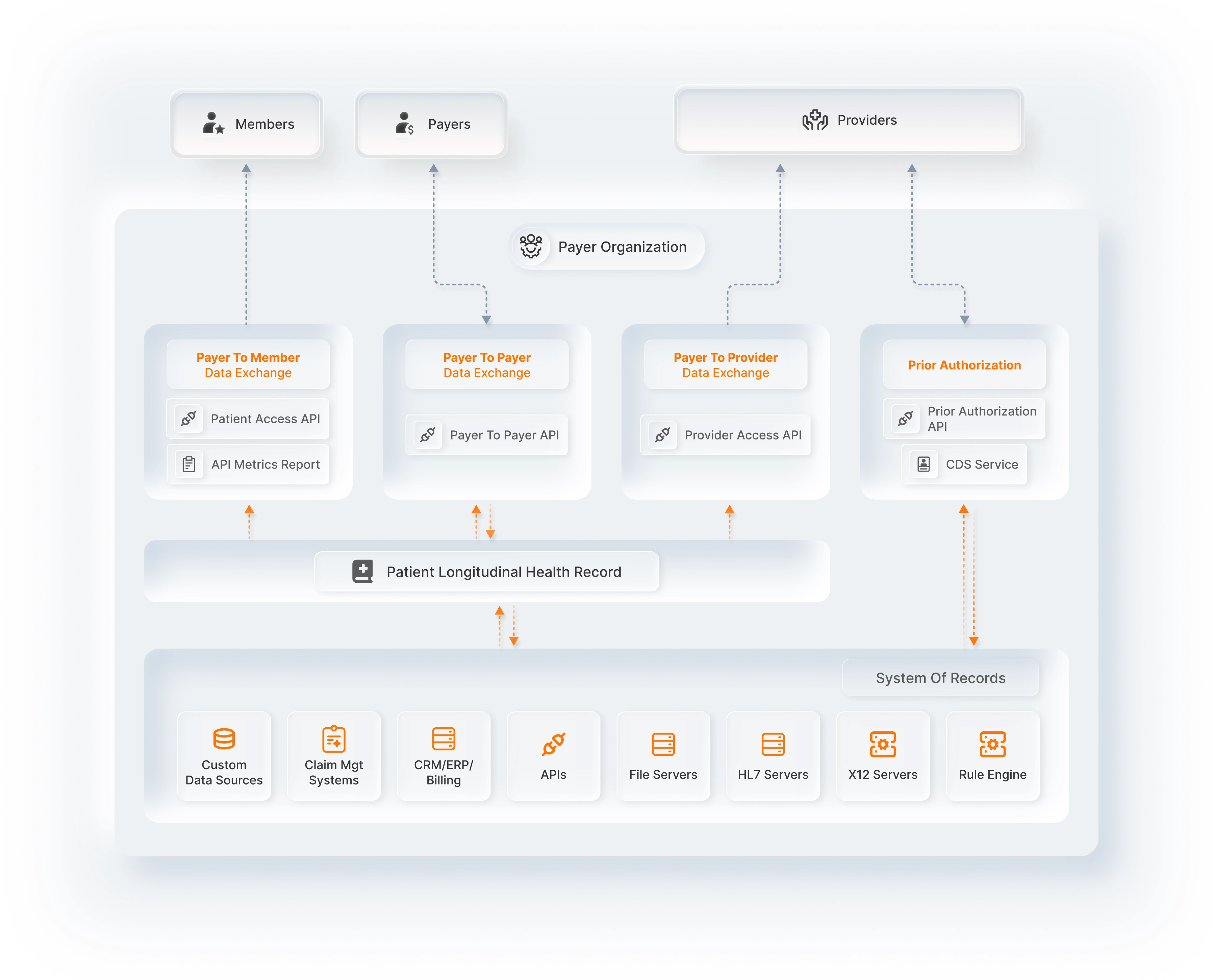
Streamline approvals with the Prior Authorization API and integrated Clinical Decision Support (CDS) services. Payers must provide electronic access to prior authorization details for non-drug items and services, boosting efficiency while reducing administrative burden and delays.
What you need to do |
What we provide |
|---|---|
|
|
Seamlessly exchange member records among payers
When members switch Payers, the Payer-to-Payer Data Exchange API ensures secure, efficient exchange of patient health records, including claims, encounters, and prior authorization data, using the HL7 Da Vinci PDex Implementation Guide as mandated by the CMS 0057-F.
What you need to do |
What we provide |
|---|---|
|
|
Empower patients with
real-time health data access
Enable patients to retrieve claims, encounter, coverage, and prior authorization data directly from their payers via the Patient Access API, mandated under CMS 0057-F and compliant with USCDI v3 and HL7 FHIR® R4.0.1. Prior authorization details (non-drug) must also be included and API usage metrics must be reported to CMS.
What you need to do |
What we provide |
|---|---|
|
|
Deliver up-to-date patient data directly to providers
Securely expose claims, encounter, and prior authorization data to providers via the Provider Access API. Built on FHIR® R4 and USCDI v3, it reduces administrative burden and supports informed, coordinated care under CMS 0057-F.
What you need to do |
What we provide |
|---|---|
|
|
WSO2 Accelerator for Healthcare
The WSO2 Accelerator for Healthcare delivers a robust foundation for CMS-0057-F compliance by supporting all major data exchange workflows, including Patient Access, Provider Access, Payer-to-Payer, and Prior Authorization APIs. With a powerful reference implementation built on HL7® FHIR® standards, the accelerator simplifies deployment and minimizes compliance risk.
Pre-built FHIR® APIs
Ready-to-use reference implementation with FHIR® R4 APIs for Patient Access, Prior Authorization, and more, aligned with CMS-mandated implementation guides.
Seamless system integration
Pre-built connectors for EHRs, claims systems, and rule engines, supporting FHIR®, HL7® v2, CDA, and X12.
End-to-end compliance
Aligned with CMS-0057-F, HL7® FHIR®, US Core, and PDex, ensuring secure, standards-based data exchange from day one.
Rapid implementation
Accelerates development with reference implementations, allowing focus on vendor-specific customization.
Powerful data transformation
Pre-built mappers for converting FHIR®-based prior authorization into X12 278/275 formats, bridging modern APIs with legacy systems.
Flexible deployment
Lets you choose the deployment model that fits your current and future needs, whether on VMs, Docker, or Kubernetes.
Beyond the mandate: Build your interoperability future
True interoperability goes far beyond the CMS-0057-F mandate. The WSO2 Accelerator for Healthcare helps you seamlessly meet payer requirements while upgrading your infrastructure for the future. Bridge legacy systems with modern FHIR APIs, leverage AI-driven integration, and deploy anywhere with a platform built for long-term healthcare innovation. Explore how we help you drive third-party innovation, secure autonomous agents, and streamline operations.
Secure Identity Management
Manages user identities (CIAM) and Consent Management beyond CMS/ONC compliance.
API Management
Securely exposes APIs for third-party apps and Regulatory compliance.
Al Trust & Governance
Features an Al Gateway for traffic guardrails and Agent Identity for securing autonomous agents.
Third-Party Innovation
Pre-built connectors and connector generation features enable developers to build system integrations with ease.
Al-Driven Integration
Uses Al-assisted coding (Al for Code") to rapidly connect EMRs and streamline operations.
Powerful Data Transformation
Pre-built mappers convert well known formats to FHIR format, bridging modern APls with legacy systems.
Flexible Deployment
Deploy anywhere-VMs, Docker, Kubernetes, or WSO2 Devant (Al-native iPaaS).