

How a Global Entertainment Giant Built a Multi-Agent AI Assistant for Employee Support

- Sasindu Alahakoon
- Associate Technical Lead, WSO2
Every day, employees across large organizations need answers to routine questions. The answers exist, but they are usually buried across disconnected systems.
For a global leader in entertainment, gaming, and hospitality managing thousands of employees across international operations, this was a daily productivity drain. Teams were overwhelmed with the same routine questions, new hires struggled to get up to speed, and no two employees were guaranteed to get the same answer to the same question.
It was a problem they were determined to solve. Having already partnered with WSO2 to build an AI-powered virtual support engineer that transformed how their customer care teams operated, tackling employee support with the same partner was the natural next move.
With the help of WSO2, they built an AI-powered virtual team member, a multi-agent assistant giving employees a single conversational interface to instantly access HR policies, IT support, project management guidance, and live ServiceNow ticket data.
The key challenges faced by the organization
Across the organization, employees regularly needed answers to questions spanning human resources, IT support, and project management. The information they needed existed, but finding it was not easy. The key challenges they faced included:
Information scattered across multiple systems: HR policies lived in document repositories, IT procedures were buried in SharePoint sites, Project Management Office (PMO) templates and governance processes were spread across dedicated portals, and company property information sat in separate internal databases. Employees had no single place to go for answers.
Repetitive burden on support teams: HR and IT support teams fielded the same types of questions repeatedly, from benefits enrollment details and Paid Time Off (PTO) policies to password resets and VPN connectivity issues. Each inquiry, no matter how routine, required a team member's time to research and respond.
Complex ServiceNow navigation: Employees needed to interact with ServiceNow for IT incidents, service requests, and change requests. Navigating the ServiceNow portal, however, to check ticket statuses, submit new requests, or understand the right issue category was cumbersome, leading to delays and incorrectly filed tickets.
No institutional knowledge retention: When experienced team members left, or rotated roles, their accumulated knowledge of internal processes (where to find specific policy documents, which PMO templates to use, or how to handle edge-case IT issues) left with them. New team members faced a steep learning curve with no easy way to get up to speed.
PMO process complexity: The project management office maintained detailed governance frameworks, enterprise priority reviews, and portfolio compliance requirements. Teams frequently needed guidance on which template to use, what the approval workflow looked like, or where to find the latest version of a governance document, and the answers were rarely easy to find.
With thousands of employees across global operations, the cumulative impact was significant: lost productivity from searching for information, delayed support resolutions, inconsistent answers depending on who you asked, and support teams stretched thin by routine inquiries that could be automated.
The solution they built: An AI-powered virtual team member
Building on the success of their first AI agent implementation, the organization continued their partnership with WSO2 to develop a multi-agent virtual team member. Unlike traditional chatbots that follow rigid, pre-scripted conversation flows, this virtual team member functions as a knowledgeable colleague, capable of reasoning across context, retrieving relevant information dynamically, and instantly answering employee questions across four key domains: HR, IT, project management, and organizational property information.
How the virtual team member works
Imagine a new team member who needs to understand their benefits package, has a VPN issue, and wants to know the right process for submitting a new project proposal, all in the same afternoon.
Previously, this would mean navigating three different systems, possibly waiting on hold with HR, and sending emails to the PMO team. Now, they simply open the virtual team member and start a conversation.
A natural, conversational experience: Conversing with the virtual team member feels like chatting with a knowledgeable colleague who happens to have expertise across every department. Employees describe what they need in plain English, and the AI understands not just the words but the intent behind them. Here are a few examples:
"What dental insurance options do I have, and when is the next enrollment period?"
"My VPN keeps disconnecting when I work from home. What is the reason?"
"I need to submit a new project proposal. What's the PDO process and where do I find the template?"
Intelligent routing to the right expertise: Behind the scenes, the virtual team member uses an orchestrator that analyzes each query and routes it to the most appropriate specialized agent: one for HR and company policies, one for IT support and ServiceNow operations, one for PMO processes and governance, and one for property and location information. This happens transparently and the employee simply gets the right answer, regardless of which domain their question falls under.
Answers grounded in organizational knowledge: Unlike a general-purpose chatbot, every response is grounded in the organization's actual documentation. The system is backed by an automated knowledge ingestion pipeline that continuously pulls the latest HR policy documents, IT procedures from SharePoint, PMO governance templates, and property data from internal systems. When the virtual team member answers a question, it cites its sources, so employees can verify the information and dig deeper if needed.
ServiceNow integration that just works: For IT-related issues, the virtual team member goes beyond answering questions. Employees can check the status of existing ServiceNow tickets simply by asking:
"What's the status of my incident 0012345?"
The virtual team member queries ServiceNow in real time and returns a clear, formatted summary including the ticket's current status, priority, assignment, and latest updates. It also provides direct links to the ServiceNow portal to help employees track their requests further. All ServiceNow data is presented directly from the source, unmodified, ensuring complete accuracy.
Governed and secure AI interactions: Since the virtual team member handles sensitive employee data, all interactions between the users and the LLM are governed through the WSO2 AI Gateway. It automatically masks personally identifiable information (PII) before it reaches the LLM.
Contextual, multi-turn conversations: The virtual team member remembers context within a conversation. An employee can ask a follow-up question like "What about vision coverage?" after asking about dental benefits, and the assistant understands the context without requiring the employee to re-explain. This persistent conversation memory makes interactions feel natural and efficient, just like talking to a real person.
High-level architecture of the AI assistant
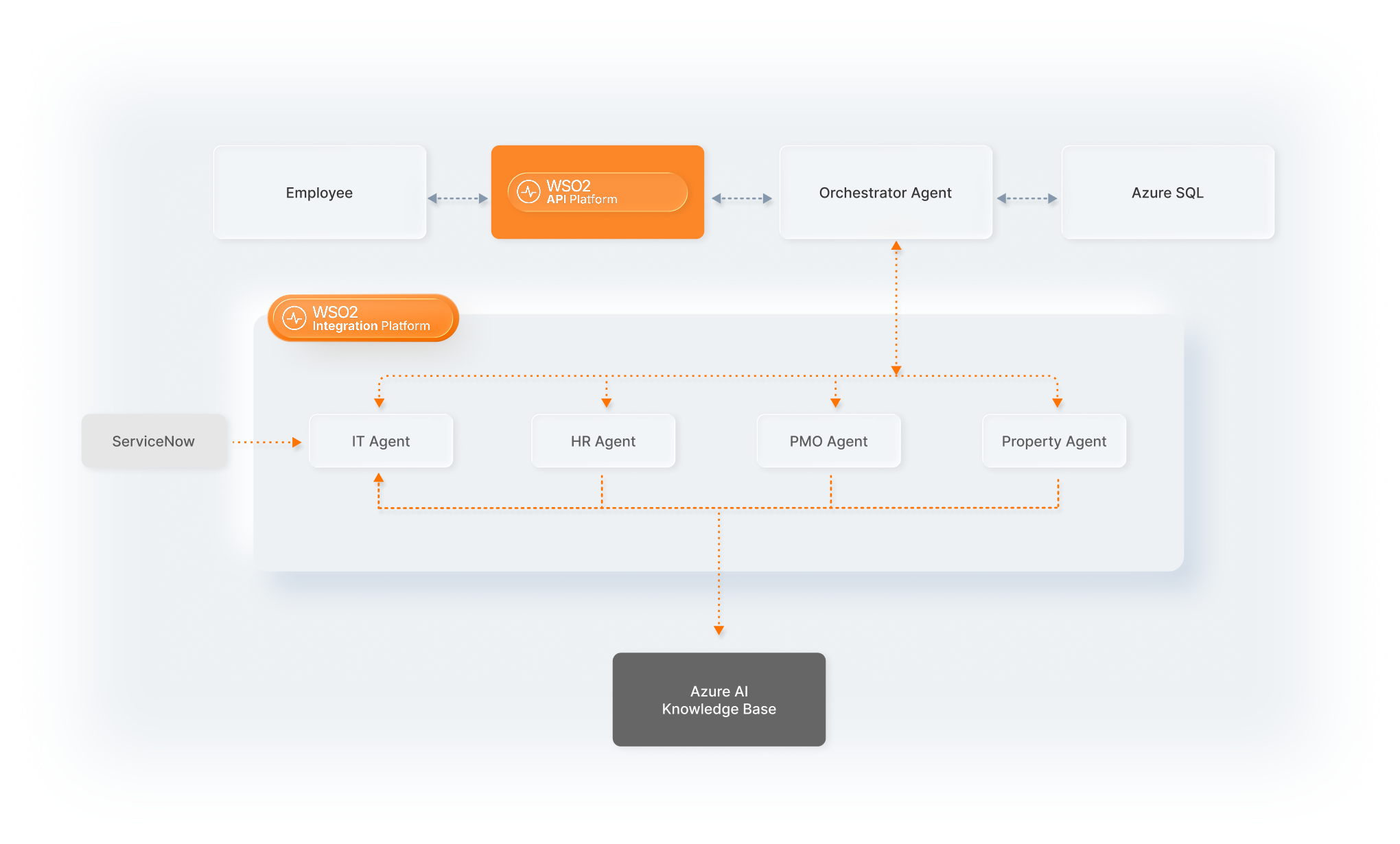
The solution architecture builds on the organization's existing WSO2 foundation and leverages several key components:
The multi-agent AI service built with WSO2 Integrator employs an orchestrator pattern. An orchestrator agent receives each user query, analyzes its intent, and delegates to the appropriate specialized agent: HR, IT, PMO, or Property. Each specialized agent connects to its domain-specific knowledge base and, in the case of the IT agent, to ServiceNow for real-time ticket operations.
WSO2 API Gateway serves as the secure entry point for all interactions with the virtual team member, managing authentication, rate limiting, and routing requests to the backend agent service.
WSO2 AI Gateway sits between the multi-agent orchestration layer and the LLM, enforcing enterprise-grade controls including PII masking, semantic prompt guarding, and response validation.
The knowledge store, powered by Azure AI Search, provides semantic and vector search across four separate indexes: HR documents, IT procedures, PMO governance materials, and property information. This enables the AI agents to retrieve the most relevant information for each query with high accuracy.
The persistent memory layer, powered by Azure SQL, maintains conversation history and session context, enabling the virtual team member to handle natural, multi-turn conversations where follow-up questions build on previous context.
ServiceNow integration provides real-time access to the organization's IT service management platform, enabling the IT agent to query ticket statuses, surface ticket details, and guide employees through the process of submitting new requests.
Why did this organization choose WSO2 to build this AI solution?
1. Proven success with the first AI agent: The organization had already seen tangible results from the AI-powered troubleshooting agent built with WSO2, validating WSO2's ability to deliver production-grade AI solutions in the organization's environment. Expanding to a new use case with the same platform was a natural next step.
2. Existing technology investment: The organization's existing WSO2 infrastructure, including integration services, API management, and identity and access management, provided a ready-made foundation. The new AI agent plugged directly into this ecosystem, significantly reducing implementation time and operational complexity.
3. Integration-first architecture for AI: Building a multi-agent system that pulls knowledge from SharePoint, Azure Blob Storage, internal APIs, and ServiceNow is fundamentally an integration challenge. WSO2 Integrator's native connectivity to enterprise systems, HTTP services, and databases made it the ideal platform for building both the AI agent orchestration layer and the knowledge ingestion pipeline.
4. Comprehensive platform capabilities: WSO2 provided everything needed in a single platform: an API gateway for secure access control, an AI gateway for governing and securing all LLM interactions with built-in guardrails and observability, robust integration capabilities for multi-system orchestration, and the flexibility to build sophisticated AI agent workflows. This eliminated the need to stitch together multiple vendors or frameworks for both the integration and AI governance layers.
5. Security and governance at enterprise scale: For an organization handling sensitive employee data, including HR records, IT credentials, and internal project information, WSO2's built-in security features for controlling LLM interactions in the AI Gateway, including PII masking capabilities and role-based access control, aligned with the organization’s data privacy requirements.
The WSO2 products used in the solution
| Products | Role in the solution |
| The WSO2 Integration Platform | Multi-agent AI system development, knowledge ingestion pipeline, ServiceNow integration, and backend system orchestration with WSO2 Integrator. |
| The WSO2 API Platform | API-level security and traffic monitoring with the WSO2 API Gateway, and controlling LLM interactions with the WSO2 AI Gateway. |
The results after implementing the solution
The implementation of the AI-powered virtual team member delivered significant measurable outcomes:
Instant access to organizational knowledge: Employees who previously spent considerable time searching across multiple systems for policy documents, process guides, or property information can now get accurate, sourced answers in seconds through a simple conversational interface, reducing average information retrieval time by an estimated 60–75%.
Reduced volume of routine support inquiries: HR and IT support teams saw an estimated 70–80% reduction in repetitive questions, from benefits and PTO policies to common IT troubleshooting steps, as employees could now self-serve through the virtual team member. This freed up support staff to focus on complex, high-value issues that genuinely require human expertise.
Streamlined ServiceNow interactions: Employees no longer need to navigate the ServiceNow portal to check ticket statuses. A simple question to the virtual team member returns real-time ticket details, reducing friction and improving the employee experience with IT service management, with an estimated 70–80% decrease in portal-based status check lookups.
Consistent, accurate answers across the organization: By grounding every response in the organization's actual documentation and citing sources, the virtual team member eliminated inconsistencies that came from different support team members giving different answers, reducing answer variability by an estimated 90-95%. Every employee gets the same accurate information, regardless of when or how they ask.
Accelerated employee onboarding: New team members now have an always-available resource that can answer questions about company policies, benefits, IT setup procedures, PMO processes, and more, without needing to identify who to ask or where to look. This contributed to an estimated 65–75% reduction in time-to-productivity for new hires.
Self-maintaining knowledge base: The automated ingestion pipeline ensures the virtual team member's knowledge stays current without manual intervention. As HR policies are updated in SharePoint, new PMO templates are published, or IT procedures are revised, the pipeline automatically processes and indexes the changes, eliminating an estimated 10–15 hours per week of manual knowledge base maintenance.
Foundation for expanded AI adoption: Building on the success of both AI agent implementations, the organization now has a proven pattern and platform for deploying intelligent automations across additional departments and use cases, accelerating their broader digital transformation.
What's next for the virtual team member?
The multi-agent framework is being extended to cover additional departments including facilities management, legal, and finance. On the ServiceNow side, the roadmap goes beyond ticket status queries to enable full ticket creation, updates, and automated routing directly through the virtual team member.
The most significant shift on the horizon is proactive employee support. Rather than waiting for employees to ask, the virtual team member will notify employees about upcoming deadlines, policy changes, and relevant announcements based on their role and department.
Conclusion
This case study demonstrates how enterprises can systematically transform employee support through intelligent automation. By building on an established foundation of WSO2 integration and API management capabilities, the organization created a multi-domain AI-powered virtual team member that unifies fragmented knowledge, streamlines support operations, and empowers employees to find answers instantly.
The virtual team member exemplifies how the combination of enterprise integration expertise with modern AI capabilities, including multi-agent orchestration, retrieval-augmented generation, real-time system integration, and AI governance, can deliver tangible business value while building towards a fully agentic enterprise.
Contact us to discuss how WSO2 can help your organization build your own AI-powered solutions, and enable your agentic enterprise.