

Vertical AI: Why Industry-Specific AI Matters

- Amjadh Ifthikar
- Technical Lead, WSO2
This blog expands on insights Amjadh Ifthikar shared during his WSO2Con Asia 2025 presentation. Watch the full session here.
General-purpose AI vs. vertical AI
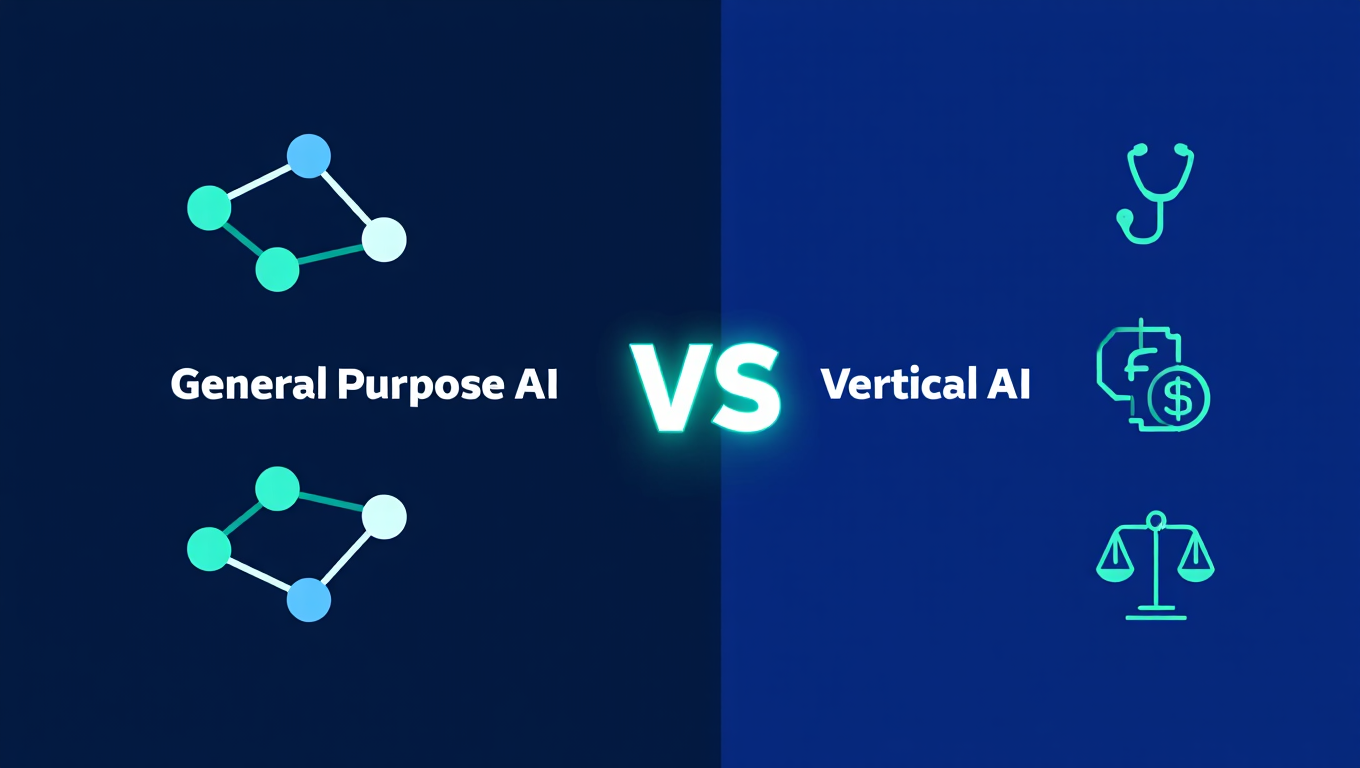
General-purpose AI offers comprehensive language and reasoning capabilities, making it widely used for both personal and business tasks. Vertical AI, by contrast, narrows the AI’s focus to industry-specific knowledge, terminology, and workflows. This narrowing delivers higher precision, relevance and compliance for regulated domains where mistakes or misinterpretation carry significant consequences.
Why vertical AI is becoming essential
- Domain expertise: Vertical models understand specialised jargon, clinical or financial contexts, and task-specific subtleties that horizontal models miss.
- Regulatory alignment: Healthcare, finance, and legal industries are highly regulated; solutions must meet strict data, access and audit requirements.
- Automation and efficiency: Industry-specific automation of repetitive, rules-driven processes boosts productivity and frees experts for higher-value work.
- Competitive differentiation: Verticalised offerings become harder to replace with general tools because they solve exact business problems.
Where vertical AI creates immediate value
Prime candidates for early vertical AI adoption include repetitive, compliance-heavy, or administrative tasks like claim processing, medical billing, clinical documentation, and customer support, especially in regulated industries. These are routine processes that benefit from automation without sacrificing regulatory safeguards.
How vertical AI is built: The layered model
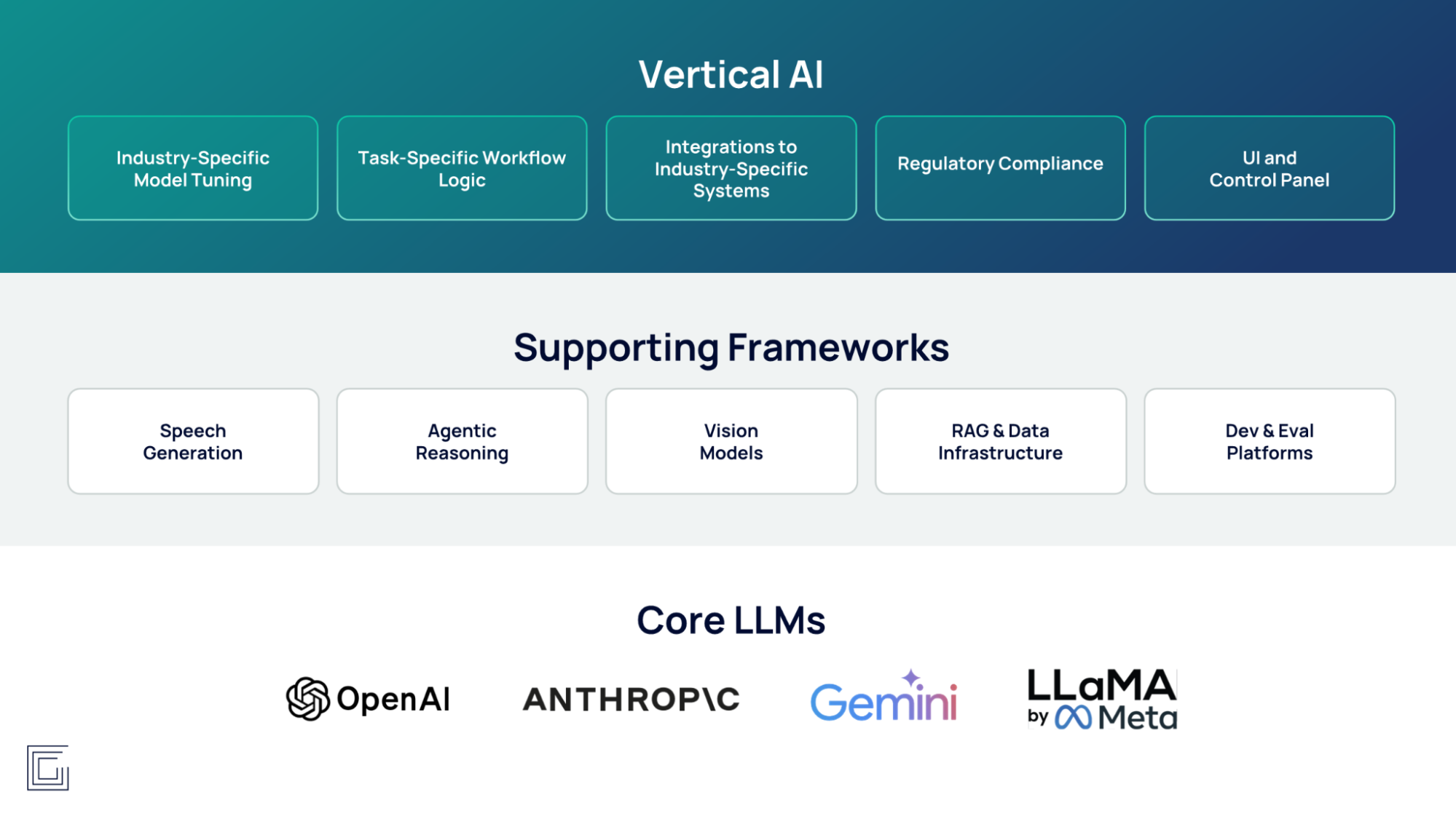
Vertical AI is best understood as a layer built on top of horizontal AI and its supporting frameworks. The typical architecture includes:
- Foundational LLMs: Horizontal models from OpenAI, Anthropic, Google, Meta, etc.
- Supporting frameworks: Retrieval-augmented generation (RAG), data infrastructure, speech and guardrails for safety and observability.
- Vertical AI layer: Industry-specific model tuning, specialised knowledge bases, workflow and decision logic, regulatory validations, and native integrations to domain systems (EHRs, open banking APIs, payment gateways, etc.).
This vertical layer enables the AI to perform role-specific tasks, speak the customer’s language, and integrate securely with existing enterprise backends.
Example: Healthcare customer support with EHR integration
Consider a customer support assistant agent deployed at a hospital. At the base layer, foundational language models (LLMs) provide the general-purpose language capabilities needed to understand and generate human-like responses.
Built on top of these foundational models, horizontal supporting frameworks specialized for customer-support and conversation management adds value, creating adaptable tools that can handle customer interactions across multiple industries.
To make AI truly effective in customer support for healthcare, a final vertical-specific layer is essential. This layer can:
- Understand clinical terminology and care pathways.
- Comply with patient privacy and data-handling regulations.
- Integrate with electronic health record (EHR) systems and clinical messaging standards.
Without this tailored vertical layer, the AI solution would lack the necessary understanding of healthcare nuances and regulatory constraints, making it impractical to deploy in real-world healthcare settings.
WSO2’s role: Building blocks and developer tooling
WSO2 contributes to vertical AI adoption by offering integration, identity and access management, and API management building blocks that accelerate domain-specific solutions.
- AI for code: Developer-focused capabilities that supercharge productivity across the software development lifecycle. For example, WSO2 Integrator Co-pilot is made vertical aware so that it will know about the vertical-specific use-cases of developers and how our industry-specific libraries fit into those implementations.
- Code for AI: Reusable programming abstractions and components used to build AI-enabled products—for example, exposing domain servers as tools that AI agents can call. For example, WSO2 AI Gateway has the capability to automatically expose Healthcare FHIR servers as MCP servers.

WSO2 integration capabilities already include support for healthcare standards (FHIR, HL7, X12, CDA) and banking message formats (ISO 20022/MX, SWIFT MT, ISO 8583, BIAN), plus pre-built translations (e.g., SWIFT MT to MX, HL7 to FHIR). These make it possible to create vertical co-pilots tailored to healthcare or banking developers.
Vertical AI agents: Two illustrative use cases
User-present agents (chat agents): Rescheduling a cardiology appointment
Traditional manual flow: The patient calls, waits to be transferred, is repeatedly verified, staff searches schedules manually, updates the booking and sends confirmation—a slow and error-prone process.
Vertical AI flow: A chat agent with EHR integration and authentication can list upcoming appointments, offer rescheduling options, verify identity via the integrated auth flow, update appointments and send confirmations instantly. The result is faster resolution, reduced staff burden and a better patient experience.
User-absent agents (ambient/automated agents): Conditional bill payment
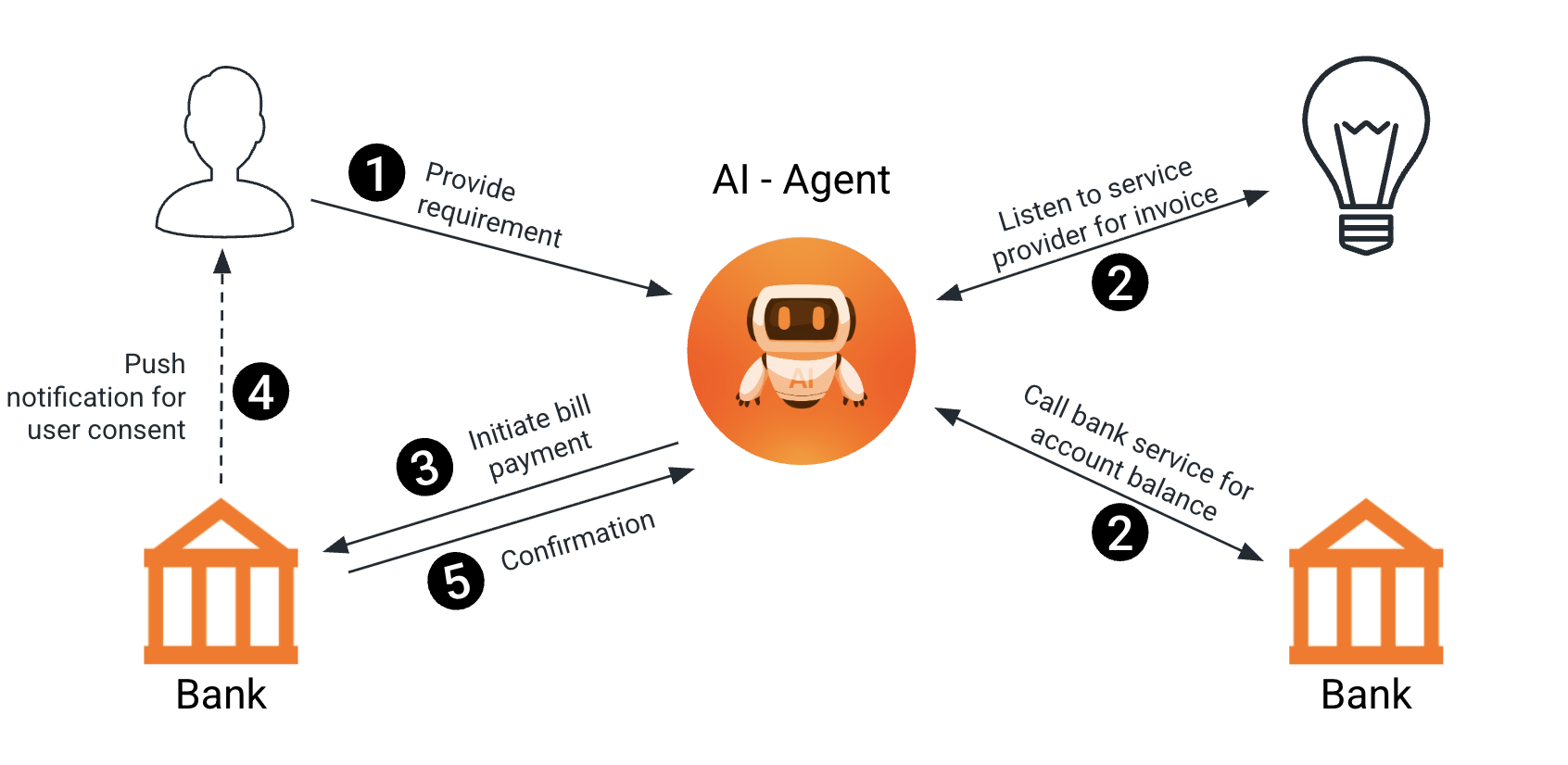
Ambient agents operate in the background based on triggers or conditions. Example: an agent pays an electricity bill only when two conditions are met—the bill is posted and the salary has been credited.
With open banking and service provider APIs the agent can monitor bill status and account transactions. To perform a payment, the agent can initiate a bank-backed authentication flow with decoupled (Async) authentication (e.g., CIBA (Client Initiated Back-Channel Authentication) to request user approval and obtain a token to initiate the payment. This enables reliable, auditable automation while keeping the user in the loop for authorization.
Key components that enable safe, compliant vertical AI
- Industry-specific model adaptation: Training/tuning on proprietary vertical data and task-specific logic.
- Workflow and decision logic: Embedding established processes so AI outputs align with existing operations.
- Native integrations: Pre-built connectors to EHRs, banking APIs, messaging systems and other domain systems.
- Regulatory guardrails: Consent flows, audit logs, data minimisation and validation layers to meet compliance needs.
Where is this heading?
The industry is at the beginning of a vertical AI wave. Horizontal LLMs will continue to provide foundational capabilities, while specialised vertical stacks will be built on top to meet strict domain requirements and unlock automation across regulated processes. Companies that embed vertical AI into their products and services will gain a significant advantage by delivering faster, more accurate and compliant outcomes.
Final thoughts
Vertical AI complements horizontal models by incorporating domain expertise, necessary integrations, and adherence to regulatory compliance. This layering is crucial for deploying AI effectively in production, particularly within regulated industries. WSO2 offers the foundational components to accelerate your development of relevant, production-ready AI experiences tailored to the specific needs of vertical industries.
"Innovation is the ability to see change as an opportunity, not a threat." — Steve Jobs
Embracing vertical AI offers organizations a strategic advantage to achieve tangible efficiencies, elevate customer experiences, and pioneer new service models, all while adhering to regulatory requirements. The transformative potential is limitless and is set to define the trajectory of every industry.