

WSO2 Identity Server 7.2: Open-Source IAM to Secure AI Agents and MCP servers

- Sagara Gunathunga
- Head of IAM DevRel, WSO2

AI adoption is accelerating across every industry, from customer service and marketing to finance and retail, and we’re still far from its peak. Many organizations have already begun integrating AI agents into their business operations. A key aspect of this transformation is the use of AI agents, whether purpose-built or off-the-shelf, to assist with or even replace tasks traditionally handled by humans. While this shift improves scalability and efficiency, it also introduces new challenges in security, compliance, and access management, raising important questions such as: How do you define the identity of an AI agent? How do you control and audit its access to systems and data?
At WSO2, we’ve been exploring how open source identity can evolve to meet this new frontier. Building on the AI-powered developer features we introduced earlier, such as Login Flow AI, Registration Flow AI, and Branding AI, our latest WSO2 Identity Server 7.2 release introduces Identity for AI Agents. This addition makes it one of the most comprehensive IAM platforms for securing AI agents and their interactions. In this post, we’ll explore what Identity for AI Agents means for developers and highlight other key updates in the 7.2 release.
Identity for AI Agents
AI agents differ fundamentally from traditional applications in their adaptability and autonomy. The traditional applications follow static, predefined instructions and must be explicitly programmed for every possible scenario or logic branch, making it reliable but inherently rigid. In contrast, AI agents learn from data, interact with their environment, and make decisions independently in real time. They continuously optimize performance, adapt to new information, and operate with minimal human intervention.
This adaptive behavior changes how access and identity must be managed. Unlike traditional applications that rely on static, pre-assigned permissions, AI agents often need to request or adjust access dynamically at runtime to achieve their current goals. In other words, the consent and identity models used for conventional applications are no longer sufficient for AI agents to function as intended.
At the same time, AI agents can’t simply be treated like human users. They lack empathy, emotional intelligence, and nuanced judgment of humans. This gap creates a unique challenge in defining “who” an AI agent is and how it should securely interact with systems and data. To address this, we introduced a distinct notion of identity for AI agents, one that goes beyond static application identities yet remains clearly separate from human identities, following the industry best practices like Just-in-Time (JIT) access and Just-Enough Privilege (JEP).
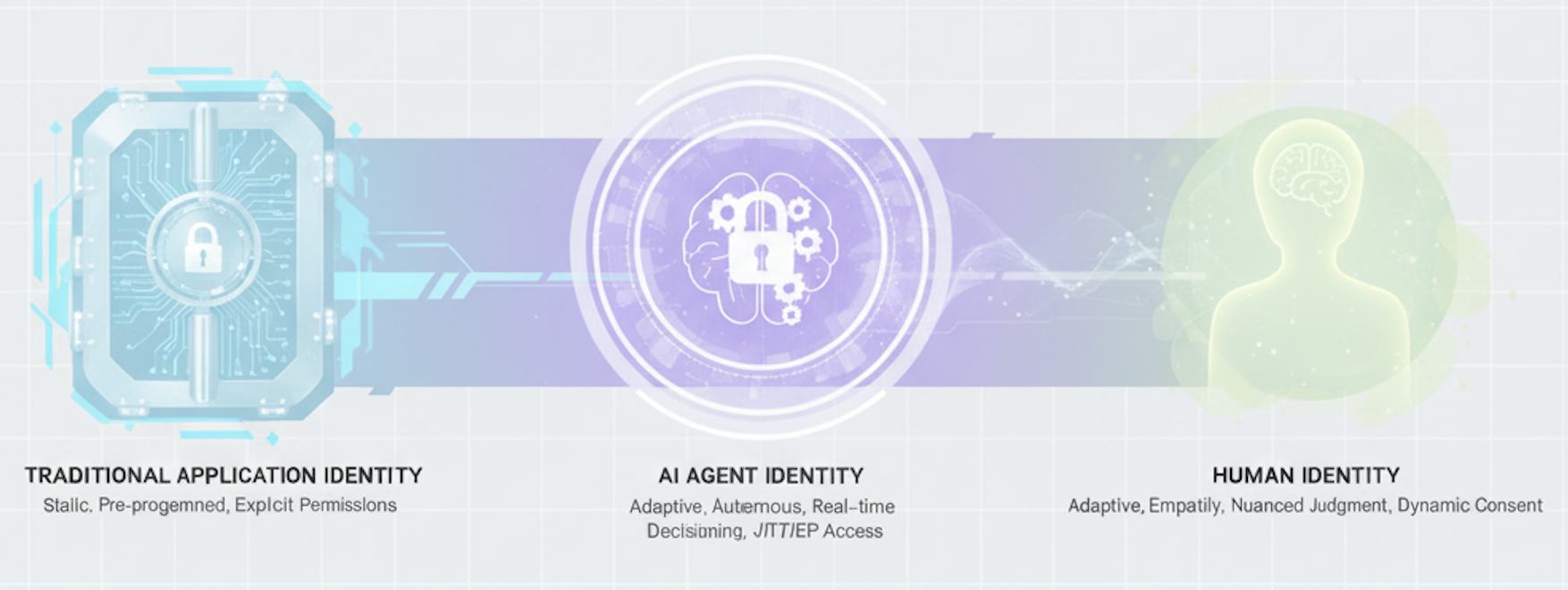
The Identity for AI Agents capability introduces a structured way to define and manage how AI agents are identified and governed within an organization. Each agent is assigned a unique and immutable identifier, independent of the underlying software or hardware it runs on. The system also supports agent lifecycle management, enabling automated provisioning and de-provisioning of agent identities as they are created or retired. A secure registry of all active AI agents including their properties, capabilities, and intended purposes serves as the foundation for effective governance and auditing.
Equally important is the ability to log and audit every action performed by an AI agent. This includes access attempts, data modifications, and autonomous decisions. Each recorded event should be traceable to the specific AI agent involved, the human or system that initiated the request, and the policies that granted authorization. Such traceability is essential for compliance, debugging, and accountability, ensuring organizations maintain full visibility into how AI agents operate within their identity and access management ecosystem.
Security for MCP servers and clients
The Model Context Protocol (MCP) has been gaining traction among developers for its ability to provide universal adaptability when connecting LLM-based applications, including AI agents and Gen AI tools, with real-world data sources and services. After several iterations, MCP has fully adopted OAuth 2.1 as its security specification, enabling secure communication between MCP clients, typically LLM-based applications, and MCP servers, which represent real world data sources and tools. This approach also allows developers to leverage existing OAuth 2.1–compatible IAM solutions to secure MCP instructions without building security capabilities from scratch.
With WSO2 Identity Server, MCP authorization requirements are supported out of the box. The latest 7.2 release introduces purpose-built templates for registering MCP servers as resources and MCP clients within the Identity Server. These templates abstract away unnecessary OAuth 2.1 complexities for MCP developers, while enforcing security best practices by design and by default, simplifying integration and reducing the risk of misconfiguration.
Flows for intuitive user journeys
The era of onboarding users through simple web forms is becoming a thing of the past. Modern user experiences and security requirements demand more dynamic and intuitive user journeys, both for onboarding and account recovery. For example, organizations are expected to onboard users via enterprise and social identity providers without asking the users to fill lengthy forms, while also verifying users through SMS, email, or push notifications. In sensitive applications such as banking, users may need to be onboarded using government-issued digital identities or undergo additional identity verification (IDV) during the onboarding process. As the number of onboarding and verification options grows, managing these flows manually becomes increasingly complex.
WSO2 Identity Server 7.2 addresses this challenge by introducing visual and AI-powered journey design capability called Flows. Developers can use a drag-and-drop designer to create complex user journeys or describe the desired flow in plain text, allowing the generative AI capabilities in WSO2 Identity Server 7.2 to generate the flow automatically. This release supports both self-onboarding flows and invited-user onboarding flows, as well as designing password recovery flows, making it easier to deliver secure, flexible, and modern user experiences.
Flexibility to build multi-tenant SaaS and partner apps
Many developers, both our subscription customers and open-source users have been using WSO2 Identity Server as a solid foundation for building multi-tenant SaaS and partner applications. Their feedback has helped shape how we evolve our B2B identity capabilities.
The latest WSO2 Identity Server 7.2 release enables developers to easily share root-level resources with sub-organizations while maintaining proper governance and access boundaries.
Some of the key capabilities introduced include:
- Sharing login and registration flows across sub-organizations
- Sharing user attributes while enforcing access control
- Sharing scopes between parent and sub-organizations
- Sharing branding configurations for a consistent experience
- Sharing email and SMS templates across tenants
Brand new React and Next.js SDKs
The application development landscape is evolving rapidly, with diverse architectural patterns ranging from single-page applications (SPAs) running in browsers to server-side rendering (SSR), hybrid, cross-platform, and native mobile architectures. To align with modern developer expectations and the evolution of these frameworks, we’ve been revamping our SDKs to deliver a more consistent and intuitive developer experience.
With the WSO2 Identity Server 7.2 release, developers can now use our brand-new React and Next.js SDKs, which have been completely redesigned to offer a component-driven developer experience. As a React or Next.js developer, you can use prebuilt UI components such as <SignIn />, <SignUp />, <UserProfile />, and <UserDropdown /> to quickly build and style user authentication experiences that fit your application’s branding. The new SDKs support both hosted UI and app-native API architectures, allowing you to render authentication interfaces either through hosted pages or natively within your app using the same intuitive set of UI components in both approaches. These SDKs are released under the unified Asgardeo brand name which can be used with Asgardeo cloud identity as well as WSO2 Identity Server.
To make integration even easier, Identity Server 7.2 introduces two purpose-built application templates for React and Next.js. These templates simplify app registration with WSO2 Identity Server, removing the need to understand every detail of OpenID Connect configuration. Each template prompts for only the essential parameters and automatically fills in the rest based on the framework. You can try these out by following the updated React Quickstart Guide and Next.js Quickstart Guide.
Post-quantum IAM capabilities
The WSO2 Identity Server 7.x series pioneered to provide a quantum-safe IAM for the open-source community. This is very important in addressing the growing “harvest-now, decrypt-later” threat that many enterprises face today. Earlier versions introduced quantum-safe TLS for inbound connections and quantum-safe symmetric encryption for securing sensitive data such as passwords for secondary user stores, credentials for event publishers, and client secrets for federated authenticators.
With the WSO2 Identity Server 7.2 release, this capability has been extended to include TLS support for outbound communications as well. This means you can now enable quantum-safe encryption for both inbound and outbound connections, providing end-to-end protection against future quantum-based attacks.
Flexible product extensions
WSO2 Identity Server is well-known for its highly extensible architecture which allows you to create custom extensions to meet your requirements, and the extensibility continues to be a core focus.The previous 7.1 release introduced a service-based extension model, a major shift that enables developers to build extensions using any preferred technology, host them anywhere, and integrate them via standard HTTP endpoints similar to invoking RESTful APIs.
With 7.2, this model evolves further. You can now configure actions (service extensions) at the sub-organization level, providing better flexibility for multi-tenant and B2B use cases. The update also adds a new Update Profile action, allowing developers to extend and customize profile update flows.
The latest release also brings webhook-based event publishing, allowing applications to respond to events happening inside the Identity Server. You can now listen to user logins, registrations, token events (issuance or revocation), and session activities. Simply register an HTTP endpoint, and WSO2 Identity Server will deliver JSON-formatted event payloads to your service making it easy to trigger workflows, analytics, or notifications in real time.
Summary
AI adoption continues to reshape the technology landscape, introducing new challenges in identity, security, and access management. The WSO2 Identity Server 7.2 release addresses these challenges by extending its open-source IAM capabilities to support AI agents, redefining how digital identities are managed for AI agents. This release introduces Identity for AI Agents to uniquely identify, governing, and auditing AI-driven entities using principles like Just-in-Time access and Just-Enough Privilege.
Beyond AI-focused identity, the release enhances developer productivity and security through several major updates. It includes native support for MCP (Model Context Protocol) authorization, visual and AI-powered flow design for intuitive onboarding journeys, and multi-tenant resource sharing to streamline SaaS and partner application development.
Developers also gain access to redesigned React and Next.js SDKs with component-driven UIs and simplified app registration templates, improving integration with modern web frameworks. On the security front, post-quantum TLS support now extends to both inbound and outbound communication, ensuring future-proof encryption.
Finally, flexible extension and eventing capabilities allow developers to integrate custom logic through HTTP-based service extensions and real-time webhook event publishing—making WSO2 Identity Server 7.2 one of the most adaptable and forward-looking open-source IAM platforms for securing humans, applications, and now AI agents.