

The Answer to Enterprise Complexity: A Scalable and Flexible Integration Strategy

- Shazni Nazeer
- Director - Solutions Architecture, WSO2
The Importance of a Comprehensive Integration Strategy
The modern enterprise is highly distributed with systems, applications, and data spread out across multiple cloud and/or on-premises environments. Enterprises operating in today’s dynamic and rapidly evolving digital landscape must be able to seamlessly connect these disparate systems, applications, and data sources to truly unlock their full potential and remain competitive. Integration, therefore, becomes a foundational aspect of driving the modern enterprise forward. Consequently, the success of the enterprise is dependent on defining the correct integration strategy—one that is scalable and flexible to meet current and future business needs, able to support the complexities of modern IT environments, and centered on selecting an integration technology that can support diverse integration scenarios, architectural styles, and deployment requirements.
A comprehensive integration strategy, combined with the right technology, empowers enterprises to seamlessly break data silos, automate business processes, and consistently deliver exceptional digital experiences to their customers. Without this foundation, enterprises risk IT fragmentation, inefficiency, a critical inability to adapt to market demands, leading to missed opportunities, decreased customer satisfaction, and loss of competitive advantage in an increasingly competitive landscape.
The Three Stages of a Successful Integration Strategy
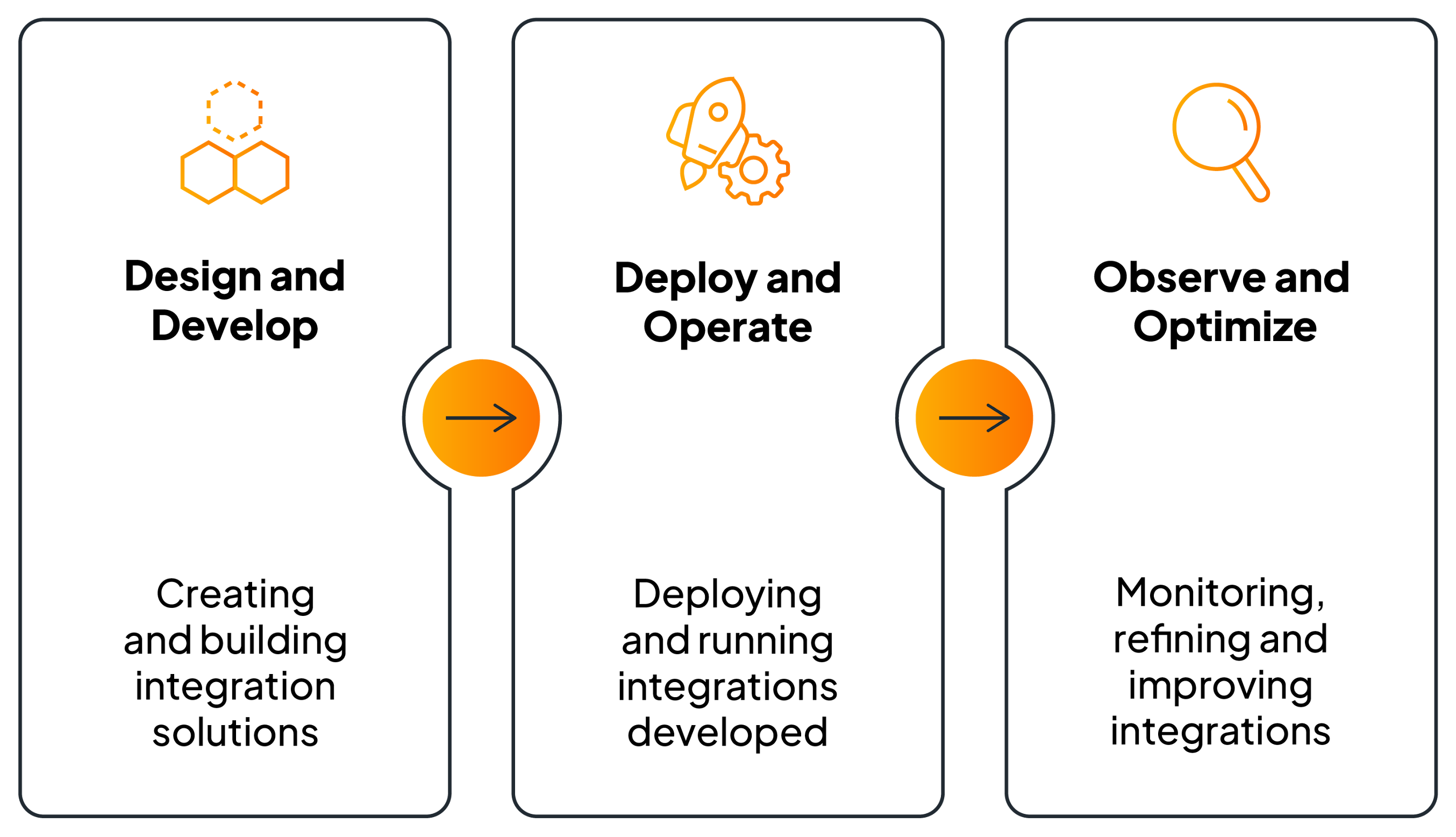
Figure 1: The three stages of a successful integration strategy
A successful integration strategy within an enterprise is not a one-time project but rather a continuous, evolving lifecycle that is divided into three stages—design and develop, deploy and operate, and observe and optimize. Each stage plays a vital role in ensuring that the integration strategy and technology is not only initially successful, but also retains the flexibility to address continuously evolving business needs over time.
1. Design and Develop
The Design and development stage is the foundational stage where the goal is to build integrations that are not only functional, but also flexible enough to accommodate future changes and growth. The key focus during this stage is to translate the conceptual design into a tangible, working solution through two primary activities—designing the architecture and building the integrations.
Designing the architecture involves creating a detailed blueprint for how different systems, applications, and data sources will connect and interact. This includes identifying the relevant integration scenarios, defining the appropriate integration patterns, and establishing communication protocols.
The following table highlights common integration scenarios that enterprises frequently tackle.
| Integration Scenario | Description | Examples |
| Task automations | Automatically trigger tasks based on a pre-defined schedule. | Extracting and consolidating text reports in a file location every day at a given time . |
| AI agents | Trigger agents through APIs, events, or timers. These agents can reason and plan with GenAI models and available knowledge bases, make autonomous decisions, and execute the next step of the flow. | Automatically scheduling and/or updating patient appointments based on conversational input. |
| Integrations as APIs | Compose services, expose business functionality as APIs, and use API requests to call these integrations in real-time. | Consuming multiple services and exposing as a single service. |
| Event-driven integrations |
Trigger integrations based on the occurrence of a business, or system, event. This includes event-driven and streaming architectures. |
Triggering an integration when a message gets dropped in a Kafka topic. |
| File-driven integrations | Trigger integrations based on files being added to specific locations. | Trigger an automation based on the availability of a new file in a remote file location. |
Table 1: Common integration scenarios
Consideration must also be given to factors such as scalability, security, reliability, and performance to ensure the architecture can meet current and future business needs. Sample outputs from this stage include business and technical architecture diagrams, data flow diagrams, and technical specifications to guide the development process.
Building the integrations then translates this architecture into concrete implementations. This involves developing the actual code, configurations, and connectors that facilitate data exchange and process orchestration between disparate systems.
Tasks during this stage include:
- Developing APIs and connectors: Creating interfaces that allow systems to communicate with each other.
- Implementing data transformations: Ensuring data is converted into the correct format between different systems.
- Configuring message brokers and queues: Setting up infrastructure for reliable message delivery.
- Developing orchestration logic: Defining the sequence of steps and business rules for complex integration flows.
- Implementing error handling and monitoring: Building mechanisms to detect and respond to integration failures and track performance.
The speed of building integrations is also critical for enterprises to be able to launch new products faster than competitors. Therefore, it is important that the chosen integration technology offers capabilities that enhance the developer experience, helping to boost productivity and accelerate time to market.
Such capabilities include:
- AI-assisted development: A natural language-based interactive development experience (AI copilot) that enables developers to describe integration requirements (and refine them) in natural language, and have AI generate the code.
- AI-assisted data mapping: An AI copilot that can automatically map data fields between the source and target schema where developers can also upload documents to provide the AI copilot with additional knowledge to assist with the data mapping.
- Low-code and pro-code development: Tooling that allows development in both low-code and pro-code with the ability to switch between the two approaches while maintaining parity. This hybrid approach allows business users, integration specialists, and software developers to use a single platform for their integration projects, enabling seamless collaboration between business and technical users and reducing feedback loops.
- Pre-built connectors: Availability of ready-to-use connectors to quickly connect applications, AI agents, files, events, databases, and systems across environments. The integration technology should also support creating custom connectors, including automatically generating them from specifications like OpenAPI or Web Services Description Language (WSDL).
- AI agent / RAG support: Support to build AI agents and Retrieval-Augmented Generation (RAG) applications, including connectors for vector databases (e.g. Pinecone, Weaviate, PostgreSQL) and large language models (LLMs) (e.g. OpenAI, Gemini, Deepseek) to ground AI responses in enterprise data.
2. Deploy and Operate
Once design and development are completed, the integration project progresses to the deploy and operate stage, which focuses on bringing the integrations to life and ensuring they continuously operate as designed.
Tasks in this stage include:
- Configuring and installing the integration platform, services, and applications, often leveraging automation tools and containerization technologies for efficiency and consistency.
- Performing routine maintenance, applying security patches, and managing updates to ensure stability, performance, and security, and to maintain a high level of availability and reliability.
Enterprises have diverse deployment requirements—some must comply with strict data privacy and compliance regulations that necessitate full control over their data, while others prefer to hand over the operational overheads of managing their deployments to the vendor. These requirements can also change over time as market dynamics change. Therefore, it is important that enterprises choose an integration technology that not only supports their immediate deployment requirements, but also provides the flexibility to support any future deployment requirements.
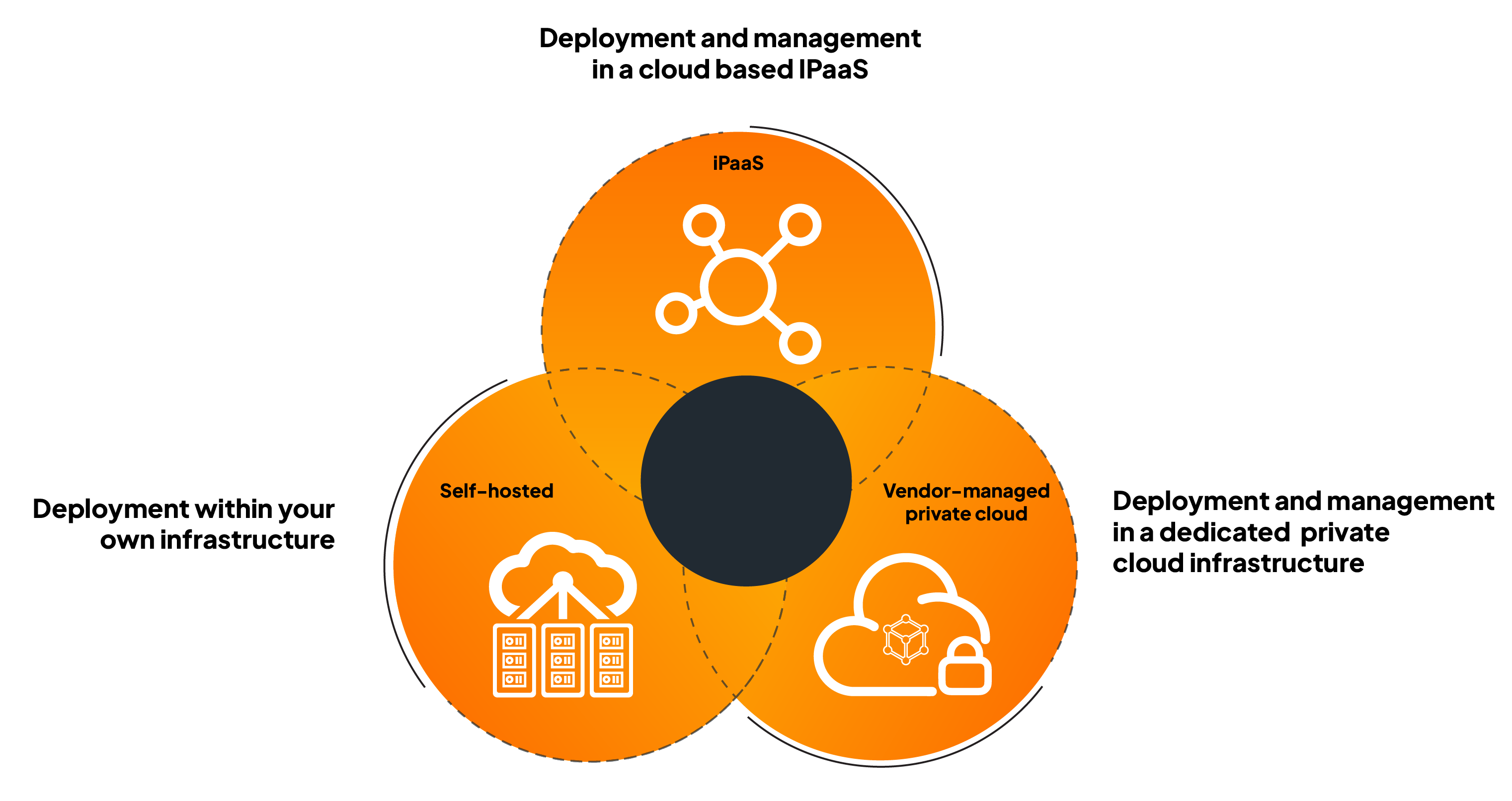
Figure 2: Deployment options
Deployment options can be categorized into 3 categories:
- Self-hosted: This approach involves the enterprise hosting and managing the deployment within their own physical or cloud infrastructure. While offering maximum control over the environment and data, it necessitates the enterprise's IT team to undertake the full spectrum of self-management responsibilities, including hardware / cloud infrastructure provisioning, software installation, patching, monitoring, and troubleshooting. This option is often favored by organizations with stringent security policies, existing on-premise IT investments, or specific regulatory mandates that prohibit data storage in multi-tenanted infrastructure.
- SaaS (iPaaS): Modern integration vendors offer cloud-based Integration Platform as a Service (iPaaS) solutions for enterprises seeking a more streamlined and managed experience. These solutions eliminate the operational overhead for the enterprise as the vendor is wholly responsible for managing the integration platform within secure, scalable, and flexible cloud environments. This iPaaS option is best suited for enterprises that do not have strict data privacy compliance requirements, require increased scalability and flexibility, and wish to offload the responsibility of managing the underlying infrastructure to the integration vendor.
- Vendor-managed private cloud: The private cloud option complements the control of on-premises infrastructure with the convenience of cloud management. With this option, the integration platform is deployed and managed within a compartmentalized cloud environment dedicated to each customer, providing an enhanced level of isolation, security, and resource dedication. Crucially, the integration vendor retains the responsibility for managing the integration platform. This makes it a perfect fit for enterprises that demand the enhanced security and dedicated resources of private infrastructure, but without the operational overhead of self-management.
Of the three, the iPaaS option is increasingly becoming the preferred choice for global enterprises because it significantly simplifies the transition from strategic planning to a fully operational, production environment. It empowers developers to concentrate on their core strength—writing and committing code—while the platform automatically handles all the complexities of setting up and managing the build, release, and run processes. By abstracting away these complexities from development teams, the iPaaS option offers enterprises several key benefits—accelerated development cycles, reduced operational costs, minimized risk of human error, and the ability to rapidly respond to changing business needs. Furthermore, outsourcing infrastructure maintenance enables internal resources to focus on innovation instead.
3. Observe and Optimize
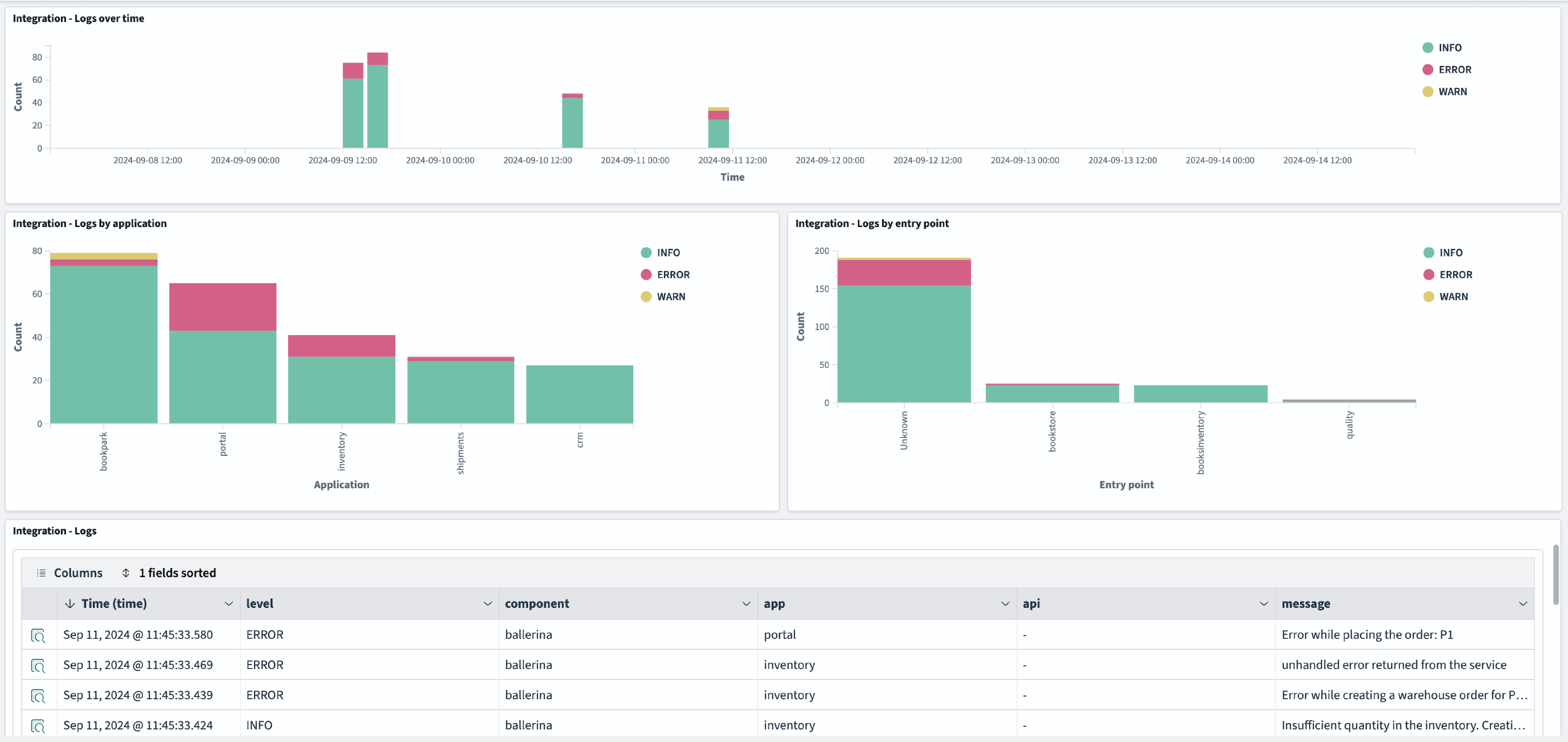
Figure 3: Observability
Finally, the observe and optimize stage is crucial to continuously monitor and improve the performance, availability, and overall health of the integrations. By leveraging advanced analytics and monitoring tools for observability, enterprises can gather and analyze vital insights on data flow, latency, error rates, and resource utilization to proactively identify bottlenecks, anticipate potential issues, and pinpoint areas for improvement.
- Request tracking: Monitoring the flow of requests through the integrated systems provides visibility into the volume, patterns, and success rates of data exchange.
- Error rates: High or escalating error rates can indicate critical issues within the integration, such as data format mismatches, authentication failures, or system outages.
- Latency: Measuring latency, or the time taken for a request to complete, is vital for assessing the responsiveness and performance of the integrations as excessive latency can negatively impact user experience and business operations.
Optimization efforts can involve refining integration flows, refactoring APIs, scaling resources, or adopting alternative integration patterns. This iterative approach of observation and optimization guarantees that integrations remain highly effective, continuing to boost efficiency, lower costs, and enhance overall business agility.
- Code adjustments: Refining existing code to improve efficiency, reduce resource consumption, or fix logical errors.
Infrastructure scaling: Adjusting the underlying hardware or cloud resources to meet demand by adding more servers, increasing memory, upgrading storage, or leveraging auto-scaling features in cloud environments. - Re-architecting integrations: In some cases, fundamental changes to the integration's design—such as changing integration patterns, or redesigning data flows—might be necessary to overcome inherent limitations or address complex issues.
- Testing: No changes should be deployed without rigorous testing to ensure their effectiveness, and to prevent the introduction of new problems.
This continuous feedback loop ensures that integrations remain robust, performant, and aligned with evolving business requirements, ultimately empowering enterprises with enhanced agility and efficiency through comprehensive observability.
Summary
Today’s digital landscape is extremely dynamic, and enterprises must have the agility and flexibility to quickly adapt to the constantly changing market demands in order to remain competitive and relevant. Integration is the key enabler of this agility and flexibility. Therefore, success depends heavily on defining the correct integration strategy—without such a strategy in place, enterprises struggle to quickly adapt to market demands, leading to missed opportunities, and losing their competitive advantage.
On the other hand, a comprehensive, scalable, and flexible integration strategy that covers the three key stages of an integration project— design and develop, deploy and operate, and observe and optimize— and includes selecting the correct integration technology, enables enterprises to easily break data silos, automate business processes, consistently deliver exceptional digital experiences to their customers, and stay ahead of the competition in an increasingly competitive market.
How WSO2 can help with your integration strategy
WSO2 has 20+ years experience helping our customers across the globe design integration strategies that have set them up for short and long-term success.
Additionally, WSO2’s 100% open source, modern, AI-native integration technology enables enterprises to build any type of integration across any environment without vendor lock-in. It also includes support for building AI agents and RAG apps, AI-assisted low-code and pro-code development, AI-assisted data mapping, and more to boost productivity and accelerate time to market.
WSO2’s integration technology also supports self-hosted, iPaaS, and WSO2-managed deployment options, providing enterprises complete deployment flexibility.
Contact us to start discussing your integration strategy
About The Author
- Shazni Nazeer
- Director - Solutions Architecture, WSO2
Shazni is the lead of solution architecture for integration at WSO2. In this role, he collaborates closely with WSO2 regional solutions architects, customers and partners to formulate integration solutions aimed at facilitating digital transformation. Shazni architects solutions tailored to evolving customer requirements as a trusted advisor to optimize the utilization of the WSO2 platform. With over fourteen years of experience spanning product engineering, professional services delivery, and pre-sales, Shazni is a seasoned technical advocate who contributes to the strategic development of products, aligning them with market demands. His interest areas are, performant integrations and development of cloud-native applications.