



Build Enterprise AI Agents, End to End
Expose existing systems as MCP tools, build enterprise AI agents with natural language or pro-code, govern their actions, and deploy them wherever your data resides. WSO2 Integration Platform supports the full lifecycle, from the first MCP server to production agents.
Why enterprise AI agents stall before production
Agent projects rarely fail because of the AI itself. They run into issues when an agent has to interact with a system of record, understand what the data means, and respond within rules the business can defend.
The same three challenges come up repeatedly: legacy systems are difficult for agents to access, raw data lacks the context agents need, and governance is often treated as an afterthought. Those gaps are what prevent a pilot from moving to production.
What agents need to succeed in production
A successful pilot proves that an agent can work. Successful production requires a foundation that allows agents to scale securely, make informed decisions, and adapt as requirements change.
Reuse integrations across agents
Once a system is made available as an agent-ready tool, future agents can use the connection. Each new project becomes quicker and less expensive because teams are not rebuilding integrations from scratch.
Give agents the context they need
Access to data is not enough. Agents also need business meaning, historical information, related events, and the policies required to interpret and react to the data correctly.
Build in governance from the start
Policy enforcement, human approval for critical actions, observability, and evaluation help organizations control risk and limit the impact of mistakes.
Deploy where the data resides
Production agents must operate across on-premises, private cloud, sovereign cloud, and hybrid environments, especially for regulated or sensitive workloads.
Protect flexibility as technology evolves
Open standards and an open-source foundation allow organizations to change models, frameworks, or providers without completely rebuilding their integrations.
Without this foundation, agent initiatives may succeed as demos, but struggle to become secure, scalable production systems.
How enterprise AI agents deliver value
Enterprise assistants that work with real systems
Agents that retrieve data, invoke APIs, call MCP tools, and trigger workflows across CRM, ERP, and other line-of-business systems.
Agents that become part of everyday business processes
An integration flow triggers an agent at a decision point through an event, API, file, or automation. The agent reasons, decides, and the flow executes one of a defined set of outcomes.
Claims and case handling
A claims agent gathers information in conversation, reasons over historical and real-time context, decides on the claim, then routes it to accept, reject, or human approval.
Operational intelligence
Agents that monitor events, detect anomalies, and act in real time across distributed systems.
A unified architecture for AI-native integration
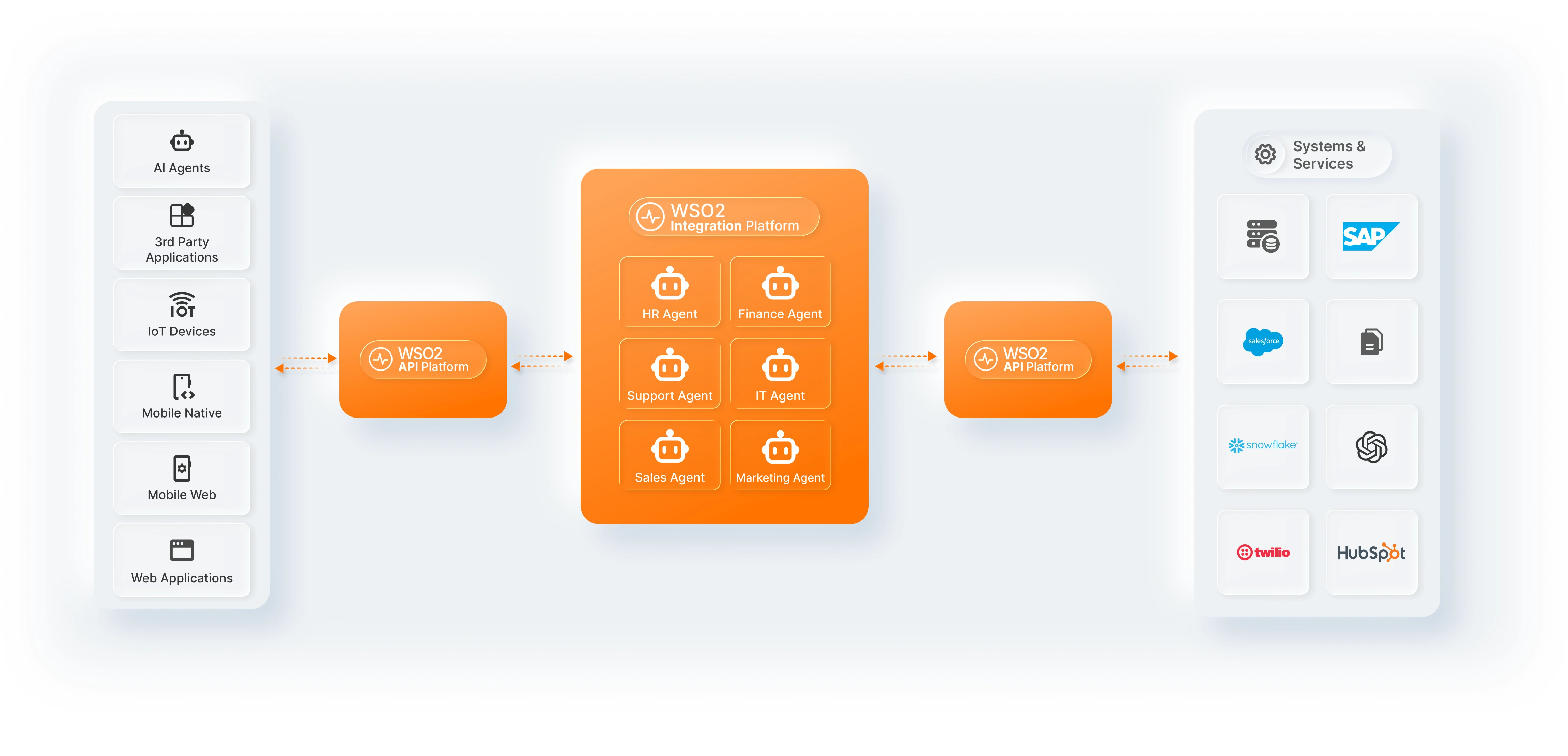
How WSO2 supports AI agents end to end
Four stages, one open and governed platform.
Expose: Make enterprise data and systems agent-accessible
An agent can only act on what it can access. WSO2 builds an integration layer over the systems you already run and exposes their data and functionality through events, APIs, files, and automations.
A real-time context layer gives agents the information they need to act, rather than handing them raw records. Context graphs and data pipelines keep that information current and relevant.
Build new MCP servers where needed, or adapt existing APIs instead of starting over, so agents can access context, data, and systems through a single protocol.
Build: Natural language or pro-code
Start by describing what the agent should do in plain language, then move into code when the logic becomes more complex. Agents connect to context, data, and enterprise systems through MCP.
The platform also includes support for building RAG pipelines, prebuilt tools, and multiple ways to trigger and interact with agents.
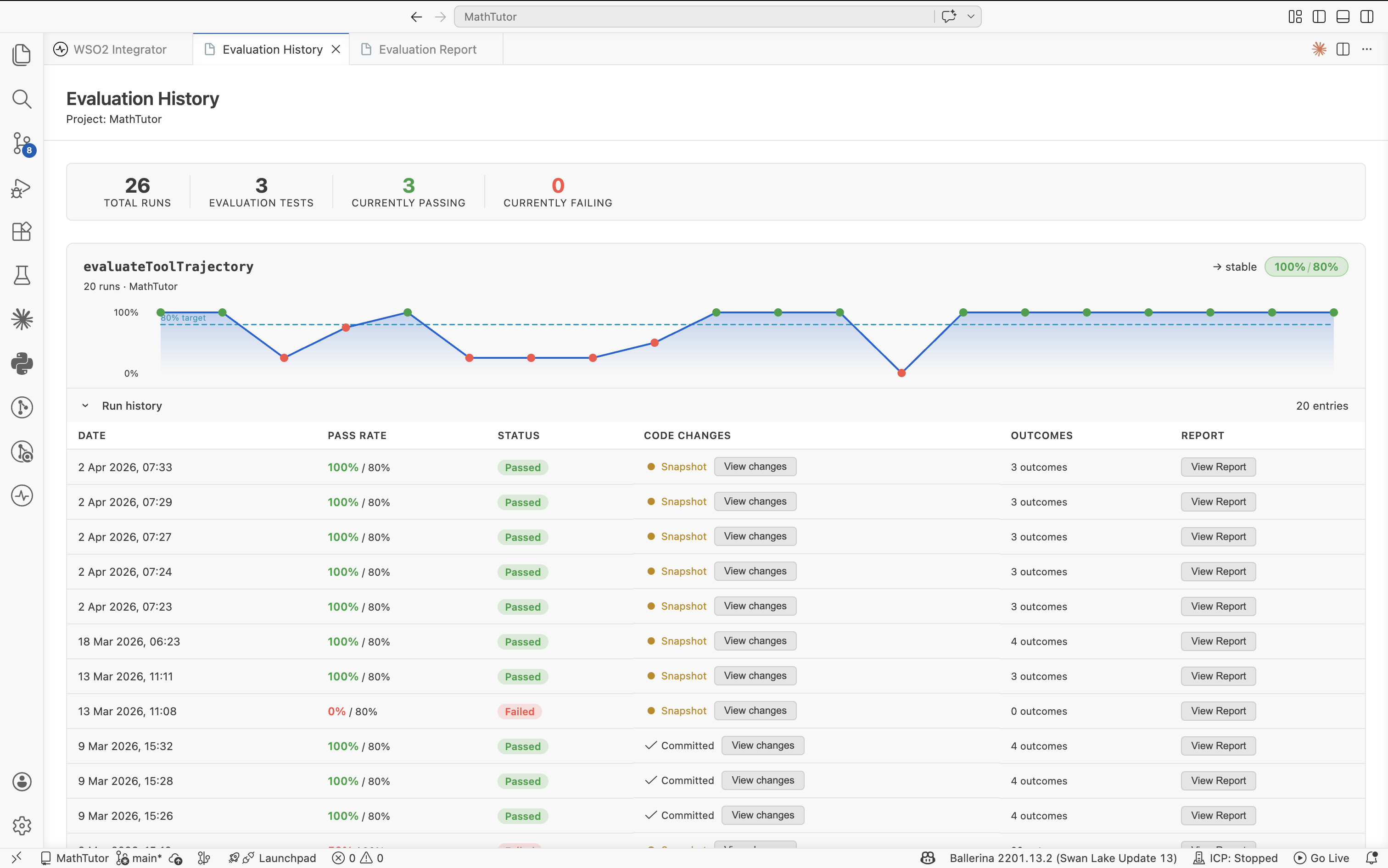
Security, governance, and observability are built into the development process from the start, not added after the agent is already built.
Govern: Manage the impact
Left unchecked, an agentic system can do real damage. Three safeguards can help prevent that.
Governance should sit close to the logic it controls, inside the integration or agent code. When policy is in a separate layer, it can become out of sync with how the agent actually functions.
Human-in-the-loop workflows put a person in the path of anything sensitive or high-value. Autonomy becomes something you grant intentionally, case by case, rather than an always-on model. Agent reasoning is evaluated during development so edge cases surface before they affect production systems.
Operate: Deploy it where the data lives
Deployment decisions should be driven by data, compliance, and operational needs, not vendor limitations. Run on-premises, on Kubernetes, in private or sovereign cloud, across multiple clouds, in a hybrid mix, or as a managed iPaaS, with the same runtime behavior and developer experience across each.
Observability spans the entire execution path, with metrics, logs, traces, execution flows. It also provides real-time visibility into agent reasoning, tool usage, and decisions. That makes managing your environment a matter of understanding what happened, instead of piecing it together after the fact.
Open Source: Maintain flexibility as requirements change
Your integration and AI architecture should not lock you into one vendor, deployment model, or proprietary standard. WSO2 is 100% open source and built on open standards, giving organizations greater control over how they run, extend, and govern the platform.
That flexibility matters when sovereignty, regulatory, or operational requirements vary by region or change over time. Teams can deploy across existing environments, work with the systems they already use, and adapt without waiting on a vendor roadmap.
Run it your way.
The only integration technology that is available as 100% open source self-hostable software, or as a iPaaS.
Self-hosted
Full control over your stack. Deploy directly to your own servers, bare metal, or a private cloud environment. Your data never leaves your perimeter.
- ✓ Complete data sovereignty
- ✓ Air-gapped environment support
- ✓ Kubernetes, Docker, VM, or bare metal
- ✓ Bring your own CI/CD pipeline
iPaaS
Zero infrastructure to manage. WSO2 handles provisioning, upgrades, scaling, and availability. Get started in minutes.
- ✓ Data plane anywhere you want
- ✓ Centralized control and observability
- ✓ Continuous updates, zero downtime
- ✓ Multi-region availability