



API-First Integration for Modern Enterprises
Turn integration logic into discoverable, reusable, and governed APIs. Expose legacy systems, orchestrate multiple services, and deliver secure, composable digital capabilities across cloud, hybrid, and on-prem environments.
Point-to-point integration does not scale
Traditional integration is focused on connecting systems directly—application to application, database to database. While effective for isolated use cases, this approach creates tightly coupled architectures that are difficult to evolve.
As enterprises adopt microservices, SaaS platforms, digital channels, partner ecosystems, and AI agents, integration must become a standardized, governed capability layer.
Without exposing integrations as APIs, organizations face duplicated logic, inconsistent security policies, limited reuse, and slower innovation cycles.
APIs are the primary interface of the modern enterprise
APIs are now the primary interface for applications, partners, digital channels, and AI agents.
Turning integrations into managed APIs enables:
Standardized governance
Authentication, throttling, monitoring, lifecycle management, and policy enforcement become consistent across all integrations.
Reusability and composability
Integration flows become discoverable business capabilities instead of one-off project artifacts.
Reduced architectural complexity
Backend systems can evolve independently while maintaining stable API contracts.
Faster innovation
New channels, products, and AI-powered experiences can be delivered without rebuilding core integrations.
API-led integration strategy
Integration evolves from connectivity plumbing into a strategic capability layer.
Real-world integrations as APIs scenarios
Modernizing legacy systems
Continue leveraging legacy investments by exposing functionality as REST, GraphQL, or gRPC APIs without rewriting core systems.
AI agent consumption
Deliver stable, structured APIs that AI agents and GenAI applications can reliably invoke.
Composite services and backend-for-frontend (BFF) layers
Orchestrate multiple systems behind a single API contract to power mobile apps, web portals, and digital experiences.
Partner and ecosystem enablement
Provide secure, governed APIs for external partners and suppliers.
Cross-system orchestration
Combine transformation, connectors, events, and file integration into unified API-driven workflows.
Reference architecture
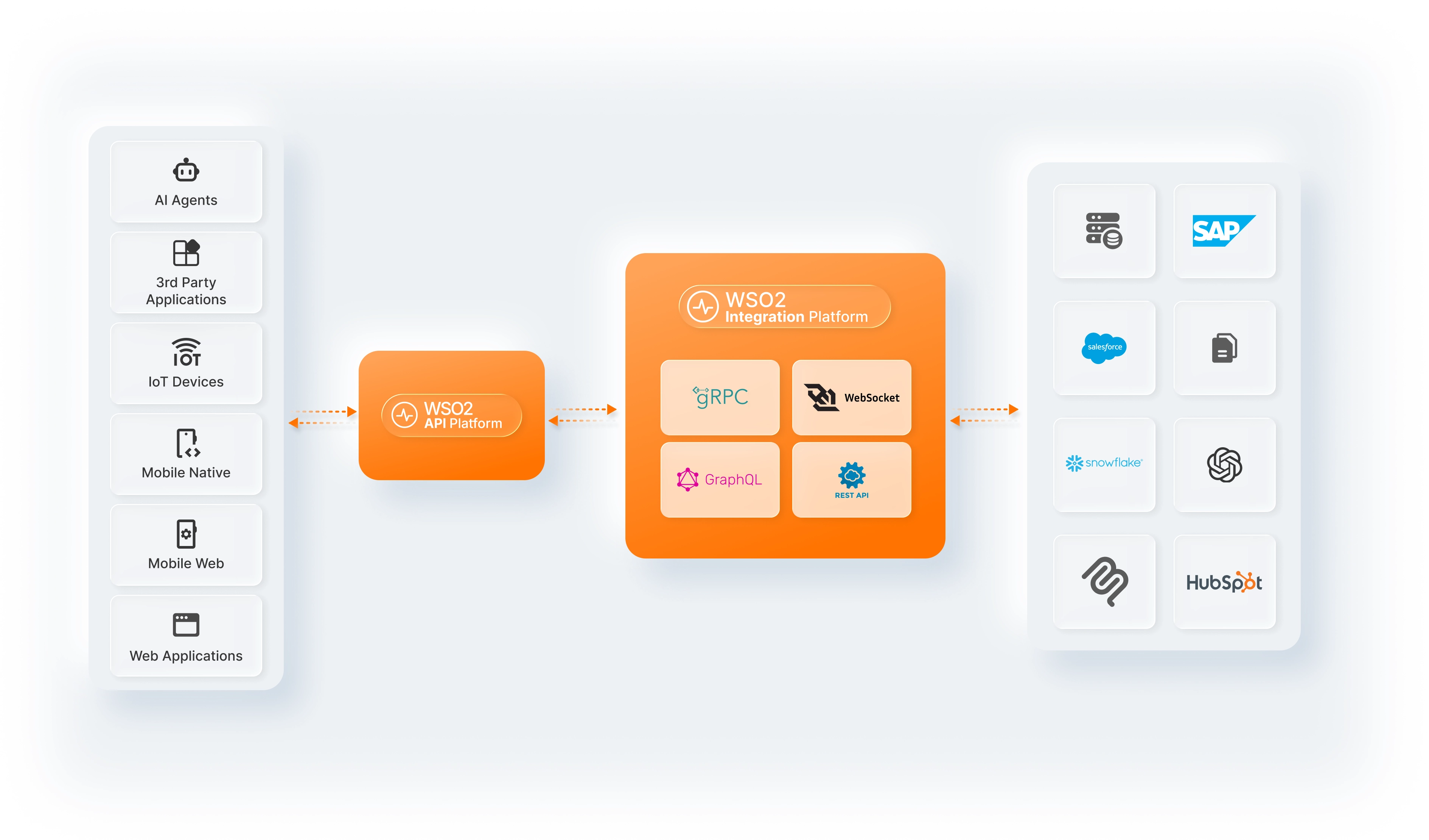
Why use WSO2 for integrations as APIs
API-first by design
WSO2 Integrator is built around an API-first philosophy. Every integration can be designed, versioned, secured, and governed as a managed API from day one.
Support for all API styles
Support for REST, SOAP, GraphQL, WebSocket, Async APIs, webhooks, and streaming enables modernization of legacy systems while supporting event-driven and real-time architectures.
Unified integration + API capabilities
Integration logic and API exposure operate on a single platform, reducing architectural complexity and eliminating the need for disconnected tooling.
Low-code and pro-code development
Unified low-code and pro-code development with 100% parity, powered by the Ballerina programming language.
Enterprise-grade runtime
Execute APIs with high-performance mediation, transformation, clustering, retries, and distributed observability.
Deploy anywhere
Run self-hosted on VMs or Kubernetes, in hybrid environments, or as a fully managed iPaaS, while maintaining architectural control.
Build once. Reuse everywhere.
Empower developers to design integration flows as reusable API contracts while enabling platform teams to enforce governance and consistency.
API-first specification support
Design and expose integrations as structured API contracts from day one, ensuring consistent interfaces across teams.
Reusable integration components
Build modular, shareable integration flows that can be reused across projects and teams to eliminate duplicated effort.
Centralized lifecycle management
Manage integration versions, dependencies, and deployments from a single control plane with full governance visibility.
Built-in metrics, logs, and tracing
Monitor integration health with end-to-end observability including OpenTelemetry support and real-time diagnostics.
AI-assisted development support
Use the MI Copilot in VS Code to generate integration artifacts, validate syntax, and iterate on flows conversationally.
Turn integrations into digital capabilities
Design, expose, and manage integrations as reusable APIs that power applications, partners, and AI agents.
Self-Hosted
Full control over your stack. Deploy directly to your own servers, bare metal, or a private cloud environment. Your data never leaves your perimeter.
- ✓ Complete data sovereignty
- ✓ Air-gapped environment support
- ✓ Kubernetes, Docker, VM, or bare metal
- ✓ Bring your own CI/CD pipeline
SaaS
Zero infrastructure to manage. WSO2 handles provisioning, upgrades, scaling, and availability. Get started in minutes.
- ✓ Data plane anywhere you want
- ✓ Centralized control and observability
- ✓ Continuous updates, zero downtime
- ✓ Multi-region availability