

How WSO2 Forward Deployed Engineers Help You Build an Agentic Enterprise

- Ruwan Linton
- Senior Vice President & Chief Customer Officer, WSO2

- Thibaut Rouffineau
- Senior Vice President & Chief Marketing Officer, WSO2
Agentic AI is a different kind of IT project. The ground moves under you and models improve every few months. Your organization's thinking on what to automate shifts as soon as the first agents ship. New failure modes appear that no runbook covers. Traditional 2-5-year roadmaps break under that kind of pressure.
That reality breaks the way enterprise software has historically been delivered. Fixed-scope statements of work, quarterly checkpoints, and a clean handover from vendor to customer assume a stable target. Agentic AI does not give you one.
This is why we structured our Forward Deployed Engineer (FDE) service the way we did. It sits between a triangle of traditional consulting, product engineering, and customer success, and it is built for the kind of work where the destination gets clearer as you move toward it.
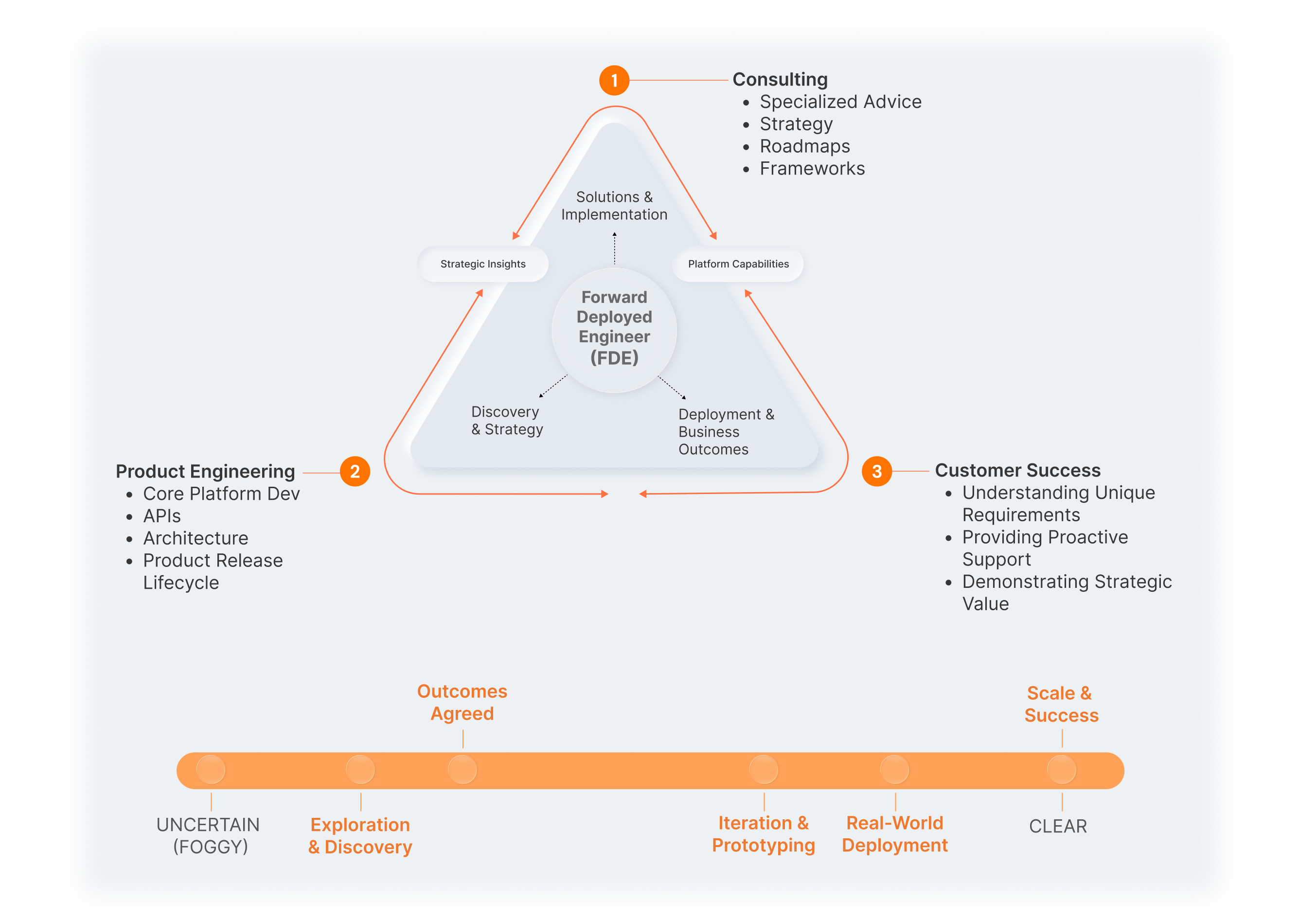
Figure 1: How an FDE draws on consulting, product engineering, and customer success to achieve business outcomes
What a Forward Deployed Engineer actually does
An FDE is a senior WSO2 engineer who is embedded in your team for the duration of a meaningful business outcome, not for a billable task list. They know our platform in depth, they write code, and they are measured on whether your objective lands, not on whether a timesheet fills up.
That framing changes the incentives. The work is not finished when a module is deployed. It is finished when your agents do what you set out for them to do: reduce support resolution time, automate a procurement workflow, put a working copilot in front of your internal teams that pulls from the right systems, and enable agentic consumption of your business APIs.
Most engagements in the market sit on one side or the other. Consultancies plan, advise, and provide the expertise. Support teams react to tickets. Customer success teams run QBRs. An FDE is none of these. They are an engineer inside your problem, working with you from initial scoping through to deployment and outcome delivery.
What’s unique about WSO2 FDE engagements
Four key principles that shape how our FDEs work, and together they describe the kind of partner we are trying to be.
Outcome-led
We structure engagements around the outcome you want to reach, not the features you want to install, not the tasks carried out as part of the scope. In practice, that means agreeing on measurable objectives and key results (OKR) up front, then adjusting the mix of platform, integration, model choices, and workflow until you reach them. We have adapted that instinct to the realities of agentic deployment: smaller increments, faster checkpoints, and more rework as the ground shifts.
Embedded
Our FDEs work inside your team. They attend your standups, sit in your planning sessions, and take ownership alongside your engineers. This is deliberate. The gap between "a vendor who understands their platform" and "a partner who understands your business" is where most agentic projects stall. Embedding closes it. At the end of the day, there’s no requirement of knowledge transfer.
WSO2 agent fabric
Becoming an agentic enterprise takes more than assembling a set of agents. You need an enterprise-grade foundation that governs how agents access tools, interact with systems, and operate within defined policies.
In practice, the WSO2 agent fabric brings together the core capabilities that make agents safe and manageable at enterprise scale. It accounts for something most platforms overlook: your environment will never be purely agentic. Probabilistic, agentic workloads will run alongside deterministic, non-agentic ones, and the fabric has to handle both.
- Agent Platform: Build, secure, operate, and manage agents and their associated tools, with governance applied across the full agentic environment.
- API Platform: Expose APIs and MCPs for agents to consume on the ingress side, and route internal traffic to LLM models and external APIs through an AI Gateway on the egress side.
- Identity Platform: Manage digital identities for humans, devices, and agents alike, including Agent ID for agents and tools.
- Integration Platform: Connect agents to existing systems, acting as the hub for agent-to-system interaction.
- Engineering Platform: Support rapid development cycles and scalable deployment, with observability to manage new agentic workloads in production.
FDEs work across this entire stack. When they join your team, they are not learning the platform on the job. They bring deep working knowledge of how these components fit together, and how to configure them for your specific environment.
Open source
Everything we help you build sits on open source foundations. That is not a stylistic preference; it is a resilience principle. It is in our genes, with all our products, processes, and methodologies. You can read the code. You can fork it. You can keep running it if our commercial relationship ends tomorrow. An FDE is there to make you more capable, not more dependent.
Where FDEs have the most impact
FDEs are useful for rapid transformations of operations and business to get desired outcomes. They bring immediate technical expertise, faster time-to-value, and customized solutions, with strategic partnerships for your organization to start becoming an agentic enterprise.
Making the leap to an agentic AI enterprise
The gains from agentic AI show up when an organization rewires how work flows, not when it bolts a chatbot onto an existing process. That shift is hard to plan in the abstract. FDEs help you identify the handful of use cases where agents will genuinely change your cost or speed curve, then build those first, so momentum compounds before the organizational appetite runs out.
Building digital resilience in your team
We want you to be able to run your own infrastructure. An FDE spends as much time transferring capability to your team as they do writing code. They pair on pull requests. They explain architectural trade-offs. They make sure your engineers understand the underlying open source components well enough to extend the system later, not just to file tickets against it. That is what "getting the best of open source" looks like in practice.
Architecting, deploying, and operating agentic environments
Agentic systems introduce complexity that traditional integration teams have not had to deal with. Tool use, memory, guardrails, evaluation, observability, human-in-the-loop handoffs, multi-agent orchestration. FDEs bring patterns from other deployments and apply them to yours, so you are not rediscovering every trap from scratch.
Transforming IT and consolidating vendors
A well-designed agentic layer can absorb functionality that today is spread across half a dozen tools. Part of the FDE's job is to identify where consolidation is realistic, so you capture productivity gains from AI and cost savings from a leaner vendor footprint at the same time. In most engagements, the consolidation story is what makes the programme self-funding.
From a two-hour manual process to a one-minute agent: A proof point
A global leader in entertainment, gaming, and hospitality worked with our team to rebuild customer support troubleshooting around AI agents. The manual resolution process that used to take two hours now takes about one minute, handled by an AI Troubleshooting Agent that sits inside a broader multi-agent architecture.
That outcome is the kind of gap that only opens up when the delivery model matches the problem. A fixed-scope engagement would have shipped a chatbot. An FDE engagement structured around the outcome, "cut the time our customers wait for a resolution," kept adjusting the architecture, the tool choices, and the workflow until the two-hour number actually moved. The multi-agent design, the integration points with their existing systems, and the governance around the agents all came out of iteration with the customer's engineers, not out of a pre-written SOW.
Why this matters for your agentic deployment
If you are choosing a partner for becoming an agentic enterprise, the question is less about who has the best feature checklist and more about who will stay with you through the parts that are genuinely uncertain. The technology is moving. Your own requirements are moving. The partner you want is one whose incentives, working model, and technical foundations are built for that reality, not retrofitted to it.
Our FDE model is our answer. It is outcome-led, so we are paid to care about the same things you care about. It is embedded, so we feel what you feel. It is open source at its core, so the capability you build with us stays with you.
That combination is how we think you derisk an agentic programme without slowing it down.
Talk to us about your first agentic objective
If you are planning an agentic initiative in the next 12 months, talk to us about scoping an FDE engagement. We will work with your team to shape a first objective, agree on how we will measure it, and deploy a senior engineer in the room with you inside weeks.
Contact WSO2 FDE