

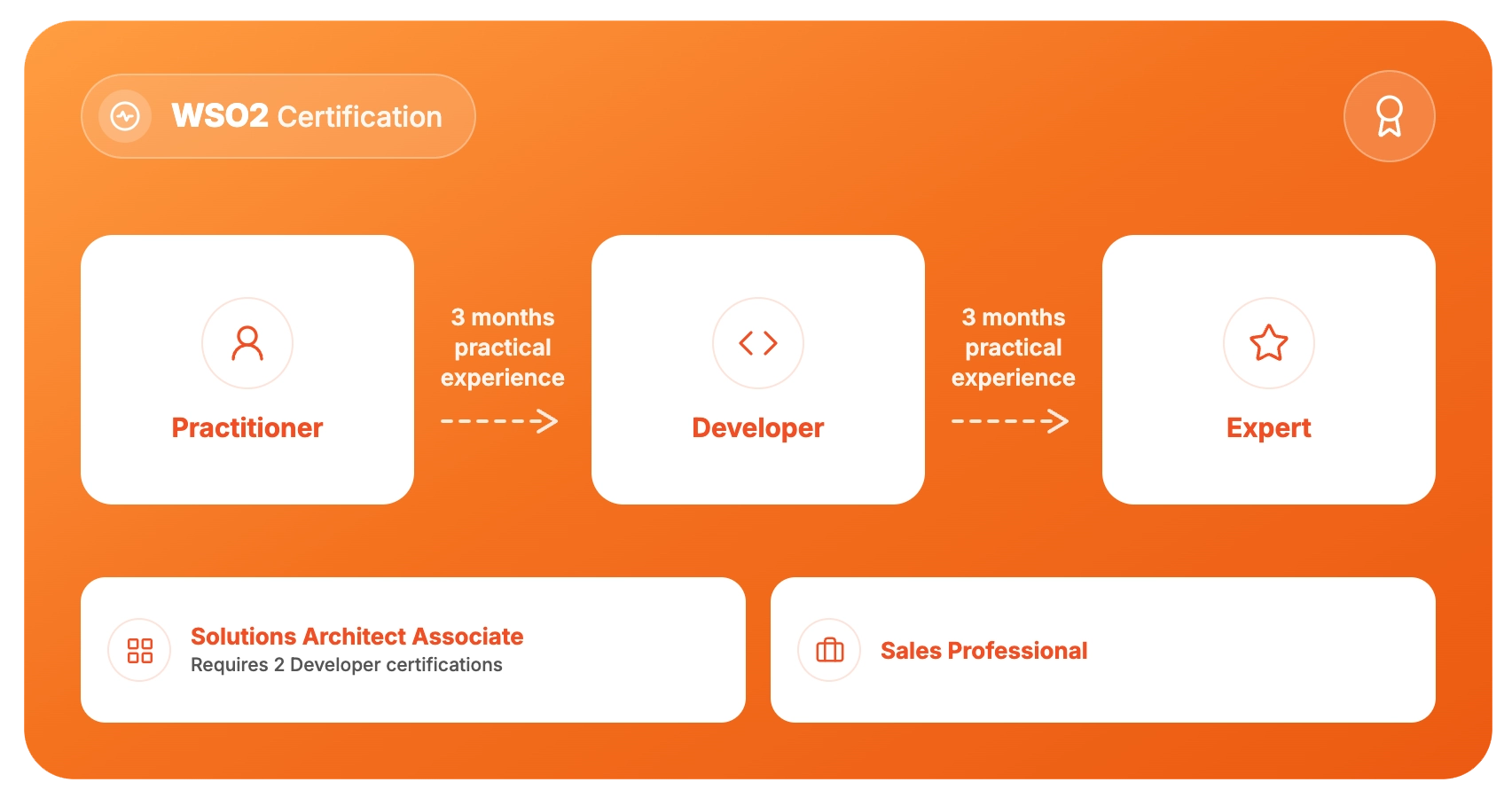
WSO2 Certification Exam Levels
Practitioner
Recommended for developers, the Practitioner Certification is the ideal starting point for becoming certified in WSO2 products. Each product certification includes a 30-question multiple-choice (MCQ) exam. Candidates must complete the relevant Fundamentals training course on the WSO2 Online Training Platform before attempting the exam.
A WSO2 Certified Practitioner should be able to:
- Evaluate business requirements and identify how WSO2 products can be used to design and implement effective solutions.
Developer
Suitable for developers, the Developer Certification is an advanced certification that builds upon the Practitioner Certification. The exam consists of 50 multiple-choice questions (MCQs). Candidates should have approximately three months of practical experience with the product and complete the relevant Fundamentals and Advanced training courses on the WSO2 Online Training Platform before attempting the exam.
A WSO2 Certified Developer should be able to:
- Understand business requirements and evaluate how WSO2 products can be used to address them.
- Conduct pre-sales discussions using core product concepts and features.
- Deliver standard product demonstrations, proof-of-concepts (POCs), and samples.
- Configure and deploy WSO2 products to deliver an out-of-the-box solution.
- Provide high-level solutions and deployment architecture.
Expert
Ideal for experienced developers, the Expert Certification consists of two practical examinations that assess advanced product knowledge and hands-on skills. Candidates must have an in-depth understanding of the product, at least six months of practical experience, and the relevant Developer Certification.
A WSO2 Certified Expert should be able to:
- Propose pre-sales solutions using domain concepts, product features, architecture and message flows, extension points, WSO2 connectors, third-party integrations, and deployment best practices.
- Deliver customized pre-sales demos, POCs, and samples based on business use cases.
- Provide development services, including configuration, artifact development, and custom extensions.
- Set up products and dependencies using standard deployment patterns.
- Develop product-standard extensions, localizations, and customizations.
- Review deployment configurations and troubleshoot development issues.