



What Is an Internal Developer Platform (IDP)?
An internal developer platform (IDP) is a cohesive set of tools and processes that abstracts infrastructure complexity, streamlines software delivery, and empowers development teams to build, deploy, and manage cloud native applications independently. Unlike traditional toolchains cobbled together by DevOps or platform engineers, a well-designed IDP provides a unified, self-service experience for developers, while ensuring control, security, and compliance for platform teams.
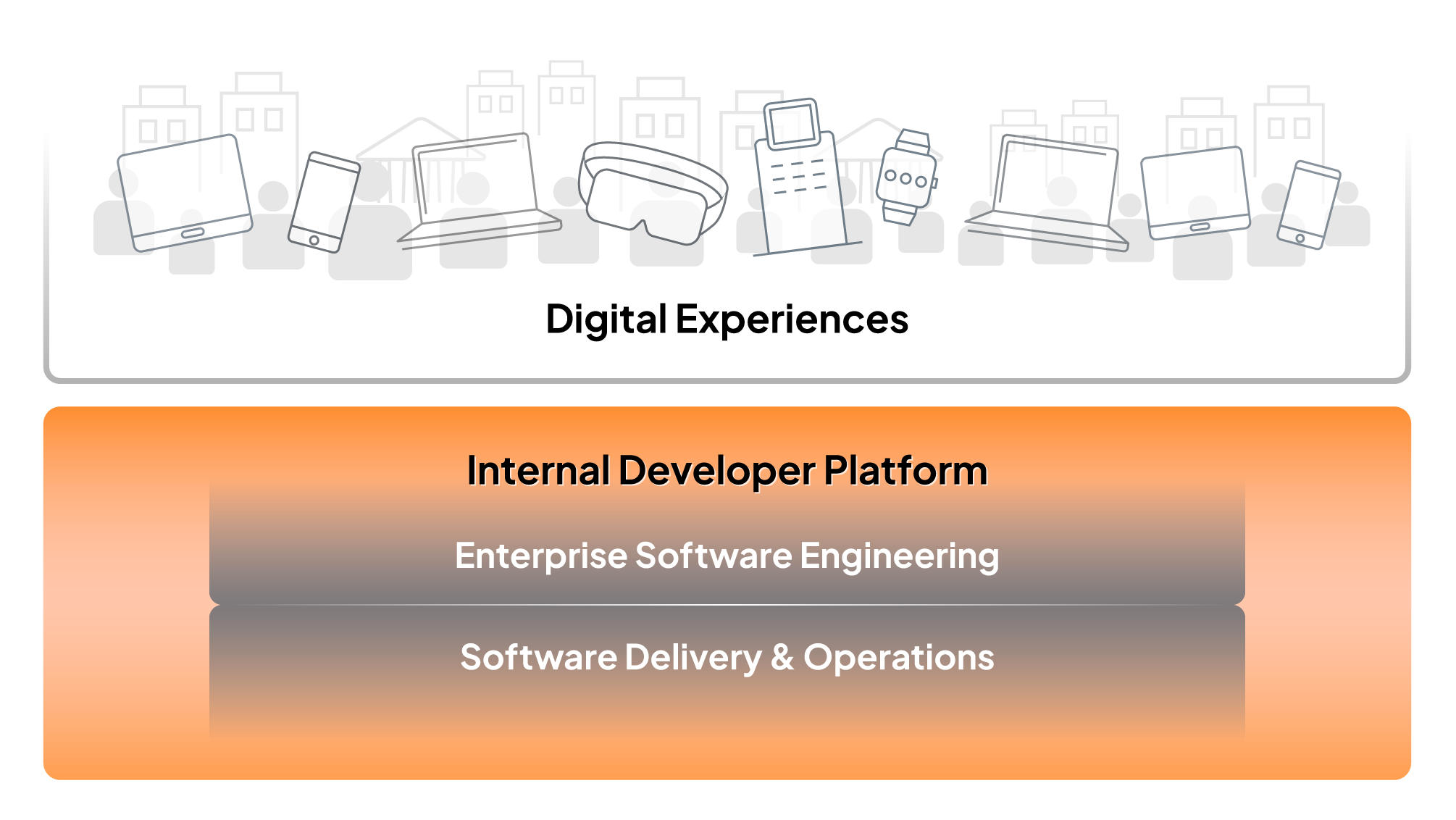
Why do you need an internal developer platform?
As organizations scale, the complexity of software development increases. Developers often face challenges such as:
- Managing diverse infrastructure environments.
- Navigating complex deployment pipelines.
- Ensuring compliance with security and governance policies.
- Collaborating across distributed teams.
An IDP addresses these challenges by providing:
- Standardization: Establishes consistent workflows and practices across teams.
- Automation: Streamlines repetitive tasks like provisioning and deployment.
- Visibility: Offers insights into system performance and resource utilization.
- Governance: Enforces security and compliance policies automatically.
By implementing an internal developer platform, organizations can accelerate software delivery, improve developer productivity, and maintain high standards of security and compliance.
Traditionally, IDPs have been viewed primarily as automation platforms - managing deployments, infrastructure, and CI/CD workflows. While this view captures some core functionalities, it misses critical elements that affect how enterprise software is actually engineered and delivered.
Learn more about navigating the complexity of internal developer platforms
A true IDP must support both enterprise software engineering and software delivery and operations equally. This dual-layer approach addresses not only the automation and infrastructure needs but also the application architecture, test tooling, design patterns, and developer experience necessary for long-term innovation and agility.
An IDP’s primary user is the application developer. Therefore, the platform must handle the entire application lifecycle from design and testing to deployment and retirement. This requires deep integration with developer tooling and strong alignment with architectural best practices such as domain-driven design and microservices.
In short, a complete IDP is not just about DevOps automation—it’s a platform that shapes how software is built, shipped, and scaled.
Key capabilities of an internal developer platform
1Enterprise software engineering
A robust IDP must support modern software engineering practices to help teams build resilient, scalable, and secure applications:
API-first development
Emphasizes designing APIs before implementation. An IDP should provide built-in API management and discovery tools.
Domain-driven design (DDD)
Helps structure software around business capabilities. Cell-based architectures can enforce DDD in practice.
Microservice architecture
Promotes loosely coupled services that are independently deployable. IDPs must enable component reuse, versioning, and service composition.
Test-driven development (TDD)
IDPs should integrate with testing frameworks to support pre-commit validation and automated regression testing.
Automated DevOps
Automation must be the default. CI/CD pipelines, infrastructure as code, and GitOps workflows should be built in.
Secure by default
Communication policies, access controls, and compliance must be first-class citizens.
Version management
Enable tracking, rollback, and compatibility management across services and environments.
Iterative architecture
Support incremental evolution of services and architecture over time.
AI-augmented engineering
Use AI to assist in code generation, troubleshooting, testing, and optimization.
2Software delivery and operations
The operational backbone of any IDP lies in how effectively it automates and manages delivery workflows:
Developer self-service
Provisioning environments, deploying services, and accessing observability tools should require minimal platform team involvement.
Containerization & Kubernetes
Support Docker and Kubernetes as the runtime backbone. Provide native multi-tenancy and workload isolation.
CI/CD & GitOps
Seamless integration of source control, continuous integration, and Git-based deployments.
Resource optimization
Monitor usage patterns and auto-scale based on demand. Cost visibility and AI-powered FinOps are a plus.
Multi-cloud & multi-environment
Support dev, staging, and prod across AWS, Azure, GCP, or on-prem environments.
Observability & alerting
Built-in support for metrics, logs, distributed tracing, and alerting.
Config & secret management
Secure and centralized management of environment variables, file mounts, and secrets.
Resiliency, scalability, & HA
Ensure services are fault-tolerant, scalable, and highly available by design.
Operational & business insights
Provide dashboards and analytics for performance, DORA metrics, and user engagement.
Benefits of implementing an internal developer platform
Implementing an IDP offers numerous advantages:
- Enhanced developer productivity: Developers spend less time on infrastructure and more on coding.
- Faster time-to-market: Automated processes reduce the time from development to deployment.
- Improved collaboration: Standardized tools and processes facilitate better teamwork.
- Scalability: Easily manage growing teams and applications without a proportional increase in complexity.
- Cost efficiency: Optimized resource utilization leads to cost savings.
WSO2 Developer Platform: Your internal developer platform as a service
WSO2 Developer Platform by WSO2 is an AI-native internal developer platform (IDP) as a service that empowers developers and platform engineers to build, deploy, secure, and operate cloud native applications without the usual complexity. Designed for speed, scale, and security, WSO2 Developer Platform simplifies every stage of modern software delivery. It offers:

A unified software delivery platform
Manage code, APIs, workflows, and infrastructure - all from a single, intuitive interface. WSO2 Developer Platform brings together CI/CD, service mesh, API management, security, and observability under one platform.

Built-in CI/CD with Git integration
Automatically trigger builds and deploy across multiple environments using extensible CI/CD pipelines powered by Argo Workflows. Integrate natively with GitHub, GitLab, or Bitbucket for seamless code-to-cloud delivery.

Secure
by default
Enforce Zero-Trust security with built-in identity, access control, and encryption. WSO2 Developer Platform provides mTLS, RBAC, API-level rate limiting, and automated vulnerability scanning to keep applications compliant and secure from the ground up.

Full observability and
analytics
Monitor logs, metrics, and traces out-of-the-box with integrated tools like Prometheus, OpenTelemetry, and Fluentbit. Gain real-time insights into system health, performance, and usage with dashboards and alerts.

Composable
architecture
Enable teams to build and reuse modular components using WSO2 Developer Platform’s internal service marketplace. Accelerate development with reusable APIs, databases, caches, and message queues.

Multi-cloud
ready
Deploy workloads to AWS, Azure, GCP, or your on-prem Kubernetes clusters. WSO2 Developer Platform’s flexible data plane model ensures vendor neutrality and operational consistency across environments.

AI-augmented
engineering
Boost team productivity with WSO2 Developer Platform Copilot. Get intelligent suggestions for deployment issues and performance tuning powered by generative AI.

Enterprise-grade
governance
Maintain control with centralized policy management, DORA metrics, audit trails, and business analytics. WSO2 Developer Platform helps enforce consistency and compliance without slowing down innovation.
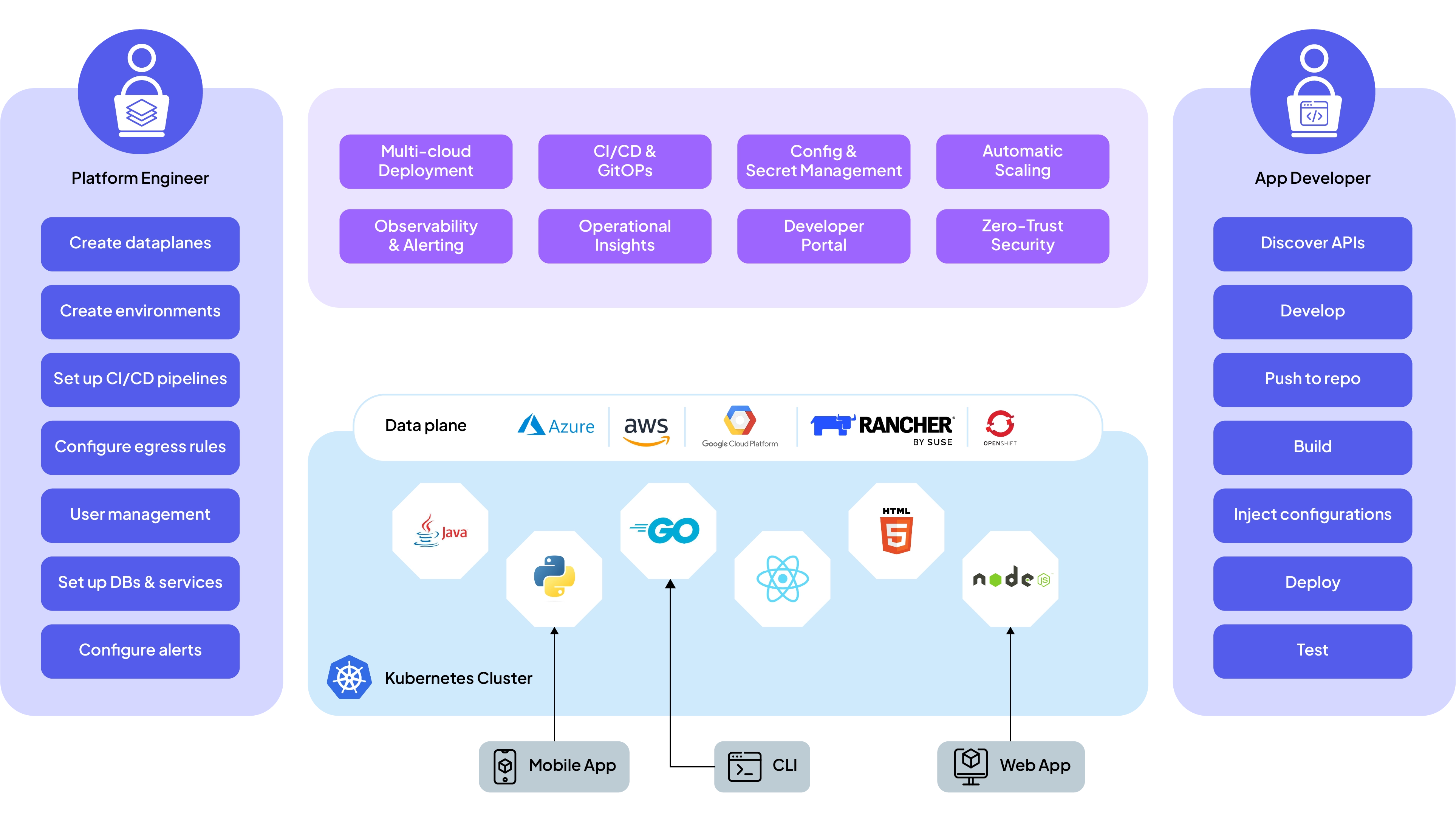
A modern internal developer platform must go beyond infrastructure automation. It must empower developers, enforce enterprise-grade governance, and enable scalable, composable application architecture.
WSO2 Developer Platform stands out as a leading example of this next-generation IDP approach—designed not just for DevOps teams, but for the entire software delivery lifecycle.
Experience the benefits of WSO2 Developer Platform and transform your software delivery processes.
Learn More About WSO2 Developer Platform Try WSO2 Developer Platform for Free
Resources to deepen your understanding
- Reference Architecture: Internal Developer Platform
- What is Platformless?
- The Role of an IDP in Application Modernization
- Navigating the Complexity of Internal Developer Platforms
- Why Building an Internal Developer Platform May Not Be Your Best Bet
- Why Building Platforms Fail - Architects Dissect 5 Critical Reasons