CDC for PostgreSQL
PostgreSQL CDC integrations capture row-level changes from PostgreSQL tables in real time using Debezium-based Change Data Capture. Use them for data synchronization, audit logging, and event-driven workflows that must react to database inserts, updates, deletes, and truncates without polling.
Logical replication must be enabled on the PostgreSQL database and on the specific tables you want to track before creating this integration. See Prerequisites.
Prerequisites
Before creating the integration:
wal_level = logicalmust be set inpostgresql.conf, and the server restarted. Without this, the connector cannot read change events from the write-ahead log.- The connecting user needs the
REPLICATIONattribute. Verify withSELECT rolname, rolreplication FROM pg_roles WHERE rolname = '<username>';. - Each tracked table needs
REPLICA IDENTITY FULLso thatbeforeimages are emitted for updates and deletes.
-- Set in postgresql.conf
wal_level = logical

-- Grant replication permission to the user
ALTER USER <username> REPLICATION;

-- Enable full replica identity on the table
ALTER TABLE <schema>.<table> REPLICA IDENTITY FULL;
The connector uses a logical replication slot (default name debezium) and a publication (default name dbz_publication); both are created automatically on first run. For advanced Debezium properties, see the Debezium connector for PostgreSQL.
Create a CDC service for PostgreSQL
- Visual Designer
- Ballerina Code
-
Click + Add Artifact in the canvas or click + next to Entry Points in the sidebar.
-
In the Artifacts panel, select CDC for PostgreSQL under Event Integration.
-
In the creation form, select Create new to configure a new listener.
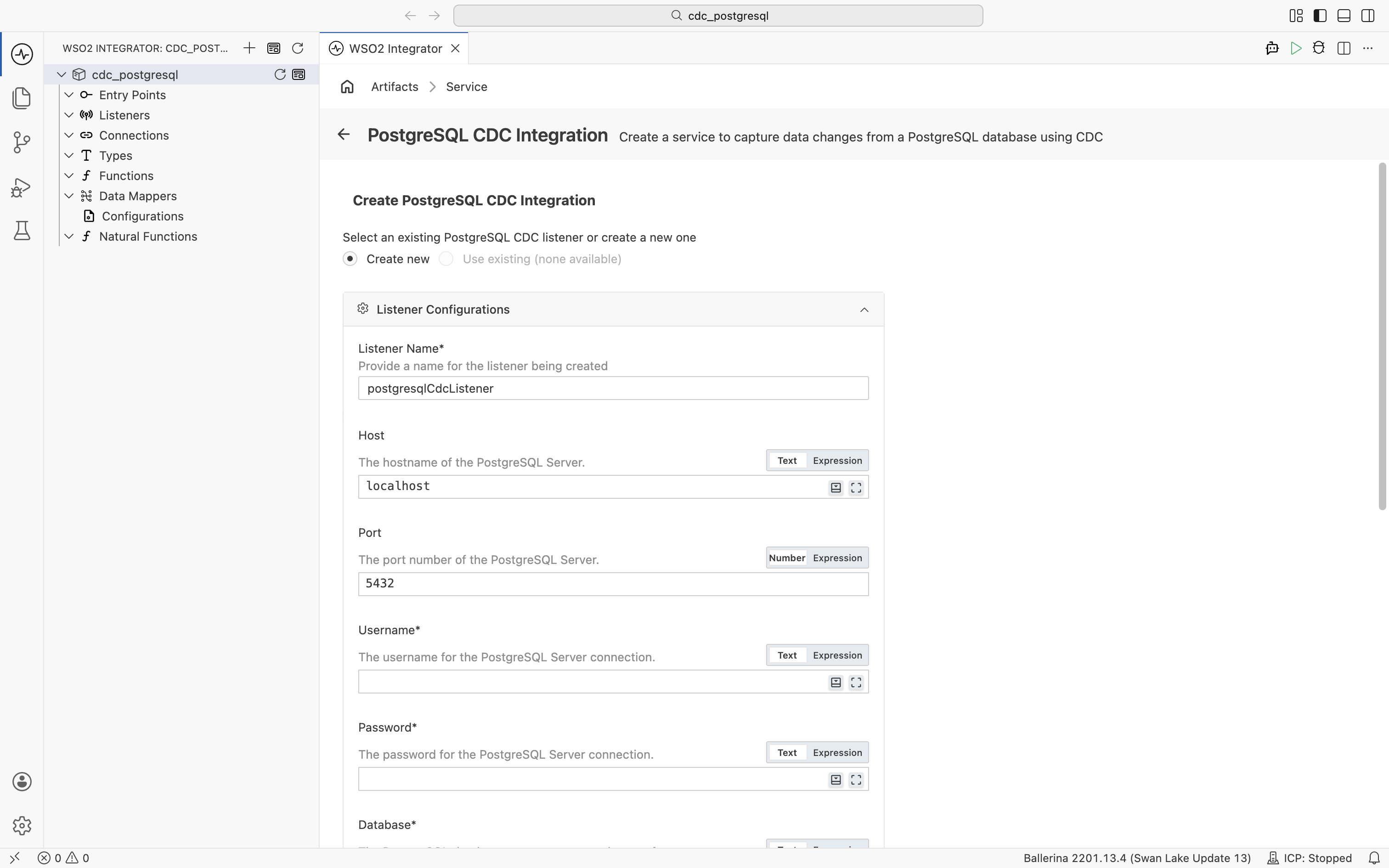
Under Listener Configurations, fill in the following fields:
Field Description Default Host Hostname of the PostgreSQL server. localhostPort Port number of the PostgreSQL server. 5432Username Username for the PostgreSQL connection. Required Password Password for the PostgreSQL connection. Required Database Name of the database to capture changes from. Required Schemas Regular expressions matching schema names to capture changes from. Click + Add Item to add each pattern. — Expand Advanced Configurations for additional settings:
Field Description Default Listener Name Identifier for the listener created with this service. postgresqlCdcListenerSecure Socket SSL/TLS configuration for a secure connection. — Options Additional options for the CDC engine as a record expression. Common keys include snapshotMode(for example,cdc:NO_DATAto skip the initial snapshot) andskippedOperations(for example,[cdc:TRUNCATE, cdc:UPDATE, cdc:DELETE]to skip truncate, update, and delete events; note that snapshot reads still triggeronReadunlesssnapshotModeis also set tocdc:NO_DATA).— Under Table, enter the fully qualified table name to capture events from in the format
<database>.<schema>.<table>(for example,mydb.public.customers). -
Click Create.
-
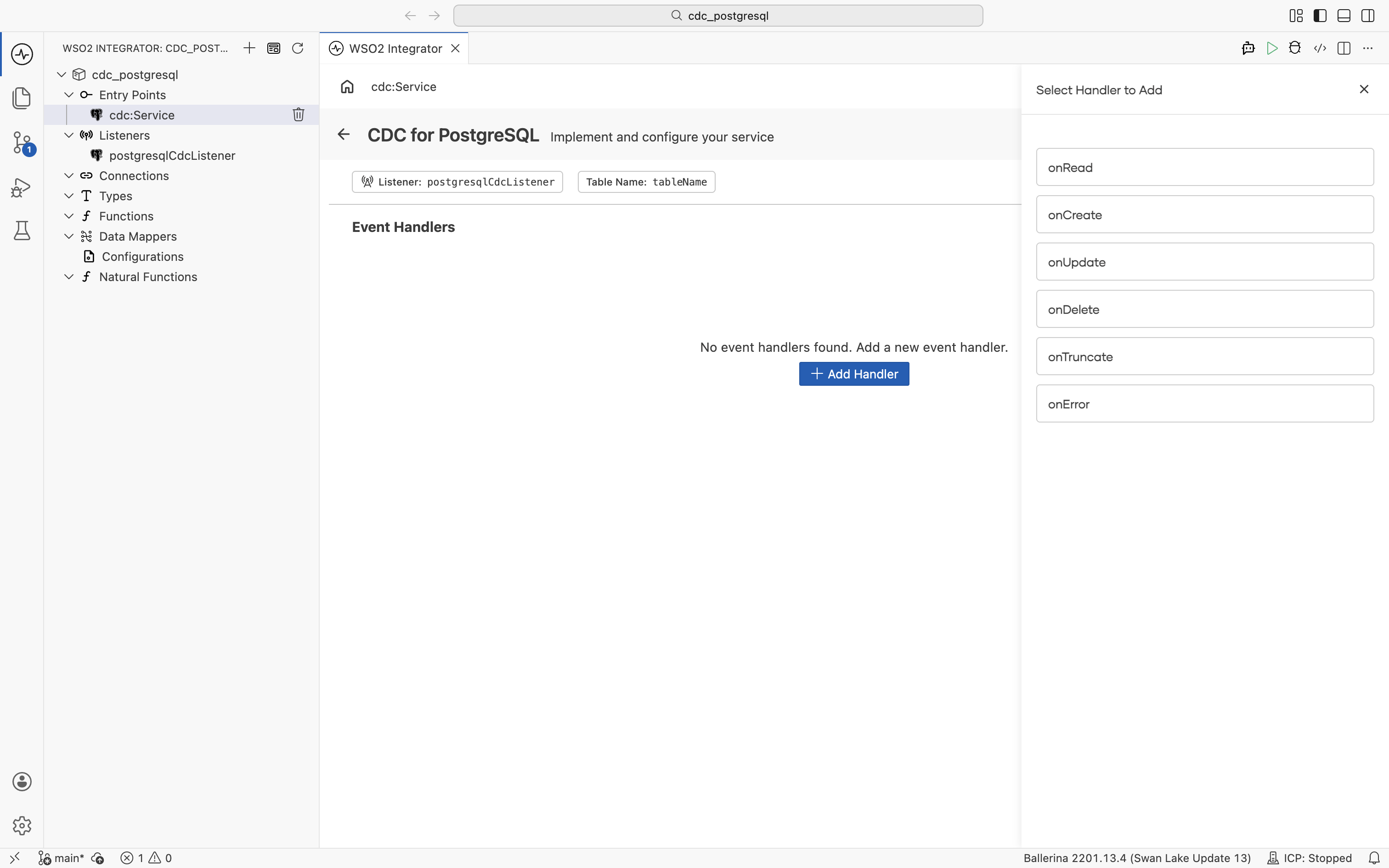
WSO2 Integrator opens the service in the Service Designer. The canvas shows the attached listener pill and the table name pill.
-
Click + Add Handler to add event handlers.
import ballerina/log;
import ballerinax/cdc;
import ballerinax/postgresql;
import ballerinax/postgresql.cdc.driver as _;

configurable string username = ?;
configurable string password = ?;
configurable string database = ?;
configurable string tableName = ?;

listener postgresql:CdcListener postgresqlCdcListener = new (database = {
    hostname: "localhost",
    port: 5432,
    username,
    password,
    databaseName: database,
    includedSchemas: ["public"]
});

@cdc:ServiceConfig {
    tables: tableName
}
service cdc:Service on postgresqlCdcListener {

    remote function onCreate(record {} after) returns error? {
        log:printInfo("Row inserted", data = after.toString());
    }

    remote function onUpdate(record {} before, record {} after) returns error? {
        log:printInfo("Row updated",
                before = before.toString(),
                after = after.toString());
    }

    remote function onDelete(record {} before) returns error? {
        log:printInfo("Row deleted", data = before.toString());
    }

    remote function onError(error err) returns error? {
        log:printError("CDC error", 'error = err);
    }
}
Service configuration
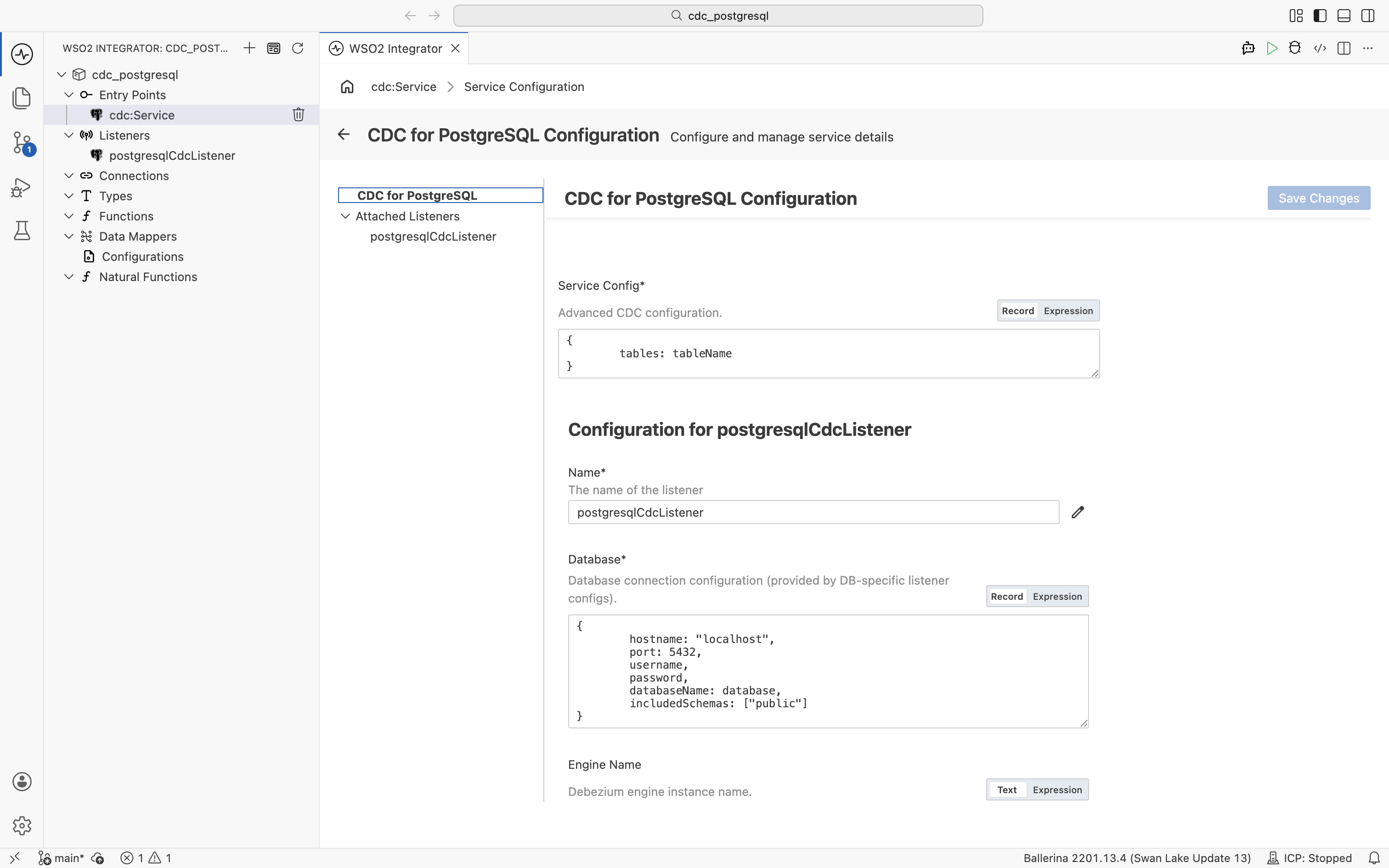
In the Service Designer, click the Configure icon in the header to open the CDC for PostgreSQL Configuration panel. Select CDC for PostgreSQL in the left panel.
- Visual Designer
- Ballerina Code
| Field | Description |
|---|---|
| Service Config | Advanced CDC configuration as a record expression. The tables field sets the fully qualified table name (format: <database>.<schema>.<table>). |
@cdc:ServiceConfig {
    tables: "mydb.public.customers"
}
service cdc:Service on postgresqlCdcListener { }
Listener configuration
In the CDC for PostgreSQL Configuration panel, select postgresqlCdcListener under Attached Listeners to configure the listener.
- Visual Designer
- Ballerina Code
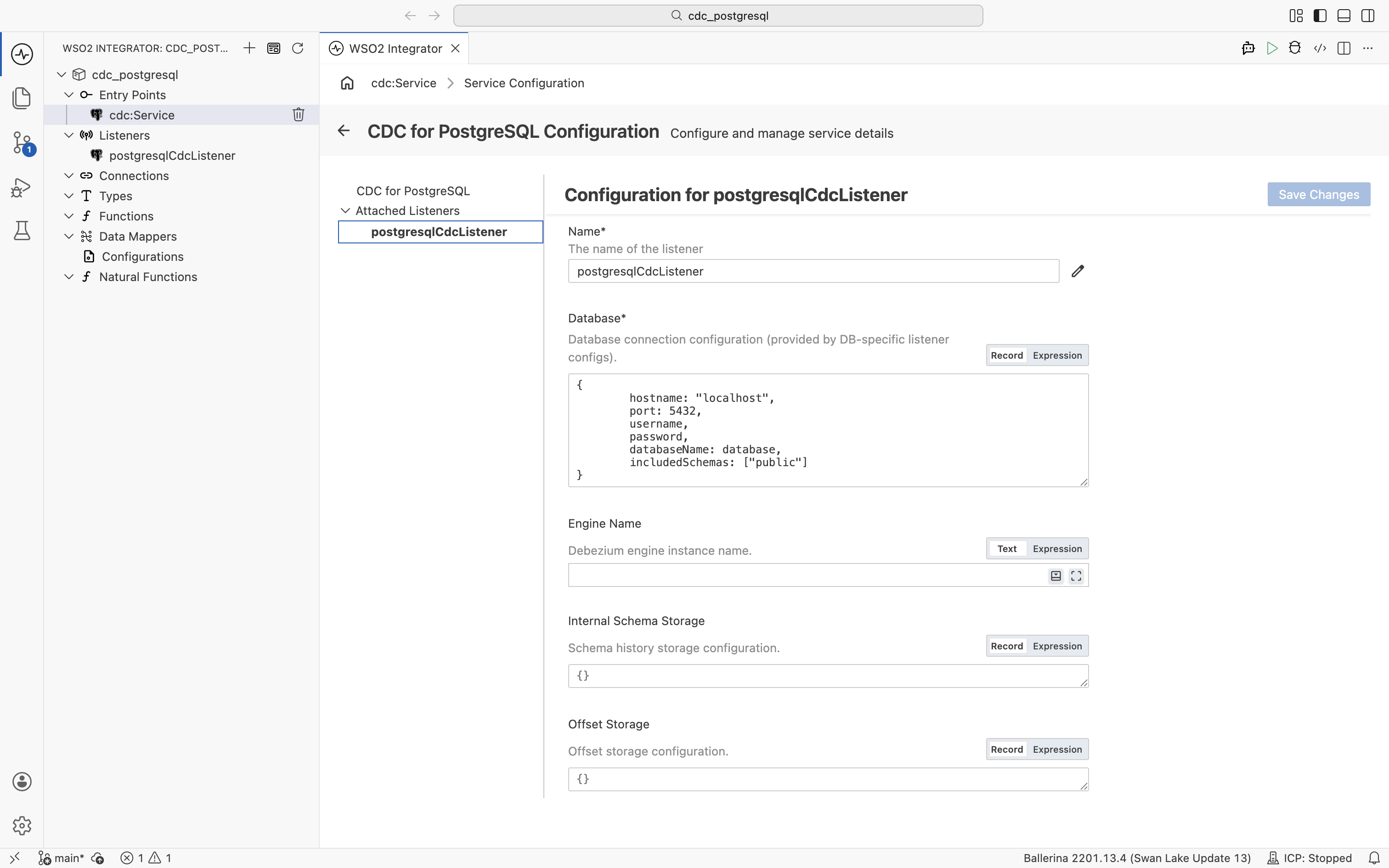
| Field | Description | Default |
|---|---|---|
| Name | Identifier for the listener. | postgresqlCdcListener |
| Database | Database connection configuration as a record expression with hostname, port, username, password, and databaseName fields. | Required |
| Engine Name | Debezium engine instance name. | ballerina-cdc-connector |
| Internal Schema Storage | Schema history storage configuration. | {fileName: "tmp/dbhistory.dat"} |
| Offset Storage | Offset storage configuration for tracking CDC progress. | {fileName: "tmp/debezium-offsets.dat"} |
| Liveness Interval | Interval in seconds for checking CDC listener liveness. | 60.0 |
| Options | Additional connector options as a record expression. | {} |
Click + Attach Listener to attach an additional listener to the same service.
Click Save Changes to apply updates.
The connector uses a logical replication slot and a publication on the source database. The defaults (debezium and dbz_publication) work for most cases. To change them or to control auto-creation, set replicationConfig and publicationConfig inside the Database field.
listener postgresql:CdcListener postgresqlCdcListener = new (database = {
    hostname: "localhost",
    port: 5432,
    username,
    password,
    databaseName: "mydb",
    includedSchemas: ["public"]
});
postgresql:PostgresListenerConfiguration accepts the following top-level fields:
| Field | Type | Default | Description |
|---|---|---|---|
database | postgresql:PostgresDatabaseConnection | Required | Database connection (see fields below) |
engineName | string | "ballerina-cdc-connector" | Debezium engine instance name |
internalSchemaStorage | cdc:InternalSchemaStorage | {fileName: "tmp/dbhistory.dat"} | Schema history storage configuration |
offsetStorage | cdc:OffsetStorage | {fileName: "tmp/debezium-offsets.dat"} | Offset storage configuration |
livenessInterval | decimal | 60.0 | Liveness check interval in seconds |
options | postgresql:PostgreSqlOptions | {} | PostgreSQL-specific CDC options |
The database value (postgresql:PostgresDatabaseConnection) has these fields:
| Field | Type | Default | Description |
|---|---|---|---|
hostname | string | "localhost" | PostgreSQL hostname |
port | int | 5432 | PostgreSQL port |
username | string | Required | Database username |
password | string | Required | Database password |
databaseName | string | Required | Database to capture changes from |
includedSchemas | string|string[]? | — | Regex patterns for schemas to capture |
excludedSchemas | string|string[]? | — | Regex patterns for schemas to exclude |
includedTables | string|string[]? | — | Regex patterns for tables to capture |
excludedTables | string|string[]? | — | Regex patterns for tables to exclude |
secure | cdc:SecureDatabaseConnection? | — | SSL/TLS connection configuration |
replicationConfig | postgresql:ReplicationConfiguration? | — | Logical decoding plugin and slot configuration |
publicationConfig | postgresql:PublicationConfiguration? | — | Publication name and autocreate mode |
tasksMax | int | 1 | Maximum connector tasks. The PostgreSQL connector always uses a single task, so this value is ignored |
connectTimeout | decimal? | — | Connection timeout in seconds |
For the full set of fields (including messageKeyColumns, includedColumns, excludedColumns, and streamingConfig), see the ballerinax/postgresql package on Ballerina Central.
Event handlers
Adding an event handler
- Visual Designer
- Ballerina Code
In the Service Designer, click + Add Handler. The Select Handler to Add panel lists onRead, onCreate, onUpdate, onDelete, onTruncate, and onError.
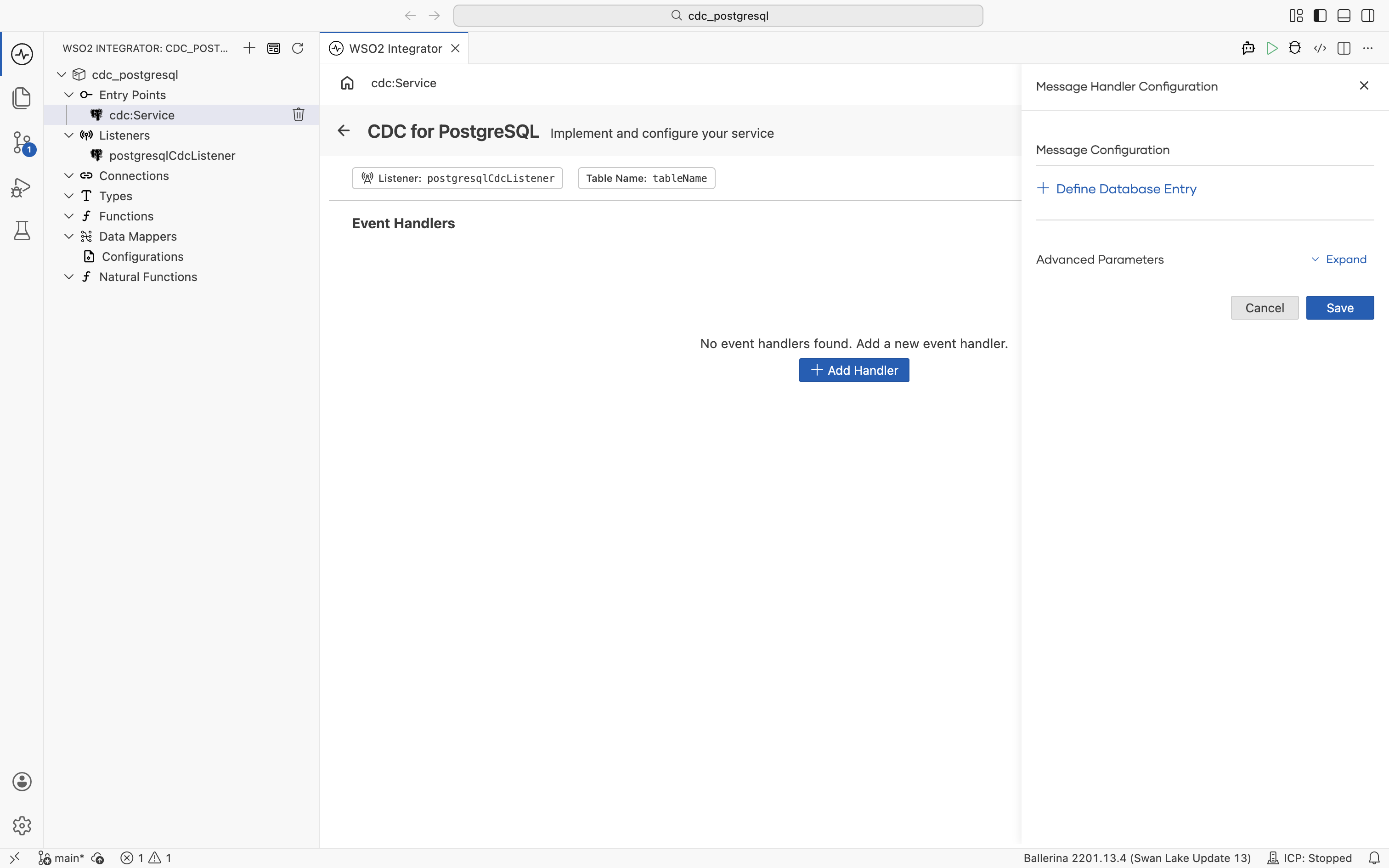
onRead, onCreate, onUpdate, and onDelete each open a configuration panel with a + Define Database Entry option to define the expected record type for the change event. Expand Advanced Parameters to find the TableName checkbox, which scopes the handler to a specific table. Click Save to add the handler.
onTruncate and onError are added directly without additional configuration.
By default, TRUNCATE operations are in the skippedOperations list, so onTruncate is not invoked. To receive truncate events, remove cdc:TRUNCATE from skippedOperations (for example, set it to []) in Options.
type Customer record {|
    int id;
    string name;
    string email;
|};

@cdc:ServiceConfig {
    tables: "mydb.public.customers"
}
service cdc:Service on postgresqlCdcListener {

    remote function onRead(Customer after) returns error? {
        log:printInfo("Initial snapshot row", data = after.toString());
    }

    remote function onCreate(Customer after) returns error? {
        log:printInfo("Row inserted", data = after.toString());
        check syncToDownstream("INSERT", after);
    }

    remote function onUpdate(Customer before, Customer after) returns error? {
        log:printInfo("Row updated",
                before = before.toString(),
                after = after.toString());
        check syncToDownstream("UPDATE", after);
    }

    remote function onDelete(Customer before) returns error? {
        log:printInfo("Row deleted", data = before.toString());
        check syncToDownstream("DELETE", before);
    }

    remote function onTruncate(string tableName) returns error? {
        log:printInfo("Table truncated", tableName = tableName);
    }

    remote function onError(error err) returns error? {
        log:printError("CDC processing error", 'error = err);
    }
}
The onCreate, onUpdate, onDelete, and onRead handlers receive the row data as record {} (or a typed record matching your table columns, as shown by Customer above). onTruncate accepts no parameters, or a single string tableName parameter that holds the name of the truncated table.
Handler types
| Handler | Triggered when | Use when |
|---|---|---|
onRead | A row is read during the initial snapshot of the table | Bootstrapping downstream systems with existing data |
onCreate | A row is inserted into the tracked table | Syncing new records to downstream systems |
onUpdate | A row is updated in the tracked table | Propagating field changes |
onDelete | A row is deleted from the tracked table | Removing records from downstream systems |
onTruncate | The tracked table is truncated (PostgreSQL only; skipped by default) | Clearing or resetting downstream data |
onError | A CDC processing error occurs | Logging failures and sending alerts |
What's next
- CDC for Microsoft SQL Server — capture changes from Microsoft SQL Server tables
- Kafka — consume messages from Apache Kafka topics
- Connections — reuse database credentials across services