AI Gateway Security: Guardrails for LLM Traffic
The moment you put a large language model behind a public endpoint, your threat model changes. A traditional API gateway inspects headers, tokens, and IP addresses, and for most services that is enough, but for an LLM it is not. The payload that matters is the prompt itself, the block of free text the model treats as instructions.
That shift, from metadata to content, is why standard API security doesn't fully cover LLM traffic. This is why teams running multiple model providers, attributing AI spend across teams, handling regulated data in prompts, or scaling past a single-team pilot tend to introduce a dedicated AI gateway as a control plane. This guide walks through the concrete controls that secure LLM and agent traffic: prompt-injection defense, PII redaction, authentication and RBAC, guardrails, and audit logging, mapped to OWASP categories and to the compliance obligations.
What Is AI Gateway Security?
AI gateway security is the practice of inspecting, filtering, and governing the content of every AI interaction at a dedicated control point that sits between your applications and the models they call. A traditional API gateway manages traffic based on metadata such as HTTP headers, tokens, API keys, IP addresses, and rate limits, while an AI gateway extends that role to the content itself by reading what's actually inside the prompt and the response before either reaches its destination.
That distinction matters because a prompt behaves less like structured data and more like a set of instructions the model will attempt to follow. A secure gateway built for LLM traffic does work a metadata-only proxy was never designed for: evaluating the content of a request for injected instructions, redacting sensitive data in real time, authenticating the caller, and recording the exchange for later review. The specific controls that do this, content inspection, policy enforcement, data protection, and logging, are covered in the next section.
Why Traditional API Security Falls Short for LLMs
Those metadata checks described above, stop working the moment the threat lives inside the LLM prompts. An attacker does not need a malformed header when the payload that hijacks a model is a polite paragraph of English. The attack surface shifts from the envelope into the free-text content of the call, which is territory legacy gateways were never built to inspect.
The OWASP Top 10 for LLM Applications makes the gap explicit. Its number one entry, LLM01 Prompt Injection, describes exactly this class of attack as a crafted input that overrides the developer's original instructions. No amount of TLS, token validation, or IP filtering catches it, because every one of those checks passes while the malicious instruction rides along inside a legitimate request.
There is a second problem: standard gateways do not read responses for what they leak. An LLM can emit training data, another user's context, or its own system prompt, and a metadata-only proxy has no mechanism to catch it. Securing LLM traffic means treating the model as an untrusted component in both directions, inspecting the content going in and the content coming back out. That is the new attack surface, and closing it requires a content-aware layer.
Key AI Gateway Security Controls
Effective AI gateway security is defense in depth. No single filter stops every threat, so a production gateway layers several controls in the request and response path. The table below maps the primary LLM threats to the control that addresses each and the sections that follow explain how they work.
| Threat | AI gateway control | Reference |
|---|---|---|
| Prompt injection / jailbreak | Semantic filtering, prompt hardening, response analysis | OWASP LLM01 |
| Sensitive data leakage | PII detection and redaction (ingress + egress) | OWASP LLM02 |
| Unauthorized access | OAuth 2.1, RBAC, token lifecycle, least privilege | OWASP LLM06 |
| Unsafe or non-compliant output | Guardrails, content filtering, DLP, tool risk scoring | OWASP LLM10 |
| No accountability | Immutable audit trail with risk scores | GDPR / EU AI Act |
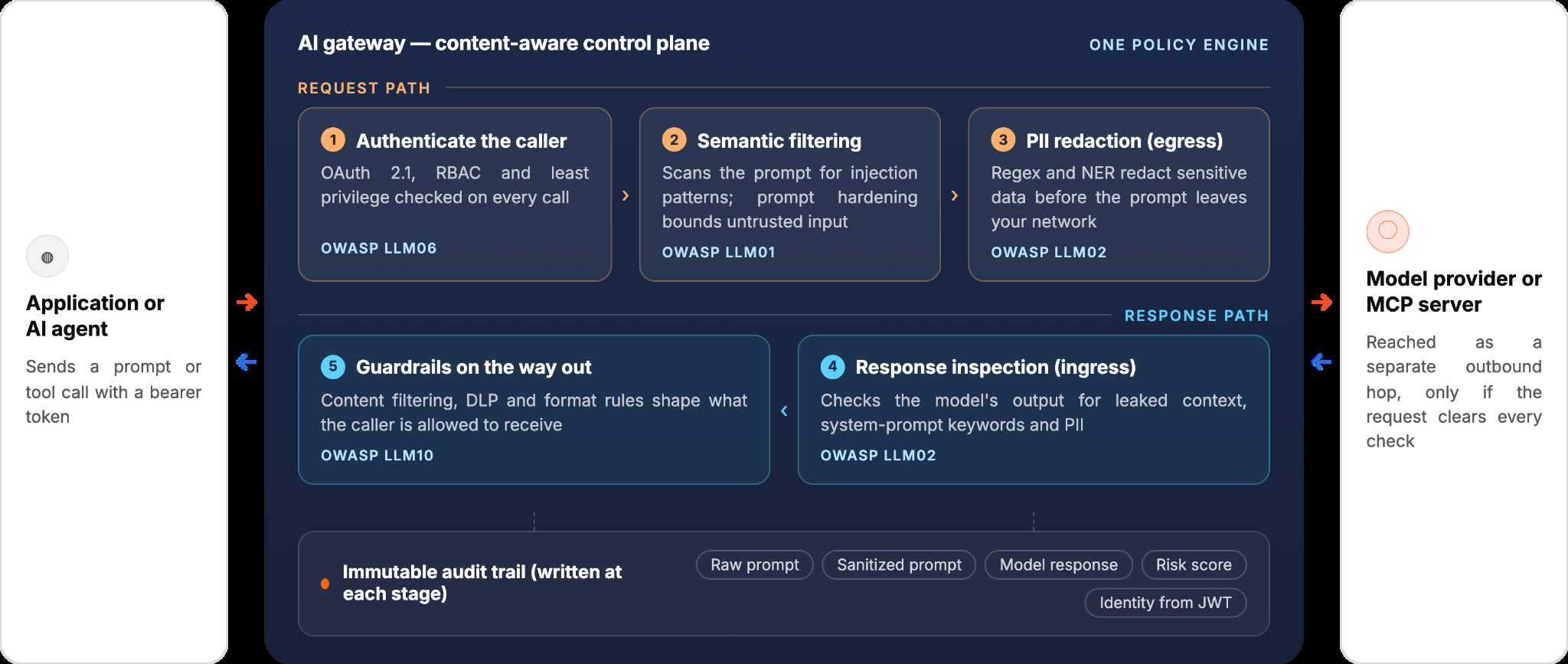
The above figure shows the request and response flow through an AI gateway's security layers.
Prompt-injection defense (OWASP LLM01)
Prompt injection tricks the model into ignoring its original instructions, whether that means goal hijacking, leaking the system prompt, or executing a forbidden function. A layered prompt injection defense combines three techniques.
- Semantic filtering and sanitization analyze prompt content for known attack patterns such as "ignore your instructions" or "you are now in developer mode."
- Instructional defense or prompt hardening, prepends hardened security instructions that create a semantic boundary between the trusted system prompt and untrusted user input.
- Response analysis inspects the model's output before it reaches the user and blocks it if it contains system-prompt keywords or triggers a forbidden action.
PII detection and redaction
Once a prompt leaves your network for a third-party model, any sensitive data inside it is out of your control. A gateway addresses this on both sides of the exchange. On egress, it scans outbound prompts using regular expressions and Named Entity Recognition to detect and redact PII in real time before the prompt is sent. On ingress, it inspects responses to check whether the model has revealed data it shouldn't have. PII redaction on both sides substantially reduces the chance that names, account numbers, or health record details reach an external provider, which lowers regulatory exposure and breach risk without eliminating either entirely.
Authentication, authorization and RBAC
AI gateways enforce security at the identity layer with end-to-end authentication and authorization applied on every call. Modern deployments integrate with OAuth 2.1-compliant identity infrastructure and add token lifecycle management so that credentials are issued, rotated, and revoked cleanly. Role-based access control then applies least privilege access, scoping each user or service to only the models, routes, and rate limits it needs. The gateway authenticates the caller on every request, not just at login. It narrows how much damage a leaked token can do.
Guardrails and content filtering
Beyond injection and PII, output can be unsafe, off-policy, or simply wrong in a costly way. Guardrails are the configurable rules a gateway applies to shape and constrain traffic, such as blocking disallowed topics, enforcing structured formats, or running data-loss-prevention by scanning across requests and responses. In agentic settings, guardrails extend to tool risk scoring, rating how sensitive a given tool call is before allowing it, combined with rate limits that cap how much an agent can do within a given window. These controls shift from filtering bad input towards constraining what the system is permitted to do.
Audit logging and observability
You cannot govern what you cannot see. A proper AI gateway log includes the full raw user prompt, the sanitized prompt actually sent, the complete model response, the details of security actions taken, a risk score, cost and latency metrics, and the authenticated user identity pulled from the JWT. Logging every AI interaction into an immutable audit trail gives you the who, what, and when for forensics, incident response, and regulator questions. It is the accountability layer that makes the other controls verifiable.
AI Gateway Security and Compliance (GDPR, HIPAA, EU AI Act)
Security controls and compliance obligations overlap significantly at the gateway layer, since much of what regulators ask for is exactly what a secure AI gateway is already positioned to provide. GDPR calls for data minimization and records of processing activities; the gateway's real-time PII filtering supports the first, and an audit trail that captures every interaction supports the second. HIPAA requires reasonable safeguards against unauthorized disclosure of protected health information; egress redaction reduces the risk of PHI reaching a third-party model call.
The EU AI Act raises the bar for high-risk AI systems, requiring technical and organizational controls, logging, and human oversight, though the timeline for those obligations has shifted. On June 29, 2026, the EU's Digital Omnibus simplification package became law and reset the compliance clock. Stand-alone high-risk systems under Annex III now have until December 2, 2027, and product-embedded high-risk systems under Annex I until August 2, 2028. Article 50's transparency obligations, disclosing AI interaction and labeling AI-generated content, were not delayed and remain due August 2, 2026.
Regardless of the exact date, an AI gateway is a natural place to implement several of the underlying controls: centralized audit records, enforced access policy, and content filtering all map to what the Act expects from high-risk deployments.
Centralizing these controls at the gateway rather than rebuilding them in every application reduces duplicated effort and gives auditors a single, consistent place to look. When PII redaction, access control, and logging live at the gateway, individual application teams rely on a shared set of controls instead of reimplementing their own. This narrows the audit surface to one well-instrumented layer.
Securing Agentic AI and MCP Traffic
Agentic AI raises the stakes. An autonomous agent does not just answer questions, it takes actions such as calling tools, querying databases, and chaining requests without a human in the loop. That requires continuous verification rather than a one-time login: the gateway authenticates the agent and then verifies every action, enforcing policy inline in the request path, for the full session on every tool call. Trust is re-checked continuously rather than assumed once and cached.
Two patterns matter most for securing MCP and agent traffic:
- Least-privilege access at the agent level: define an agent's job in plain language and grant it a tailored persona with only the tools and permissions it needs, then enforce strict boundaries on what it can access and execute.
- Controlling which MCP servers an agent can reach: the Model Context Protocol lets agents discover and call external tool servers, and a malicious or unvetted server can be a path to data exfiltration.
A gateway that enforces its own allowlist of approved servers, rather than relying on MCP's public server registry as a trust signal, combined with inline authorization keeps agents from reaching servers that haven't been explicitly approved. DLP scanning on agent requests and server responses catches sensitive data exposure across dozens of detection types. This is the missing agentic security layer that moves AI from experimental prototypes to production-ready assets. WSO2 Agent ID implements this pattern directly, defining which agents can connect to which MCP servers and enforcing OAuth 2.1 on those connections, so trust rests on an explicit, gateway-managed list rather than on registry presence alone, governed through the same control plane as the rest of the AI Gateway.
AI Gateway Security with WSO2
The controls above are vendor-neutral, and several vendors implement them well. Cequence, Cloudflare, and Portkey all offer capable AI security features. WSO2's positioning centers on depth in identity and governance paired with an open-source, deployment-flexible foundation, which matters most when the data involved is regulated.
The WSO2 AI Gateway is a single control plane spanning outbound LLM traffic and inbound MCP/agent traffic, both delivered through the WSO2 API Platform and governed by the same policy engine. It maps to the security controls in this guide as follows:
- Guardrails on outbound LLM traffic: The LLM Gateway applies AI guardrails including semantic prompt validation, PII masking, and URL and JSON Schema checks, with semantic caching to reduce cost and latency. It integrates with Azure Content Safety and AWS Bedrock Guardrails, or a custom provider. It then routes across OpenAI, Azure AI, AWS Bedrock, Anthropic, and Mistral AI with round-robin and failover.
- Identity-based access control: WSO2 Identity Server provides OAuth 2.1, RBAC and token lifecycle management. Therefore, authentication and least privilege are enforced by a dedicated identity system rather than bolted on.
- Agent and MCP security: The AI Gateway governs inbound agent traffic, auto-generates MCP servers from existing REST APIs, catalogs them in the MCP Hub, and enforces authentication, authorization, throttling, and rate limiting on every agent call, with MCP traffic insights for visibility. Agent ID complements this by treating each agent as a distinct, auditable identity. It enforces OAuth 2.1 for MCP connections specifically, can require user consent before an agent acts autonomously and flags unusual access patterns against an established baseline.
- Token-based controls and chargeback: Token-based rate limiting plus department-level chargeback keep usage bounded and accountable.
Another important consideration for security teams is deployment flexibility. WSO2 is 100% open source and can run self-hosted for full data sovereignty and air-gapped environments, hybrid with the data plane inside your network and a SaaS control plane, or fully managed in the cloud. For teams with GDPR or HIPAA data-residency requirements, running the data plane on your own infrastructure means sensitive prompts stay within your environment rather than transiting to a third-party control plane. WSO2's control plane also supports gateway federation for external gateways, which matters if you're adding AI governance to an existing multi-gateway architecture rather than starting from a blank slate.
Conclusion
LLM threats are largely content-level: a prompt-injection payload can ride through metadata checks untouched, and a response can leak data a network proxy was never built to inspect. Pairing content-aware guardrails, PII redaction, OAuth 2.1-based identity, and an audit trail at a single control plane addresses most of that gap and turns experimental AI into a governed, compliant, production system. If you're evaluating what that looks like in practice, the WSO2 AI Gateway brings guardrails, identity and flexible deployment together under one control plane for both LLM and agent traffic.
Frequently Asked Questions
What is an AI gateway in enterprise AI security? It's a content-aware control plane that sits between your applications and the AI models they call. It inspects prompt and response content, not just request metadata in order to catch threats like prompt injection, redact sensitive data, enforce authentication, and logs every AI interaction for review.
How is a secure AI gateway different from a standard API gateway? A standard API gateway manages traffic based on metadata: headers, tokens, and IP rules. Those checks don't inspect what's inside an LLM prompt. A secure gateway built for AI traffic reads the content itself and applies semantic filtering, PII redaction and response analysis based on what it finds.
Does an AI gateway help with GDPR and HIPAA compliance? It supports several of the technical controls both frameworks call for. Real-time PII filtering aligned with GDPR's data-minimization principle, keeps HIPAA-protected health information out of third-party model calls, and audit logging that maps to records of processing that regulators require.
How does an AI gateway secure agentic AI and MCP traffic? It treats agent identity as a problem distinct from model access: authenticating each agent independently, scoping which MCP servers it can reach, and requiring consent before it acts autonomously.