LLM Routing: How It Works, Strategies, and Why It Matters
At one point in time, there were very few models to choose from. This meant that most teams started with one model and one API key and brought LLM capabilities into their apps and services. Now, models are coming out at an extremely rapid pace with wildly differing capabilities.
Daily it seems that a cheaper model ships, a frontier model gets better at reasoning, a compliance rule forces an EU-hosted option, and suddenly a single hardcoded endpoint is a liability. LLM routing is how you turn that sprawl into a decision: send each request to the model that best fits its cost, latency, and capability needs, and switch models without rewriting application code. This guide explains what LLM routing is, the main routing types and strategies, how it differs from load balancing, the challenges that come with running multiple models, and where a governed gateway fits.
What Is LLM Routing?
LLM routing is the practice of directing each request to the most suitable model from a pool of options, based on factors like cost, latency, capability, and availability. A routing layer sits between your application and the model providers. It evaluates each incoming request and selects the best model in real time, rather than sending everything to one hardcoded endpoint. The component that makes that decision is often called an LLM router.
The traffic control analogy is a useful one. LLM routing is comparable to a smart traffic controller guiding user queries to the most appropriate API or tool, the way air traffic control sequences aircraft instead of letting every pilot pick their own runway. A simple classification or extraction task does not need a frontier model. A complex, multi-step reasoning task does. Routing matches the request to the right model instead of overpaying for everything or under-serving hard queries.
This is a shift away from the traditional single-model approach, which lacks adaptability. Once you run models from more than one provider, you need something that decides where each request goes. That is the job LLM routers do.
Why LLM Routing Matters (Cost, Reliability, Flexibility)
Routing is becoming a critical capability for three practical reasons: it cuts cost, it improves reliability, and it keeps you flexible in a market that changes monthly.
Cost. The biggest driver is matching request complexity to model capability. Simple tasks such as classification or extraction go to cheaper models, while complex reasoning goes to frontier models. Practitioners report that this kind of matching typically saves 50 to 80 percent on inference spend, and responses for the simplest requests can be roughly 90 percent cheaper when served by a smaller model. Because routing concentrates traffic through one layer, it also gives finance a place to track spend per project instead of staring at a single provider dashboard that only shows total spend. If cost is your primary driver, pair routing with a broader LLM cost control strategy that adds budgets and token limits on top.
Reliability. When one provider has an outage or rate-limits you, a router can fail over to a backup model automatically. The application keeps working. That single behavior, automatic failover, is often what moves routing from a nice-to-have to a production requirement.
Flexibility. Routing keeps you model-agnostic instead of locked into one vendor. Developers set a field in their request and the router handles delivery to any supported model, so teams can adopt a better or cheaper model as it appears without building a special integration for each one. In an ecosystem where competitors regularly match or surpass the current leader, that optionality is worth real money.
Types of LLM Routing
Routing mechanisms fall under a few categories. Most implementations combine them.
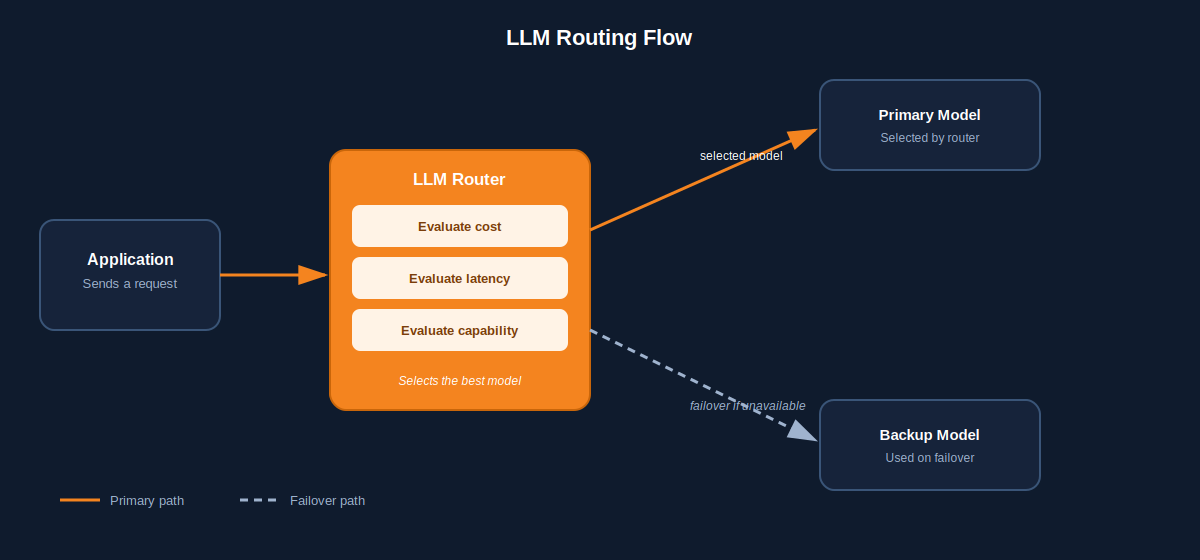
The above figure shows how routing layer evaluates each request against cost, latency, and capability signals, selects the best model, and falls over to a backup provider when the primary is unavailable.
Static routing
Static routing uses preset rules that do not examine request content. The classic example is round robin, which distributes requests evenly across a set of models in rotation. Rule-based variants send traffic by fixed criteria, such as always routing a given project or API key to a specific model. Static routing is predictable and simple to reason about, which is why it is a common starting point. Its limit is that it ignores what each request actually needs.
Dynamic routing
Dynamic routing adjusts in real time to the changing state of the system and the demands of each query. It uses task requirements and live model performance metrics, such as latency, error rate, and resource availability, to select the most appropriate model per request. Because it reacts to current conditions, dynamic routing adapts when a provider slows down or a queue backs up, at the cost of more moving parts to monitor and tune.
Model-aware routing
Model-aware routing chooses models based on their specific capabilities. It considers where each model is strong, then sends coding tasks to a model that codes well and long-context summarization to a model built for it. Model aware routing is where cost and quality gains compound, because it stops treating models as interchangeable and starts assigning work by fit. It also depends on good evaluation data, since the router needs to know how each model actually performs on each task type.
LLM Routing vs. Load Balancing
These two get conflated, and there is a very big difference between these two tactics. Load balancing distributes requests evenly to prevent any one backend from being overloaded. It is about spreading traffic. LLM routing considers the content and requirements of each request, then selects the best model based on cost, latency, and capability. It is about matching.
The cleanest way to hold the distinction: load balancing asks "which instance is free?" while routing asks "which model is right?" Load balancing can even be one routing strategy among several. Round robin across identical model deployments is really load balancing wearing a routing label. True routing is content-aware. It reads the request before it decides.
| Load balancing | LLM routing | |
|---|---|---|
| Decision basis | Availability and even distribution | Request content, cost, latency, capability |
| Goal | Prevent overload, spread traffic | Match each request to the best model |
| Awareness | Content-agnostic | Content-aware |
| Typical trigger | Backend is busy or down | Request needs a cheaper, faster, or more capable model |
In practice a mature setup uses both. Routing picks the target model, and load balancing spreads requests across the healthy instances of that model.
Key Routing Strategies and Criteria
Once you decide to route, the question becomes what to route on. The common criteria map to the trade offs every team makes between cost, latency, and quality.
- Cost-based routing. Send each request to the cheapest model that can handle it. This is where most of the 50 to 80 percent savings come from, driven by matching simple work to smaller models.
- Latency-based routing. Prefer the fastest available model, which matters for interactive and user-facing paths where response time is the product.
- Weighted routing. Split traffic by fixed percentages, useful for canary rollouts of a new model or for gradually shifting load between providers.
- Capability or quality routing. Route by which model performs best on the task, the model-aware approach applied as an explicit strategy.
- Failover routing. When the primary model is unavailable, automatically send the request to a backup. This is the reliability play that can keep applications and services in service when there is an issue with the primary model. For the deeper failover patterns, retry logic, and health checks involved, see our guide to LLM fallback.
Most decisions involve trade offs. A cheaper model may be slower or less accurate, and the fastest model may not be the cheapest. Good practice, following the pattern several router designs use, is to make the trade offs explicit at the application level and let the router carry them out per request, rather than baking one global rule for every workload. Standardized benchmarks help you make those calls with data. RouterBench evaluates routing systems across cost, latency, and accuracy, and the RouteLLM research project studies learning to route between a strong and a weak model from preference data. Both are worth reading before you settle on a strategy.
Challenges and Best Practices
Running multiple models is not free of friction. Operating several LLMs introduces complexity because each model has unique strengths and constraints, and integration across providers takes work.
When implementing a multi-model setup and the corresponding routing, here are the main challenges most organizations face:
- Consistency. Ensuring stable, predictable output quality when the same prompt can land on different models. Two models rarely format or reason identically.
- Evaluation. You cannot route by capability without measuring capability. Routing quality is only as good as the eval data behind it, so a constant feedback loop that compares how each model performs and switches specific tasks to better models is essential.
- Bias and ethics. A router does not fix model bias or hallucination on its own. What it does give you is the ability to compare providers and switch or test models easily, which supports responsible model selection.
- Operational overhead. More providers means more keys, more rate limits, more failure modes, and more places for cost to hide.
The best practices that address these are simple in theory but can be difficult to implement. Firstly, teams doing multi-model routing should centralize LLM requests through one layer so you get a single place for security inspection, cost tracking, and monitoring, which is more secure and efficient than every application calling providers directly. Start simple with static routing or round robin, then add dynamic and model-aware logic as you gather performance data. You also need to keep a feedback loop that re-evaluates model choice over time. The last common hurdle is the need to treat data residency as a first-class routing input, since some workloads must stay in a specific region such as the EU.
LLM Routing with WSO2 AI Gateway
Research projects and standalone router libraries prove the ideas. What enterprises need is routing that comes with governance, security, and observability built in, at the layer where all AI traffic already passes. That is the case for doing routing at an AI gateway rather than in each application.
The WSO2 AI Gateway sits over outbound LLM traffic through its LLM Proxy. You create an AI API by selecting an AI service provider, with built-in support for OpenAI, Azure OpenAI, AWS Bedrock, Anthropic, Google Gemini, Mistral AI, and Azure AI Foundry, plus custom services. From there the relevant routing capabilities include:
- Multi-model routing. Dynamically route across multiple models within a provider, so a single AI API can spread work over several models.
- Load balancing and failover. Distribute requests across models and providers with round robin, and automatically route to a backup provider when the primary is unavailable. That is failover implemented at the gateway, so every application behind it inherits the behavior without its own retry code.
- Semantic caching. An embedding-based cache with configurable similarity thresholds and TTLs, with a best-practice starting similarity threshold of 0.95. WSO2 documentation notes that semantic caching can reduce API calls by roughly 40 to 60 percent, which compounds the savings routing already delivers.
- Token-based rate limiting and chargeback. Enforce token-level rate limits and spending limits, with department-level chargeback so cost is attributable by team.
- Observability. Usage statistics and performance metrics across all routed traffic, which is exactly the eval and monitoring feedback loop that model-aware routing depends on.
The differentiator for our offering is that routing, guardrails, PII masking, caching, cost control, and observability live in one governed control plane rather than scattered across application code. WSO2 API Platform is 100 percent open source and deploys self-hosted, hybrid, or as SaaS, so data-residency and air-gap requirements are a deployment choice rather than a blocker.
Conclusion
LLM routing sends each request to the best model by cost, latency, and capability, and it is most powerful when it runs at the gateway rather than in scattered application code. Start with a simple static routing rule, measure how your models actually perform, then layer in dynamic and model-aware logic, failover, and caching as the data comes in. Do it centrally and you get cost attribution, security inspection, and reliability as a byproduct rather than a series of one-off integrations. To see governed routing, load balancing, failover, and semantic caching in one control plane, explore the WSO2 AI Gateway.
Frequently Asked Questions
What is an LLM router? An LLM router is a system that directs user queries to the most appropriate model from a pool of models, matching the right tool to the right job. It evaluates each request and selects a model based on cost, latency, capability, and availability, and it lets developers reach many models by setting a field in the request rather than integrating each provider separately.
How does routing work in LLM models? A routing layer intercepts each request before it reaches a provider. It evaluates the request, static routing applies preset rules such as round robin, dynamic routing reads real-time performance metrics, and model-aware routing weighs each model's capabilities, then it forwards the request to the selected model and can fail over to a backup if that model is unavailable.
How does LLM routing reduce costs? By matching request complexity to model capability. Simple tasks such as classification and extraction go to cheaper models, while complex reasoning goes to frontier models. Teams typically save 50 to 80 percent, and the cheapest requests can be around 90 percent less expensive than sending everything to a top-tier model.
What is the difference between LLM routing and load balancing? Load balancing distributes requests evenly to prevent overload and is content-agnostic. LLM routing considers the content and requirements of each request and selects the best model based on cost, latency, and capability. Load balancing may be one strategy inside a broader routing setup.