Vertical AI API Strategy: Building Domain-Specific AI APIs
Ask a general-purpose model to reschedule a cardiology appointment and it will write a polite, confident reply. It cannot see the clinic's schedule, verify the patient, or update the record. That gap between fluent language and a completed task is where vertical AI lives.
For engineering teams, closing it is mostly an API problem. The model is the easy part. The integrations, identity, and guardrails around it are where the real design decisions sit. This guide is part of WSO2's broader guide to building and governing LLM APIs. It covers the layers, the build-or-buy decision, and what governance a vertical AI API needs in production.
What Is Vertical AI, and Why Build It as an API?
Vertical AI is AI narrowed to the knowledge, terminology, and workflows of specific industries such as healthcare or financial services. In practice, it is rarely a separate kind of model. It is a domain layer of knowledge, integrations, and guardrails built around a general-purpose foundation model. That layer is increasingly delivered and consumed as an API.
IBM describes vertical AI agents as specialized systems built for tasks in one industry or area of expertise. That definition is useful, but it describes the consumer of the capability rather than how the capability is delivered. Once more than one team needs the same domain logic, it has to live behind a stable interface.
An API gives industry-specific AI the properties any shared capability needs. It has a versioned contract, so a patient portal, a contact center tool, and an internal agent can all call the same appointment logic. It has an authentication boundary, so each caller gets only the access it should. It also produces usage data, so you can attribute cost and prove what happened during an audit.
Vertical AI agents vs. vertical AI APIs
The two terms are often used as if they mean the same thing. They don't. A vertical AI agent is an actor. It plans, reasons, and decides which tools to call. A vertical AI API is the governed contract through which domain capability is exposed. Agents call APIs, and so do web apps, batch jobs, and partner systems.
This distinction matters for design. If you build domain logic directly into one agent, only that agent can use it. Expose it as an API or a governed tool instead. Then every consumer gets the same behavior, access controls, and audit trail. Most engineering teams end up needing both, with the API as the durable layer and the agents as its consumers.
Why General-Purpose AI Runs Out of Road in Regulated Industries
General-purpose AI handles broad language and reasoning tasks well. It starts to fall short when a task depends on domain expertise, strict data rules, or a system of record. Four gaps show up repeatedly in regulated industries, and each one is a reason to add a vertical AI layer.
- Domain expertise: Clinical and financial language carries meaning a general model may miss. A vertical system knows that a "hold" on a payment and a "hold" on a medication order are different events with different consequences.
- Regulatory alignment: Healthcare, finance, and legal work sit under strict rules for data handling, access, and audit. A general-purpose model has no built-in knowledge of which data a caller may see.
- Automation and efficiency: Many domain processes are repetitive and rules-driven. Automating them frees specialists for work that needs judgment.
- Competitive differentiation: A vertical offering that solves an exact business problem is harder to replace with a generic tool.
The earliest wins tend to come from compliance-heavy administrative work. Claims processing, medical billing, clinical documentation, and customer service are good candidates for a first vertical AI project. They are routine enough to automate and regulated enough that the guardrails matter from the first release.
The Layered Architecture: From Foundation Model to Vertical Layer
Vertical AI is best understood as a set of layers built on top of general-purpose foundation models. Four layers cover most designs.
- Foundation model layer: A general-purpose model from a provider such as OpenAI, Anthropic, Google, or Mistral. It supplies language and reasoning. You rarely own it.
- Knowledge layer: The domain knowledge the foundation model lacks. This includes retrieval-augmented generation over curated sources, specialized knowledge bases, and in some cases fine-tuned models trained on proprietary data.
- Integration layer: Connections to systems of record such as EHRs, claims platforms, core banking, and payment services. Domain standards define much of this layer. FHIR, the HL7 standard for healthcare data exchange, defines resources such as Appointment, Schedule, and Slot that a scheduling workflow would use. A Slot marks time that may be available for booking. It is not a guaranteed booking.
- Guardrail and governance layer: Consent handling, access controls, PII masking, output validation, and audit logging. This layer turns a working prototype into something you can run in regulated industries.
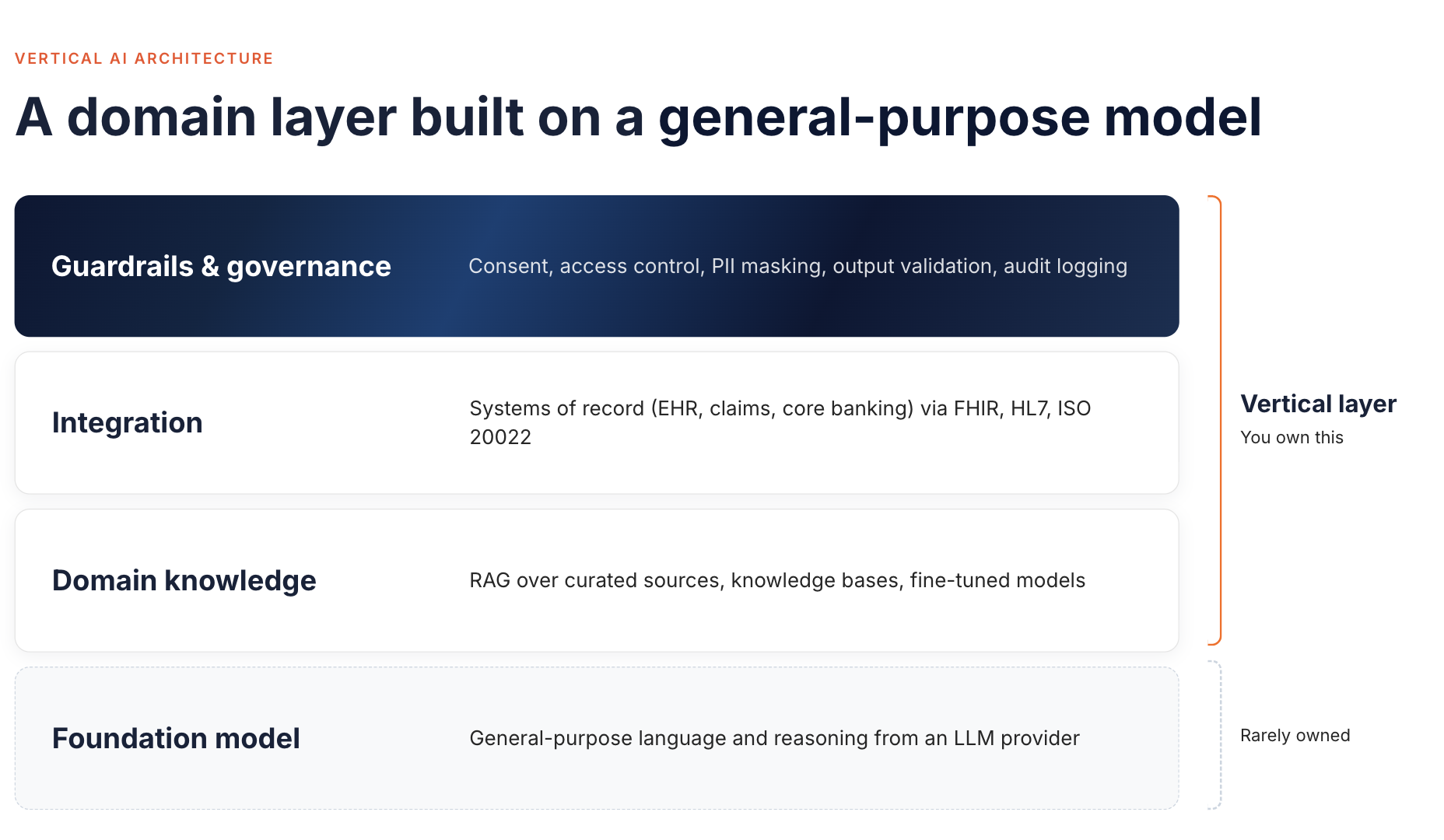
These are layers of responsibility, not a chain of network hops. A single request does not pass through four services in order. Retrieval, integration calls, and policy checks run where the design needs them. Some run in parallel and some are skipped entirely for a given request.
At runtime, two traffic paths matter, and they are independent. The inbound path carries calls from clients and agents to your vertical API or tools. The outbound path carries calls from your service to an LLM provider. Each path needs its own authentication, limits, and logging. The WSO2 API Platform governs both paths from one control plane. The AI Gateway handles outbound LLM calls and inbound MCP tool access, and the API Gateway handles inbound REST calls.
The integration layer is also where domain-specific systems differ most. On the integration side, separate from the gateway, WSO2's healthcare integration supports FHIR, HL7 v2, CDA, and X12, with prebuilt transformers from HL7, X12, and CCDA to FHIR. For financial services, WSO2 provides prebuilt artifacts for ISO 20022, ISO 8583, and SWIFT MT, along with BIAN-based interoperability. This is the unglamorous work that decides whether a vertical AI agent can act on real data or only talk about it.
Build, Buy, or Integrate? The Real Engineering Decision
Every team building vertical AI faces a build-or-buy question, and there is a third option that often fits better. You can build the vertical layer yourself or buy a vertical-specific product. You can also integrate a general-purpose model with a governed API layer that adds the domain pieces around it.
| Approach | Control | Speed to production | Compliance burden |
|---|---|---|---|
| Build a custom vertical stack, possibly with fine-tuned models | Highest. You own the application code, data, and logic. Rights to model weights depend on the base model's license | Slowest. Needs ML, data, and domain expertise in-house | On you. Every control is yours to design and prove |
| Buy a vertical-specific product or model | Lowest. Behavior and roadmap belong to the vendor | Fastest for standard workflows | Shared. Depends on the vendor's certifications and your contract |
| Integrate a general-purpose model behind a governed API layer | High where it counts: knowledge, integrations, and guardrails | Moderate. Reuses existing identity, integration, and API tooling | On you, but enforced centrally rather than in each app |
Buying makes sense when the workflow is standard and a vendor already meets your compliance needs. Building makes sense when your proprietary data is the differentiator and you can staff a team to maintain models. For most engineering teams, integrating is the practical default. It keeps domain logic and data under your control while letting the foundation model change underneath.
Provider choice also shapes this decision. Google Cloud's 2025 ROI of AI study surveyed 3,466 senior leaders. In it, 37% of respondents placed data privacy and security among their top three LLM provider considerations. Integration with existing systems and cost followed. Those are the same concerns an integration layer is designed to address.
Whichever path you choose, the case for a dedicated governance layer comes from operational triggers rather than traffic volume:
- Multi-model needs: Different tasks call for different providers, or you need failover when a provider degrades.
- Spend attribution: Finance needs to know which product, team, or tenant consumed which tokens.
- Regulated data in prompts: Patient or account data can reach a model, so data privacy controls such as masking and audit logging become requirements.
- Production scale: More than one application or agent depends on the same domain capability, and inconsistent controls start to leak.
What This Looks Like in Practice: Two Worked Examples
Two vertical AI agents show how the layers and traffic paths fit together in enterprise AI systems. One works with a user present. The other works in the background.
User-present agent: rescheduling a cardiology appointment
In the traditional flow, a patient calls, waits for a transfer, and is verified more than once. Staff then search schedules by hand, update the booking, and send a confirmation. It is slow and error-prone.
A chat agent built on a vertical layer handles the same request differently:
- The patient authenticates through the organization's identity flow, so the agent acts with that patient's scope and nothing more.
- The agent lists upcoming appointments from the EHR through a governed tool that reads FHIR Appointment resources.
- It offers free Slot resources from the clinic's schedule and lets the patient pick one.
- The backend revalidates the selected slot and applies the change only if the appointment is still at the expected version. If another booking won, the API returns a conflict and the agent offers new times. The agent confirms only after the EHR does.
A small application contract makes this concrete. This is a proposed contract for your own API, not a standard FHIR reschedule operation:
POST /appointments/{appointmentId}/reschedule
Body: { "slotId", "expectedVersion", "operationId" }

200 Confirmed   The EHR accepted the change
409 Conflict    The slot was taken or the version changed
403 Forbidden   The caller may not change this appointment
The operationId makes retries safe. A repeated request with the same ID returns the first result instead of booking twice.
Two independent paths run during this conversation. The agent's reasoning calls go outbound to the LLM provider. Its tool calls go inbound through the governed interface to the EHR. Neither path routes through the other. Separate enforcement points let you limit, audit, and apply different controls to each path. They do not, by themselves, stop patient data from reaching the provider. A tool response can still land in the agent's next prompt. Minimize the fields each tool returns, and control which results may enter the model prompt. The EHR backend should also authorize every read and write, not only the login at the start.
User-absent agent: conditional bill payment
Ambient agents run in the background on triggers. Consider an agent that pays an electricity bill only when two conditions hold: the bill has been posted, and the user's salary has arrived.
Through open banking and service provider APIs, the agent checks bill status and account transactions. These are separate checks against separate systems, and either can complete first. When both conditions are true, the agent needs the user's approval to move money. It can request that approval through Client-Initiated Backchannel Authentication (CIBA). CIBA lets the agent obtain tokens after the user approves on a separate device, without a browser redirect. WSO2's identity platform supports the CIBA grant for this kind of decoupled approval.
CIBA handles authentication and consent. A generic CIBA token is not, by itself, proof that this exact payment was approved. The payment service must independently validate the payee, amount, account, scope, and consent state. It should execute the payment idempotently, so a retried request cannot pay twice. Where the bank defines a transaction authorization profile, use it to bind the approval to the payment.
The result is automation that stays auditable. The user keeps control of authorization, and every step leaves a record.
Governing Vertical AI APIs: What Safe, Compliant Deployment Requires
Four components separate a safe vertical AI deployment from a demo:
- Industry-specific model adaptation: Prompting, retrieval, or tuning against proprietary domain data and task logic.
- Workflow and decision logic: Existing processes encoded so that outputs match how the business already operates.
- Native integrations: Connectors to EHRs, banking APIs, messaging systems, and other domain systems.
- Regulatory guardrails: Consent flows, audit logs, data minimization, and validation.
The first three are domain engineering, and they differ across specific industries. The fourth is where API governance applies directly. Govern a vertical AI API the way you would govern any production API, and then add controls specific to AI traffic.
On the outbound path, the gateway sits between your application and the model provider. It can mask PII in prompts and responses, enforce a JSON Schema on output, and apply token-based rate limits. In this setup, the application never holds the provider's API key. Multi-provider load balancing and failover address the multi-model trigger.
On the inbound path, agents reach domain systems as tools through the Model Context Protocol (MCP). REST calls from apps and partner systems still follow the standard API gateway path. The AI Gateway example here covers the MCP part of inbound traffic.
Exposing a system's full tool list to every agent is rarely what a regulated workflow needs. WSO2 AI Gateway applies MCP governance to that traffic. It decides who connects, which tools each caller sees, what those tools are called, and how often they run. Authorization is checked per tool. A tool filtered out of a caller's list is never offered in the first place. For a scheduling agent, that means it can see appointment tools while billing tools stay out of reach.
Identity needs the same attention. An agent acting for a patient should carry that delegation explicitly. With WSO2 Agent ID, agents are first-class identities, and tokens record whether an agent acts for itself or on a user's behalf. That distinction is what makes audit logging meaningful when a reviewer asks who approved a change. Agent ID is an identity component, configured separately from the gateway.
Developer tooling closes the loop. WSO2 Integrator carries those healthcare and banking standards. WSO2 also describes the Integrator copilot as vertical-aware, meaning it knows how WSO2's industry libraries fit into vertical use cases. The gateway places LLM traffic and MCP traffic under one control plane, with integration and identity as companion components that have their own configuration. That gives engineering teams one place to set policy for both the model traffic and the tool traffic of a vertical AI system.
Where Vertical AI APIs Are Headed
General-purpose LLMs will keep supplying the foundation. The specialized vertical AI stacks built on top are where enterprise AI adoption turns into completed work. Those stacks meet domain rules, reach systems of record, and act within limits someone can audit.
For engineering teams, the takeaway is practical. In the architecture described here, the vertical capability lives mainly in domain data, integrations, and governance around a foundation model. Other systems also use domain-trained or domain-tuned models. The decisions that matter live in that layer: whether to build or buy, which integrations to support, and which guardrails to enforce.
Conclusion
The foundation model underneath a vertical AI system will keep changing. The work that lasts is the domain layer around it. That layer holds the integrations that reach systems of record and the identity model that records who acted for whom. It also holds the policies that decide what each caller can see and do.
Treat that layer as an API from the first release. Give it a versioned contract and keep its inbound and outbound traffic on separate, governed paths. Apply access controls and audit logging before a second consumer depends on it. Adding controls early costs less than retrofitting them onto an agent that already has broad access to patient or account data.
To bring LLM traffic and MCP tool traffic under one control plane, explore WSO2 AI Gateway. It works alongside WSO2's integration and identity capabilities to support the governed layer a vertical AI API depends on.
Frequently Asked Questions
What are verticals in AI?
A vertical is a single industry or domain, such as healthcare, banking, or insurance. Vertical AI is AI specialized for one of them, with that domain's terminology, data sources, and rules built in.
What is the difference between vertical AI and horizontal AI?
Horizontal AI serves many industries with broad, general capability. Vertical AI serves one industry with depth, adding domain knowledge, system integrations, and regulatory controls that general models lack.
How do you build vertical AI?
Most teams start with a general-purpose foundation model. They add a knowledge layer for domain context, an integration layer for systems of record, and a governance layer for access, masking, and audit. They then expose the result as an API.
Do vertical AI agents need their own identity?
Yes, in most regulated settings. A distinct agent identity lets you scope what the agent can reach and record whose behalf it acted on. It also separates agent actions from human activity in audit logs.

