GraphQL vs REST: Key Differences & When to Use Each
Sooner or later, every team building a new API reaches the same fork in the road: REST or GraphQL? The two approaches solve overlapping problems in different ways, and choosing one under deadline pressure often means living with the trade-off for years.
This guide explains how REST and GraphQL actually differ in data fetching, versioning, caching, and error handling, and where each holds up better in production. It also covers a question most comparisons skip: how to govern and secure both API types consistently once you've made your choice.
What Is REST?
REST (Representational State Transfer) is an architectural style for networked applications, first described in Roy Fielding's 2000 doctoral dissertation. A REST API exposes data as resources, each identified by a URL, and clients interact with those resources using standard HTTP methods such as GET, POST, PUT, and DELETE.
Core principles of REST
Three constraints account for most of what developers mean when they call an API "RESTful":
- Statelessness. Every request from a client must contain all the information the server needs to process it. The server doesn't keep session context between requests, which is what allows REST APIs to scale horizontally without sticky sessions.
- Resource-based URLs. Data is modeled as resources (a user, an order, a product) addressed by a URI, rather than as remote procedure calls.
- Standard HTTP verbs. HTTP methods carry defined semantics that a REST API is expected to respect:
GETfor retrieval,POSTfor creation,PUTfor full updates, andDELETEfor removal. This is also what makes REST responses straightforward to cache, sinceGETrequests can be cached at the HTTP layer without any API-specific logic.
REST doesn't require JSON, HTTP, or any particular implementation. Fielding's dissertation describes an architectural style, not a protocol. In practice, though, nearly every REST API today is built on JSON over HTTP.
What Is GraphQL?
GraphQL is a query language for APIs and a runtime for executing those queries against your data. It was originally developed at Facebook and open-sourced in 2015. Instead of many endpoints that each return a fixed data shape, a GraphQL API exposes a single endpoint backed by a schema, and clients specify exactly which fields they need in each request.
Core principles of GraphQL
- Single endpoint. Where a REST API might expose
/users,/users/{id}/orders, and/products, a GraphQL API typically exposes one endpoint. The shape of the response isn't fixed by the endpoint; it's determined by the query the client sends. - Schema and type system. Every GraphQL API is backed by a schema, written in Schema Definition Language (SDL), that defines the available types, fields, and relationships. The schema serves as a contract between client and server and as introspectable documentation.
- Client-specified queries. A client asks for exactly the fields it needs in a single round trip, even when those fields come from related types nested several levels deep.
Key Differences Between GraphQL and REST
The two architectures differ most visibly in how they fetch data, but the differences extend to versioning, error handling, and caching too.
| Dimension | REST | GraphQL |
|---|---|---|
| Endpoint structure | Multiple endpoints, one per resource type | A single endpoint for all queries and mutations |
| Data fetching | Fixed response shape per endpoint | Client specifies the exact fields it needs |
| Versioning | Typically versioned in the URL (/v1/, /v2/) | Schema evolves by adding fields; existing queries keep working |
| Error handling | HTTP status codes (404, 500, and so on) | Typically 200 with a data/errors envelope; request-level failures can return 4xx/5xx depending on the media type |
| Caching | Cacheable when the method, directives, and authorization allow it | Client- or gateway-level caching by default; GET plus persisted queries can enable HTTP caching |
| Real-time support | Usually added through webhooks or polling | Subscriptions are part of the GraphQL spec |
| Learning curve | Familiar to most backend developers | Requires learning schema design and resolver patterns |
Data fetching (over-fetching and under-fetching)
REST's fixed response shapes cause two recurring problems. Over-fetching happens when an endpoint returns more fields than the client needs, such as a mobile app downloading a full user object when it only needs a display name. Under-fetching happens when one view needs data from several endpoints, so the client has to make multiple round trips and stitch the responses together.
GraphQL addresses both by letting the client describe its data requirements in the query itself. A single request can fetch exactly the fields needed from several related types, which is why GraphQL adoption tends to cluster in mobile and multi-client applications, where network round trips are expensive.
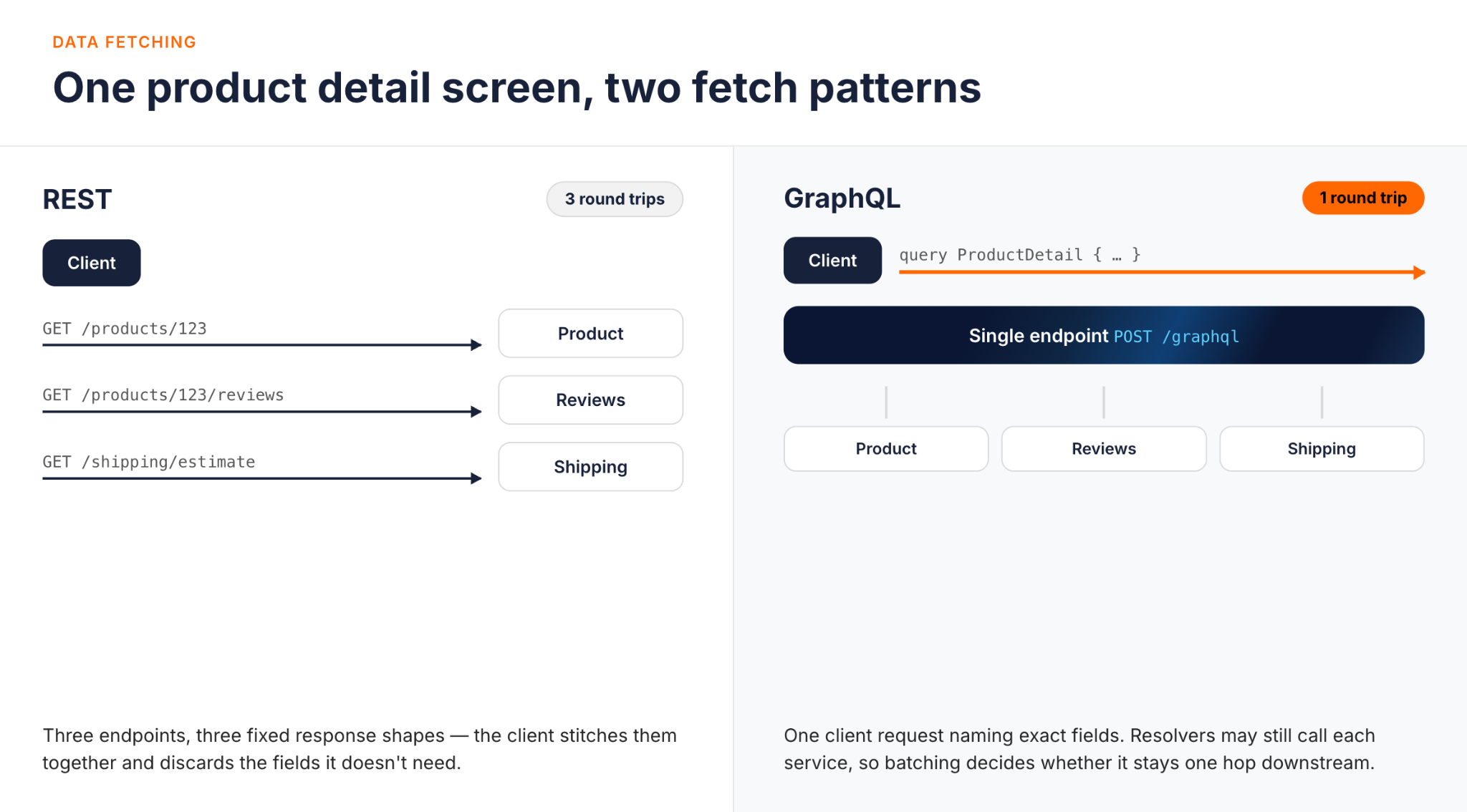
Take a concrete case: a product detail screen that needs a product's name and price from one service, its reviews from another, and shipping estimates from a third. Over REST, that's three round trips, each returning a fixed shape the client may only partly use:
GET /products/123
GET /products/123/reviews
GET /shipping/estimate?productId=123
This is one way to design a REST API for this screen, not something inherent to REST as an architectural style. A team could just as easily expose a single purpose-built aggregate resource for the screen, or support optional field selection through query parameters (sometimes called sparse fieldsets), both of which are commonly documented using the OpenAPI Specification. OpenAPI doesn't require one endpoint design over another; it describes whichever REST API a team chooses to build.
Over GraphQL, it's one query naming exactly the fields needed from each of the three underlying types, resolved in a single request:
query ProductDetail {
  product(id: "123") {
    name
    price
    reviews {
      rating
      comment
    }
    shippingEstimate {
      days
      cost
    }
  }
}
It's worth being precise about what that single client request gets you. One request to a GraphQL server doesn't mean one downstream request. If the product, review, and shipping fields are resolved independently, the server can still make three separate calls to the underlying services. Once lists are involved, this can compound into the classic N+1 pattern, where fetching a list triggers a separate call for each item's related data. GraphQL's own performance guidance covers this directly, recommending batching and caching techniques so that a single client-facing request doesn't turn into many uncoordinated backend calls.
Endpoint structure (single vs. multiple endpoints)
A REST API's surface area grows with the number of resource types and the relationships between them, so a reasonably complex domain can end up with dozens of endpoints. A GraphQL API keeps that complexity inside the schema rather than in the URL structure. That simplifies routing but moves the design burden to schema modeling.
Versioning approach
REST APIs usually version through the URL path or a header, and running several live versions at once is a normal part of operating a REST API at scale. GraphQL favors a versionless approach: new fields and types are added to the schema, existing queries keep working unchanged, and fields that are no longer wanted are marked deprecated rather than removed outright. That moves the maintenance burden from managing parallel API versions to managing schema evolution and deprecation timelines.
Error handling
REST APIs communicate success and failure mainly through HTTP status codes, which fit neatly with existing HTTP tooling such as load balancers and monitoring systems.
GraphQL's response format separates two kinds of failure. A request that fails before execution starts, such as a malformed query, is a request-level error. Servers using the newer application/graphql-response+json media type return an appropriate 4xx or 5xx status for these, although legacy servers using application/json often return 200 regardless.
Once execution has started, a query can partially succeed: some fields resolve, while others raise a field-level error that's reported in a separate errors array alongside whatever data did resolve. HTTP has no status code for partial success, so this case is still typically a 200 either way.
That partial-success behavior, more than a blanket "GraphQL always returns 200," is the practical distinction. Status-code-based monitoring still works for outright request failures on servers using the newer media type, but it has to look inside the response body to catch field-level errors.
Caching (HTTP caching vs. GraphQL's more complex caching story)
REST's use of GET requests and resource URLs makes HTTP caching easier to reach for, but it isn't automatic. Whether a response is actually cached depends on the method, response directives like Cache-Control, authorization requirements, and how a representation varies by request headers, all defined in the HTTP caching standard.
GraphQL isn't locked out of HTTP caching either. The GraphQL spec allows GET for query operations, and techniques like persisted queries replace a long query string with a short, cacheable identifier, which makes GET-based caching practical. POST to a single endpoint is the more common default, not a hard restriction.
In practice, teams still often add caching on the client (normalized caches such as Apollo Client or Relay) or through a gateway that understands GraphQL query structure well enough to cache at the field level, because GET support and persisted queries aren't available in every GraphQL server implementation.
Advantages and Limitations of Each
Neither architecture is strictly better. The right choice depends on the shape of your data, the variety of your clients, and how much surrounding tooling you're willing to build.
It's also worth separating each architecture's inherent trade-offs from differences in ecosystem maturity. REST has a head start of more than fifteen years on tooling, so some of its "advantages" are really the benefits of a larger installed base rather than anything fundamental to the style.
Where REST wins
- Caching. Native HTTP caching means less infrastructure to build and run.
- Simplicity for simple APIs. With a small number of resources and predictable access patterns, REST's directness is easier to reason about and quicker for new developers to learn.
- Tooling maturity. Monitoring, API gateways, and testing tools built around HTTP status codes and URL structures work out of the box.
- Public API familiarity. Most third-party developers already know how to consume a REST API, which matters for public and partner-facing APIs.
Where GraphQL wins
- Client diversity. When mobile, web, and third-party clients each need different subsets of the same data, GraphQL avoids maintaining separate endpoints for each client.
- Aggregating multiple sources. GraphQL is a natural fit as a facade in front of several backend services, letting a single query resolve fields from multiple sources.
- Rapid frontend iteration. Frontend teams can change the fields they request without waiting for backend endpoint changes, as long as the schema already exposes the data.
- Precise data requirements. Applications with deeply nested or highly variable data needs avoid the over-fetching that REST's fixed shapes tend to produce.
When to Use GraphQL vs REST
There's no universal verdict here, just a set of signals to weigh against your own architecture.
Lean toward GraphQL when:
- Your clients are diverse (native mobile, web, third-party integrations), and each needs a different slice of the same underlying data.
- A single view in your application has to aggregate data from several backend services or data sources.
- Frontend teams are iterating quickly and keep asking backend teams for new endpoint variants.
Lean toward REST when:
- Your API is mostly simple CRUD operations against a small number of well-defined resources.
- HTTP caching at the CDN or proxy layer makes a material difference to your performance or infrastructure cost.
- You're building a public API where third-party developer familiarity and tooling compatibility matter more than fetch efficiency.
Neither list is exhaustive, and the two sets of signals aren't mutually exclusive within one organization. A company can run a REST API for internal service-to-service traffic and a GraphQL layer for its public mobile app without either choice being wrong. The decision worth making deliberately is at the level of a single API surface and its known consumers, not a one-off architectural mandate for the whole company.
Many teams don't have to choose just one, as the next section shows.
Can You Use Both REST and GraphQL Together?
Yes, and it's a common pattern rather than an edge case. REST and GraphQL often operate at different layers of a system: REST handles service-to-service communication and simple CRUD backends, while GraphQL sits in front as an aggregation layer for client-facing traffic.
Common hybrid patterns
The most common pattern is GraphQL as a Backend-for-Frontend (BFF) layer in front of one or more existing REST services. The GraphQL layer resolves fields by calling the underlying REST APIs, giving frontend teams a single, client-tailored query surface without rewriting the backend services underneath.
As GraphQL APIs and the teams that own them grow, a related pattern is GraphQL Federation, where one GraphQL API is composed from several independently owned subgraphs instead of a single monolithic schema. Each team owns and deploys its own subgraph, and a router or gateway composes them into one graph that clients query as though it were a single service. This avoids having one team own an ever-growing monolithic schema, which tends to become a bottleneck once more than a handful of teams need to contribute types and fields.
How WSO2 Supports Both REST and GraphQL
The REST-versus-GraphQL decision doesn't have to be a platform decision. WSO2 API Platform manages GraphQL services as fully managed APIs, applying the same governance, security, and analytics controls used for REST APIs from a single control plane, instead of treating GraphQL as a bolted-on afterthought.
In practice, a team can import a GraphQL schema and expose it with the same quality-of-service controls a REST API gets: rate limiting, authentication, usage analytics, and monetization plans defined per subscriber tier.
A single GraphQL operation can still touch many fields and resolvers, even though only one operation runs per request, so controls at the field or resolver level matter more than they do for REST, where one URL usually maps to one action. A request that selects ten fields shouldn't necessarily count the same against a rate limit as one that selects a single field. For the same reason, the depth and complexity limits covered in GraphQL's own security guidance matter more for GraphQL than for REST. The platform doesn't currently document these query-shape controls for GraphQL proxies, so if they matter for your schema, enforce them in the GraphQL server itself or with a custom gateway policy. What the platform does provide is a GraphQL test console for trying queries and mutations against a deployed proxy.
For teams whose GraphQL schema has outgrown a single service, federation lets schema ownership scale across several teams. Federation only composes the schema, though. It doesn't enforce authentication, authorization, or rate limits by itself. Those controls still have to be applied at the gateway layer in front of the composed graph, the same WSO2 API Platform layer that already applies them to REST and non-federated GraphQL APIs. Schema ownership can then scale without each team reimplementing security policy for its own subgraph.
That governance model is what matters most once a team has made the REST-versus-GraphQL call and needs to run both in production: consistent security policy, consistent throttling behavior, and one place to look for analytics across API types, instead of separate tooling for each.
Looking further ahead, the same governance model extends to how APIs and GraphQL services are consumed by AI agents. WSO2's AI Gateway, through its MCP Proxy capability, applies authentication, authorization, per-tool rate limiting, and usage monitoring to MCP traffic under the same control plane that governs REST and GraphQL. Discovery is handled by the API Portal and MCP Hub, whose MCP Registry gives agent developers a searchable catalog of MCP servers, much as human developers browse an API catalog today. This solves the governance problem of managing REST, GraphQL, and MCP access consistently. It doesn't make the REST-versus-GraphQL architectural decision for you, and no platform reasonably can.
You can explore the full set of capabilities on the WSO2 API Platform product page.
Conclusion
REST and GraphQL solve the same underlying problem, getting data from a server to a client, with different trade-offs in fetching precision, caching, and versioning. REST remains the simpler default for straightforward CRUD APIs and public-facing services where caching matters. GraphQL earns its extra complexity as client diversity or data aggregation needs grow. Combining the two tends to make sense once an organization has several client types, such as mobile, web, and partner integrations, drawing on the same backend services, rather than as a default choice for every team.
If you're managing, or planning to manage, both under one roof, WSO2 API Platform applies consistent security, throttling, and observability across REST and GraphQL APIs today, with the same governance model extending to MCP as agent-driven traffic grows.
Frequently Asked Questions
Is GraphQL better than REST?
Neither is universally better. GraphQL reduces over-fetching and under-fetching for clients with varied data needs, while REST is simpler to cache and easier for third-party developers to pick up. The right choice depends on your client diversity and data access patterns.
Is GraphQL still relevant in 2026?
Yes. GraphQL remains widely used for client-facing APIs, particularly where mobile and web clients need different data shapes from the same backend, and it continues to develop actively through its schema federation and subscription capabilities.
Is GraphQL harder than REST?
It has a steeper initial learning curve. Teams need to design a schema and write resolvers, which is a different skill set from defining REST endpoints, although tooling has matured a lot since GraphQL's early years.
Can GraphQL replace REST API?
It can replace REST for client-facing aggregation layers, but most GraphQL implementations still rely on REST or other protocols for service-to-service communication underneath. Replacement is more common at the API surface than throughout the backend.

