AI API vs Traditional API: What's Actually Different
"AI API" gets used loosely. It can mean a model provider's endpoint, a chatbot backend, or any service with a model somewhere behind it. The distinction that matters to an engineer is narrower than that.
A traditional API runs a defined sequence of code against a known application state. For the same input and the same state, it returns the same result. An AI API, in the sense used here, is one backed by a large language model (LLM). LLM-backed APIs often keep the same HTTP interface as conventional APIs. What changes is that part of the response is generated by a model. Applications therefore need explicit checks for correctness, completeness and permitted actions. Existing requirements for authorization, idempotency, cache validity and dependency validation still apply.
The Traditional API Flow
A conventional web API endpoint usually follows three steps:
- Validate request: Check the payload against the API contract, authorization rules and business constraints.
- Execute business logic: Read or write data, call dependencies and apply the rules your code defines.
- Return representation: Serialize the result and send it to the caller.
Each step can be complex, but the logic is explicit. Your code defines how the result is produced, even when it also depends on time, concurrency or external systems. Exact-match test assertions rely on that property. Retries and caching rest on other guarantees. Safe retries depend on idempotency and side effects, and cache validity depends on freshness and request context.
The AI API Flow and Why It's Not Just a Proxy
The first version of most AI endpoints is a thin proxy. It takes the request, forwards a prompt to the model and returns whatever comes back. In a first-person breakdown of AI endpoint flows, backend engineer Daniel Balcarek describes how that version failed him. Passing client prompts straight to the model let other people use the endpoint for unrelated tasks and spend his AI usage credits.
A common application design for production AI endpoints uses six steps:
- Validate request: Beyond schema checks, restrict the topic and input size, screen for suspicious instructions and decide which tools the model may call.
- Prepare prompt, tools and context: Assemble instructions, conversation history, retrieved documents, tool definitions and generation settings.
- Generate probabilistic output: Make the model call.
- Validate schema, meaning and safety: Check that the output parses, is logically consistent and is safe to return.
- Retry, repair, reject or fall back: Decide what happens to output that fails validation.
- Return representation: Send the accepted result, or a controlled error, to the caller.
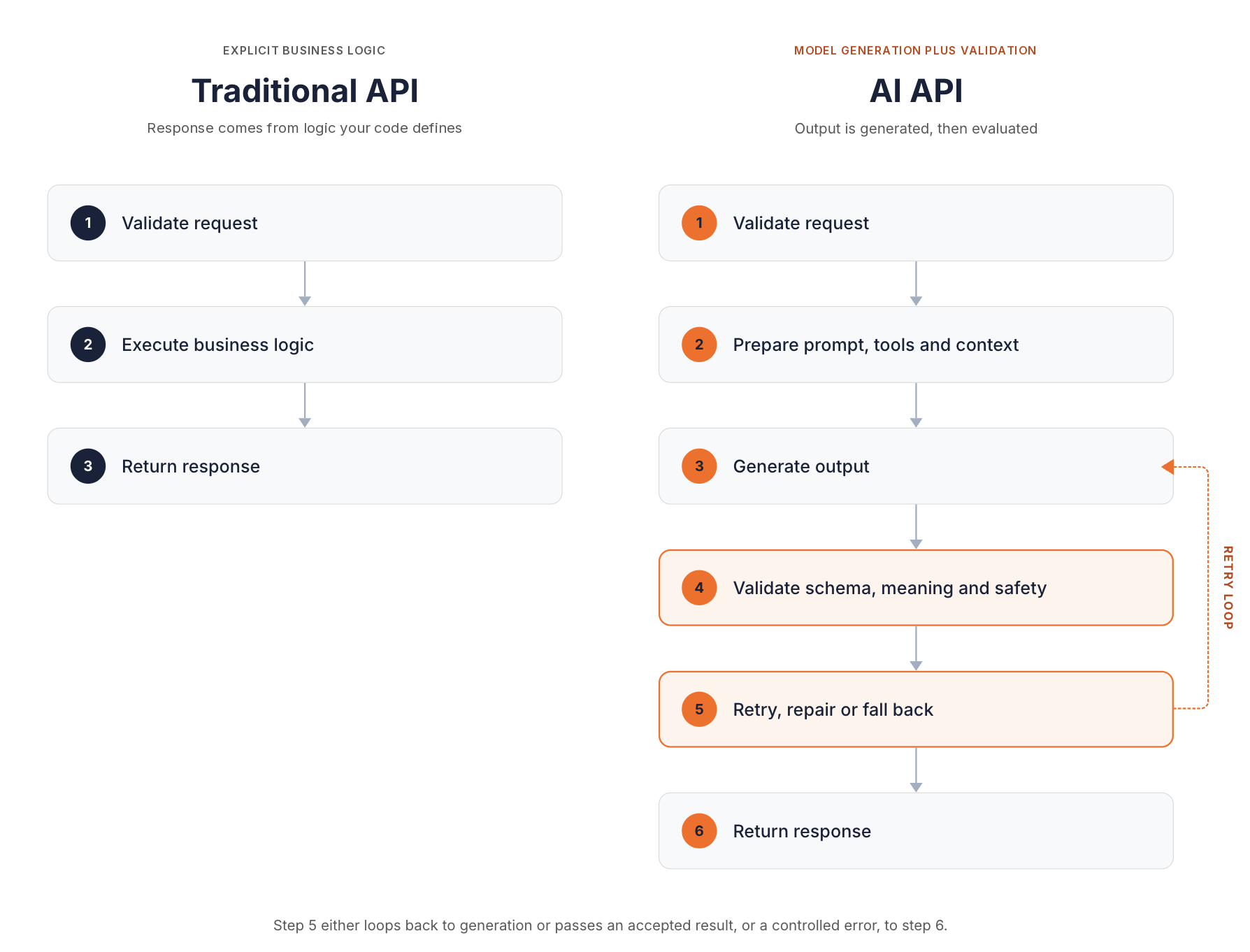
Most of the design work sits in steps 4 and 5. A successful HTTP response from the model provider only tells you the model generated something. It doesn't tell you the result is complete, correct or safe to show a user.
That leads to the core distinction. A traditional API's backend executes the rules. An AI API's backend orchestrates and evaluates a result it doesn't fully control.
What Actually Changes: Five Concrete Differences
Validation Happens on Both Ends
In a traditional API, input validation guards execution, and your code defines how the response is produced. Output from downstream dependencies still needs validation. In an AI API, validation also becomes a post-processing step, because AI output can be valid JSON, match your schema and still be wrong.
Balcarek's example is an approval response that sets approved: true while listing a failed age check in the same payload. The JSON parses, and the decision contradicts itself.
Post-generation checks work best in layers:
- Schema: the output parses and matches the response contract.
- Business rules: values fall within the domain's constraints.
- Consistency: fields agree with each other and with the supplied context.
- Safety: nothing leaves the service that shouldn't, such as sensitive data or unsafe content.
Latency Depends on the Model, Not Only Your Code
Traditional latency comes from your logic, I/O and queries, which you can profile and tune. AI generation time also depends on the selected model, prompt and context size, output length and provider load. One request may finish after a single model call, while another needs tool calls or a regeneration attempt.
In practice, set explicit timeouts and latency budgets, and stream responses when the client can use partial output. It also helps to shrink what the model has to generate. One technique is to ask for record IDs instead of full objects and map the IDs back to data in code. Validate those IDs against the input set, because a model can return one that doesn't exist.
Retries Can Add Inference Cost and Duplicate Side Effects
A traditional retry re-sends a request after a transient network or dependency failure. If the operation has side effects, a duplicate can repeat a payment, a job or a notification. AI retries add another cost. A retry that reaches inference may incur additional charges, even if the earlier response was lost. Requests rejected before inference, such as throttled ones, often aren't billed, but billing rules vary by provider. Retry transient failures within a deadline and attempt budget, and deduplicate side-effecting operations. Treat each failure type on its own terms. Provider throttling calls for backoff or a different provider. Budget exhaustion calls for a controlled error, not a retry. Transport ambiguity, where you can't tell whether the call completed, calls for deduplication before any replay. Validation failure is different again. The next attempt can also return a different answer that is still wrong. That makes the decision after a failed validation a cost-aware design choice:
- Retry only on transient provider errors, with a strict attempt limit.
- Repair by sending the validation failure back to the model, so the next attempt has more information than the last. Re-sending an identical prompt often reproduces the same mistake.
- Fall back to another model or provider when the primary one is failing or throttling requests.
- Reject with a controlled error when another attempt is unlikely to help.
A useful fallback crosses failure domains. Switching to another model at the same provider doesn't help during a provider-wide outage. The guide to LLM fallback and retries covers fallback chains, backoff and circuit breakers in more depth.
The Same Input Can Produce a Different Output
Traditional test suites assert exact values. That approach breaks for generated text. A valid answer can be worded many ways, and a model update can change the wording without changing the meaning.
As a result, three practices change.
Testing shifts to asserting properties instead of strings. Check ranges, allowed values, required fields and forbidden content. The deterministic parts of the endpoint, such as authorization, parsing, tool permissions and fallback logic, still get normal unit tests.
Idempotency gets harder when the model can act through tools. If validation fails after a tool call and the whole operation is retried, the model may create a second order or send a second email. Idempotency keys and persisted operation results prevent the duplicate side effect.
Observability needs model-specific signals alongside request metrics. Track input and output tokens, model version, generation attempts, validation failures and estimated cost. An endpoint can keep returning 200 OK while its cost climbs and its output quality drifts. Without these signals, it is hard to explain why an endpoint became slower or more expensive.
The Misuse and Abuse Surface Is Different
Traditional API security focuses on who is calling and what they can reach. AI APIs add risks that live inside the payload itself. The OWASP Top 10 for LLM Applications ranks prompt injection first, as LLM01:2025. OWASP separates two forms. Direct injection comes from a user's own input. Indirect injection comes from external content, such as websites or files, that the model reads. Indirect injection matters for AI APIs because retrieved documents and tool outputs reach the prompt without passing through the user's request.
Cost is part of the attack surface too. OWASP's LLM10:2025 Unbounded Consumption covers denial-of-wallet attacks that exploit per-use pricing with high request volumes. An endpoint that forwards client prompts unchecked is exposed to both risks. It follows whatever instructions arrive, and you pay for the tokens. Typical controls start with scoping what the endpoint will answer and capping input size and token usage per caller. Isolating untrusted retrieved content and checking output before it leaves the service reduce exposure, but they do not eliminate prompt-injection risk. Enforce authorization deterministically at tool execution, and give tools least-privilege credentials. Output screening can't undo a tool action that has already run. For specific techniques, see prompt injection defense.
Where This Gets Confused: AI API vs AI Gateway
The term "AI API" often gets mixed up with "AI gateway." They answer related but different questions. An AI API is an endpoint, and the question is how a single call behaves. An AI gateway is infrastructure, and the question is how traffic is routed, secured and governed across many calls.
The two also sit on different traffic paths. Take a support chatbot. The browser calls your chat endpoint, which is inbound traffic that an API gateway can govern. Your chat backend then calls an LLM provider, which is outbound traffic that an AI gateway can govern. The gateways govern separate legs of the flow rather than forming one pipeline.
An AI gateway can take on some evaluation steps from the flow above, such as token limits, provider failover and prompt or response guardrails. It doesn't know your business rules, so checking that an approval matches the eligibility data stays in your application. For the infrastructure view, see API gateway vs AI gateway.
A Related Question for Later: What About AI Agents?
Everything above describes an AI feature inside a normal request-response API. A person or an application calls your endpoint, and your backend makes the model call.
AI agents change who the caller is. An agent discovers capabilities, chooses tools and acts across multiple steps, often without a human approving each call. That raises a separate design question about how agents should find and call your services. Part of it is whether REST APIs or the Model Context Protocol (MCP) suits them better. Governance also moves to the tool level. In WSO2's AI Gateway, MCP governance policies on an MCP proxy decide who connects, which tools they see and how often they can call them. A dedicated article on REST APIs vs MCP for AI agents will cover this question in depth.
How WSO2 Approaches This
Several steps in the orchestrate-and-evaluate flow are cross-cutting controls that work the same way for every AI endpoint. Those are the steps a gateway can enforce centrally. The WSO2 API Platform runs its API Gateway and AI Gateway under one control plane. Inbound service traffic and outbound model traffic therefore share one governance model.
On the model-call leg, the AI Gateway applies policies from the WSO2 Policy Hub. Guardrails cover PII masking, semantic prompt guarding, prompt injection detection and JSON Schema validation on requests or responses. Token-based and cost-based rate limits and semantic caching address cost. For fallback, round-robin policies suspend a model that returns a 5xx or 429 error and send later requests to the rest of the pool. Suspension doesn't retry the request that failed, so the caller still sees that error and owns any retry. Business-rule validation and repair prompts stay in your application code.
Conclusion
Both kinds of API can share the same HTTP interface. In a traditional API, explicit business logic produces the response. In an AI API, part of the response comes from a model, so your backend orchestrates and evaluates a result it doesn't fully control. Two-sided validation, latency budgets, cost-aware retries, property-based tests and payload-level security all follow from that one difference.
If you're adding model calls to existing APIs, list every point where output needs checking. Then separate the checks that are specific to one endpoint from the ones every AI endpoint shares. The shared checks are candidates for a gateway. To see how WSO2 governs API and AI traffic under one control plane, explore the WSO2 API Platform.
Frequently Asked Questions
What's the difference between AI and an API?
An API is an interface that lets one program request data or actions from another. AI refers to systems, such as LLMs, that generate output from learned patterns. An AI API is an API whose response comes, at least in part, from an AI model.
What does an AI API mean?
An AI API is an endpoint backed by an AI model, usually an LLM. Its output is probabilistic, so the backend validates each model response before returning it.
Is ChatGPT an API?
ChatGPT is a consumer application. OpenAI offers a separate API platform for developers, and API usage is billed separately from ChatGPT subscriptions.
Is an LLM API the same as a REST API?
Many LLM APIs are exposed over REST, so the transport looks familiar. The behavior differs. LLM output can vary between identical requests, is priced by tokens and needs validation after each call.

