Cloud Native API Gateway: Architecture Guide for 2026
A cloud native API gateway is the entry point that sits in front of a Kubernetes-based application, handling routing, authentication, and rate limiting for every request that reaches its backend services. Unlike a traditional gateway bolted onto a monolith, it is built to run as a first-class citizen of the cluster, scaling and configuring itself the same way the services around it do.
That single-sentence definition covers the mechanics. It does not explain why the API gateway keeps showing up at the center of cloud native architecture discussions, or why its role has kept shifting since the pattern first took hold. This guide walks through both.
The Role of the API Gateway in Cloud-Native Applications
A cloud native application is built to take advantage of what the cloud offers. Its services are deployed, scaled, and recovered independently of one another. It gets resilience through redundancy and observability into how each piece behaves in production. Its infrastructure is described in code instead of racked by hand. Running in a container isn't enough on its own to make an application cloud native. It's the independent deployability and scaling of the services inside it that make the rest of this possible. Most applications built this way share a similar shape, with four recurring components.
- The front-end renders the interface and talks to backend services through APIs, commonly built with a framework like React, Angular, or Vue.js and designed to stay lightweight so it can respond quickly under load.
- Backend-for-Frontend (BFF) services sit between the front-end and the deeper backend, aggregating and reshaping data from multiple services into whatever the front-end actually needs. A mobile app and a web dashboard often want different shapes of the same underlying data, and the BFF layer is where that translation happens rather than inside the front-end itself.
- Back-end services do the actual work: the microservices that each own a narrow slice of business logic, deployed independently and communicating with each other through APIs. They are commonly written in Java, Python, Node.js, Go, or Ballerina, and packaged as containers.
- A database, relational or NoSQL depending on the workload, holds the state those services read and write.
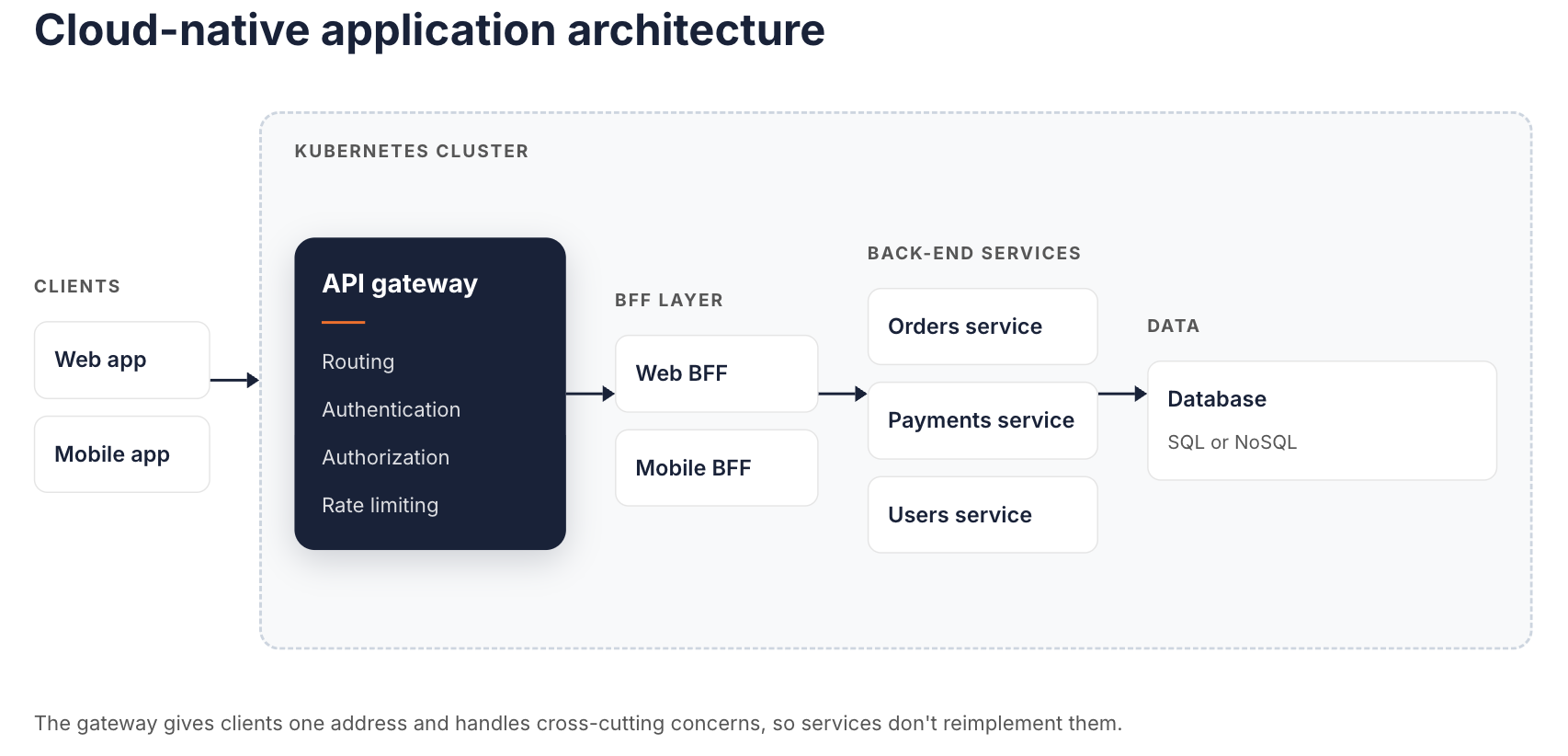
The API gateway is what ties these components together. It gives external clients one address to call instead of dozens. It also takes on the cross-cutting work: request routing, authentication, authorization, and rate limiting. Individual services do not each have to reimplement it. That consolidation is what keeps a growing microservices estate from turning into a security and observability mess.
It is also common to see two gateways rather than one. Organizations that group their services into business domains, often following domain-driven design, tend to route external traffic through one gateway and cross-domain internal traffic through a second, separate gateway. External and internal API traffic have different trust boundaries, and keeping them on separate gateways makes that boundary explicit instead of implicit.
Kubernetes: The Operating System of the Cloud
Software architecture has gone through a few of these platform shifts before. Just as Linux became the default operating system underneath enterprise applications, Kubernetes has become the default operating system underneath cloud native applications. It abstracts away the individual machine and gives every workload the same API for deployment, scaling, and service discovery, regardless of which cloud (or on-prem rack) sits underneath it.
That abstraction is what lets a team build once and run the same workload across providers without rewriting deployment logic for each one. Kubernetes handles automatic scaling, load balancing, service discovery, and rolling deployments as built-in primitives. It integrates with the rest of the cloud native stack, including service meshes and API gateways. Together they form a complete application delivery layer.
The API Gateway Is Becoming Part of the Cloud Operating System
If Kubernetes is the operating system, the API gateway is one of its higher-level abstractions, the same way a traditional OS abstracts away disk I/O so applications do not have to manage block storage directly. As the number of microservices in an application grows, managing and securing the APIs between them stops being something each team can handle ad hoc.
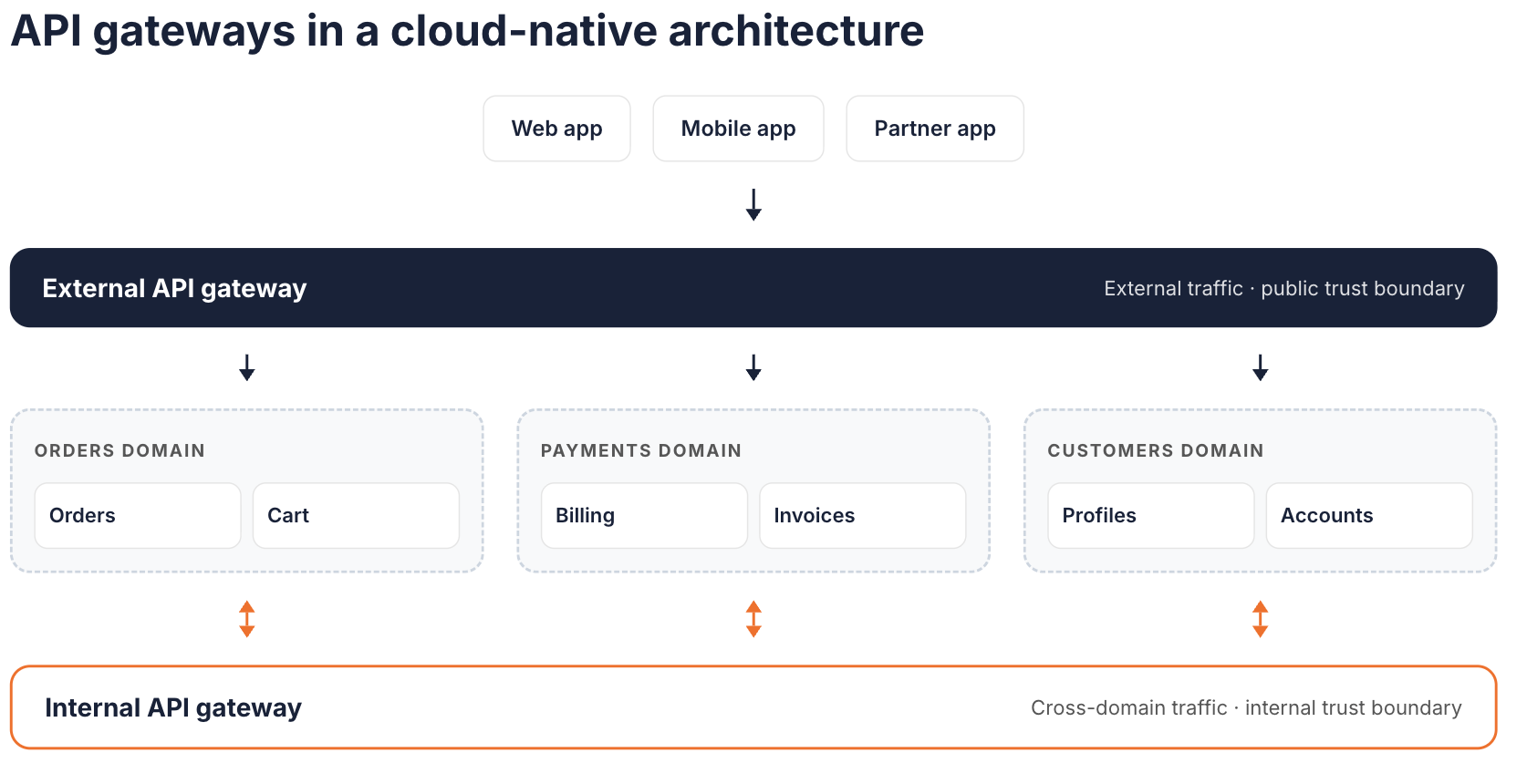
The gateway is where that complexity gets absorbed. It gives developers a single place to apply routing rules, authentication, and traffic policy, instead of asking every service owner to implement the same controls independently. That is a meaningful simplification for teams. It is also why the gateway has become infrastructure rather than an application-level concern. It behaves less like a component you deploy next to your services and more like a platform capability that every service sits behind.
Kubernetes Gateway API and Envoy Gateway, Updated for 2026
The Kubernetes community formalized this shift with the Kubernetes Gateway API, a specification for defining and operating gateways declaratively, as Kubernetes manifests, rather than through gateway-specific configuration formats. Gateway, GatewayClass, and HTTPRoute reached general availability in the Gateway API's v1.0 release in October 2023. The set of GA resources has kept growing since. It now covers routes for gRPC, TLS, TCP, and UDP traffic, among others. TCPRoute and UDPRoute joined the Standard channel in v1.6 in 2026. What started as a promising spec three years ago is now a stable, broadening standard. It's worth being precise about which layer these resources touch: GatewayClass, Gateway, and HTTPRoute configure the data plane, meaning the proxy instances that actually handle traffic. The control plane is the broader work of managing policy, governance, and multiple gateways from one place. It sits a level above the spec, and it is where products differentiate. This guide comes back to that distinction later.
Envoy Gateway is one of the most widely used implementations of that spec, built on the Envoy Proxy data plane that many service meshes already use. It is not the only option, though. kgateway is an Envoy-powered, Kubernetes-native gateway that also implements the Gateway API. It was accepted into the Cloud Native Computing Foundation at the Sandbox maturity level in March 2025. Several cloud providers now ship their own Gateway API implementations natively. Istio's gateway layer and various cloud-vendor gateways round out a landscape that has clearly moved past the early-adopter phase this pattern was in a few years ago.
There is one more piece of the 2026 picture worth a direct mention. Ingress-NGINX, the controller project that had long been the default entry point for a large share of Kubernetes clusters, was retired in March 2026. That retirement is specific to the Ingress-NGINX controller project. It does not extend to NGINX as a web server, and it does not retire the Kubernetes Ingress API resource type itself, both of which continue on their own separate tracks. Existing Ingress-NGINX deployments keep running, but the project now receives no further releases, bug fixes, or security patches. The Kubernetes project recommends migrating to Gateway API or another actively maintained controller. If you are planning that migration and want the deeper mechanics, including timelines and tooling, that deserves its own dedicated look rather than a detour here.
What Standardization Did (and Didn't) Change
A few years ago, the expectation in parts of this community was that Gateway API standardization would make the underlying gateway runtime itself close to irrelevant. Once configuration was portable, the thinking went, organizations could treat runtimes as interchangeable and vendors would mostly compete on price.
That part of the prediction landed. Configuration genuinely has standardized. Teams can define routing and policy once, in Kubernetes-native resources, and move between compliant implementations without rewriting that configuration from scratch.
What did not happen is runtime commoditization. Gateway vendors, WSO2 included, have instead differentiated hard on the capabilities that sit outside the Gateway API spec entirely. That includes governance for AI and LLM traffic, support for agent-facing protocols like MCP, and federated management across multiple gateways from one control point. The more accurate 2026 story is not "the runtime stopped mattering." It is that the spec absorbed the parts of gateway configuration that never needed to be a differentiator. That frees vendors to compete on the parts that do.
Cloud-Native Architecture and AI Workloads
Every component described above, front-end, BFF, backend services, database, still applies when an application starts calling out to a large language model or exposing itself to an AI agent. What changes is the traffic pattern, and it is worth being precise about that pattern rather than waving at it.
Inbound traffic from a client or an AI agent calling your APIs is one thing: it arrives at your gateway, gets authenticated, gets routed, and gets a response, the same as it always has. A backend service making an outbound call to an LLM provider is a separate thing. That call starts inside your architecture and leaves it, headed for OpenAI, Anthropic, Azure AI, or wherever the model lives. These are not two steps in one sequential chain. A request does not have to pass through an LLM on its way to becoming an API response. An LLM call does not have to pass back through the inbound gateway path to reach the model provider. Treating them as one linear pipeline misrepresents how the traffic actually moves, and it is a mistake worth avoiding when you are designing for it.
What ties them together is that both are traffic categories the gateway layer is now expected to govern. An LLM-backed service is, from the gateway's point of view, another kind of backend service, one that happens to carry prompts and can behave unpredictably in ways a database call rarely does. An AI agent calling your APIs through a tool-exposure protocol is, from the gateway's point of view, another kind of client, one that authenticates and gets rate-limited like any other consumer. Neither requires a new architecture. Both are reasons the existing gateway layer is being asked to do more than it used to.
The trigger for treating this formally, rather than improvising it service by service, tends to be architectural rather than a specific traffic volume. Teams usually reach for centralized AI governance in four situations. They route to more than one model provider and need consistent policy across them. Security or finance needs to attribute AI spend to a team or product. Prompts or completions might carry regulated data that needs the same handling as any other sensitive field. Or an AI feature has moved from a pilot into production, with real users depending on it. Any one of those is a better signal than an arbitrary request-count or token threshold, because the risk those triggers describe doesn't scale linearly with volume.
How WSO2 Fits
The WSO2 API Platform is built around the pattern described here. One control point handles inbound API and agent traffic. Outbound calls to backend services and AI models are governed under the same policy model. It positions itself as a single control plane for both traditional APIs and AI assets, rather than as two separate products bolted together.
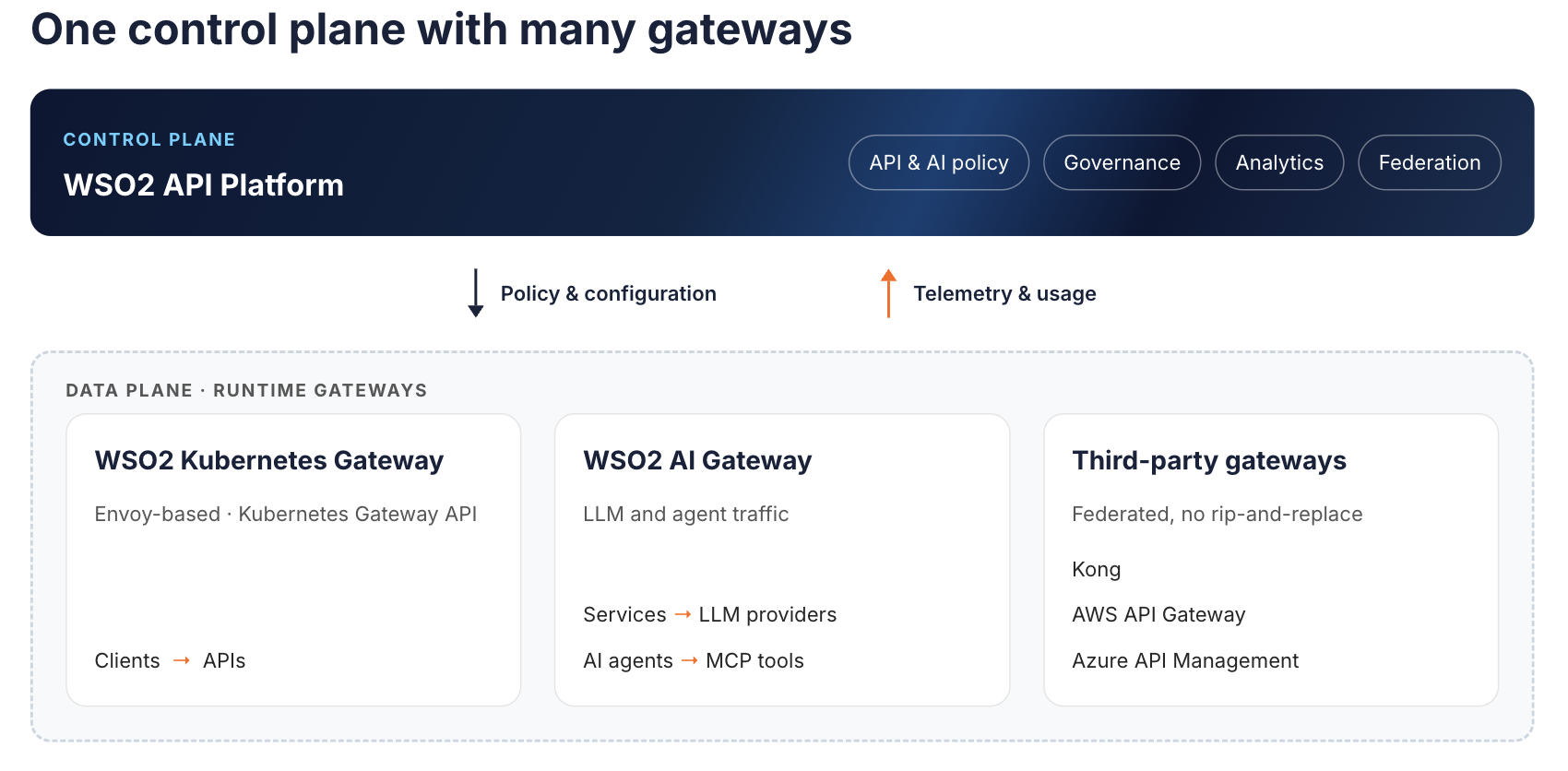
Concretely, that shows up in two places.
On the AI traffic side, the WSO2 AI Gateway covers both halves of the pattern described above. LLM proxies govern outbound LLM consumption. MCP proxies govern inbound tool exposure through MCP. Both are managed from one control plane, not two separate tools with two policy models. That matters because it avoids a common failure mode. LLM governance and agent-traffic governance get built as two unrelated projects, each with its own rules, audit trail, and gaps.
On the Kubernetes gateway layer itself, the WSO2 API Gateway is built on Envoy. In Kubernetes Operator mode, it accepts either WSO2's own CRDs (APIGateway and RestApi) or standard Gateway API resources (GatewayClass, Gateway, and HTTPRoute). Teams can use the same spec described earlier in this guide. They don't have to adopt something proprietary just to get gateway functionality inside the cluster.
For teams that already run gateways from other vendors, WSO2's control plane supports federation with third-party gateways. These include Kong, AWS API Gateway, Azure API Management, and Envoy. No rip-and-replace migration is required. That matters in practice. Most organizations past a certain size are not choosing a single gateway from scratch. They are trying to bring governance to whatever mix of gateways they already have.
None of this replaces the architectural fundamentals covered earlier. It is one way to implement them without standing up separate control planes for APIs, LLM traffic, and agent traffic as they each come up.
Conclusion
The core architecture has not changed since cloud native applications first standardized around front-end, BFF, back-end, and database components fronted by a gateway. What has changed is how much of that gateway's configuration is now standardized through the Kubernetes Gateway API. The gateway is also expected to govern new traffic from AI agents and LLM-backed services, alongside the API traffic it has always handled.
If you are evaluating how your own gateway layer should evolve to handle that broader mix of traffic under one control plane, the WSO2 API Platform documentation and learning hub are a reasonable next stop.
Frequently Asked Questions
Does AWS have an API gateway?
Yes. Amazon API Gateway is AWS's managed gateway service for building, publishing, and securing APIs at any scale.
Does GCP have an API gateway?
Yes. Google Cloud offers Apigee as its full-lifecycle API management product, alongside a lighter-weight Cloud API Gateway for simpler use cases.
Is Cloudflare an API gateway?
Cloudflare offers API gateway capabilities, including schema validation, rate limiting, and bot management, as part of its broader edge and application security platform, rather than as a standalone Kubernetes-native gateway.
What are the top API gateways?
There is no single ranked list that holds up over time, since the right choice depends on deployment target and existing infrastructure. Common categories include cloud-native/Kubernetes gateways (Envoy Gateway, kgateway, the WSO2 API Platform's API Gateway), general-purpose gateways (Kong, Apigee), and cloud-vendor gateways (AWS, Azure, GCP). Most enterprise buyers narrow the list by deployment model and existing gateway investment before comparing feature sets.

