What Is an API Gateway? Functions, Architecture & Use Cases
An API gateway is a single entry point that sits between clients and backend services, routing every request to the right destination while handling authentication, rate limiting, and traffic management along the way. Instead of every service enforcing its own security and traffic rules, the gateway does it once, centrally, for all incoming API traffic.
Picture a large office complex with dozens of departments. Visitors don't wander the building looking for the right door. They check in at a single reception desk, show identification, get directed to the right floor, and the front desk keeps a record of who came and went. An API gateway plays the same role for backend services: one checkpoint, consistent rules, and a clear record of every request that passes through.
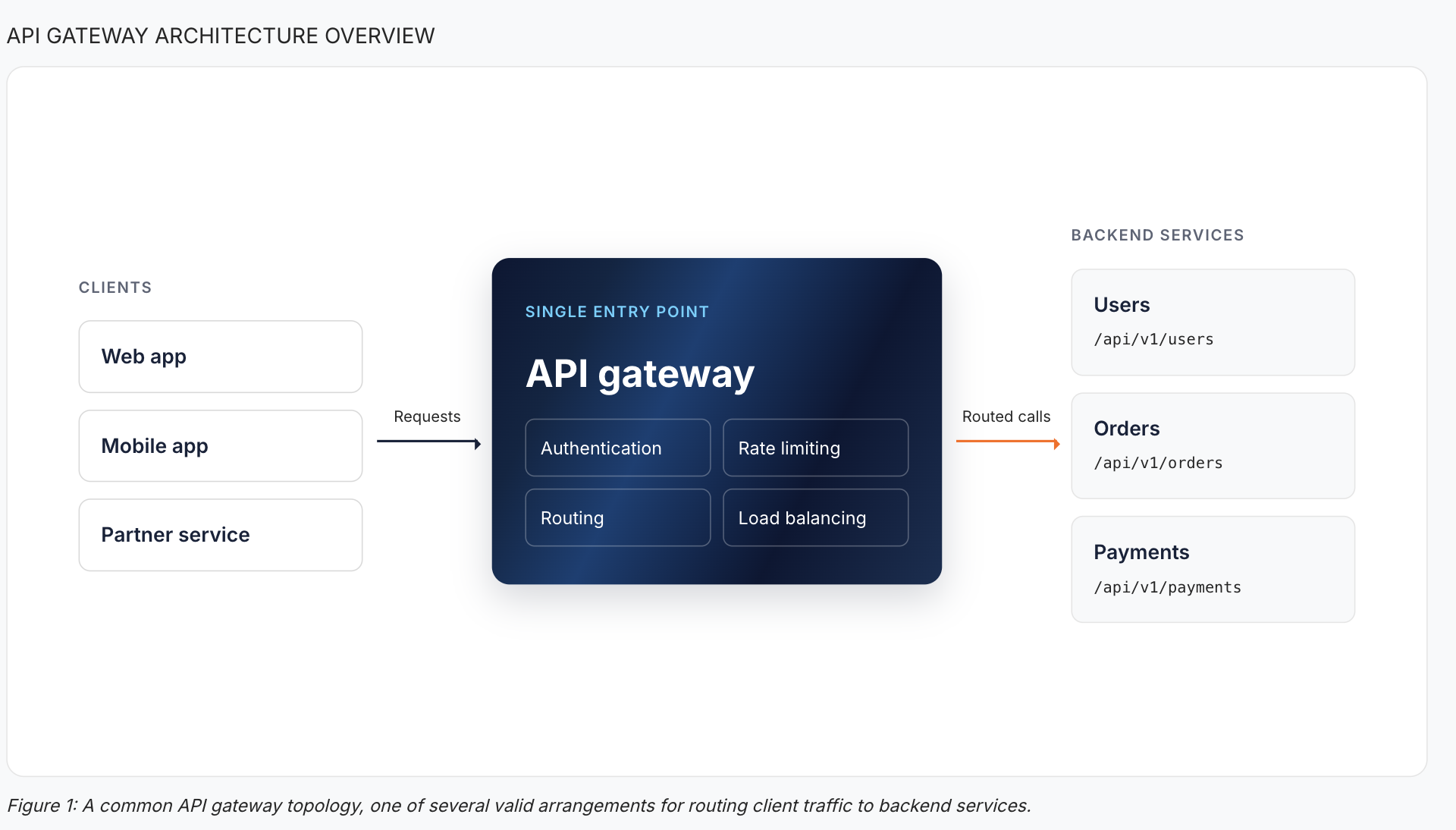
In a typical setup, a front-end application, whether that's a web app, a mobile app, or another service, calls your APIs directly for everyday operations like reading and writing data. As that setup moves toward production, new questions come up. How do you keep the API from being called by anyone who feels like it? How do you stop one client from sending far more requests than the backend can absorb? How do you keep traffic flowing if a backend instance goes down? An API gateway exists to answer exactly these questions. It sits as the single point of entry between clients and backend services, taking on the security and scaling work so individual services don't have to.
This piece sits in WSO2's API tools, management & gateways hub, alongside deeper comparisons of specific gateway products.
How Do API Gateways Work?
At a technical level, an API gateway works as a reverse proxy. It sits in front of backend services, intercepts every incoming request, runs it through a series of checks, and only then forwards it to the right destination. That sequence typically completes in milliseconds, but a fair amount happens in that short window. The order of checks below is a common pattern, not a fixed spec. Exact sequencing, and which checks run first, vary by gateway implementation and configuration.
Request processing and routing
When a client calls an API, the gateway first validates the request, checking that the endpoint exists, that the format is correct, and that the HTTP method is one the endpoint supports. It then applies routing rules, often based on the URL path, headers, or query parameters, to decide which backend service should handle the call. A request to /api/v1/users might go to a user-management service, while /api/v1/orders goes to an order-processing service, without the client needing to know these are separate systems.
Security implementation
Authentication and authorization are where a gateway does some of its heaviest lifting. Rather than every microservice implementing its own login checks, the gateway verifies credentials once, before a request ever reaches a backend. Most gateways support several methods, including API keys, OAuth 2.0, JWTs, and mutual TLS, and reject invalid or missing credentials immediately.
Authentication answers who is calling. Authorization answers what they're allowed to do once they're in. A gateway typically checks both at a coarse level, confirming identity and then checking whether that identity's role or scopes permit the specific endpoint and action being requested. Resource-level checks usually still happen at the service that owns the data. That means checking whether this caller may see this specific record. The gateway doesn't generally have that business context. With JWTs, the gateway can typically validate the token's signature, issuer, and audience locally. It doesn't need to call another service first, so the check stays fast under load. Not every OAuth access token is a JWT, though: opaque tokens require the gateway to call the authorization server to introspect them before it can trust the request. Mutual TLS adds a further layer for service-to-service calls, where both sides present certificates rather than relying on a bearer token alone.
Traffic management and rate limiting
Backend services need protection from too much traffic, whether that traffic is legitimate or malicious. Rate limiting caps how many requests a client can make in a given window, for example 100 requests per minute per API key. Exceed that limit and the gateway returns a 429 response without bothering the backend at all. Quotas apply a similar idea over a longer window, and throttling controls the pace at which requests get processed rather than just the count. Together, these mechanisms keep a spike in demand from turning into an outage.
Load balancing and failover
Where several instances of a backend service run for redundancy, the gateway distributes incoming requests across them using strategies like round robin, least connections, or weighted distribution. It also watches the health of each instance. If one starts failing, the gateway stops sending it traffic and redirects requests to healthy instances. This reduces the chance that one failing node takes the API down. Health checks alone don't guarantee availability, though.
Response processing
A gateway's job doesn't end once a request reaches the backend. On the way back, it can transform the response format, add or strip headers, cache responses to speed up future requests, or combine replies from multiple backend calls into a single response for the client.
Putting it together
A concrete example makes this easier to follow. Say a mobile app calls GET /api/v1/orders/482 with a bearer token in the Authorization header. The gateway first checks that the path matches a known route. It then validates the token's signature, issuer, and audience. If the token checks out, the gateway checks the token's scopes to confirm the caller has read access to order data. It then checks the client's rate-limit counter and forwards the request to the order-processing service. The scope check alone doesn't confirm this caller is allowed to see order 482 specifically, though. That kind of object-level check, whether this order actually belongs to this caller, is business context the gateway usually doesn't have, so it's the order-processing service's job to make that call before returning any data.
On the way back, the gateway might strip an internal-only header the backend added and return the result to the app. Caching that response is possible, but only if the cache key includes the caller's identity or tenant and the same authorization check still runs on a cache hit, not just a miss. Skip that scoping, and a cache built for one user's convenience can end up serving another user's order data. Route matching, token validation, a scope check, a rate-limit check, and response handling all happen inside that one round trip, in roughly the time it takes a screen to load. The service's own authorization check adds a little more time. It runs after the gateway's checks, not instead of them.
The Architecture of API Gateways: Data Plane and Control Plane
An API gateway is one component inside a broader API management setup, and understanding how the pieces fit together matters once you're building something meant to scale.
The data plane
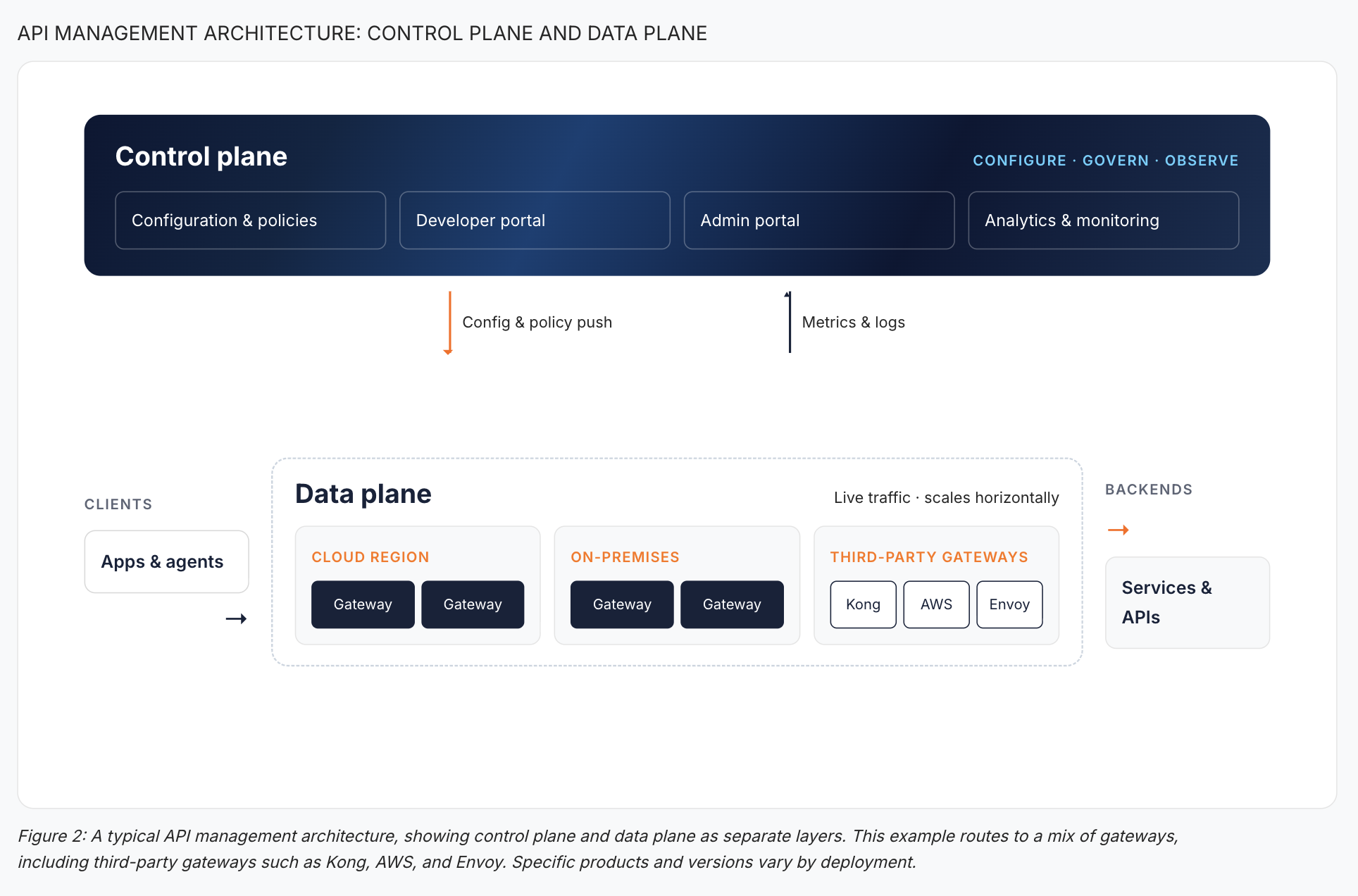
The gateway itself is usually called the data plane. This is where live traffic actually flows. Request validation, policy enforcement, routing, and security checks all happen here, on every call, which is why data plane components are built for speed. In practice, that usually means keeping rate-limit counters and cached credentials in memory. The gateway avoids a database round trip on every request. Even a little added latency per call adds up once traffic grows.
In production, teams typically run several data plane instances for availability and to spread load. Modern API gateways, including the API Gateway in the WSO2 API Platform, are built to scale horizontally, so you add gateway instances as traffic grows rather than trying to make one instance handle everything. Individual request handling is largely stateless, in that any instance can typically process any incoming call without needing context from a previous request. That doesn't mean the data plane holds no state. The rate-limit counters and cached credentials mentioned above are real state. Keeping them consistent across instances usually means sharing them through a distributed cache. Another option is to route the same client to the same instance every time. The WSO2 API Gateway, for example, shares rate-limit counters across runtime instances through Redis. That's a real scaling consideration to plan for, even if it's simpler than replicating a full backend's state.
The control plane
The control plane is where you configure and manage the data plane. It's normally a separate layer, providing the interfaces used to define policies, configure routes, set up authentication, and monitor traffic. A few things typically live here:
- Configuration management: Defining APIs, routing rules, security policies, and rate limits, then pushing those changes to data plane instances, often without downtime.
- Developer portal: Where API consumers discover available APIs, read documentation, and get credentials, which matters a lot for adoption.
- Admin portal: Tools for monitoring traffic, reviewing usage, managing access, and investigating issues.
- Analytics and monitoring: Metrics and logs pulled from the data plane, covering performance, error rates, latency, and usage patterns.
In larger deployments, this setup often spans multiple regions or a mix of cloud and on-premises environments. A single control plane usually manages data plane instances spread across those environments, which lets teams serve traffic from wherever is closest to users while keeping configuration and policy centralized. For a broader look at how these pieces fit into overall system design, see API architecture.
API Gateway Benefits
A gateway's impact shows up across development velocity, operating cost, and security posture. Some of the most consistent benefits teams report:
Simplified architecture
Instead of every backend service building its own security, rate limiting, and monitoring, the gateway centralizes those concerns. That matters most in microservice environments with many services, where adding a new authentication method once, at the gateway, beats updating every service individually.
Enhanced security
Centralizing coarse-grained authentication and authorization creates a single point that's easier to audit than dozens of scattered implementations. That covers identity and general role- or scope-level permissions. Resource- and object-level checks stay where the business context lives, in the service itself. The gateway also acts as a buffer between the public internet and internal services, validating requests before they get anywhere near a backend.
Improved performance
Response caching at the gateway can meaningfully cut the number of requests that reach the backend for frequently accessed data. Offloading SSL/TLS termination to the gateway frees backend services from that overhead, and load balancing with automatic failover helps APIs stay responsive under load.
Better developer experience
A developer portal gives consumers one place to find APIs, read docs, and get credentials, and a consistent gateway interface makes those APIs easier to work with regardless of what's running behind them.
Faster time to market
With authentication, rate limiting, and monitoring already handled at the gateway, new APIs can go live faster. Each service doesn't have to build those capabilities itself. Developers can focus on functionality instead of plumbing.
Cost optimization
A gateway is an infrastructure investment, but it typically pays that back by cutting the development time spent reinventing security and traffic-control code in every service. Its usage data also helps teams spot over-provisioned backend capacity, stale API versions nobody uses, and clients whose traffic deserves a closer look. Teams can act before any of that turns into unnecessary spend.
None of these benefits requires a large or complex deployment to show up. A small team running a handful of services behind a single gateway instance already gets centralized auth and consistent rate limiting. The benefits simply compound as the number of services, teams, and clients grows.
API Gateway Future Trends
The gateway landscape keeps shifting as new API styles and workloads show up. SOAP, REST, gRPC, and GraphQL have each pushed gateways to adapt, and the more recent wave of AI-driven applications is doing the same.
AI-native API management: As AI becomes a bigger part of application traffic, gateways are picking up AI-specific capabilities. Token-based rate limiting caps LLM usage by token count rather than request count, which matters because most providers bill per token, not per call. Semantic caching reuses a stored response when a new prompt is close enough in meaning to one already answered, cutting both latency and repeat model cost. Guardrail policies screen prompts and outputs for unsafe or non-compliant content before it reaches a model or a user.
Some platforms also let teams expose selected existing APIs to AI agents as MCP tools. This gives agents a governed way to call services that weren't built with agents in mind. Not every API needs to become an MCP tool. That's a separate mechanism from the inbound-application, outbound-provider flow described in the next section. Here the gateway is routing agent calls to internal services, not to a model provider. Others are applying machine learning internally to spot unusual traffic patterns and adjust routing on the fly.
GraphQL and API federation: GraphQL adoption continues, if more slowly than a few years ago, and gateways are adding support for query validation, depth and complexity limits, and federating multiple GraphQL services behind one schema. That lets separate teams own different parts of an API while presenting one coherent interface to consumers, without any single team needing to own the entire schema.
Service mesh convergence: In Kubernetes environments, the boundary between API gateways and service meshes keeps blurring. A gateway traditionally manages north-south traffic, the requests coming in from outside the cluster, while a mesh manages east-west traffic between services inside it. As both layers pick up overlapping capabilities around observability, mutual TLS, and policy enforcement, most gateway vendors are adding some level of mesh-adjacent support so teams don't have to fully separate the two concerns.
AI Gateway vs. API Gateway
As AI-backed APIs multiply, teams managing them run into needs a general-purpose gateway wasn't originally built to handle. That's the gap an AI gateway fills: a specialized API gateway built for managing traffic to AI and machine-learning model APIs, including large language models.
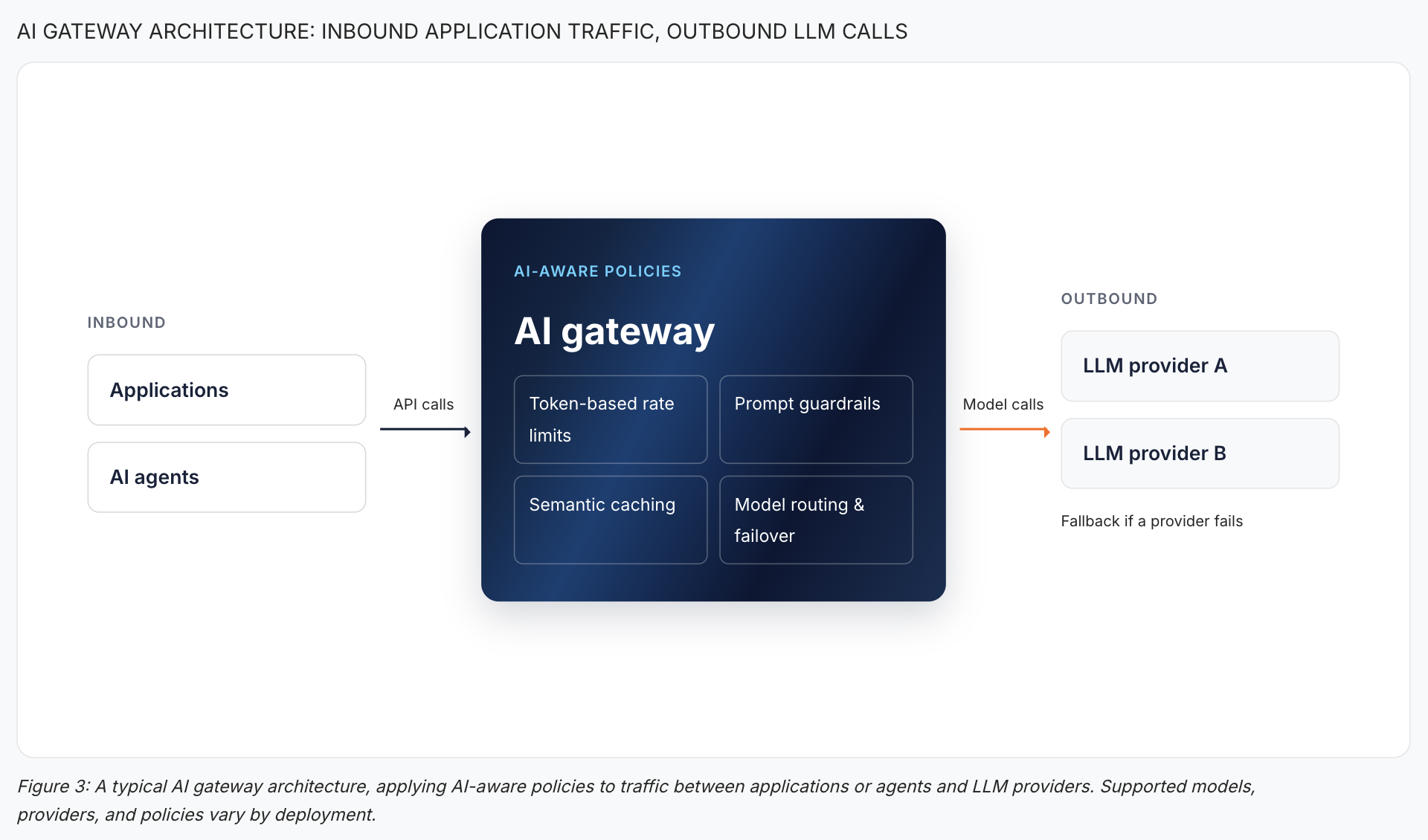
An AI gateway shares the core mechanics of a traditional gateway, including routing, authentication, and rate limiting. It adds capabilities suited to how LLM traffic behaves. These include token-based rate limiting instead of pure request counts and prompt-level guardrails that catch unsafe or malicious input. They also include semantic caching for similar prompts and model routing with automatic fallback when a provider has issues.
It helps to keep the two directions of traffic distinct. They are two legs of the same transaction, not separate, unrelated calls. Inbound, the gateway authenticates the incoming request from an application or agent the same way it would for any API call. Outbound, it uses its own configured provider credentials and routing policy to make the corresponding call to an LLM provider. That's one proxied request handled with two different credential sets, not a chain of separate services a request has to pass through in sequence.
Most organizations end up running a mix of traditional and AI-backed APIs. That raises a real question: run a dedicated AI gateway alongside a traditional one, or bring both under a single API platform?
The case for a single platform gets stronger as specific needs show up rather than as a matter of scale alone. Routing across more than one model provider is one signal. Needing to attribute LLM spend back to particular teams or products is another. So is handling regulated data in prompts. Another signal is when running two separate gateway stacks has become its own maintenance burden. Short of those triggers, a lighter, single-purpose setup is often the more practical choice.
Conclusion
API gateways have grown from simple reverse proxies into a core piece of API-first architecture, handling the security, scaling, and developer-experience work that turns an internal service into something ready to expose in production.
Whichever end of that spectrum you're on, an API gateway centralizes security enforcement, absorbs traffic spikes, and gives you visibility you wouldn't otherwise have. The alternative, building those capabilities into every individual service, means duplicated work and more places for something to go wrong. As AI-backed APIs become part of the same traffic mix, the same gateway concept, extended with AI-aware policies, is what keeps that traffic under similar control.
Keep the data plane and control plane split in mind as you evaluate options. A gateway that's fast at request time but hard to configure and monitor at scale will become the bottleneck it was meant to remove. If you're weighing how a gateway fits your architecture, the WSO2 API Gateway overview is a good starting point.
Frequently Asked Questions
What's the difference between an API gateway and a load balancer?
A load balancer distributes requests across instances of the same service. Layer 7 load balancers, like AWS's Application Load Balancer, can also handle some authentication and routing logic. An API gateway typically goes further, bundling authentication, fine-grained rate limiting, protocol translation, and request transformation as core, configurable capabilities rather than add-ons. The practical difference is breadth and depth of API-specific features, not a hard line where one handles security and the other doesn't.
Do I need an API gateway for a microservices architecture?
It's not strictly required. Patterns like a backend-for-frontend layer or service discovery can solve parts of the same problem without a full gateway. But without one or an equivalent layer, clients typically need to track every service endpoint directly, authentication gets duplicated across services, and cross-cutting concerns multiply with every new service added. A gateway gives you one entry point and lets your backend evolve without breaking existing clients.
How does an API gateway affect latency?
A gateway adds a small amount of processing time, generally a few milliseconds depending on which policies are applied. That overhead is usually minor next to backend processing time, and caching or efficient routing at the gateway can offset part of it.
What's the difference between an API gateway and API management?
An API gateway is the runtime component that handles live traffic, the data plane. API management is the wider platform, the gateway plus the control plane, including developer portals, analytics, and lifecycle tooling.
Can I run multiple API gateways together?
Yes, and larger organizations often do. Common patterns include an external gateway for public APIs paired with a separate internal one for service-to-service traffic, or regional gateways placed for latency. What matters is keeping policies consistent and monitoring all of them from one place.
Are API gateways only for REST APIs?
Modern gateways typically support GraphQL, gRPC, WebSocket, SOAP, and other protocols. Many can also translate between specific, pre-configured protocol pairs. That lets a client using one protocol reach a backend built on another. The translation has to be set up for each pair. It doesn't happen automatically for any two protocols.
What happens if an API gateway instance fails?
Production deployments run multiple instances specifically so a single failure doesn't take down API traffic. New requests can go to any healthy instance, since most request handling doesn't depend on which instance served a previous call. Requests that were in flight on the failed instance are the exception. Depending on where they were in processing, a retry can duplicate a side effect, which is why idempotency matters for operations like payments or order creation.

