AI Gateway vs API Gateway: Key Differences
An API gateway and an AI gateway solve different problems. You usually need both in production AI systems. An API gateway fronts your application traffic, handling authentication, enforcing rate limits and routing requests across backend microservices. An AI gateway governs large language model traffic. It tracks cost by the token, handles unpredictable latency, and mitigates AI-specific security risks like prompt injection and sensitive data leaks.
Teams that try to route LLMs through a conventional API gateway alone tend to encounter three primary failure modes:
- Unmonitored token costs
- Zero model-level visibility
- Security gaps that generic policies cannot catch
Several dedicated AI gateway solutions have entered the market. However, the primary architectural question isn't "which product wins", it's "where each layer belongs" in a modern production stack. This article breaks down the key differences, where they overlap and how to decide where each one belongs.
AI Gateway vs API Gateway: The Short Answer
An API gateway and an AI gateway govern two fundamentally different directions of network traffic. An API gateway manages inbound traffic from clients into your microservices. It works as a reverse proxy that handles basic authentication, rate limiting, and load balancing for standard request and response payloads.
An AI gateway manages outbound traffic from your applications to LLMs and model providers. It tracks token usage, dynamically routes across multiple LLM providers, caches prompt responses semantically, and applies guardrails against AI-specific threats.
They do not operate sequentially, where one gateway hands traffic off to the other. Instead, they govern distinct paths across your architecture:
- Inbound Traffic: A client or web application sends a request to your application backend, a path governed by your API gateway.
- Outbound Traffic: Your application backend calls an external LLM (such as OpenAI or Anthropic) or a self-hosted model, a path governed by your AI gateway.
Consider a website chatbot. When a user sends a message, the browser calls your chat backend through an API gateway only if the backend is exposed as a managed API. Your chat backend then makes an outbound call to an LLM provider through the AI gateway. The API gateway handles client authentication and service traffic while the AI gateway handles token budgeting, prompt guardrails and model routing.
So in a nutshell: API gateways govern how clients reach your services while AI gateways govern how your applications call language models. Production AI systems require both because they manage two entirely different traffic flows.
What Is an API Gateway?
An API gateway is the centralized entry point for client requests to your backend services. It acts as a reverse proxy that sits between callers and a fleet of microservices, so clients talk to one stable endpoint instead of dozens of internal ones. Instead of every backend service reimplementing these cross-cutting concerns, the gateway handles them centrally:
- Authentication and Security: Handles authentication and authorization via API keys, JWTs, or OAuth so only valid callers reach a service.
- Traffic Management: Controls rate limits and throttling to shield backends from overloads and enforce fair use across consumers.
- Request Routing: Executes routing based on URL paths, HTTP verbs and headers, plus request and response transformation between client and service formats.
- System Infrastructure: Manages load balancing across service instances, SSL termination, and response caching.
For over a decade, this setup worked like a charm because standard web traffic is structured and predictable. You deal with structured JSON or XML, with request and response shapes you can validate against a schema. Observability is framed around requests, latency percentiles, and error rates. Enterprise API gateways that include WSO2 API Manager, Kong, NGINX, Apigee, and AWS API gateway were built for this operational model.
The challenge arises when an application integrates a Large Language Model. Standard API gateway plumbing like TLS, authentication and endpoint routing still works. However, LLM traffic introduces an entirely new unit of measurement (tokens instead of requests) and a brand-new threat model that traditional gateways were never designed to inspect.
What Is an AI Gateway?
An AI gateway is a specialized middleware layer designed specifically for LLM and generative AI traffic. Traditional API gateways process generic HTTP requests without inspecting prompt payloads. An AI gateway recognizes prompts, tracks token consumption, and dynamically selects model providers based on real-time cost, latency, or capability. It gives you one standardized interface in front of many providers such as OpenAI, Anthropic, Mistral AI, and self-hosted models.
Here is what sets it apart from a standard proxy:
- Multi-Model Routing and Failover: Dynamically routes calls across multiple providers based on capability, token limits, or cost, and seamlessly fails over the instant a provider degrades.
- Token Cost Tracking: Meters input and output tokens per team, application, and model, replacing opaque vendor bills with actionable attribution.
- Semantic Caching: Serve cached responses for prompts that are semantically similar, which cuts both latency and repeat token cost.
- Prompt Management and AI Guardrails: Enforces prompt versioning, validates them, masks personally identifiable information, and screens inputs and outputs for unsafe content.
Observability also gets a major upgrade. Instead of basic HTTP status codes, you track exact token consumption, per-prompt costs, and model-level latency. To lock down these workloads, AI gateways implement specialized defenses with guidance from the OWASP Top 10 for LLM Applications to stop prompt injection and sensitive data exposure.
Key Differences (Side by Side)
At first glance, these two gateways look similar on the surface. Both act as reverse proxies, both handle security and authentication and both apply policies. Yet the second you open up the hood, you realize they are measuring and controlling entirely different worlds. This table maps the functional gap across the dimensions that matter when you're planning a gateway strategy.
| Dimension | API gateway | AI gateway |
|---|---|---|
| Primary Job | Manage and secure traffic to services and microservices | Orchestrate and govern traffic to AI models |
| Traffic Direction | Inbound (Client → Application Services) | Outbound (Application → Model Providers) |
| Unit of Control | HTTP requests, payload bandwidth | Prompts, completions, and token counts |
| Routing Logic | Endpoint-aware (URL paths, headers, weighted canary splits) | Context-aware (prompt content, token cost, latency, model capability) |
| Data Type | Structured JSON / XML | Unstructured text, prompts, images |
| Observability | Request throughput, latency percentiles, error rates | Tokens, per-model cost, prompt and response logs |
| Cost Management | Requests per second and bandwidth metering (no native token awareness) | Token usage tracking, budget caps, and per-model cost estimation |
| Authentication | API keys, JWT, OAuth 2.0 | OAuth and RBAC plus model-level access policies |
| Error Handling | Basic endpoint retries and server failover | Intelligent retries and fallback to alternate LLM models |
| Multi-model Support | Connects API endpoints | Connects OpenAI, Anthropic, Mistral AI, and others |
| Examples | WSO2 API Gateway, Kong, NGINX, Apigee, AWS API gateway | WSO2, Portkey, Helicone, TrueFoundry |
We recommend that you read this table as two different toolsets built for two different operational problems. Neither tool was designed for the other's job. An API gateway is optimized for managing service traffic, handling authentication, and balancing requests across backend service instances. An AI gateway is optimized for managing non-deterministic model traffic, balancing costs across LLM providers and enforcing prompt guardrails.
Do They Compete or Complement?
AI gateways do not replace API gateways. They are complementary because they govern entirely different directions of traffic, not because they form a sequential pipeline.
An API gateway sits at the edge of your infrastructure to manage inbound client traffic to your backend services. An AI gateway sits between your internal application backends and external model providers to manage outbound LLM calls.
When building an AI-enabled application, the architectural choice is how your application calls language models:
- Direct Provider SDK Calls: Your application calls OpenAI or Anthropic SDKs directly. This approach leads to unattributable spend, no ability to cap runaway prompt costs, and zero guardrails against prompt injection.
- Managed AI gateway Routing: Your application routes outbound calls through an AI gateway. The gateways applies token rate limits, semantic caching, provider failover, and input sanitization before the request leaves your network.
Architectures also incorporate a third layer which is the MCP (Model Context Protocol) Gateway. As autonomous AI agents start calling your backend tools, an MCP gateway governs that inbound agentic traffic, enforcing authentication, authorization, and throttling on the tools agents are allowed to invoke.
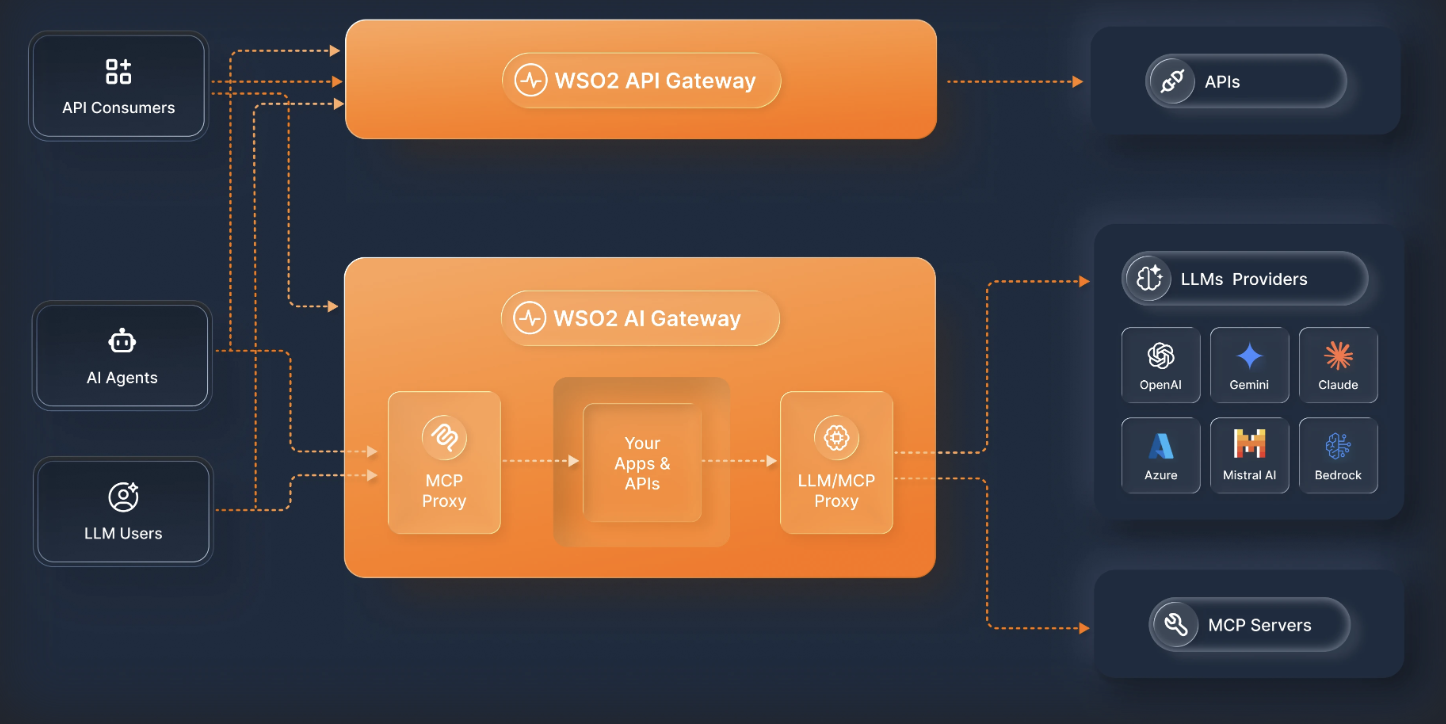
The above diagram portrays the dual traffic paths:
- Inbound client requests routed to services via the API gateway.
- Outbound application requests routed to model providers via the AI gateway.
The golden rule of modern architecture: API gateway for service traffic, AI gateway for model traffic and MCP gateway for agent traffic. Three specialized tools under one unified governance model beats stretching a standard gateway far past its purpose.
When to Use Which (Decision Guide)
You already need an API gateway the moment you expose more than a couple of services to clients. That decision rarely requires a checklist. However, the decision to add an AI gateway is much more nuanced. It's less about basic connectivity and more about controlling cost, safety, and model orchestration.
Add an AI gateway when:
- Multi-Model Operations: Multiple application teams are calling different model providers. You need intelligent, unified routing based on real-time cost, latency and model capabilities rather than hard-coding provider logic into every application.
- Cost Management: AI spend is opaque or growing rapidly. You need granular token metering, cost estimation, and vector-based semantic caching to gain total spend attribution.
- Compliance and Security: Your applications process regulated data in finance, healthcare or government. You need centralized audit trails, PII masking and strict guardrails to prevent prompt injection and data leaks.
- Production Scale: AI features are integrated into production applications serving external users, making ad-hoc token management and unmonitored vendor API keys an unacceptable reliability risk.
You can defer adopting an AI gateway if your setup is limited to a single application calling one model provider or an early proof-of-concept. In these early stages, calling the provider SDK directly from your application keeps the architecture simple until multi-model or governance requirements arise.
If you've decided you need an AI gateway and are weighing options, a focused AI gateway comparison is the logical next step for evaluating multi-model routing, guardrails and cost controls across vendors.
How WSO2 Provides Both
Most vendors specialize in one side of this comparison. The WSO2 API Platform takes a different approach by shipping both API gateway and AI gateway under a single unified control plane, allowing standard service traffic and your generative AI workloads to share one identity and governance model instead of two disconnected stacks.
Here is how WSO2 bridges both worlds:
Traditional API: Delivers complete API lifecycle management. From OpenAPI or AsyncAPI design, automated governance policies, versioning, and publishing APIs as products. Its control plane doesn't just manage WSO2 gateways, it manages Kong, AWS, Azure and Envoy gateways together.
AI gateway umbrella: WSO2 tackles modern AI traffic through two complementary components:
- Outbound LLM Gateway: Handles multi-model routing and automatic failover across OpenAI, Azure AI, AWS Bedrock, Anthropic and Mistral AI. It enforces safety guardrails (semantic prompt validation and PII masking), semantic caching and provides token-based rate limiting with department-level chargeback.
- Inbound MCP Gateway: Governs autonomous agentic traffic by creating MCP Proxies on top of existing MCP servers, enforcing strict authentication, authorization and throttling on agent calls.
You get one unified platform with 100% open source, deployable across self-hosted, hybrid or SaaS environments from a recognized Leader in The Forrester Wave™: API Management Software, Q3 2024. For enterprise architects, adopting an AI gateway doesn't have to mean gluing on a separate tool with a whole new policy language and its own audit trails.
Conclusion
API gateways manage your standard service traffic, AI gateways handle LLM traffic and MCP gateways step up as autonomous agents come online. If you already have an API gateway guarding your perimeter, add an AI gateway the moment token costs, multi-model routing or safety guardrails demand more than generic proxying.
If you would rather run all three layers under one unified control plane instead of stitching together separate tools, see how the WSO2 API Platform unifies API, AI and MCP traffic under one roof.
Frequently Asked Questions
What is the difference between an API gateway and an AI gateway? An API gateway controls client access to your applications and microservices, handling standard HTTP authentication, load balancing and request rate limits. An AI gateway controls outbound requests from your applications to language models, managing token consumption, cost attribution, provider failover and prompt guardrails.
What is an AI gateway? An AI gateway is a control plane for managing interactions with large language models. It gives developers a single interface to connect with vendors like OpenAI, Anthropic or self-hosted models while providing centralized controls for token budgeting, semantic caching, PII redacting and prompt safety inspection.
Do I need an AI gateway? You should adopt an AI gateway if your organization manages multiple LLM providers, requires spend attribution across teams, handles regulated data in prompts or serves external production users. You can wait if you are building an early proof-of-concept with a single application calling one model provider directly.
Should I route LLM calls through an AI gateway or call provider SDKs directly? Calling provider SDKs directly works for small prototypes, but it creates architectural blind spots as applications scale. Directly integrated SDKs leave organizations vulnerable to unmonitored API spend, lack prompt caching to reduce token costs, and provide no centralized mechanism to stop prompt injection or enforce compliance policies across models. Routing outbound calls through an AI gateway enforces those controls before requests leave your network.