What Is an AI Gateway? Features, Benefits and How It Works
It is quite simple to ship your first LLM feature. You connect your code directly to OpenAI or Anthropic, hit deploy and watch the magic happen. However, in reality, another team could add a different model. Someone can accidentally leak a confidential prompt during a live demo. Then finance comes knocking on your door asking why the AI bill tripled in a month with no clear way to attribute the spend. That gap between a working prototype and governed, enterprise-scale AI is exactly where an AI Gateway becomes essential.
This guide explains what an AI gateway is, how it works, the important features, and how it differs from the traditional API gateway. This will help platform and AI engineers figure out where AI Gateway fits in their stack.
What Is an AI Gateway?
Consider a traditional web service where every request has a predictable shape, a fixed cost and speaks standard HTTP. Now switch that out for generative AI where every LLM call is priced per token. It can return sensitive or unsafe content, may hallucinate and might need to fail over to a different provider mid-incident. Traditional API gateways have been designed to manage standard API traffic. They handle endpoints, routing, and HTTP headers. They cannot inspect prompt semantics or track token-level consumption.
AI Gateway serves as a middleware control plane that sits between your applications or agents and the AI models. The gateway provides a single entry point to govern AI traffic, enforcing routing, security, cost control and compliance policies. Traditional API gateways focus on traditional API traffic. AI Gateway focuses on prompts, tokens and model behavior, capabilities that fall outside the scope of traditional API management.
The gateway enforces these policies on unpredictable traffic. For example:
- Detect and mask sensitive information automatically before it reaches a model.
- Choose which model handles a request dynamically.
- Cap AI consumption using precise token counts.
- Switch providers mid-incident if a primary model drops offline or slows down.
- Log requests with sensitive data redacted, for audit and operational visibility.
In short, AI gateways allow teams to move from opaque and risky AI consumption to a transparent and governable one.
How Does an AI Gateway Work?
An AI gateway acts as a broker between applications and the models. No application holds its own provider keys and calls models directly. Instead, applications call the gateway and the gateway forwards the request downstream. The pattern mirrors how an API gateway fronts your backend services. Because of that, AI gateways so often reuse and extend existing API-gateway runtimes instead of reinventing the proxy layer.
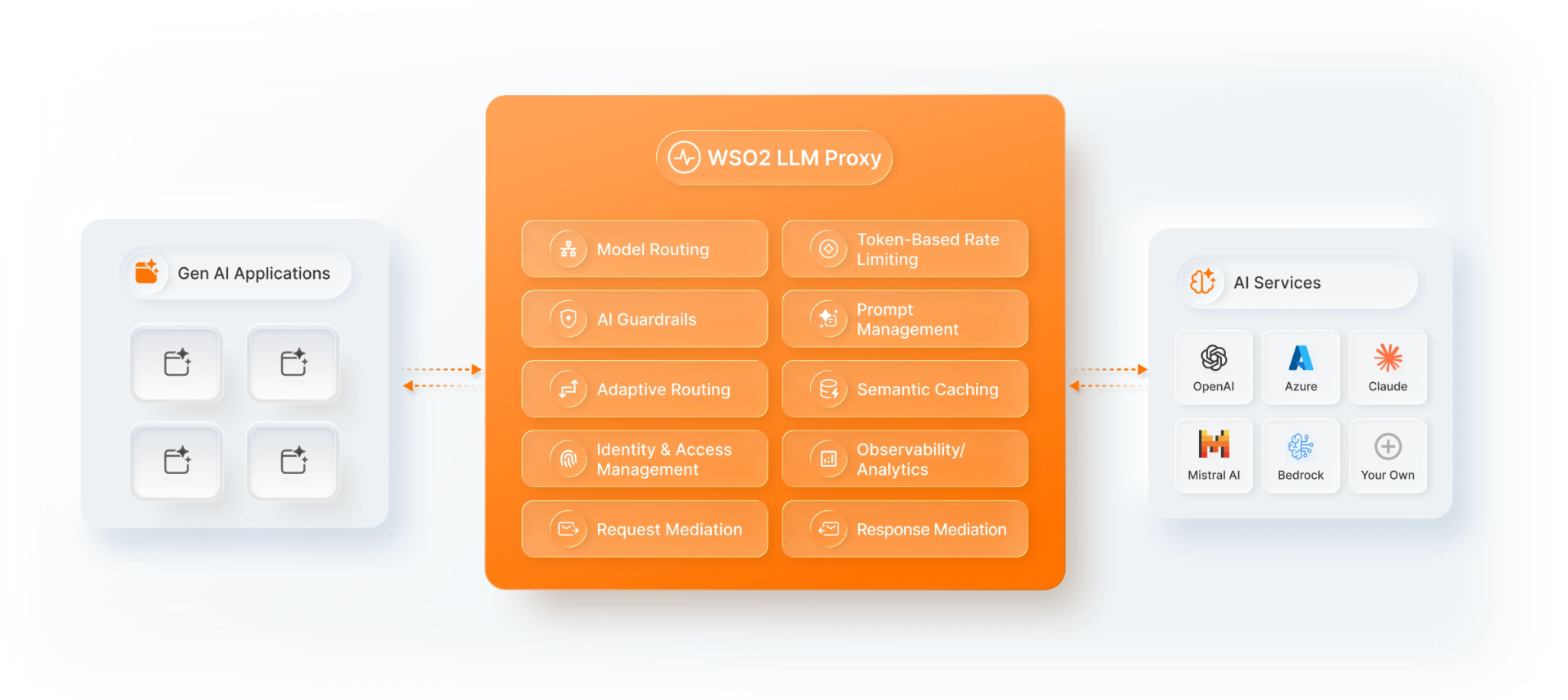
The above figure shows how an AI gateway centralizes routing, guardrails, cost control, and observability between applications and multiple model providers.
Why makes this pattern so powerful? Let's observe what happens when a user sends a message to an automated customer support assistant.
- Step 01: The application sends a request to the AI gateway instead of connecting directly to a model provider's API.
- Step 02: The gateway authenticates the caller and enforces policy. The gateway checks: "Is this app authorized to use these models? Does it have enough token budget for the month?"
- Step 03: Before data leaves your network boundary, the gateway runs the prompts through guardrails. The guardrails automatically mask personally identifiable information data (PII), block prompt-injection attacks, and handle other AI-specific risks.
- Step 04: The gateway routes the task to the best AI provider. If the primary model is degraded or suffering an outage, the gateway reroutes the request to a backup provider.
- Step 05: The gateway validates the AI's response to ensure it meets safety guidelines, redaction rules and proper formatting. It also logs the exact token count, cost and latency.
- Step 06: Your application receives a clean, standardized answer.
Each step represents a critical policy decision. Without an AI Gateway, every engineering team in your organization must build these safety, cost and security mechanisms into their code. An AI Gateway centralizes these functions in a single place to secure, govern and observe all AI traffic across the entire organization.
Key Features of an AI Gateway
Traditional API gateways and AI gateways share proxy fundamentals. However, the two diverge in the capabilities purpose-built for model traffic.
Multi-model access and API standardization
An AI gateway exposes a single, canonical API surface that maps to multiple underlying providers. Your application talks to the gateway in a consistent format and the gateway handles the per-provider translation. Parameter formats, tool calls, and model names still vary. But a unified surface significantly reduces application-side rewriting when swapping providers. For example, Cloudflare's gateway allows proxying requests through the OpenAI SDK by changing a single base-URL.
Intelligent routing and model orchestration
Beyond a static endpoint, the gateway decides which model serves a request. So the gateway acts as an intelligent dispatcher. That includes model-aware routing (send small and inexpensive classification to a small model while complex reasoning to a large one), versioning, staged rollout and failover logic that prevents a single provider outage from taking down your AI features by silently rerouting traffic to a backup model.
Dedicated routing and fallback behavior is deep enough that it usually warrants its own design discussion.
Token tracking, rate limiting and cost control
Traditional rate limiting counts requests, which doesn't work for AI. A single long prompt can cost hundred times more than a short one. AI gateways meter traffic by token consumption. WSO2's rate limiting lets you cap consumption based on token counts. This gives companies per-team quotas and budget tracking to prevent runaway bills.
Security and governance (guardrails)
Prompts leave your boundary and responses come back from a probabilistic system. So both directions need inspection. For this reason, the gateways apply guardrails. Gateways enforce several key controls:
- Semantic validation of prompts
- PII masking and redaction
- Output enforcement against a JSON Schema or regex
- Content filtering
Centralizing these controls helps mitigate risks like prompt injection and sensitive data disclosure documented in the OWASP Top 10 for LLM Applications.
Observability and logging
You cannot govern what you cannot see and standard API logs don't give you the full picture. An AI gateway tracks metrics across every interaction:
- Prompt and completion data (subject to redaction, retention, and privacy policies)
- Request volume and response times
- Error rates and provider latency
- Token counts and cost per interaction
It typically integrates with standard observability tooling like OpenTelemetry which ensures AI metrics appear directly inside existing SRE dashboards.
Semantic caching
Standard caching requires an exact string match which rarely happens with natural language. Semantic caching embeds queries as vectors in order to understand the intent of each prompt. The gateway then serves a cached response when a new prompt is semantically similar to a previous one. Prompts like "What's your refund window?" and "How long do I have to return an item?" return the same cached answer instantly, lowering latency and model fees. The semantic cache also depends on the similarity threshold that you set and too loose a threshold risks serving inaccurate answers.
Prompt management
Prompts hardcoded into application source mean every change needs a deployment, and each team ends up with its own conventions. AI Gateways pull prompts out of the application layer into managed policies. You can define a template once and apply it consistently across every application calling a model. For example, a template might instruct the AI to act as a support agent, answer in two sentences, and never reveal internal IDs. You can then adjust these rules without shipping code. WSO2 uses prompt templates and prompt decorators to inject safety rules and instructions dynamically without redeploying application code.
AI Gateway vs. API Gateway
While many AI gateways are built on top of API gateway technology and extended for AI, they govern different aspects of your stack. The difference lies in what each layer understands and controls.
| Dimension | API gateway | AI gateway |
|---|---|---|
| Primary traffic | REST, GraphQL, gRPC between clients and backend services | LLM and AI-model calls, agent traffic and prompts |
| Unit of control | Requests, routes, methods | Tokens, prompts, model responses |
| Rate limiting | By request count | By token consumption |
| Security focus | AuthN/AuthZ, schema validation, WAF | Prompt-injection defense, PII redaction, output guardrails |
| Reliability | Retries, load balancing | Model failover, multi-provider routing |
| Cost model | Roughly fixed per call | Variable per token; spend forecasting |
The practical takeaway is that API gateways route predictable data while AI gateways govern unpredictable content and token spend.
Benefits of an AI Gateway
Deploying AI into production usually triggers three pain points: security, cost and reliability. An AI gateway targets all three:
- Real-World Cost control — Traditional request limits can't stop a single massive prompt from generating a multi-thousand-dollar bill. Token-level metering lets you enforce hard budget caps and allocate exact costs per department so teams can discover which application is driving spend.
- Security and Compliance by Default — You don't have to rely on individual developers to build safety rules. Centralized guardrails automatically strip private data and block prompt-injection attacks across every app simultaneously. Audit logging and policy enforcement ensure every AI-powered feature inherits the same protections.
- Reliability at Scale — If an AI provider suffers a slow down or outage, an automatic multi-provider failover instantly switches traffic to a backup model. The feature thus remains available through a provider outage.
These engineering gains deliver three outcomes executives demand:
- Risk management: Contain AI-specific threats like data leaks, toxic outputs, and runaway spend before they reach customers.
- Enterprise governance: Deliver centralized audit trails and access controls that security and legal teams require.
- Business acceleration: Move company projects from pilot stages into production without reinventing security policies for every use case.
That combination has cemented AI gateway as a standard architectural pattern.
AI Gateway Deployment Models
Where you deploy an AI Gateway directly impacts latency, regulatory compliance, and system failure isolation. Enterprise architectures rely on distinct patterns based on specific operational needs. Common patterns include:
- Global / Centralized: A central gateway handles all enterprise AI traffic. Use a centralized gateway for maximum visibility and simplified governance.
- Data-zone/Regional: Localized gateways that keep prompts, completions and sensitive data strictly within regional or national boundaries. This model solves strict data residency laws and sovereignty requirements.
- Multi-cloud/Multi-provider: Unified control plane spanning models hosted across multiple cloud vendors and self-hosted environments. This model prevents vendor lock-in and provides multi-cloud redundancy.
- Micro-gateway and sidecar: Lightweight runtimes deployed alongside individual application services such as Kubernetes sidecars. This model delivers low latency and fine-grained workload isolation.
Most enterprise organizations end up combining them. For example, you can have a central control plane for global policy and cost visibility. And you pair that with regional or in-cluster gateway instances running close to actual workloads. This lets regulated teams keep sensitive data on-premises while still calling cloud-hosted AI models.
A useful way to choose is to work backward from your hardest constraint.
- If it's data residency or a regulator, choose a data-zone or on-premises model.
- If it's latency for a real-time feature, push a microgateway or sidecar close to the workload.
- If it's provider diversity across clouds, consider a multi-cloud control plane.
WSO2 supports this hybrid use case by offering a family of gateway runtimes governed under a single control plane:
- Universal Gateway
- Kubernetes Gateway
- Immutable Gateway
- Event Gateway
This ensures your physical deployment topology can adapt without forking your security policies. Do not build an isolated, "AI-only" control plane separate from your existing API management platform. It creates security blind spots and reintroduces the exact platform fragmentation an AI gateway is designed to solve.
AI Gateways, Agents, and MCP (Emerging Trends)
The AI gateway landscape is evolving rapidly around three emerging shifts:
Retrieval-Augmented Generation (RAG): This turns the gateway into an orchestration layer where it connects models to external knowledge. Rather than scattering data logic across services, gateway policies govern data retrieval and prompt assembly in one place.
Agentic AI: This raises the stakes because autonomous agents don't just generate text. They call tools, execute actions and query databases independently. Gateways manage authentication and permissions for these actions to prevent ungoverned agent behavior. Without gateway governance, the agents risk creating severe shadow IT and uncontrolled cost problems.
The Model Context Protocol (MCP): MCP is the emerging industry standard for how AI agents discover and execute backend tools. This is where outbound LLM management and inbound agent tool access converge. Modern AI gateways govern both outbound model requests and inbound MCP tool traffic.
WSO2's AI Gateway positions itself as a single control plane covering both LLM consumption (outbound) and MCP tool exposure (inbound). It allows platform teams to build managed MCP Proxies on top of MCP servers, giving developers a controlled, secure endpoint to expose tool capabilities to AI agents.
The WSO2 AI Gateway
The AI Gateway in WSO2 API Platform provides a single control plane for all AI traffic. It covers both LLM consumption and MCP tool exposure. You can apply guardrails, monitor usage, optimize costs, and govern agent access, all from one place.
Here is how AI Gateway helps you manage and secure AI traffic for LLM APIs and MCP servers:
- LLM consumption (outbound traffic):
- Handles multi-provider and multi-model routing, load balancing, round-robin routing across supported providers such as OpenAI, Azure AI, AWS Bedrock, Anthropic, and Mistral AI.
- Enforces PII masking, semantic prompt validation, URL and JSON schema checks and integrates with external services like Azure Content Safety and AWS Bedrock Guardrails.
- Uses token-based rate limiting and semantic caching to enable department-level chargebacks.
- MCP servers (inbound traffic):
- Exposes managed endpoints that applications use to access your MCP servers.
- Exposes all generated and external third-party MCP servers inside a searchable catalog for agent developers with authentication, authorization and throttling on every agent call.
WSO2 provides full support for hybrid, self-hosted, and SaaS deployments, as well as federating third-party gateway runtimes like AWS API Gateway from the same control plane.
Hyperscalers and standalone AI startups build great single-purpose tools. WSO2 doesn't race to ship every individual feature first. Its strength is unifying traditional REST APIs, LLM traffic, and autonomous AI agents (MCP) together under a single, open, hybrid-capable control plane.
For engineering teams already managing APIs, it delivers total AI governance without forcing you to build or maintain a second, siloed control layer.
Conclusion
An AI gateway is the operational control plane for your AI traffic. It provides a single place to route across models, cap expenses by token, enforce guardrails against prompt injection and data leakage, and provides complete observability.
You wouldn't run production microservices without API management. Similarly, running unpredictable, token-heavy AI workloads without an AI gateway introduces severe financial and security risks.
If you're mapping out where a gateway fits, start with the WSO2 AI Gateway to see how AI agent and API governance can share one control plane.
Frequently Asked Questions
What is an AI gateway in simple terms? It's the traffic controller sitting between your apps and your AI models. It handles routing, security, spend and monitoring for AI traffic.
How is an AI gateway different from a traditional API gateway? An API gateway governs conventional API traffic by request, route and method. An AI gateway governs model traffic by understanding prompts and tokens, adding purpose-built capabilities like prompt-injection defense, PII masking, token-based rate limits and model failover.
Do I need an AI gateway if I only use a single AI model? A gateway provides centralized cost tracking, security guardrails, and observability even with a single model. It also simplifies adding or switching models later on.
Does an AI gateway work with self-hosted, open-source models? AI gateways front proprietary, third-party cloud models and self-hosted open-source models behind a unified API surface. This is ideal for hybrid deployments as it keeps sensitive data on-premises.
What is semantic caching? Semantic caching is vector-based caching that understands prompt intent rather than exact text matches. If a new prompt is semantically similar to a previous one, the gateway serves the stored response to reduce latency and model calls.