API Gateway vs Load Balancer vs Reverse Proxy: Clearing the Confusion
An API gateway, a load balancer, and a reverse proxy all sit somewhere near the edge of your architecture. All three get called on to "handle traffic," and that overlap is exactly why the terms get used interchangeably in interviews and architecture reviews. Each one still answers a different question. A load balancer asks which healthy server should take this connection. A reverse proxy asks how to forward this request without exposing the origin. An API gateway asks whether this specific API call should be allowed through at all, and what should happen to it on the way.
None of the three replaces the others. None of them is a required stop on the way to the next, either. This guide breaks down what each one actually does and where the boundaries genuinely blur. It also covers how teams combine them in production, without turning the edge of their architecture into a chain of hops nobody can explain.
API Gateway, Load Balancer, Reverse Proxy: What Each One Actually Does
- Load balancer: distributes incoming network traffic across a pool of backend servers so no single instance gets overwhelmed, and keeps serving traffic if one instance fails.
- Reverse proxy: a server that sits in front of one or more backend servers and forwards client requests to them. It hides the backend's identity and adds a single point for TLS, caching, and basic traffic control.
- API gateway: an application-layer proxy purpose-built for API traffic, adding authentication, per-route rate limits, request and response transformation, and API-level analytics on top of routing.
A reverse proxy is the general category, though not every load balancer fits inside it. Layer 7 load balancers and API gateways are both specialized types of reverse proxy, each built around a different job: one around distributing connections, the other around enforcing API policy. Layer 4 load balancers, especially in passthrough or direct-server-return modes, route packets between client and server without proxying the connection at all.
What Is a Load Balancer?
A load balancer sits in front of a pool of backend servers and spreads incoming requests across them. Its job is availability and horizontal scaling, not request content. It runs continuous health checks, and when an instance stops responding, the load balancer stops sending it new connections. This limits disruption rather than eliminating it. Requests already in flight to that instance can still fail, and detection takes at least one health-check interval.
Load balancers operate at two different layers of the OSI model, and which layer matters for what they can see. A Layer 4 load balancer works at the TCP or UDP level. It reads IP addresses and port numbers only, never the payload, which makes it fast and protocol-agnostic but blind to anything happening inside the request. A Layer 7 load balancer reads the HTTP request itself, including headers and URL paths, so it can make smarter routing calls, at the cost of a little more processing overhead per request.
How Load Balancers Work
Most load balancers pick from a small set of algorithms to decide which backend gets the next request:
- Round robin: cycles through servers in order.
- Weighted round robin: same idea, but stronger servers get a larger share.
- Least connections: sends the request to whichever server currently has the fewest active connections.
- IP hash: derives the target server from the client's IP address, which keeps a given client landing on the same backend, useful for session persistence.
Hardware vs. Software Load Balancing
Hardware load balancers are dedicated physical appliances. They're built for very high, predictable throughput and still show up in data centers with strict latency budgets, but they're expensive, and scaling them means buying another box. Software load balancers run as regular processes on commodity infrastructure, scale by adding instances instead of hardware, and are what most cloud-native teams reach for by default. Cloud provider load balancers (an AWS Network Load Balancer or a Google Cloud Load Balancer, for example) are the managed version of the same idea.
What Is a Reverse Proxy?
A reverse proxy is a server that sits in front of one or more origin servers, intercepts client requests, and forwards them to the appropriate backend on the client's behalf. From the client's point of view, the reverse proxy is the destination. The actual backend isn't exposed to clients directly, which supports a broader security posture. Hiding the origin's address doesn't secure it on its own, and network segmentation and access controls on the backend still matter.
Cloudflare describes the core job plainly: a reverse proxy forwards client requests to the servers behind it, typically to improve security, performance, and reliability. Beyond forwarding, a reverse proxy commonly handles TLS termination (so backend servers don't each need their own certificate), response caching, and basic load distribution across a pool of servers.
That last capability is exactly where the confusion with load balancers starts. Load balancing is something a reverse proxy can do, not something that requires a separate named component. NGINX and HAProxy are reverse proxies that also load balance, and a cloud provider's Layer 7 (proxy-mode) load balancer works the same way. Not every load balancer fits this pattern, though. Layer 4 load balancers in passthrough or direct-server-return modes forward packets without terminating the connection. They aren't proxying traffic in the architectural sense, even though they're still called load balancers. Some load balancers do operate as full Layer 7 proxies. There, the difference from a reverse proxy is often emphasis and configuration on the same software. They are not two unrelated categories of infrastructure.
What Is an API Gateway?
An API gateway is a reverse proxy built specifically for managing API traffic rather than generic web traffic. It sits in front of a set of backend services and centralizes the concerns that would otherwise get duplicated inside every service. That includes authentication and authorization, per-consumer rate limiting, request and response transformation, protocol translation, and API-level observability such as per-endpoint latency and error rates.
A reverse proxy or a load balancer typically routes on connection or URL alone. An API gateway goes further. It routes and enforces policy based on the caller's identity, the specific API and version being called, and the terms that consumer agreed to. A gateway like the WSO2 API Platform can also apply that same policy layer to traffic leaving your services toward third-party APIs, not only to traffic coming in. That distinction, API-aware policy versus generic traffic handling, is the throughline for the rest of this guide.
Feature Comparison: Load Balancer vs. Reverse Proxy vs. API Gateway
| Dimension | Load Balancer | Reverse Proxy | API Gateway |
|---|---|---|---|
| Primary job | Distribute traffic across backend instances | Forward client requests to origin servers on their behalf | Manage and secure API traffic end to end |
| Typical OSI layer | Layer 4 or Layer 7 | Layer 7 | Layer 7 |
| Traffic awareness | Connection or, at Layer 7, basic HTTP attributes | Full HTTP request, before any API-specific logic | Full HTTP request plus API identity, version, and consumer context |
| Authentication | Supported on some Layer 7 products (e.g., OIDC and JWT validation on AWS ALB) | Not typically | API keys, JWTs, OAuth |
| Rate limiting | Basic, connection-level in some products | Basic, IP or connection-level | Granular, per API, per consumer, per plan |
| Request and response transformation | Limited, on some Layer 7 products (host and URL rewrites) | Limited | Yes |
| Caching | Limited | Yes | Yes, often with per-route policy |
| Observability | Connection counts, basic health metrics | Access logs | Per-API and per-consumer analytics |
| Common examples | AWS NLB, F5, HAProxy in LB mode | NGINX, HAProxy, Cloudflare | WSO2 API Gateway, Kong, Apigee, AWS API Gateway |
Read this table as three overlapping toolsets rather than three strict tiers. Most API gateways include load-balancing logic internally, and most reverse proxies can be configured to do some of an API gateway's job in a pinch. The table shows what each category is optimized for, not a hard technical wall between them.
When to Use Which (and When to Use All Three Together)
Reach for a load balancer alone when the problem is purely distribution and availability: you have several identical instances of the same service, and you need traffic spread across them with automatic failover. Internal traffic between microservices, or a simple website behind two web servers, rarely needs anything more.
Reach for a reverse proxy when you need a stable public-facing address in front of one or more origins, plus TLS termination and caching, without necessarily needing per-API authentication or rate-limit policy.
Reach for an API gateway once you're exposing multiple APIs to external or third-party consumers. At that point you need to enforce who can call what, how often, and under which terms. That policy has to be consistent across services, and it shouldn't live inside each one separately.
In practice, most production systems combine all three, and not in a single fixed order. A common pattern places a Layer 4 or cloud load balancer in front of a cluster of API gateway instances. The load balancer handles raw connection distribution and failover across gateway nodes. The gateway, itself a specialized reverse proxy, applies authentication, rate limits, and routing to the actual API calls. Other deployments skip the separate load balancer entirely. A single API gateway with load balancing built in does both jobs at once.
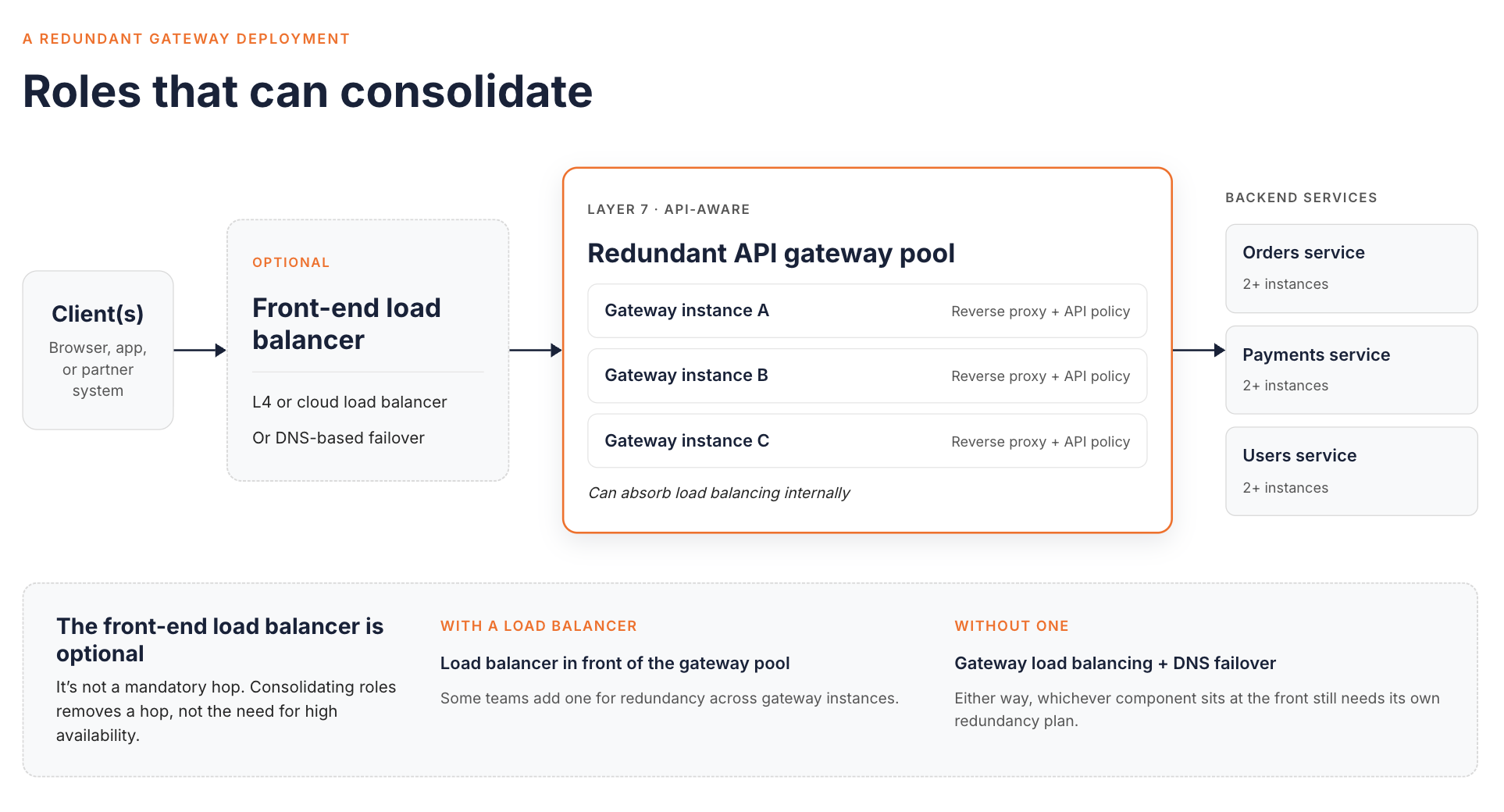
Both arrangements are correct. Which one you run depends on scale, existing infrastructure, and how much you want to operate yourself, not on a rule that says one component must always sit in front of the other. One caveat is worth planning for. If an API gateway does its own load balancing across backends, the gateway's own instances still need a highly available entry point. That can be a cloud load balancer, DNS-based failover, or an anycast address in front of the gateway pool. Consolidating roles removes a hop. It doesn't remove the need for redundancy at whichever layer ends up as the front door.
The signal to add an API gateway on top of a load balancer or plain reverse proxy isn't a specific traffic volume. It's whether multiple teams or external partners now consume your APIs. It's also whether you need consistent authentication and per-consumer throttling, or a single place to see API-level usage instead of piecing it together from server logs. A single internal service behind a load balancer usually doesn't need that layer yet. A public-facing API program with several consumer types generally does.
How WSO2 Fits In
The WSO2 API Gateway is often deployed behind an existing load balancer or ingress layer. The load balancer keeps handling raw connection distribution. The gateway applies the API-specific policy on top: authentication, rate limiting, and routing to the correct backend service. That matches the "use them together" pattern most teams already run. You don't have to rip out the infrastructure that's working. Where a team prefers fewer moving parts, the gateway's own load-balancing and routing features can cover that role directly. That is the "consolidated" pattern described above, not a fixed rule.
In the WSO2 API Platform, the same API Gateway runtime runs on VMs, in containers, or on Kubernetes. On Kubernetes, it runs in standalone mode or under an operator. It can also run as an immutable gateway that loads its APIs from files at startup, which suits GitOps and locked-down environments. The AI Gateway handles LLM and MCP traffic on the same runtime. All of them can be managed from one control plane. That control plane can also federate third-party gateways such as AWS, Azure, Kong, and Envoy, and bring them under the same governance and visibility. Many teams already run a mix of load balancers, reverse proxies, and gateways across regions or business units. For them, one control plane changes the operational question. It stops being "which tool sits where" and becomes "do we have one consistent view of all of it."
Conclusion
A load balancer, a reverse proxy, and an API gateway solve overlapping but distinct problems, and the overlap is real, not a naming accident. A reverse proxy is the general category, though it doesn't cover every load balancer. Layer 7 load balancers and API gateways are each a specialized version of it. One is optimized for distributing connections, and the other for enforcing API policy. Layer 4 load balancers largely sit outside that category. Most production architectures end up running some combination of all three, arranged to fit the traffic they actually have rather than a fixed textbook order.
If you're already running a load balancer or reverse proxy and are deciding whether to add API-specific policy on top, see how the WSO2 API Gateway fits into that layer. It's built to add that policy without requiring you to replace what's already in place.
Frequently Asked Questions
Does the load balancer or the API gateway come first in the request path?
Neither is universally "first." A common pattern puts a load balancer in front of a pool of API gateway instances, so the load balancer distributes connections across gateway nodes before the gateway applies API policy. Other deployments run a single gateway with load balancing built in, with no separate component in front of it.
Can I use a load balancer and an API gateway together?
It's the most common production setup for teams exposing APIs at any real scale. The load balancer handles connection distribution and failover. The gateway handles authentication, rate limiting, and routing for the API traffic itself.
What's the real difference between a reverse proxy and an API gateway?
A reverse proxy forwards requests to backend servers and can add TLS termination, caching, and basic load balancing. An API gateway is a reverse proxy purpose-built for APIs, adding authentication, per-consumer rate limits, and API-level analytics that a general-purpose reverse proxy doesn't provide out of the box.
Do I need all three in my architecture?
Not necessarily as three separate components. Many teams run a load balancer plus an API gateway that also acts as their reverse proxy. That covers all three roles with two pieces of infrastructure, and it's a perfectly normal end state, not a shortcut.

