Kong vs Tyk: Open Source API Gateway Showdown
Kong and Tyk are both open source API gateways, and both get chosen for opposite reasons. Kong is an NGINX-based toolkit built for raw throughput and a plugin-per-feature model. Tyk is a Go-based, single-binary platform built for consistent latency and a batteries-included feature set. The right pick depends on which tradeoff your team is actually optimizing for.
What Is Kong?
Kong is a widely used open source API gateway built on NGINX and OpenResty, with request-handling logic written in Lua. That foundation makes it lightweight and fast under high request volumes, which is why it shows up so often in Kubernetes and microservices environments.
Kong takes a plugin-first approach. Instead of baking authentication, rate limiting, or logging into the core, you turn on a plugin for each capability. The core product line includes:
- Kong Gateway: the open source proxy itself, licensed Apache 2.0. It routes traffic, terminates TLS, and enforces policy through plugins.
- Kong Konnect: a SaaS control plane for managing, securing, and observing gateways across environments.
- Kong Mesh: a service mesh built on Kuma, for service-to-service traffic inside your infrastructure.
- Insomnia: a desktop client for designing and testing APIs before they hit the gateway.
You can run Kong Gateway on bare metal, in containers, or natively on Kubernetes, and combine it with Konnect for a managed control plane or run it fully self-hosted. Protocol support is broad. REST, gRPC, WebSocket, Kafka, and GraphQL all show up in Kong's plugin catalog. That is part of why it's a common default in microservices-heavy shops that need one gateway for several traffic types.
What Is Tyk?
Tyk is an open source API gateway written in Go and shipped as a single binary, licensed under MPL 2.0. Where Kong's core is deliberately minimal, Tyk's gateway ships "batteries-included": rate limiting, authentication, analytics, and API definitions all work out of the box, with no separate plugin install for the basics.
The free gateway is only part of the picture, though. The Tyk Dashboard and the developer portal live inside Tyk Self-Managed or Tyk Cloud, both of which require a commercial license. The practical split is that Tyk Gateway itself is fully open and unrestricted, but the management layer wrapped around it is a separate, licensed product. Tyk's product line breaks down as:
- Tyk Gateway: the open source proxy, handling REST, GraphQL, TCP, and gRPC traffic.
- Tyk Dashboard: the licensed management UI, analytics layer, and developer portal.
- Tyk Pump: an open source component that moves analytics data from the gateway to your storage backend of choice.
- Tyk Identity Broker: an optional bridge to third-party identity providers.
Tyk also runs natively on Kubernetes through the Tyk Operator. Tyk's own documentation lists the Operator as a closed-source component that needs a license key for on-premises use, the same as the Dashboard. The Gateway itself depends on Redis for distributed rate limiting and token storage, and the Dashboard adds a second dependency, MongoDB or Postgres, for its own persistent storage.
Kong vs Tyk: Key Features
| Feature | Kong | Tyk |
|---|---|---|
| Core architecture | NGINX/OpenResty, Lua plugin chain | Single Go binary, built-in policy engine |
| License | Apache 2.0 (Gateway) | MPL 2.0 (Gateway), Dashboard and Cloud are commercially licensed |
| Extensibility | Plugin architecture (Lua, Go, others) | Built-in features plus custom middleware |
| Database dependency | Postgres or DB-less mode | Redis (required), plus MongoDB or Postgres for the Dashboard |
| Deployment options | Bare metal, containers, Kubernetes, hybrid, multi-cloud | Self-managed, Tyk Cloud, Kubernetes via Tyk Operator (licensed component) |
| Developer portal | Available in Konnect/Enterprise | Included in Tyk Dashboard (licensed) |
Kong vs Tyk: Architecture and Performance
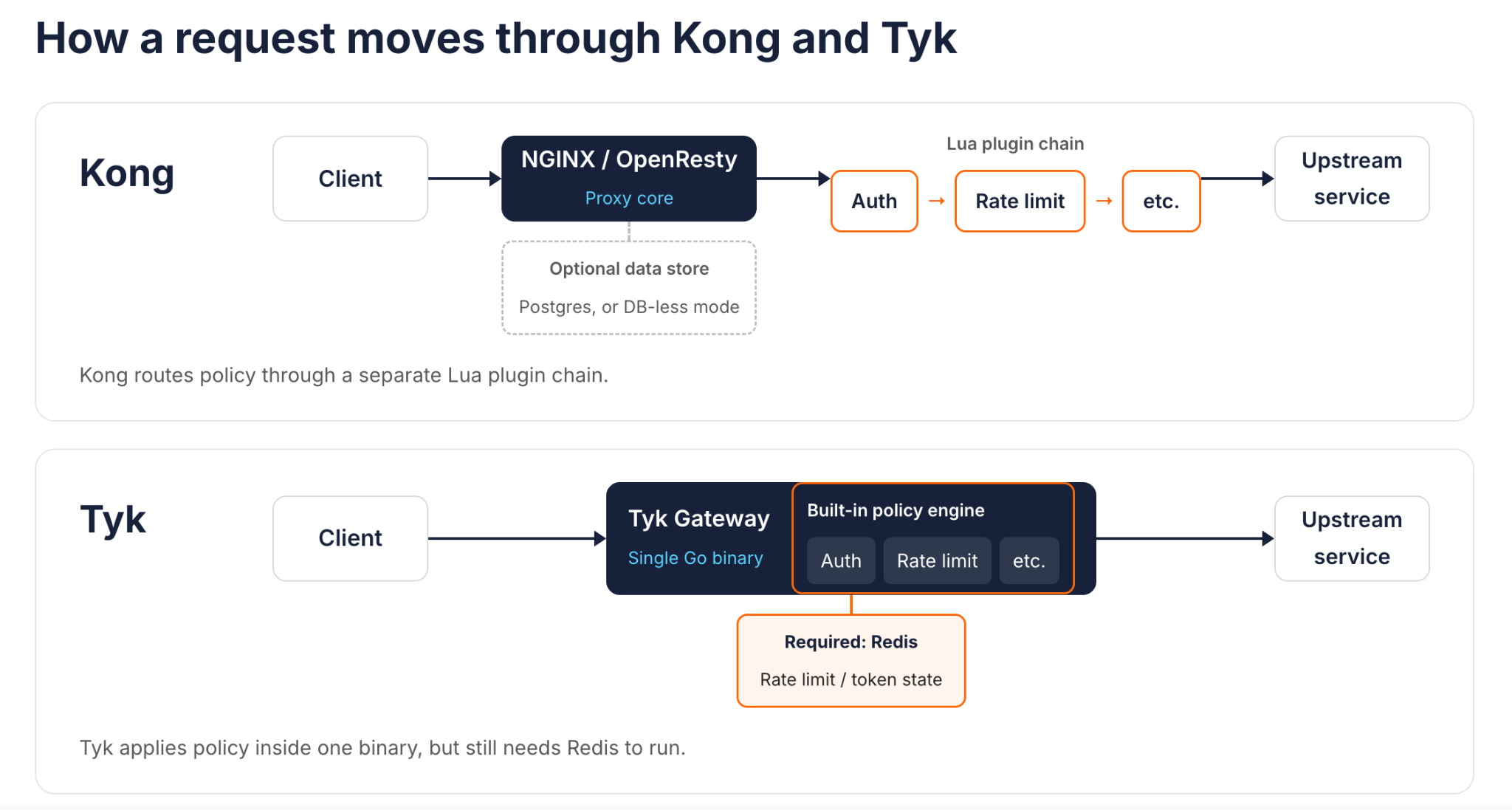
Kong's NGINX foundation is built for handling a large volume of short-lived requests with a small footprint. Under simple routing and policy chains, that architecture tends to hold latency low and scale horizontally without much tuning.
Tyk's Go runtime takes a different path. Tyk doesn't route each request through a separate plugin runtime for every policy check. Its built-in policy engine runs inside the same compiled process as the proxy. Go's single-binary model doesn't split policy logic into an external plugin chain the way Kong's Lua-based approach does.
That difference shows up most clearly with AI traffic. One third-party technical comparison argues that Tyk's concurrency model handles long-lived streaming connections, such as a token-by-token LLM response, more predictably than a Lua-based plugin chain under similar load. Treat that as one analysis, not a WSO2 benchmark. Both vendors publish their own performance claims, and neither vendor's numbers should be taken as neutral.
The practical takeaway: if your workload is high-volume, low-complexity request routing, Kong's architecture is built for exactly that. If your workload increasingly includes long-lived connections or heavier per-request logic, such as AI streaming, Tyk's model is worth testing directly against your own traffic before deciding either way. A short proof-of-concept against your actual traffic pattern, request sizes, plugin count, and connection duration included, will tell you more than any vendor's headline number.
Scaling patterns also differ a little. Kong's NGINX worker model scales horizontally in a fairly predictable, well-understood way, since it's the same scaling story teams already know from running NGINX for anything else. Tyk's Go binary scales similarly at the process level. But state like rate-limit counters lives in Redis. So your Redis cluster's throughput becomes part of the capacity plan, which doesn't apply to Kong's DB-less mode. Neither pattern is inherently better. They just move the operational burden to a different place: Kong pushes it into plugin management, Tyk pushes it into Redis capacity planning.
Kong vs Tyk: GraphQL and Protocol Support
This is one of the more concrete differences between the two, and it's worth its own section rather than a table row.
Tyk ships Universal Data Graph (UDG). It lets you stitch multiple data sources into a single new GraphQL schema. Sources can include REST APIs, existing GraphQL services, databases, and even Kafka streams. Most of the setup happens in the Dashboard rather than in hand-written code. Like the Dashboard, UDG is a closed-source, licensed component rather than part of the free Tyk Gateway. It's a genuine schema-composition tool, not just a pass-through.
Kong's GraphQL support works differently. Plugins like GraphQL Proxy Caching sit in front of an existing GraphQL upstream and cache or rate-limit its traffic. Kong proxies and protects a GraphQL service you already have. It does not compose a new schema out of separate sources the way Tyk's UDG does, and the relevant GraphQL plugins are Enterprise-only.
If your team needs to build a new unified GraphQL layer over several existing services, Tyk's UDG is the more direct fit. If you already run GraphQL upstream and just need it proxied, rate-limited, and cached, Kong's plugin model covers that without extra tooling.
Kong vs Tyk: Pricing and Licensing
Kong's open source Gateway is free and Apache 2.0 licensed, with no artificial feature caps at the proxy layer. Kong Konnect, the managed control plane, is priced on a "Plus" tier that combines a per-control-plane charge with metered API request volume, plus add-on charges for things like the AI Gateway's per-model proxying. Above that sits a custom-quoted Enterprise tier, billed annually, for teams that need SSO, audit logs, or uncapped gateway counts. This reflects Kong's published rate structure as of September 2026. Usage-based tiers like this change often, so confirm current rates with Kong before budgeting.
Tyk's Gateway is free, MPL 2.0 licensed, and not feature-gated. But the moment you want the Dashboard, the developer portal, or Tyk Cloud, you're into Tyk Self-Managed or Tyk Cloud territory, both of which require a commercial license negotiated directly with Tyk. Tyk doesn't publish self-serve pricing for that layer as of September 2026. If licensing cost is a deciding factor, get a current quote directly. Several older third-party estimates cite figures that are no longer current.
Neither vendor makes their full enterprise pricing public, which is normal for this category but worth planning for. Budget a sales conversation into your evaluation timeline for either one, and confirm current figures directly with the vendor rather than relying on third-party estimates, which drift out of date quickly in this space.
When to Choose Kong
Kong tends to be the better fit when:
- Raw throughput matters most. High request volumes with straightforward routing and policy logic play to NGINX's strengths.
- You're already Kubernetes-native. Kong's plugin model and Konnect control plane are built around cloud-native, containerized deployment patterns.
- You want granular, à la carte extensibility. Turning on exactly the plugins you need, and nothing else, keeps the runtime lean.
- Your team is comfortable managing plugin sprawl. More capability means more individual plugins to configure, version, and monitor.
When to Choose Tyk
Tyk tends to be the better fit when:
- You want a smaller operational surface. One binary with built-in rate limiting, auth, and analytics means less plugin management day to day.
- GraphQL schema composition is a real requirement, not just proxying an existing GraphQL service.
- Your traffic includes heavier per-request logic or long-lived connections, where Go's concurrency model has room to show its advantage.
- You're comfortable licensing the management layer separately from the free gateway, since Dashboard and Cloud aren't part of the OSS tier.
Where the WSO2 API Platform Fits
Kong and Tyk are both solid, single-vendor API gateways. The tension most platform teams eventually hit isn't Kong versus Tyk in isolation. Real environments end up running more than one gateway. They also carry a growing amount of AI and agent traffic that neither gateway was originally built to govern as a first-class concern.
WSO2's approach is to put API traffic, outbound AI/LLM traffic, and inbound agent-to-tool traffic under one control plane, rather than treating each as a separate system to operate. These are three parallel traffic paths, not a chain a request has to pass through in sequence. The WSO2 API Platform is built on that separation. It doesn't force everything through a single pipeline.
A few specifics worth naming:
- Federated multi-gateway management. The WSO2 API Platform can federate Kong, AWS API Gateway, Azure API Management, and Envoy-based gateways under one control plane. You don't have to standardize on one vendor's gateway before you consolidate visibility. Tyk isn't on the documented federation list, so confirm support with WSO2 if you run it.
- Governance that extends to agent traffic. The WSO2 AI Gateway handles outbound LLM routing, guardrails, and cost controls through LLM proxies. Its MCP proxies bring authentication, authorization, and access control to inbound agent-to-tool traffic. If your team already runs an MCP server, you can proxy it without changing the server's code. You can then publish it to the MCP Hub, so other teams find approved MCP servers instead of running their own ungoverned copies.
- Open-source core. The platform source is Apache 2.0 licensed and runs self-hosted, hybrid, or as SaaS on the same gateway runtime. Moving between those modes doesn't require rearchitecting.
- Native monetization and analytics. Usage-based monetization and analytics across API, LLM, and MCP traffic come through Moesif, which is part of the platform. Neither Kong's nor Tyk's open source core includes that.
None of this makes WSO2 faster than Kong's NGINX core, and it doesn't out-stitch Tyk's Universal Data Graph. Those are genuine, specific strengths of each vendor. What WSO2 offers instead is a way to stop running separate governance systems for APIs, AI traffic, and agent traffic as adoption grows past a single gateway.
Conclusion
Kong and Tyk solve the same problem with opposite starting assumptions. Kong optimizes for a minimal, plugin-driven core built on NGINX. Tyk optimizes for a batteries-included Go binary with GraphQL composition built in. Which one fits depends on your traffic shape, your GraphQL needs, and how much plugin management your team wants to own day to day.
It gets harder at a point most growing platforms reach anyway. They run more than one gateway and carry a rising share of AI and agent traffic, with no single place to govern all of it. That's the gap WSO2's API Platform is built to close. If you're already comparing Kong and Tyk, look at a federated, single-control-plane alternative before you commit to either one.
Frequently Asked Questions
Is Kong or Tyk open source?
Both have genuinely open source gateways. Kong Gateway is Apache 2.0. Tyk Gateway is MPL 2.0. In both cases, the management dashboard and developer portal are separate, commercially licensed products.
What's the core difference between Kong and Tyk?
Kong is a lightweight NGINX-based proxy that adds capability through plugins. Tyk is a Go-based single binary with rate limiting, auth, and analytics built in from the start.
Does Kong or Tyk support GraphQL natively?
Tyk's Universal Data Graph, a licensed component rather than part of the free Gateway, can compose a new GraphQL schema from multiple sources. Kong's GraphQL plugins proxy and cache an existing GraphQL service rather than build one, and sit in Kong's Enterprise tier as well.
Which is faster, Kong or Tyk?
It depends on the workload. Kong's NGINX core is built for high-volume, low-complexity routing. Tyk's Go concurrency model tends to hold up better as per-request logic or connection duration increases. Test both against your own traffic pattern before deciding.
Can WSO2 manage Kong alongside other gateways?
Yes. The WSO2 API Platform can federate Kong, AWS, Azure, and Envoy gateways under one control plane. Teams running more than one gateway don't need separate monitoring and governance systems for each. Tyk isn't on the documented list, so confirm support with WSO2 before planning around it.

