MCP Governance: Controlling Third-Party MCP Tools
Your engineers are already installing MCP servers. Some are official, some were pulled from a public directory last Tuesday, and most of them nobody in security has ever seen. That is the problem MCP governance exists to solve.
This guide is about the enterprise discipline of controlling which MCP servers run in your organization, who can use them, and under what conditions. If you already run mature API governance, the good news is that MCP governance is less a new field than a familiar one pointed at a new kind of caller. Below is a practical model for governing third-party and internal MCP tools before agent adoption outruns your controls.
What Is MCP Governance? (Enterprise vs. Project Governance)
MCP governance is the set of controls that decides which MCP servers and tools are approved in an organization, who can access them, and under what conditions those calls run. It combines a registry, policy enforcement, identity, and audit into one control plane, so agents reach tools through a governed boundary instead of an open one. The MCP standardizes how agents connect to external systems. That standardization is exactly what makes ungoverned use spread so easily.
There is a naming collision worth clearing up first, because it splits the search results for this term. One meaning is project governance: the stewardship of the Model Context Protocol as an open standard, its maintainers, and its contribution process, documented on modelcontextprotocol.io. The other is enterprise governance: how your company controls MCP servers and tools in production. They share a word and almost nothing else.
The distinction matters because it changes who owns the problem. Project governance is a community concern. Enterprise MCP governance is a platform, security, and compliance concern, and it maps cleanly onto disciplines you already run. If you have ever stood up an API governance program with a registry, approval workflows, and runtime policy, you have built most of the machinery MCP now needs.
Why Governing Third-Party MCP Tools Matters
MCP is a protocol, not a product, and that is precisely the point of friction. It lets an agent read external context and take actions across systems, so an agent connected to a CRM MCP server can edit customer data. Multiply that by the thousands of MCP servers now available publicly and you get a lot of open connections, each a potential path for an attacker or a misbehaving agent. Third-party MCP servers are the sharp edge here: you did not write them, you may not be able to read their code, and you are trusting them with tool access inside your perimeter.
- Prompt Injection: Malicious instructions hidden in content or tool output can hijack an agent's behavior and turn its privileges against you.
- Tool Poisoning and Rug Pulls: A server that looked safe at install time can change its tool definitions later, an MCP rug pull that quietly redirects what the agent does.
- Overly Privileged Agents: An agent granted broad scopes becomes a single compromise that reaches everything it can touch.
- PII and Data Leaks: Sensitive data flows out through tool responses, verbose logs, or a malicious server designed to exfiltrate it.
- Shadow MCP: Undocumented servers running with no owner, no inventory, and no monitoring, the AI-era version of shadow IT.
MCP is quickly becoming the universal interface between AI agents and enterprise systems, which is why MCP security and governance are no longer optional. These are the same authorization and boundary failures that already keep API security teams up at night, because boundaries are something you can enforce deterministically. For the server-side hardening that complements this operating model, see our guide to MCP server security.
Core MCP Governance Challenges
Most organizations discover the same gaps in the same order, usually right after the first agent pilot succeeds and everyone wants one. The core MCP governance challenges cluster into five recurring failures.
- Lack of Centralized Visibility: By default, MCP offers little insight into what is running. When IT has no idea which servers are in use or by whom, shadow MCP runs rampant, and you cannot govern what you cannot see.
- Missing Audit Logs and Oversight: Agents read data and execute actions, but without verbose, contextual logs there is no record of who invoked which tool, against which data, and when. Compliance teams need that trail and most deployments do not produce it.
- No Role-based Access Control: Without RBAC, every team and every agent effectively gets the same access. There is no clean way to provision a finance MCP server to finance and keep it away from a marketing agent.
- Server Sprawl Across Deployment Types: MCP servers come in local, remote, and managed forms. Standing up all three securely at scale takes expertise most teams do not have on day one.
- The Block-or-allow Trap: Faced with the above, IT tends to pick one of two bad options. It either blocks MCP altogether, which kills the innovation that made agents attractive, or it allows ungoverned MCP and absorbs the risk. Neither is governance. The better path is to centralize control of MCP so you can say yes safely.
The MCP Governance Control Plane
The architecture that resolves the block-or-allow trap is a centralized control plane. In practice that means an MCP gateway: a trust layer that sits between AI agents and MCP servers and monitors and controls everything flowing between them. Instead of each agent connecting directly to each server, all MCP traffic routes through one governed point where policy is applied and recorded. Cloudflare frames MCP governance as administrators controlling which servers are used, by whom, and under what conditions, and a control plane is how you make that real.
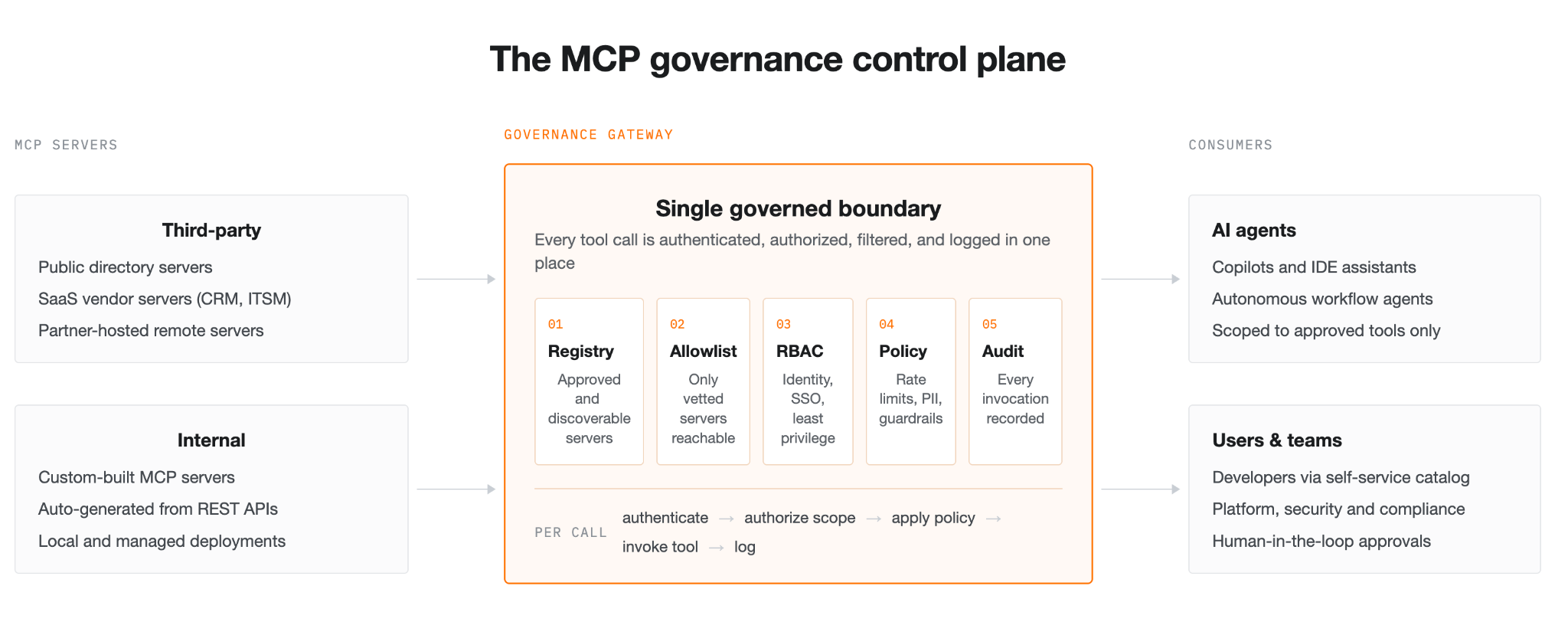
The above figure shows every call between an agent and an MCP server, request and response, passing through a gateway that authenticates, authorizes, applies policy, and logs before the tool runs.
A complete MCP governance control plane covers three layers of capability. The table below is the checklist to bring into an architecture review.
| Layer | Capability | What it governs |
|---|---|---|
| Registry | Private MCP registry / catalog | Which servers are approved and discoverable; reduces shadow MCP |
| Registry | Allowlists and server approval | Only vetted servers can be reached at all |
| Access | Identity and SSO | Users and agents authenticate through existing identity providers |
| Access | Role-based access control (RBAC) | Which teams and agents can use which servers and tools |
| Access | Tool-level provisioning | Least-privilege scoping so agents get only the tools they need |
| Policy | Runtime policy enforcement | Authorization, quotas, and guardrails applied per call |
| Policy | Rate limiting and throttling | Caps runaway or hijacked agents and controls cost |
| Policy | PII detection | Blocks sensitive data from leaking through tool responses |
| Observability | Audit logging | Verbose, contextual record of every tool invocation |
| Observability | Monitoring and alerting | Real-time visibility into token use, server use, and anomalies |
Two design points separate a real control plane from a checkbox.
- A private MCP registry / catalog is the anchor. It is both the inventory that makes shadow-server detection possible and the self-service catalog that gives developers a fast, approved path.
- A runtime policy engine alone is not complete AI governance. Verifying the provenance and supply-chain integrity of third-party tools matters just as much, because a rug pull defeats a policy that only checks traffic. Governance that covers identity, policy, provenance, and audit together is what makes scaling AI adoption a controlled decision instead of a gamble on an unvetted server.
How to Govern Third-Party MCP Tool Use (Step-by-Step)
You do not need a twelve-month program to start. This is a practical MCP governance framework you can run in four phases, moving from discovery to enforcement to continuous improvement.
Inventory and discover
You can't govern what you have not found. Start with a shadow MCP audit: catalog which servers are in use, including the unofficial ones, which teams are running agents, and what data sources those agents reach. Expect surprises. The goal of this phase is an honest map of the current landscape, and it becomes the baseline you measure every later control against.
Define policies
Classify your data so agents handling sensitive records face tighter controls than ones summarizing public documents. Define a server approval process: what a third-party MCP server must satisfy to be allowed, who signs off, and how provenance is verified. Set usage policies and human-in-the-loop boundaries for high-risk actions like deleting records or moving money. Write these down as MCP governance policies, because unwritten rules do not enforce.
Enforce at the gateway
This is where policy becomes runtime reality. Route all MCP traffic through the gateway, then turn on the controls: populate the private registry with approved servers, connect SSO so users and agents authenticate against your existing identity provider, set default RBAC so teams see only their servers, apply tool-level least-privilege provisioning, enable PII detection, and switch on audit logging. Pair the registry with a self-service catalog of pre-approved servers and a request form with an SLA for new ones, so governance speeds developers up instead of blocking them.
Monitor, audit, and iterate
Governance keeps running well past launch. Stand up role-specific dashboards and alert thresholds for the signals that matter: unusual data access, PII triggers, failed authentication, and token-usage spikes, each tied to a response runbook. Feed MCP monitoring data back into policy through monthly governance metric reviews. As agents take on new work and new servers appear, your allowlists, RBAC, and policies should keep moving with them.
MCP Governance with WSO2
Dedicated MCP-governance startups exist, and so do hyperscaler docs from AWS and Cloudflare describing how to do this on their platforms. AWS Prescriptive Guidance frames MCP governance around authentication, authorization, rate limiting, and operational metrics, which is a sound list. The question most enterprises actually face is not whether governance is possible, but whether they want to run a second, parallel governance silo for MCP right next to the mature one they already operate for APIs.
WSO2's API Platform addresses that overlap directly. It folds MCP traffic into the same control plane that already governs your APIs and AI. Therefore, MCP governance inherits the registry, policy, RBAC, and analytics disciplines your API program has run for years rather than reinventing them. Its gateway sits in front of MCP servers and enforces authentication and authorization, throttling, and rate limiting on agent calls, which turns the enforcement step above into centralized policy instead of per-server code.
A few capabilities map directly to the control plane:
- MCP Hub Registry: A searchable catalog of MCP servers for AI developers and agents. That inventory is the prerequisite for shadow-server detection, allowlists, and self-service approval, so the Hub is the anchor the whole model hangs on.
- Centralized AuthN, AuthZ, and Rate Limiting: The gateway validates identity and enforces throttling in front of every server, giving you one place to apply and audit policy across all MCP traffic.
- MCP Traffic Insights: Built-in visibility into agent calls supports the monitoring and audit layer, closing the loop from enforcement back to oversight.
The strategic point is unification. WSO2 presents LLM and MCP traffic through the WSO2 AI Gateway as a single control plane for all AI traffic. The platform is 100% open source with self-hosted, hybrid, and SaaS deployment so data-sovereignty requirements stay configuration choices, not rebuilds. WSO2 is a Leader in The Forrester Wave: API Management Software, Q3 2024. WSO2 isn't positioning itself as a standalone MCP-governance point tool; it's applying the enterprise API discipline you already trust to MCP.
Conclusion
MCP servers need governance before they need scale. Once agents can discover tools, reach data, and execute actions, unmanaged connections quickly become a security, compliance, and operational problem. The block-or-allow reflex does not help. The way through is a control plane: a registry to end shadow MCP, RBAC and least-privilege provisioning to contain potential exposure, runtime policy to enforce the rules, and audit to prove it. None of that is unique: it is the API governance discipline you already run, extended to a new class of caller.
To govern MCP without standing up a parallel control plane, explore WSO2's API Platform. You can see how its gateway and MCP Hub bring agent traffic under the same governance as your APIs, or start with what an MCP gateway is to understand the architecture first.
Frequently Asked Questions
What is MCP in AI governance? MCP, the Model Context Protocol, is the open standard that connects AI agents to external tools and data. MCP lets agents read data and take actions across enterprise systems, so governing which MCP servers agents can reach, and under what policy, becomes a core part of AI governance.
What is an MCP governance framework? A repeatable model for controlling MCP use: a registry of approved servers, RBAC and least-privilege access, runtime policy enforcement at a gateway, and audit logging with monitoring. In practice, teams run it in four phases: inventory what's running, define policies, enforce at the gateway, then monitor and iterate.
What is MCP governance in AI or sales automation? In agent-driven workflows like sales automation, agents often connect to CRM and other systems through MCP servers, which means they can edit customer records, not just view them. MCP governance here means approving which CRM MCP server is allowed, scoping the agent to only the tools it needs, and logging every action, so automation stays auditable and least-privilege.
How is enterprise MCP governance different from MCP project governance? Enterprise MCP governance is how your organization controls MCP servers and tools in production, owned by platform, security, and compliance teams. Project governance is the community stewardship of the Model Context Protocol as an open standard, documented on modelcontextprotocol.io.