API Architecture: Patterns, Principles & Modern Approaches
A payments team picks REST because every partner integration already speaks it. The mobile team next door picks GraphQL because one app screen needs data from six services in a single round trip. A data platform team standardizes on gRPC because a recommendation engine calls another internal service thousands of times a second, and every millisecond of overhead compounds.
None of them are wrong. They are giving three different, defensible answers to the same underlying question: what is API architecture actually deciding, and on what basis?
What Is API Architecture?
API architecture is the set of decisions that determine how APIs are designed, structured, secured, and connected across a system: which communication style each API uses, how services are organized and governed, and how traffic moves between clients, gateways, and backends.
It sits one level above the design of any single API. Designing a REST endpoint is a decision about resources and verbs. API architecture is the decision about which protocol, governance model, and topology apply across the whole estate.
That distinction matters more as the estate grows. A single team building one service can get away with an ad hoc choice. An organization running dozens of teams, several clouds, and, increasingly, AI agents calling internal systems cannot. Inconsistent architecture shows up later as duplicated authentication logic, gateways that don't share policy, and integrations that break every time a backend changes shape.
Core Principles of Good API Architecture
Good API architecture is less about picking the trendiest protocol and more about applying a small set of principles consistently, whichever protocol carries the traffic.
Consistency across the estate. Two REST APIs from the same organization should authenticate, version, and report errors the same way. Consistency lets a developer move from one team's API to another's without relearning conventions, and it lets a gateway apply one policy instead of dozens of one-off exceptions.
Statelessness where it earns its keep. HTTP is stateless at the protocol level, but applications routinely layer session state on top of it with cookies and server-side sessions. REST's statelessness constraint rules that out: each request carries everything the server needs to process it, so any server in a pool can handle any request and horizontal scaling stays simple. That isn't free everywhere. A trading system with strict ordering requirements, or a WebSocket-based collaborative editor, genuinely needs session state. Forcing statelessness onto those cases usually means reinventing state management one layer down rather than removing it.
Versioning discipline. Every API changes eventually. Architecture decides in advance whether that happens through URI versioning (/v2/orders), a header, or field-level deprecation, so a schema change doesn't become an unplanned outage for every downstream consumer.
Security by design, not by gateway policy alone. Authentication, authorization, and input validation belong in the architecture from the first design review, not bolted on before launch. A gateway can enforce a policy consistently, but it can't retroactively fix an API that was designed on the assumption that every caller is trustworthy.
Discoverability. An API that works but that no other team can find or understand is functionally private. Machine-readable specs (OpenAPI, AsyncAPI, or a service's .proto file) and a real catalog are what turn a working API into a reusable one. That matters for human developers browsing a portal, and increasingly for AI agents too: an agent deciding whether to call a tool needs the same clear description of what an endpoint does and what it expects, consumed programmatically instead of read on a page.
Major API Architectural Styles
Most organizations run several of these styles at once. The architecture question isn't "which protocol wins" but which protocol fits which job, and how much of that variety a single governance layer can absorb without splintering into five ungoverned islands.
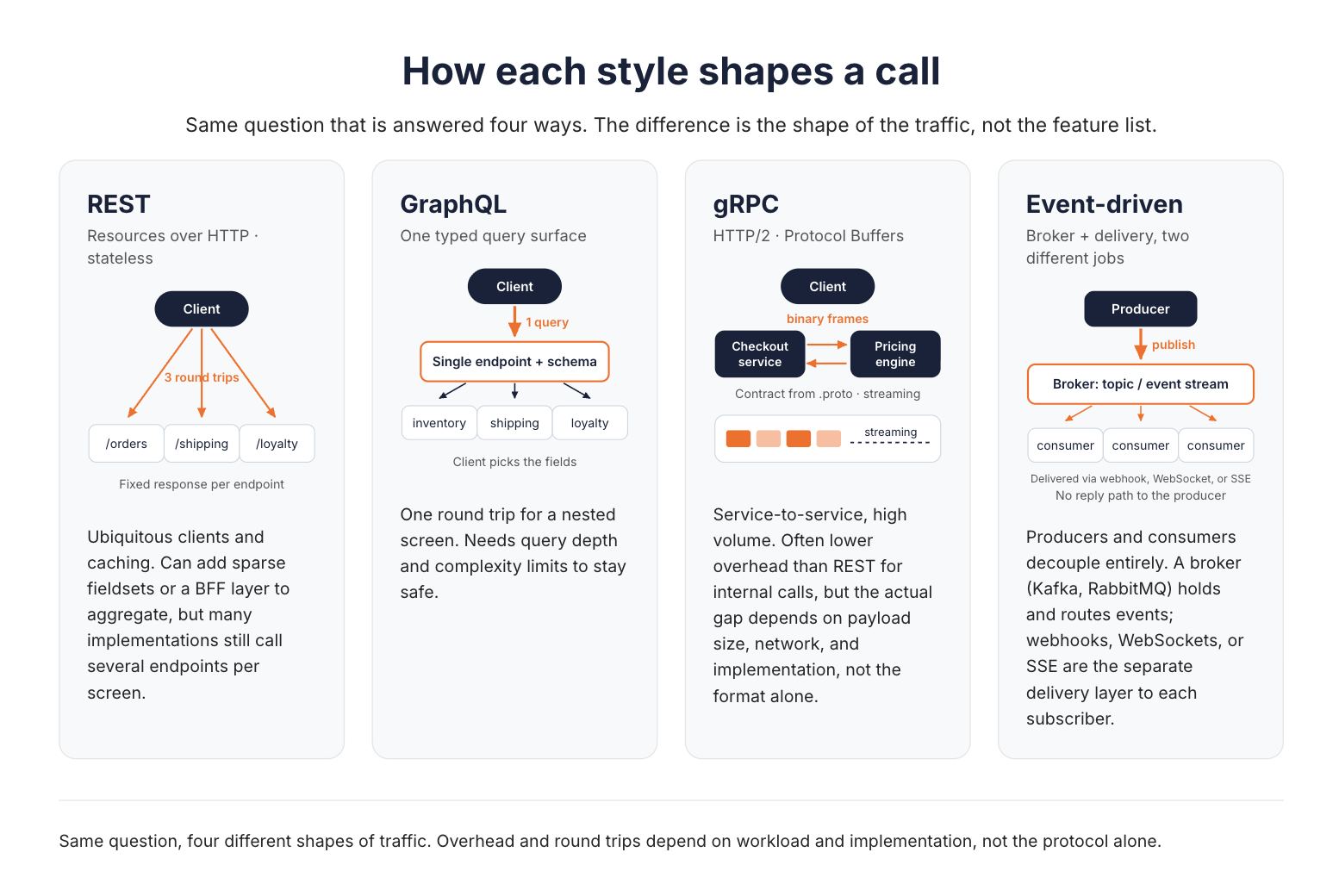
REST
REST (Representational State Transfer) comes from Roy Fielding's 2000 dissertation, which framed it as an architectural style rather than a protocol, built for scalable component interactions and independently deployable services. In practice, that means resources addressed by URLs, a small fixed set of HTTP verbs, and stateless requests.
REST's real strength is ubiquity. Every language has an HTTP client, every proxy and CDN understands it, and every engineer has seen it before. Its common weak spot is data-heavy screens, where a client often has to call several endpoints to assemble one view. Sparse fieldsets or a backend-for-frontend layer that aggregates responses can soften this, but neither is built in by default, so many implementations still over-fetch or under-fetch data across multiple calls.
GraphQL
GraphQL is a query language and server-side runtime that lets a client request exactly the fields it needs, against a type system the API provider defines. The specification has been open source since 2015.
Where REST fixes the shape of each endpoint's response, GraphQL lets the client describe exactly which fields it wants in a single request. That's why front-end-heavy teams with complex, nested screens tend to reach for it. The trade-off is that a flexible query surface needs its own discipline: without query complexity limits and depth limiting, a slow, deeply nested query becomes an easy way to overload a backend.
gRPC
gRPC is an open-source, high-performance remote procedure call framework built on HTTP/2, with Protocol Buffers for binary serialization. It's the natural fit for service-to-service traffic inside a data center or a Kubernetes cluster, where every millisecond of latency and every byte of payload gets multiplied by call volume. Streaming is a first-class feature rather than an add-on, which suits real-time internal data pipelines.
It's a poor fit for public-facing browser clients, because standard gRPC needs a proxy layer (typically gRPC-Web) to run in a browser at all.
SOAP
SOAP is a lightweight, XML-based protocol for exchanging structured information in a decentralized, distributed environment. It is built from an envelope, a set of encoding rules, and a convention for remote procedure calls.
SOAP predates REST's dominance and still shows up in banking, insurance, healthcare, and government systems, where WSDL-based contracts and formal standards like WS-Security were the price of entry a decade or more ago. New public APIs rarely start here today, but architecture has to account for it wherever a legacy system isn't going anywhere soon.
WebSockets and Event-Driven APIs
The WebSocket protocol, standardized by the IETF as RFC 6455, opens a two-way connection with a single handshake and then carries lightweight message frames over TCP. The connection stays open, so the client doesn't have to poll. That makes WebSockets the right choice for chat, live dashboards, and multiplayer or collaborative features, where the server needs to push data the moment something changes.
Event-driven APIs solve an adjacent but different problem: decoupling the producers and consumers of an event entirely, so a service can publish once without knowing or caring which other services eventually consume it. That decoupling typically runs through a message broker, such as Kafka or RabbitMQ, that holds and routes events. Delivery mechanisms like webhooks, WebSockets, or server-sent events are a separate layer that carries an individual event to a subscriber when it's time to deliver it. AsyncAPI is the common way to document either shape formally, the event-driven equivalent of an OpenAPI spec.
Choosing the Right Architecture for Your Use Case
There's no universal ranking of these styles, only a set of operational triggers that point toward one over another.
- Latency sensitivity: Internal service-to-service calls, where every millisecond compounds across a request chain, often favor gRPC's binary framing over REST's JSON over HTTP. The actual gap depends on payload size, network conditions, and implementation, not the format alone. Public APIs serving external partners rarely have the same latency budget, so REST's ubiquity usually outweighs a speed advantage that may or may not show up in practice.
- Client diversity: A public API consumed by unknown third-party developers benefits from REST's near-universal client support. An API consumed by a small number of known, sophisticated clients (your own mobile app, or a partner you have a direct relationship with) can absorb the smaller tooling ecosystems of GraphQL or gRPC in exchange for efficiency.
- Team skill and existing investment: A team fluent in schema-first design, with GraphQL tooling already in place, will ship faster with GraphQL than a team learning it from scratch for a marginal efficiency gain. Architecture decisions that ignore the team that has to operate them tend to get quietly reversed within a year.
- Ecosystem maturity for the consumer: Public developer ecosystems still lean on REST because that's where the debugging tools, client libraries, and institutional knowledge run deepest. Being technically superior for a narrow use case doesn't outweigh a shallower ecosystem when the API needs broad, low-friction adoption.
- Real-time and streaming needs: If the core requirement is server-initiated updates rather than request-response, WebSockets or an event-driven pattern belong in the architecture from the start. Retrofitting push behavior onto a request-response API is usually where systems accumulate polling workarounds.
The organizations that get this right treat it as an ongoing decision made per use case, not a one-time platform choice. Most mature API estates run REST, GraphQL, and gRPC side by side, each serving the traffic it fits.
Consider a mid-size retailer re-platforming its checkout flow. The public-facing product catalog API stays REST, because third-party affiliate sites and browser extensions already integrate against it and rewriting their clients isn't on the table. The new mobile app's order-status screen moves to GraphQL, because it needs data from the inventory, shipping, and loyalty services in one round trip instead of three separate calls competing for a slow cellular connection. The internal pricing engine, which the checkout service calls on every request and which has to respond inside a tight latency budget, moves to gRPC.
None of those is the "correct" architecture in isolation. Each is the right answer to a different constraint that the same organization is solving at the same time.
API Architecture Layers
It helps to think of API architecture as four layers, each solving a different problem, rather than as one flat decision.
| Layer | What it handles | Typical concerns |
|---|---|---|
| Data | The backend systems and data stores an API ultimately exposes | Databases, legacy systems, SaaS platforms, internal services |
| Integration | How disparate backends get connected and orchestrated | Service composition, transformation, message brokers, event streams |
| Application | The APIs themselves, as products that developers or agents consume | Endpoint design, versioning, protocol choice, documentation |
| Interaction | The gateway that enforces policy on traffic in transit (the control plane that configures it sits alongside, not in the request path) | AuthN/AuthZ, rate limiting, routing, analytics, policy enforcement |
Splitting the problem this way keeps a runtime enforcement decision at the interaction layer from turning into a data-modeling decision at the data layer.
The interaction layer is the gateway itself, enforcing policy on traffic as it passes through. Sometimes it calls out to an external policy-decision service for a specific check, but either way that's still inline enforcement. The control plane that authors and manages that policy is a separate thing again: it configures the gateway ahead of time and sits alongside the request path, not inside it.
A gateway can enforce a consistent rate-limiting policy at the interaction layer without touching how the integration layer composes services underneath it. A team can swap a backend at the data layer without every downstream consumer noticing, provided the application layer's contract doesn't change.
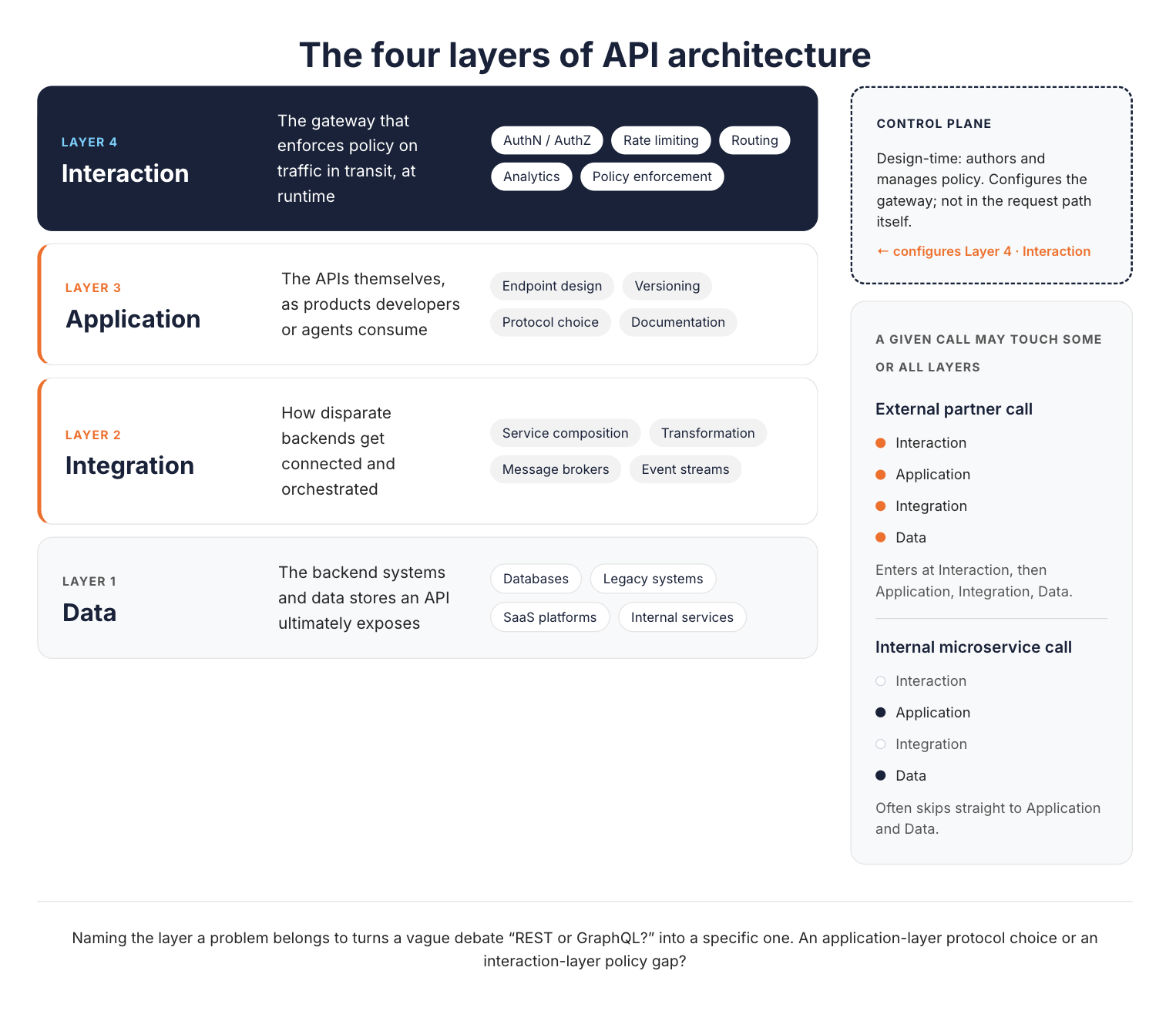
The layers aren't sequential hops every request must pass through. They're separate concerns, and a given request may touch some or all of them depending on what it's doing.
A simple internal request, one microservice calling another directly, might only touch the data and application layers. A public API call from an external partner typically touches all four. It enters through the interaction layer, where the gateway authenticates it and applies rate limits; the application layer's contract defines the response shape; the integration layer may compose data from more than one backend; and the data layer is where that data actually lives.
Naming the layer a problem belongs to often turns a vague architecture debate ("should this be REST or GraphQL?") into a specific one ("is this an application-layer protocol choice, or an interaction-layer policy gap?").
Modern Approaches: API-First, Multi-Gateway, and AI-Ready Architecture
Two shifts are changing what API architecture has to account for, on top of everything above.
API-first design
The first is API-first design: writing the OpenAPI, AsyncAPI, or protobuf contract before writing implementation code, so the contract becomes the source of truth that mocks, documentation, and client SDKs are all generated from. This isn't new, but it's increasingly the default rather than the exception.
Writing the contract first doesn't catch breaking changes by itself. That takes contract diffing, defined compatibility rules, and tests that check the implementation against the spec. What API-first buys you is a single source of truth to diff and test against, instead of one inferred from the implementation after the fact. A frontend team can build against a mocked API generated straight from the contract while the backend team is still implementing it, rather than both teams guessing at each other's interfaces and reconciling the differences later.
Multi-gateway estates
The second shift is more structural. It's easy to frame API architecture as choosing a single style for a single API. In practice, a mid-size or larger organization rarely runs one style through one gateway. It runs REST, GraphQL, and gRPC traffic, often through more than one gateway implementation: its own API gateway alongside a cloud provider's, or a service mesh sidecar next to a public-facing edge gateway. That happens because different teams adopted different tools at different times, or because a merger brought a second stack along with it. An architecture that assumes a single protocol and a single gateway describes a smaller, tidier estate than most enterprises actually run.
This is the gap WSO2's API platform is built to close: a single place to design, govern, and observe APIs, regardless of which protocol or gateway carries the traffic underneath.
That's the practical argument for a control plane that spans gateways rather than replacing them. Policy is defined once and enforced on the platform's own gateways, while APIs on third-party gateways are discovered, checked against the same governance rules, and published to the same developer portal. WSO2's API Control Plane is built around exactly that separation. The control plane handles design, policy, and observability, while the data planes (the gateways themselves) handle traffic wherever the infrastructure lives. That includes third-party gateways such as AWS API Gateway, Azure API Management, Kong, and Envoy alongside a team's own, within the limits of what each gateway technology natively supports. Not every third-party gateway can enforce every WSO2 policy identically. The point isn't to replace an existing gateway investment; it's to reduce how much policy drifts between five consoles that don't talk to each other.
AI agents as a new class of caller
AI agents add a related but distinct wrinkle, and it's worth being precise about which traffic is which. When an application calls a large language model, that's an outbound call from the enterprise's systems to a model provider. When an AI agent calls one of your internal APIs to read a record or take an action, using the Model Context Protocol (MCP) as the calling convention, that's a separate inbound flow. The agent making that call can just as easily be one of your own internal systems as an outside one.
A single agent workflow often uses both in sequence: it calls out to a model, the model decides a tool is needed, and the agent calls back in through MCP before the result goes back to the model. What matters architecturally isn't whether the two are chained in a given workflow. It's that they cross different trust boundaries and sit under different policy contexts, so governing them well means treating each crossing on its own terms rather than assuming one rule covers both directions.
WSO2's AI Gateway applies to both under one control plane, rather than standing up a separate system for each. The more defensible position isn't a parallel governance stack for agent traffic; it's extending the registry, authentication, and rate-limiting discipline an API program already runs to a new class of caller. WSO2 makes the same argument in its guidance on governing third-party MCP tools: fold the new traffic into the control plane you already trust instead of building a second one next to it.
None of this replaces the fundamentals above. API-first design, layered thinking, and picking the right protocol per use case still apply. Multi-gateway and agent-ready governance are what those fundamentals have to account for as the estate gets less uniform, not a reason to abandon them.
Conclusion
API architecture is bigger than picking a protocol. It's the set of decisions (consistency, statelessness where it belongs, versioning discipline, security by design, and discoverability) that determine whether an estate holds together as it grows. REST, GraphQL, gRPC, SOAP, and WebSockets are tools chosen per use case, not rivals for a single crown.
Thinking in layers (interaction, application, integration, data) keeps a runtime policy decision from turning into a data-modeling one, and keeps the control plane that authors policy distinct from the gateway that enforces it.
What's changed recently isn't the fundamentals; it's the shape of the estate they now have to hold together: more protocols running side by side, more gateways to govern consistently, and AI agents as a new class of caller alongside human-driven traffic. Get the fundamentals right first. Everything modern architecture asks of them after that is an extension, not a replacement.
Explore API Architecture Further
This pillar is the starting point for a broader API architecture series. The guides below go deeper on each piece as they publish to the WSO2 API Content Hub:
- API architecture diagramming: How to map protocols, layers, and gateways so a diagram matches the system it describes.
- API gateway architecture: What a gateway enforces at runtime versus what the control plane configures ahead of it.
- API-first design in practice: Contracts, mocks, and the compatibility checks that make API-first pay off.
- Monolith vs. microservices: When splitting a system into services is worth the operational cost, and when it isn't.
- Backend-for-frontend (BFF): Dedicating an aggregation layer to each client instead of one general-purpose API.
- Service mesh vs. API gateway: East-west traffic control versus north-south, and where the two overlap.
- API federation: Managing APIs and policy consistently across teams, clouds, and gateway vendors.
- API security patterns: Authentication, authorization, and the abuse patterns a gateway alone won't stop.
- Event-driven API design: Brokers, delivery mechanisms, and when to decouple producers from consumers.
- Building for resilience: Retries, timeouts, circuit breakers, and graceful degradation across a request chain.
- Caching strategies for APIs: What to cache, where, and how staleness trades against load.
You can follow the whole series on the API architecture topic page, where each guide becomes available as it's published.
For a different, more narrative take on how enterprise architecture has shifted in the API era, WSO2's earlier piece, Architecture in the Age of APIs, is a useful companion read. That post covers the business case for API-centric architecture, while this one is the structured, patterns-and-principles reference.
Frequently Asked Questions
What is API architecture?
It's the layer of decisions above any single API's design: which protocol each service uses, how those services are organized, and how a shared gateway layer enforces policy across all of them as a system, not just endpoint by endpoint.
What is API-first architecture?
API-first architecture means defining an API's contract, typically as an OpenAPI, AsyncAPI, or protobuf specification, before writing implementation code, so that documentation, mocks, and client code are generated from a single source of truth.
How do you diagram an API architecture?
A useful API architecture diagram separates the layers it touches (data, integration, application, and interaction) and shows which protocol and gateway each request passes through, rather than compressing everything into one box labeled "API."
How do you design an API architecture for a new system?
Start from the principles (consistency, appropriate statelessness, versioning, security by design, and discoverability). Pick a protocol per use case based on latency, client diversity, and team skill. Then decide how a shared interaction layer will enforce policy across whichever protocols and gateways the estate ends up running.
What is API-based architecture?
API-based architecture describes systems built around well-defined API contracts as the primary integration surface between services, as opposed to point-to-point integrations or shared databases, so each service's internals stay hidden behind a stable interface.
What is API-driven architecture?
API-driven architecture is closely related terminology for the same idea: treating APIs as the primary way the components of a system interact, with the API contract, not the internal implementation, as what other teams build against.

