API Security Architecture: Layered Defense for Modern APIs
A common and costly API failure mode doesn't start with a clever exploit. It starts with a request that looks completely normal to a firewall, because the firewall was never built to ask the question that mattered: does this caller actually own the object it's asking for? That's the gap a dedicated API security architecture is meant to close, and it's why treating API security as an extension of your web application firewall rules usually fails.
What Is API Security Architecture?
API security architecture is the layered set of controls, spanning network perimeter, gateway, service-to-service, application, and data layers, that together protect APIs from unauthorized access, abuse, and data exposure. Rather than relying on a single control point, it assumes any one layer can fail and distributes enforcement across several, so a gap in one doesn't expose the whole system.
The word "architecture" matters here. A single WAF rule or a single OAuth check is a control, not an architecture. An architecture is the decision about which control lives at which layer, and why a request that clears one layer still has to clear the next.
Why API Security Needs Its Own Architecture
Traditional web application security models were built around a browser rendering HTML and a user clicking links. APIs don't work that way. A single endpoint might serve a mobile app, a partner integration, and an internal microservice at the same time, each with different trust levels and different attack surfaces, and none of them route through a page a WAF's signature rules were designed to inspect.
That mismatch shows up as a gap in coverage, not an absence of security. A WAF can still catch SQL injection in a query string. What it generally can't catch is a request that's syntactically perfect and semantically wrong, such as an authenticated user requesting an object identifier that belongs to someone else. That failure mode, broken object level authorization, is exactly the kind of thing a layered API-specific architecture is designed to catch further down the chain, at the gateway or application layer, where object ownership can actually be checked against the caller's identity.
Consider a request to GET /invoices/4471. A signature-based filter has nothing to flag: the syntax is clean, the method is correct, and there's no injection payload anywhere in the URL. Whether that request is legitimate depends entirely on whether the caller is actually authorized to view invoice 4471, and that check requires knowing something about the caller's identity and the object's ownership, information a perimeter-level filter was never given. Closing that gap means pushing authorization logic to a layer that has both pieces of context, which is the premise the rest of this guide builds on.
The Layered Defense Model
A layered defense model assumes no single point stops every attack, so responsibility is distributed across five areas: perimeter, gateway, service mesh, application, and data. This is a representative order for inbound traffic, not a mandatory sequence every request has to traverse end to end. Whether a given request touches the service mesh depends on whether it triggers internal service-to-service calls at all, and the data layer is better understood as a cross-cutting responsibility, enforced at the storage and serialization boundary, than as a fifth proxy every request passes through in sequence. Each layer that does apply handles the class of threat it's positioned to see, and a request that slips past one still has to survive the next.
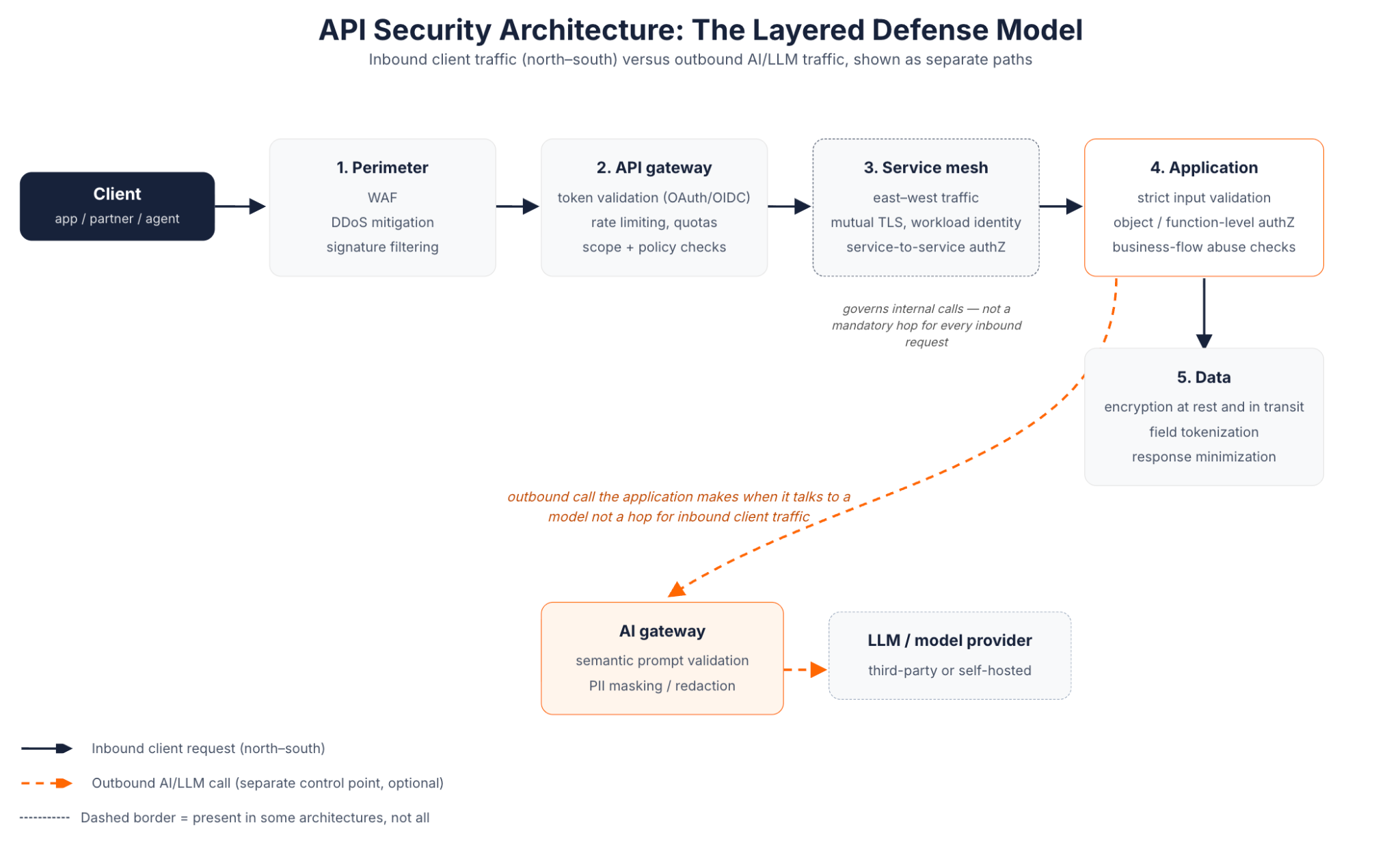
The diagram above separates two flows deliberately. The five numbered areas handle inbound, client-initiated (north-south) traffic, in the order they typically apply. The AI gateway path is drawn separately because it's an outbound call an application makes when it talks to a model provider, not a mandatory hop every request passes through.
Perimeter Layer: WAF and DDoS Protection
The perimeter is the first checkpoint a request meets, typically a web application firewall (WAF) paired with network-layer DDoS mitigation. These are usually separate controls doing separate jobs: the WAF inspects HTTP requests, including JSON and other API payloads and not just HTML pages, against known exploit signatures and malicious patterns, while malformed packets and volumetric flood traffic are more often caught by dedicated network infrastructure or a CDN sitting in front of the API entirely. Together they filter obvious, signature-level abuse before it reaches application infrastructure. This layer is necessary but narrow: it can flag a known injection pattern inside a JSON body, but it has no concept of business logic, so it won't catch a well-formed request that abuses a legitimate endpoint by asking for the wrong object.
Gateway Layer: Authentication, Rate Limiting, Traffic Control
The API gateway is where identity gets checked. This is the layer that validates OAuth tokens or API keys, enforces rate limits and quotas per client, and applies consistent policy across every API the organization exposes rather than leaving each service to reimplement its own auth logic. Centralizing this here also means a compromised or leaked credential can be revoked or rotated from one place instead of chased across a dozen services, though how fast that revocation actually takes effect depends on the token type: a self-contained JWT stays valid until it expires unless every verifier also checks it against a revocation list or introspection endpoint, which is why short token lifetimes and introspection matter as much as centralization does.
This is also the layer where traffic-shaping decisions live: a quota that caps a partner integration at a few hundred calls per minute, a rule that throttles a specific endpoint harder than the rest of the API because it's expensive to serve, or a circuit breaker that stops forwarding requests to a backend that's already struggling. None of that requires understanding what the request means, only how much of it is arriving and from whom, which is exactly the kind of decision a gateway is positioned to make quickly, before the request reaches anything that has to actually process it.
Service Mesh / East-West Traffic Layer
Once a request is inside the perimeter, it doesn't stop moving. Modern applications route requests between dozens of internal services, and that internal, service-to-service traffic (often called east-west, as distinct from the north-south traffic a gateway handles at the edge) needs its own controls. A service mesh typically enforces mutual TLS between services and fine-grained authorization for service-to-service calls, so a compromised internal service can't freely call every other service on the network.
It's worth being precise here: a service mesh and an API gateway solve different problems and aren't a mandatory sequential hop for every request. An API gateway governs external, client-facing traffic. A mesh governs internal service-to-service calls. A given request may pass through a gateway and never touch a mesh, or vice versa, depending on where it originates.
Application Layer: Input Validation, Business Logic Protection
Authentication and network controls don't validate what a request is actually asking the application to do. That's the application layer's job: validating input against a strict schema, and enforcing business logic checks like object-level and function-level authorization, so an authenticated user can't act outside what their role or ownership entitles them to. This is where most of the OWASP API Top 10 risks actually get caught, because most of them are logic failures, not network failures.
Data Layer: Encryption, Sensitive Data Handling
The last layer protects data at rest and in transit: encryption, tokenization of sensitive fields, and minimizing what any given response actually returns. A common and avoidable failure here is an endpoint that returns a full object when the client only needed three fields, which turns an authorization bug at any earlier layer into a much bigger data exposure than it needed to be.
Treat this layer as a backstop, not a first line of defense. Encrypting a database doesn't stop an authorized-looking request from reading rows it shouldn't. It limits what an attacker gets if every layer above it has already failed. It also satisfies data-protection obligations that apply regardless of how good the upstream authorization logic is. Response minimization does similar work by shrinking the blast radius of a bug at any earlier layer, without depending on that bug never happening.
Authentication and Authorization in API Security
Authentication and authorization solve different problems, and API security architectures fail more often from confusing the two than from getting either one wrong in isolation. Authentication confirms who is calling. Authorization confirms what that caller is allowed to do once identity is established.
OAuth 2.0 and OpenID Connect are the standard mechanisms behind that split in modern API architectures, and it helps to keep their roles distinct. OAuth 2.0 is fundamentally an authorization framework: it lets an application act on a user's behalf without handling their password directly. OpenID Connect adds an authentication layer on top of it, giving a service a verifiable way to confirm who the token actually belongs to. Token-based authentication using JWTs is the common implementation pattern: the gateway validates the token's signature, issuer, audience, and expiry on every call and rejects tokens signed with an unexpected algorithm, and the claims inside the token, such as scopes and roles, feed the authorization decision that follows.
That authorization decision has to happen at more than one layer to be reliable. A gateway can check whether a token has the right scope to call an endpoint at all. It generally can't check whether the specific object the caller is requesting belongs to them. That check has to happen at the application layer, against the actual data model. Least privilege, granting a token only the scopes and object access it actually needs, is what keeps a leaked or over-scoped token from becoming a full account compromise instead of a narrow one.
Take a token scoped to invoices:read. A gateway checking scopes alone will wave through a request for any invoice, since the scope says nothing about which invoices the caller owns. The application layer is what has to add the second check: does the authenticated user's account actually own the invoice ID in the path? Skipping that second check is how a correctly implemented OAuth flow still ends up with a broken object level authorization vulnerability. The token was valid the whole time. The missing piece was ownership validation the token was never designed to carry.
Mapping the Layered Model to the OWASP API Security Top 10
The OWASP API Security Top 10 (2023) lists ten categories: Broken Object Level Authorization, Broken Authentication, Broken Object Property Level Authorization, Unrestricted Resource Consumption, Broken Function Level Authorization, Unrestricted Access to Sensitive Business Flows, Server Side Request Forgery, Security Misconfiguration, Improper Inventory Management, and Unsafe Consumption of APIs. Three of the top five items on the list (API1, API3, and API5) are authorization failures, making authorization the dominant theme of the 2023 edition, which is part of why the layered model above puts so much weight on the application layer rather than treating the gateway as sufficient on its own.
The table below maps each risk to the layer with primary responsibility for addressing it, not the only layer involved, and no single layer fully eliminates a given risk on its own. Treat this as a starting point, not a substitute for reading the OWASP project in full: real deployments typically need more than one layer working together for a given risk.
| OWASP API Risk (2023) | Layer With Primary Responsibility | Why |
|---|---|---|
| Broken Object Level Authorization | Application | Requires checking the requested object against the caller's actual ownership, not just their token scope |
| Broken Authentication | Gateway | Token validation, session handling, and credential checks belong at the identity checkpoint |
| Broken Object Property Level Authorization | Application | Same logic as object-level checks, applied to individual fields in a response or request body |
| Unrestricted Resource Consumption | Gateway | Gateway-native rate limiting and quotas are the primary control, but payload size, concurrency, and execution-time limits often need enforcement at the application or infrastructure layer too |
| Broken Function Level Authorization | Gateway + Application | The gateway can block a role from an endpoint outright. The application enforces finer-grained rules within it |
| Unrestricted Access to Sensitive Business Flows | Application | Requires understanding the business process being abused, not just the request shape |
| Server Side Request Forgery | Application | Depends on validating and restricting outbound calls the application itself makes, not inbound filtering |
| Security Misconfiguration | Cross-cutting (governance) | A design-time and deployment-time problem more than a single traffic-inspection layer |
| Improper Inventory Management | Cross-cutting (governance) | Requires active discovery of undocumented or shadow APIs and a retirement process, not just a catalog of the APIs already registered |
| Unsafe Consumption of APIs | Application | The application has to validate data coming back from third-party APIs it calls, the same way it validates inbound requests |
Zero Trust and API Security Architecture
NIST's Special Publication 800-207 defines zero trust architecture around a simple shift: don't extend trust based on network location, and verify every request regardless of where it originates. Applied to APIs, that means a request from a service running inside your own VPC gets authenticated and authorized on the same terms as a request from the public internet.
That principle is exactly what the service mesh and gateway layers above are already doing when they enforce mutual TLS and per-call authorization on internal traffic instead of assuming anything inside the network boundary is safe by default. NIST's guidance on microservices security, SP 800-204, covers this same ground specifically for API gateway and service mesh architectures. Zero trust isn't a separate architecture bolted onto the layered model. It's the operating assumption behind why the internal layers (mesh and application) apply explicit verification and least privilege to internal traffic too, with the actual checks shaped by context rather than skipped because a call originated inside the network. "Internal" is not treated as a synonym for "trusted."
In practice, this shows up as short-lived, narrowly scoped credentials, per-request authorization instead of a single login gate, and identity tied to the workload or service account making the call rather than just the human user who originally authenticated. None of that requires abandoning cookie-based sessions specifically. A session cookie that's short-lived, properly scoped, and revalidated on each request can fit the same model. What zero trust actually calls for is explicit verification and least privilege applied consistently, not a specific credential storage mechanism.
Teams tend to reach for this shift when a few specific conditions show up rather than on a fixed schedule: a growing number of internal services calling each other where a single compromised service could otherwise move laterally without further checks, a compliance requirement that demands proof of who accessed what and when regardless of network origin, or a hybrid environment where "internal" no longer means one physical network. Any one of those is a reasonable trigger to extend gateway-style checks past the edge and into internal traffic, rather than waiting for an incident to force the question.
How WSO2 Implements Layered API Security
The layered model above describes what needs to happen, not a specific product. Different platforms implement each layer differently. Here's how the WSO2 API Platform maps onto it.
At the gateway layer, WSO2's API Platform applies authentication, rate limiting, and data masking policy from a single control plane. This works regardless of which gateway type enforces it. That could be the fully managed API Platform Cloud Gateway, or a Self-Hosted Gateway that runs in your own environment while the platform manages its configuration centrally. Specific controls can still vary by deployment, so confirm feature parity for the gateway you're using. This matters for the layered model because policy is defined once at the control plane. It isn't reimplemented separately for every deployment target.
The OWASP mapping above assigns security misconfiguration and inventory management to a cross-cutting governance layer, not to any single traffic layer. WSO2's API Platform handles that layer through WSO2 API Governance. Teams define rulesets covering security and compliance requirements and group them into policies. Those policies apply to every API in the organization, both new and existing. Violations are flagged as APIs are updated, so a misconfiguration surfaces during development instead of in production. A compliance dashboard then tracks adherence and violations across the whole API estate.
The layered model was originally built around REST payloads. It doesn't fully anticipate a request whose body is a natural-language prompt rather than structured JSON. That outbound traffic needs a separate control point from the inbound layers shown in the diagram above. WSO2's AI Gateway provides it, extending the same control plane with guardrails aimed at the prompt itself. Semantic validation aims to catch manipulation attempts. PII masking aims to keep sensitive fields from reaching a model provider. Like any content-inspection control, neither is a guarantee. Semantic filters can miss novel manipulation techniques, and masking depends on pattern coverage for the data types involved. That's why application-layer authorization and data minimization stay necessary once an AI Gateway is in place. The AI Gateway is still a genuinely different control from anything at the application or data layer. It inspects the content a request carries, not just the request's structure or the caller's identity.
None of this replaces the judgment call an architecture team has to make about which layers a given API needs. It describes where each control lives inside one platform. It doesn't claim that any single product removes the need for the layered thinking above.
Conclusion
A layered API security architecture works because it assumes failure at any single point and distributes enforcement so that failure doesn't cascade. Perimeter filtering catches network noise, the gateway checks identity and enforces rate limits, a service mesh extends the same scrutiny to internal traffic, the application layer catches the authorization and business-logic failures behind most of the OWASP API Top 10, and the data layer limits the damage when something upstream still gets through. Zero trust is the assumption running through all of it: verify the request, not the network it came from.
If you're mapping this onto an existing deployment, start with the OWASP table above and identify which layer is currently missing for your highest-risk APIs, then look at how WSO2's API Control Plane can apply that layer consistently rather than reimplementing it per service.
Frequently Asked Questions
What is API security architecture?
It's the layered combination of perimeter, gateway, service mesh, application, and data controls that together protect an API, rather than any single firewall rule or auth check doing the job alone.
Is a WAF enough to secure an API?
A WAF inspects HTTP and API requests well for known exploit signatures, but it generally can't detect authorization logic failures like a user requesting another user's data, which is why the application layer exists as a separate control.
Does OAuth 2.0 alone satisfy API security architecture requirements?
OAuth 2.0 handles delegated authorization, not authentication by itself, and object-level and function-level checks still need to be enforced separately at the application layer, since a valid token doesn't guarantee the caller owns the specific resource requested.
How does zero trust change API security architecture?
It removes the assumption that internal network traffic is inherently trustworthy, so service mesh and application layers apply the same authentication and authorization checks to internal calls that a gateway applies at the edge.
Where does an AI Gateway fit into a layered API security architecture?
It adds a control aimed at the request's content rather than its structure or the caller's identity, since a prompt can carry a manipulation attempt or sensitive data that gateway- and application-layer checks built for structured payloads aren't designed to catch.

