API Federation: Patterns for Multi-Team API Programs
Most write-ups on API federation start and end with gateways: how to plug three vendors' proxies into one control plane. That's a real problem, and one WSO2 has already written a full technical guide on. This one is about the problem that shows up first, usually a year or two before anyone buys a federation tool: what happens to an API program once more than one team is building APIs, and the answer to "who owns this" stops being obvious.
What Is API Federation?
API federation is the practice of letting multiple teams design, deploy, and operate their own APIs while a shared control plane enforces consistent security, standards, and visibility across all of them. It's also sometimes called federated API management, a name that emphasizes the same trade-off: distributed operation, centralized policy. The team keeps its gateway, its deployment cadence, and its on-call rotation. The organization keeps a single place to see what's running, who owns it, and whether it meets policy.
Worth flagging early, since the term gets overloaded: "API federation" and "GraphQL federation" describe two different things that happen to share a name. GraphQL federation, the pattern popularized by Apollo, composes multiple GraphQL subgraphs into one queryable supergraph through a federation router. It's about combining schemas so a client can make one request instead of several. API federation, the subject of this piece, is about organizational and infrastructure ownership. Multiple gateways, run by multiple teams, stay independent at the traffic level, while a control plane governs them without sitting in the request path. The two can coexist in the same organization, but one doesn't imply the other, and conflating them is a common source of confused vendor comparisons.
For the deeper technical breakdown, including which gateway types WSO2 supports and how discovery works, see how API gateway federation works technically. The rest of this piece is about the organizational side: why programs end up here, and what a workable pattern looks like once they do.
Why API Programs Outgrow a Single Team
Nobody plans for API sprawl. It arrives as a side effect of everything else going right: the company adds product lines, acquires a company with its own stack, or simply hires more engineers who each need to expose a service. Salesforce's engineering team described this well in the context of microservice-heavy organizations, framing the core tension as team autonomy against consistent, centrally enforced interfaces, the same trade-off that shows up in gateway federation, even though the two pieces are solving different layers of the stack.
A single, centrally owned gateway works fine while one team owns most of the APIs. It stops working at a specific, recognizable point: when a second team needs to change a rate limit, add an endpoint, or roll back a bad deploy, and the setup has no delegated permissions or self-service path, so the only option is filing a ticket with a platform team that has its own backlog. That's not a governance failure so much as an org chart outgrowing its tooling. The platform team didn't get slower. The number of people waiting on it multiplied.
Three situations tend to force the question:
- Mergers and reorganizations. The acquired company brought its own gateway, and migrating every API off it before go-live isn't realistic.
- Multi-cloud and hybrid deployment. Teams run gateways in the environments closest to their workloads, sometimes for latency, sometimes because that's where the compliance boundary sits.
- Regulated or regional data. Depending on the applicable regulatory requirements, APIs handling EU or APAC customer data may need to run on infrastructure physically inside that jurisdiction, with policy enforced locally rather than routed through one central region.
None of these are edge cases. They're what happens when an API program survives long enough to matter.
Federated vs. Siloed vs. Centralized API Management
It helps to name the three models an API program can actually run on, since federation is usually described only in contrast to whichever one an organization is leaving.
| Model | Who controls policy | Who owns deployment | Typical failure mode |
|---|---|---|---|
| Centralized | One team, org-wide | One team | Every change queues behind the same team. Velocity drops as the API count grows |
| Siloed | Each team, independently | Each team | No shared visibility. Inconsistent auth, rate limiting, and standards across teams |
| Federated | Shared control plane, org-wide standards | Each team, within those standards | Requires real investment in shared tooling and standards work up front |
Centralized management is easiest to reason about and hardest to scale: one team sets policy and owns every gateway, which keeps things consistent but turns that team into a queue. Siloed management is the opposite failure. Each team runs its own stack with no shared oversight, which is fast for any one team and invisible for everyone else, including security and compliance, who often find out about an API after it's already in production.
Federated API management sits between the two on purpose: teams keep operational ownership of their own gateways, and a shared governance layer holds the organization-wide line on authentication, rate limiting, and discoverability. It doesn't eliminate the centralized team's job. It changes what that team is responsible for, from running every gateway to setting and auditing the rules every gateway follows.
Patterns for Multi-Team API Programs
Federation isn't a single configuration you turn on. It's a set of decisions about where authority sits for a given concern, made concern by concern rather than all at once.
A typical version of this shows up about a year after an acquisition closes. The acquired company's engineering team already has APIs running on their own gateway, their own auth setup, and their own release process. The acquiring company's platform team has neither the headcount nor the mandate to rebuild all of it before the next release. Forcing an immediate migration risks breaking production APIs the business depends on. Leaving the two estates completely separate means security can't answer a basic question (what APIs do we have, and who's responsible for them?) without asking two different teams in two different tools. Federation is the middle path: the acquired team keeps its gateway and its workflow, and the platform team gets a single governance layer covering both estates, a shared auth policy, and clear ownership, without a rebuild project on the critical path.
Team Autonomy with Centralized Governance
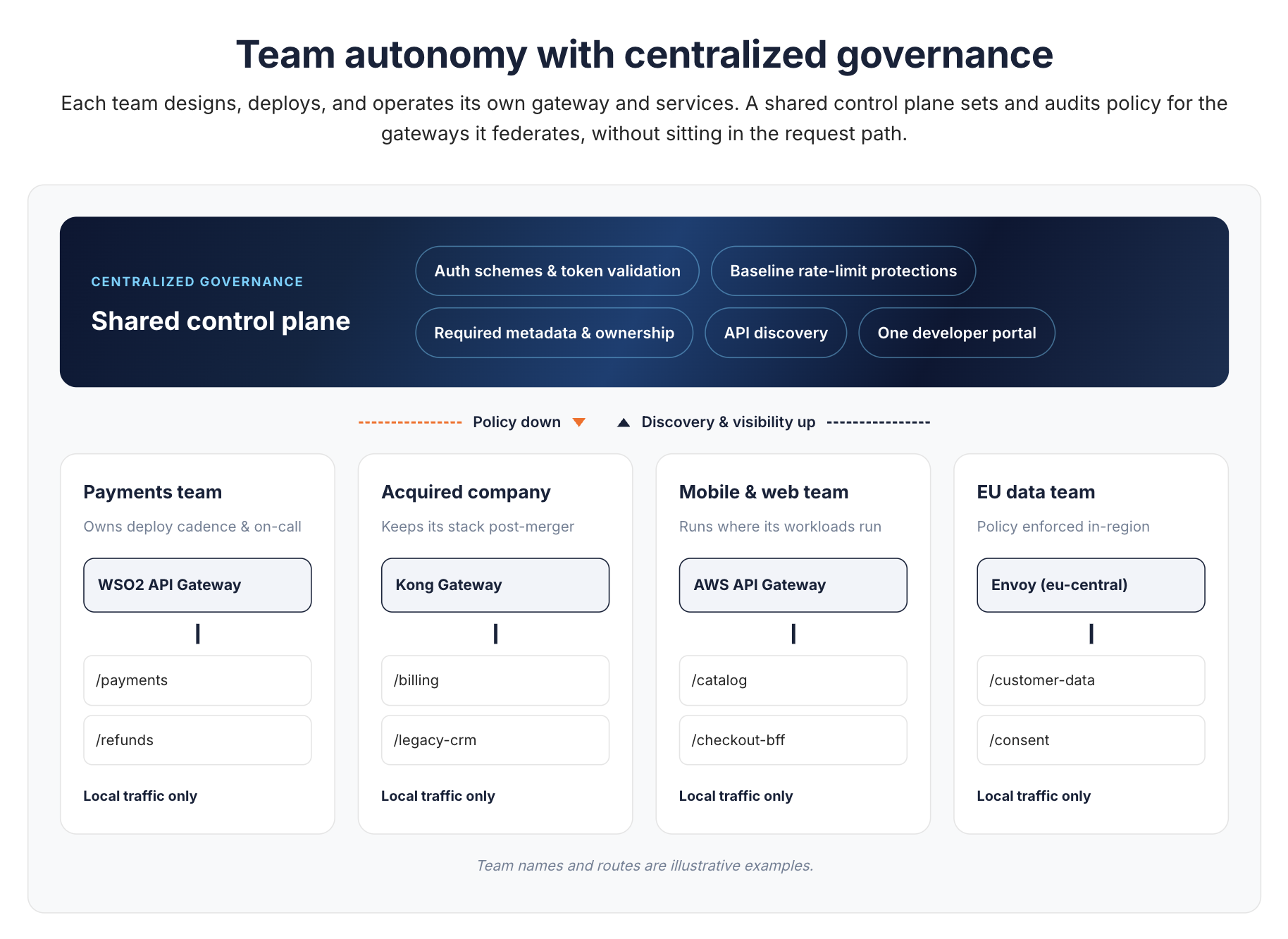
The pattern that makes federation work in practice is a narrow, explicit split: teams own runtime decisions (which framework, which deployment cadence, which gateway product), while the control plane owns organization-wide policy (auth schemes, baseline rate-limit floors, required metadata, naming conventions). Getting this split wrong in either direction recreates one of the two failure modes above. Push too much into the control plane and teams are back to filing tickets. Leave too much to individual teams and the organization loses the one thing the federation is supposed to buy, which is a consistent view of what's running.
Federated Gateway Deployment
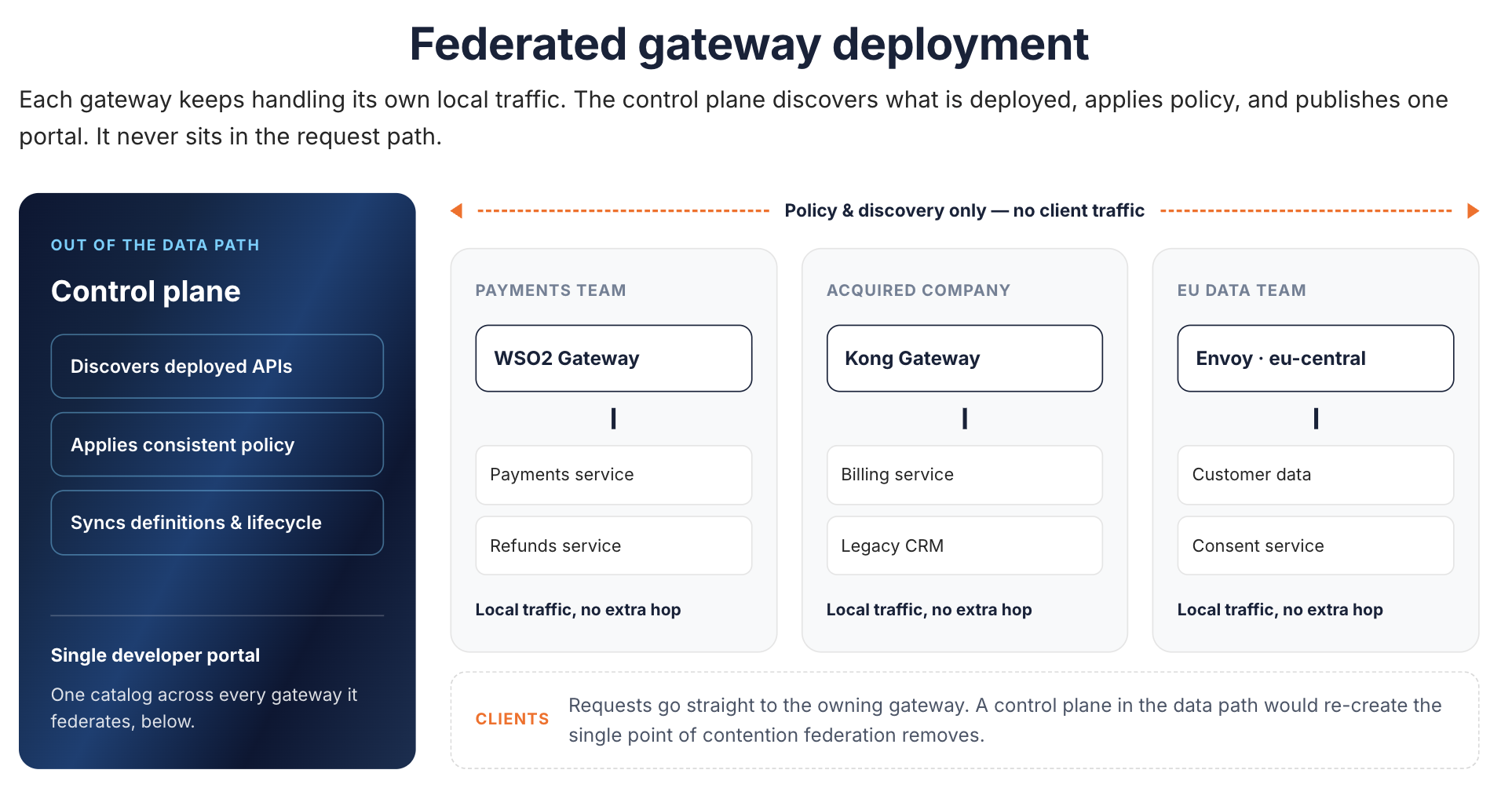
At the infrastructure layer, this pattern means multiple gateways, potentially from different vendors, keep handling their own local traffic independently. A control plane discovers what's deployed on each one, applies consistent policy, and surfaces everything through a single developer portal, but it isn't a proxy that every request passes through on its way to the backend. That distinction matters architecturally: a control plane that sat in the data path would reintroduce the single point of contention federation is meant to remove, and would add a latency hop to every call for no operational benefit. The mechanics differ by vendor, but the shape holds across the market: governance is centralized, execution isn't.
Consistent Standards Across Independent Teams
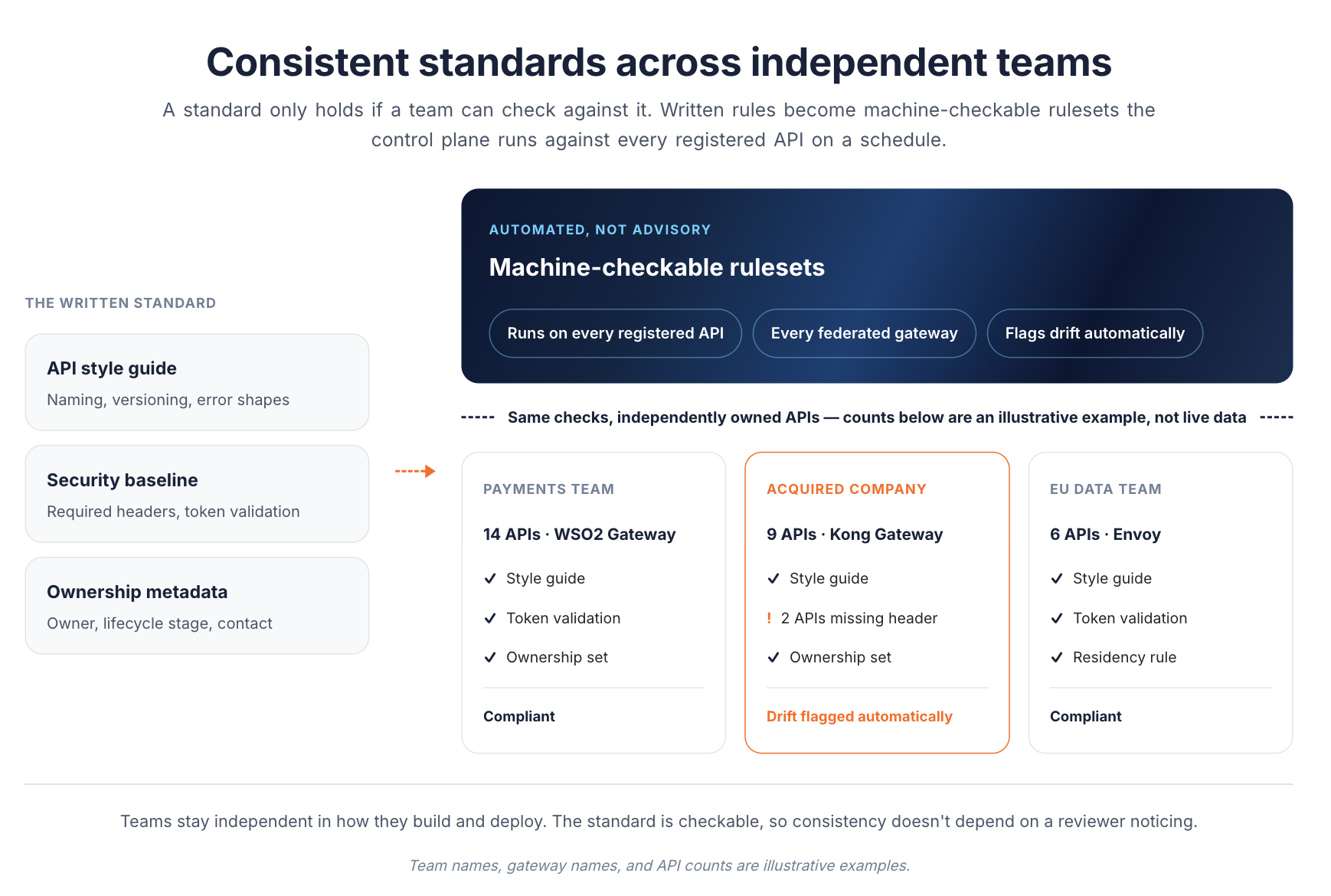
Federated ownership only holds up if "the standard" is something a team can check against, not something they have to infer from a wiki page. In practice this means a written API style guide, a shared set of required security headers and token validation rules, and increasingly, machine-checkable rulesets that a control plane can run against every registered API automatically rather than relying on a human reviewer to catch drift.
Benefits and Challenges of API Federation
Federation trades one set of problems for another. It doesn't remove problems altogether, and treating it as a strict upgrade oversells it.
What it tends to improve:
- Development speed: Teams stop waiting on a central queue for changes that only affect their own APIs.
- Fault isolation: A problem on one gateway is less likely to take down APIs running on a different one, though shared dependencies like identity providers or DNS can still cause correlated failures.
- Compliance posture for distributed data: Region-specific policy can live where the data lives, instead of every request routing through one jurisdiction.
- Visibility into shadow APIs: A discovery-based control plane surfaces APIs running on the gateways it's configured to scan, catching a meaningful share of the undocumented APIs common in siloed environments, though it won't see what it isn't pointed at.
What it adds:
- Governance overhead that has to be designed, not assumed: Federation only delivers consistency if someone owns writing and maintaining the shared policy. Skip that step and federation degrades into siloing with extra infrastructure.
- Tooling investment: A control plane, agents or connectors for each gateway type, and a unified developer portal are real engineering line items, not a checkbox.
- A harder debugging story: Tracing a request across independently operated gateways takes more deliberate observability work than tracing it through one.
When to Federate (and When Not To)
Federation earns its complexity at a specific point, not before it. A small, single-gateway estate may not need multi-gateway federation yet, even if it still needs the basics: lifecycle management, credential handling, and a working developer portal. The decision to federate tends to make sense once an organization can point to at least one of these, concretely:
- More than one team is deploying and operating its own gateway already, whether by choice or by inheritance from an acquisition.
- APIs need to run in more than one cloud or on-prem environment, and consolidating onto one gateway product isn't realistic in the timeframe available.
- Compliance or data-residency requirements mean policy has to be enforced locally in more than one region.
- Security or platform teams can no longer answer "what APIs do we have and who owns them" without manually surveying each team.
If none of those apply yet, the more useful investment is usually a style guide and a lightweight review process, not a federation rollout. Federation solves a coordination problem at scale. Introducing it before the coordination problem exists just adds infrastructure to maintain.
It's also worth separating federation from a related but different decision: how many gateway products to run. An organization can federate governance across gateways it standardizes on for good reasons (shared skills, existing vendor relationships) while still limiting how many distinct products it supports. Federation is about who governs and who operates, not about maximizing the number of tools in play. Treating "federate" and "adopt every gateway a team asks for" as the same decision is how governance overhead creeps in without the coordination benefit to show for it.
How WSO2 Supports Federated API Programs
WSO2's API Platform approaches this as a control-plane problem rather than a migration problem. Its Gateway Federation capability discovers APIs already running on third-party gateways, including AWS API Gateway, Azure API Management, Kong, and Envoy, and brings them under a single control plane without requiring teams to move off the gateway they've already chosen. Discovered APIs are brought under the platform's management, checked against the same governance compliance policies as every other API, and exposed to developers through the API Platform Developer Portal, without re-registering them by hand.
That maps directly onto the pattern this piece has described: teams keep operational control of their own gateway and deployment cadence, while a shared API governance layer (compliance rulesets, compliance monitoring, and a shared developer portal) applies across the gateways it federates from one place. A platform team federating gateways that came with an acquisition, or standardizing governance across a Kong deployment and an Envoy deployment without asking either team to rip theirs out, is the kind of scenario this capability targets. A gateway outside that supported list needs a custom integration before it can be federated the same way. Teams evaluating third-party gateway coverage in more detail can see how it stacks up against Kong specifically.
Conclusion
Federation is a response to a specific, recognizable moment in an API program's growth, not a default starting point. Most programs reach that moment already running multiple gateways in practice, whether that happened by design or by acquisition, and the real decision left is whether to keep managing that reality team by team or bring it under one control plane. The pattern that works, in the cases covered here, is narrow on purpose: teams keep the gateway, the deployment cadence, and the operational judgment calls, while a shared control plane holds the line on the things that actually need to be consistent across the organization, like authentication, rate limiting, and who's accountable for what.
WSO2's Gateway Federation capability is built for organizations making that call. It lets each team keep the gateway and workflow they already have, while giving the platform team one place to enforce governance and see what's actually running. Teams weighing whether they've reached that point, or already know they have, can start there to see how discovery and governance work across AWS, Azure, Kong, and Envoy gateways.
Frequently Asked Questions
What is API federation?
API federation is an approach where multiple teams operate their own APIs and gateways independently while a shared control plane enforces common security, standards, and visibility across all of them.
Is API federation the same as GraphQL federation?
GraphQL federation composes multiple GraphQL schemas into one queryable supergraph. API federation governs independently operated gateways from a shared control plane. They address different layers of the stack and can exist independently of each other.
Does federation replace the need for a platform team?
It changes the team's job from operating every gateway to defining and auditing the standards every gateway has to meet.
When should an organization federate instead of centralizing?
Once more than one team already runs its own gateway, or APIs must run across multiple clouds or regions for compliance or latency reasons, and a single central gateway has become a bottleneck rather than a convenience.

