Enterprise MCP: The Control Plane for AI Agents
The Model Context Protocol solved a real problem. It gave AI agents one standardized way to discover tools, read resources, and call live systems, so every new integration stopped being a bespoke connector. Then the pilots worked, teams multiplied the servers, and a second problem appeared.
The moment agents can reach production data and take production actions across dozens of servers, unmanaged MCP connections become a security, compliance, and operational risk. Enterprise MCP is the discipline of putting a governed control plane in front of that sprawl before it scales, not after. This guide covers what enterprise MCP means, why it gets hard at scale, the reference architecture that contains it, and how to operationalize it with a single control plane for APIs, AI, and MCP.
What Is Enterprise MCP?
Enterprise MCP means adopting the Model Context Protocol at organizational scale: connecting AI agents to enterprise tools and data with security, governance, and centralized control. A single developer running one MCP server on a laptop needs none of that. An organization exposing customer records, payment actions, and identity data to autonomous agents needs all of it. The protocol is the same. The operational envelope around it is completely different.
The distinction matters because MCP's design leans toward the single-host, single-user case. An MCP server exposes specific capabilities, access to data, tools, or predefined prompts, through a standardized MCP interface, and an MCP client (the agent) discovers and invokes them. That works cleanly one to one. Enterprise MCP is what you build when hundreds of agents, many teams, and multiple MCP servers all need governed access to the same shared systems without stepping on each other or leaking data. Enterprise-ready MCP means the connection is authenticated, authorized, rate-limited, logged, and discoverable through approved channels rather than ad hoc ones.
Why MCP Is Hard at Enterprise Scale
MCP adoption starts easy and gets hard in predictable ways. The friction is rarely the protocol itself. It's everything the protocol leaves to the implementer, surfacing all at once when you go from one server to many.
- Single-host design assumptions. Early MCP patterns assumed one client talking to one local server. Enterprises need multi-client access to shared resources, remote transports, and concurrency the original model didn't anticipate.
- Multi-client access to shared resources. When many agents hit the same MCP server, you need per-agent identity and scope, not a shared connection that treats every caller the same.
- Shadow MCP. Teams stand up their own servers to move fast. Without a registry and review, you accumulate connected MCP servers nobody governs, each holding real credentials.
- Governance gaps. Once agents can discover tools, access data, and execute actions, the absence of policy is a live exposure, not a backlog item.
- Enterprise integration. MCP servers must interact with existing enterprise apps and data sources while maintaining data integrity and security, which pulls in every access-control and audit requirement those systems already carry.
The K2view synthesis of MCP enterprise challenges frames the same theme from the data side: credibility (agents acting on inaccurate information), insufficient evidence (decision processes that are hard to trace), and behavioral problems (agents acting without clear boundaries). Each is an argument for enforcement at a chokepoint. The consistent enterprise concern is governance before scale, and treating third-party servers as a first-class risk is central to that, which is why MCP governance belongs upstream of any rollout, not bolted on afterward.
Enterprise MCP Architecture: The Control Plane
Enterprise MCP is ultimately about building the control plane for AI agent access: centralized identity, policy, governance, observability, and a registry of approved servers. The pattern that keeps recurring across reference architectures is a gateway acting as the control point between agents and the MCP servers that reach your systems. Instead of trusting each server to police itself, you insert one governed layer that every agent call passes through.
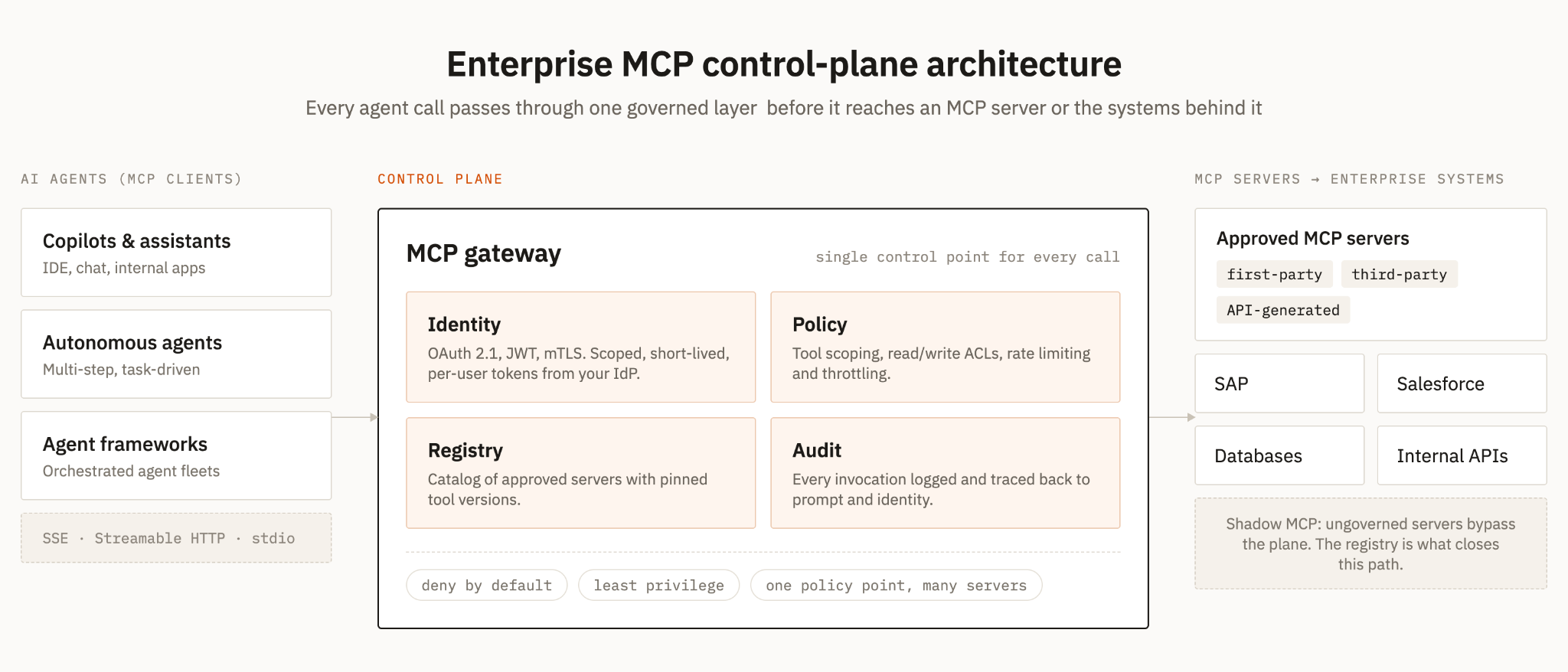
The figure above shows the enterprise MCP control-plane reference architecture: AI agents on the left connecting through a central gateway layer labeled identity, policy, registry, and audit, out to MCP servers and enterprise systems (SAP, Salesforce, databases, APIs) on the right.
Four capabilities define that plane. They map cleanly to the questions every enterprise MCP deployment eventually has to answer.
Identity and Authorization
The first question is who is calling and what they're allowed to touch. MCP's authorization story matured with OAuth 2.1, and the enterprise-managed authorization extension pushed it further. That recent MCP extension lets organizations centrally manage authorization for MCP servers: end-users access all connected MCP servers through a single login, with authorization centralized through existing identity, policy, and audit controls. This solves one of the messiest parts of using agents with data, namely how agents get user tokens for connected apps, and it moves that decision out of each server and into the platform. Scoped, per-user, short-lived tokens are what turn least privilege from a slogan into an enforced boundary.
Gateway and Policy
The gateway is where policy actually lands. This is the layer that decides which tools an agent can reach and whether it gets read or write access, enforced through tool scoping and access control lists. It supports customizable tool definitions and all the transports agents use, SSE, Streamable HTTP, and stdio, so you can put one policy point in front of heterogeneous servers. Rate limiting and throttling live here too, protecting downstream systems from a runaway agent loop. The point of concentrating this in a gateway is simple: if authentication, authorization, and rate limiting live inside each individual MCP server, every new server is a new place to get it wrong.
Registry and Discovery
Agents can only use tools they can find, and enterprises can only govern servers they know about. A registry of approved servers gives developers and agents a curated, searchable catalog instead of arbitrary public endpoints, which is the direct antidote to shadow MCP. Version pinning belongs here as well: pinning tool versions ensures upstream updates don't silently change agent behavior, a rug-pull risk the protocol otherwise leaves open. A governed registry of approved servers turns discovery from a liability into a control.
Observability and Audit
You cannot govern what you cannot see. The control plane needs monitoring and feedback (logging every interaction between client and server), plus explainability and auditability so decisions can be reconstructed later. Standardized communication contributes to better audit trails, but only if something is actually capturing them. Centralized MCP observability is what lets you correlate an action back to the prompt and the identity that triggered it, which is the difference between detecting a data-leak path and finding out about it in a post-incident review.
How to Implement MCP in the Enterprise
Operationalizing MCP is a maturity path, not a single install. The organizations that succeed treat it the way they treat API management, because it largely is API management with a non-human caller. A workable sequence:
- Inventory and consolidate. Find every MCP server already running, including the shadow ones. Implementing MCP at enterprise scale demands a unified way to expose accurate, governed data, so start by cataloging what exists and where it reaches.
- Put a gateway in front. Route agent traffic through a single control point before expanding. This is the step that converts a pile of servers into a governed surface, and it should come before you scale, not after.
- Wire in identity. Connect the gateway to your existing identity provider and enforce OAuth-based, scoped authorization on every agent call. Reuse the policy and audit controls you already run for humans and APIs.
- Publish an approved registry. Stand up a catalog of vetted servers with pinned versions so teams draw from a known set rather than the open ecosystem.
- Turn on observability from day one. Log and trace every invocation. Retrofitting audit onto a live agent fleet is far harder than building it in.
- Bring existing MCP servers under governance. Rather than standing up new infrastructure per team, proxy already-deployed MCP servers through your control plane so they inherit the same identity, policy, and audit posture instead of remaining a fresh, unvetted surface.
Each step narrows the gap between "agents can technically reach our systems" and "agents reach our systems within policy." That gap is the entire enterprise MCP problem.
Enterprise MCP Platforms and Approaches
The market for enterprise MCP tooling is young and moving fast, and no single vendor owns it. Being honest about the landscape helps you choose the right control point for your constraints.
| Approach | What it emphasizes | Best fit |
|---|---|---|
| Cloud-native MCP platforms | Reference architectures and edge control points for securing MCP workflows | Teams already standardized on that cloud's edge |
| Identity-data MCP servers | Natural-language access to enterprise identity data through MCP | Querying directory and identity systems |
| Agentic automation platforms | Governed agent access to many SaaS apps with unified orchestration | Broad app connectivity and prebuilt automations |
| API-platform control planes | Unified governance across APIs, AI, and MCP from one plane | Enterprises that want MCP governed like APIs |
A few concrete reference points. Microsoft's MCP Server for Enterprise enables AI agents to query enterprise identity data using natural language through MCP. Workato Enterprise MCP provides AI agents secure, governed access to thousands of apps with verified user access and unified orchestration. Cloudflare's published reference architecture for scaling MCP adoption walks through best practices for combining platform components into a control point. These are legitimately useful, and they converge on the same conclusion: a gateway-based control plane is the pattern. Where they differ is scope. Some govern MCP in isolation. The API-platform approach governs MCP as one more traffic type alongside the APIs and LLM calls you already manage, which matters if you'd rather not run a separate governance stack per protocol.
Building Your Enterprise MCP Control Plane With WSO2
If you already govern APIs, you already own most of the machinery enterprise MCP needs. That's the WSO2 argument. The WSO2 API Platform is the open platform to control APIs, AI, and MCP, and it treats MCP traffic as a first-class citizen of the same control plane that runs your API program, not a bolt-on.
WSO2 AI Gateway governs inbound agent traffic. It lets you enforce authentication and authorization, throttling, and rate limiting on agent calls at the edge, with tool access secured through OAuth2, JWT, and mutual SSL and invocation gated by subscriptions and access tokens. That maps directly to the identity and gateway layers of the control plane: scope and identity are checked before a call ever reaches a tool. This is the difference between an MCP proxy and an MCP gateway: rather than hand-building servers, WSO2 AI Gateway can create MCP proxies on top of your existing MCP servers with no code rewrite, so already-deployed servers inherit governed identity and policy. Your governed servers stay governed as the fleet grows.
For discovery and the shadow-MCP problem, the MCP Hub provides a searchable catalog of MCP servers for developers and agents, the registry of approved servers the architecture calls for. Versioned tool changes let you ship updates with minimal disruption, which addresses version pinning. MCP traffic insights close the observability gap with centralized visibility into agent activity. Because the WSO2 AI Gateway spans both inbound MCP traffic and outbound LLM traffic as a single control plane, you apply consistent policy across the whole agentic path rather than stitching together one tool for MCP and another for model calls.
Three properties matter for enterprise buyers specifically:
- One control plane for APIs, AI, and MCP. The same platform that runs full API lifecycle management governs your MCP servers, and it can manage WSO2, Kong, AWS, Azure, and Envoy gateways from one place, so MCP governance rides on infrastructure you already operate.
- Deployment models that respect data boundaries. WSO2 API Platform deploys self-hosted (for data sovereignty and air-gapped environments, on Kubernetes, Docker, VMs, or bare metal), hybrid (your data plane, WSO2's control plane), or SaaS. Regulated industries can keep agent traffic and enterprise data inside their own network.
- Open source, no lock-in. The platform is 100% open source, which matters when you're standardizing a control layer you expect to run for years. WSO2 was named a Leader in The Forrester Wave: API Management Software, Q3 2024.
The honest framing: a control plane won't make a model reason better or catch every novel prompt attack. What it does is apply the identity, scope, rate, and audit controls you decided on consistently to every agent call, which is exactly the enforcement layer MCP leaves to implementers.
Conclusion
Enterprise MCP is not a bigger version of a laptop demo. It's a governance problem wearing a protocol's clothes. The teams that scale MCP safely are the ones that put a control plane, identity, gateway policy, an approved registry, and observability, in front of their servers before the agent count climbs, not after an incident forces it. The good news is that this is API governance applied to a new caller, so most enterprises already own the muscle memory.
See how WSO2 AI Gateway turns these controls into policy you apply once and enforce consistently, or explore the WSO2 API Platform to govern APIs, AI, and MCP from a single control plane.
Frequently Asked Questions
What does enterprise MCP mean? Enterprise MCP means adopting the Model Context Protocol at organizational scale: connecting AI agents to enterprise tools and data with security, governance, and centralized control. In practice it's the identity, policy, registry, and observability layer, the control plane, that sits between agents and the systems they act on.
What is an enterprise MCP server? An enterprise MCP server exposes tools, data, or prompts to AI agents through the standardized MCP interface, but with enterprise controls attached: authenticated and authorized access, scoped permissions, rate limiting, version pinning, and audit logging. It's typically fronted by a gateway rather than exposed directly, so those controls are enforced consistently.
How do you implement MCP in the enterprise? Inventory existing servers, route agent traffic through a gateway as a single control point, enforce OAuth-based scoped authorization tied to your identity provider, publish a registry of approved and version-pinned servers, and turn on centralized logging and tracing from the start. Exposing existing governed APIs as MCP tools is usually faster and safer than hand-writing new servers.
What is a GitHub Enterprise MCP server? It refers to running an MCP server that connects agents to a GitHub Enterprise environment so they can work with repositories, issues, and workflows. Like any enterprise MCP server, it should sit behind authenticated, scoped, and audited access rather than being exposed with broad credentials.
Is MCP secure enough for the enterprise? The protocol leaves most security decisions to implementers, so security depends on the controls you enforce. With centralized identity, least-privilege scoping, an approved-server registry, and full observability applied at a control plane, MCP can meet enterprise requirements. Without them, it concentrates risk.