What Is an MCP Gateway? Features & Benefits
The Model Context Protocol solved the hard part of agentic AI. It gave agents a standard way to discover and call tools instead of hand-built connectors for every system. Then teams shipped it, and a new problem appeared. One customer-support agent can call get_customer_details thousands of times during an incident, a third-party MCP server can quietly change what a tool does after you approve it, and nobody can say which agent touched which system. MCP defines how agents and tools talk, but it doesn't govern that conversation, and an MCP gateway is the layer that does.
This guide covers what an MCP gateway is, how it works, the features that matter, and how to decide whether to build or buy one, for the architects and platform engineers now putting agents into production.
What Is an MCP Gateway?
An MCP gateway is a mediation layer between MCP clients (AI agents) and the MCP servers they call. It provides a single, governed entry point for tool calls, applying authentication, authorization, rate limiting, session management, and data sanitization before routing each request to the correct backend server.
In simple terms, the Model Context Protocol is the open standard for how agents talk to tools, and the gateway is where an enterprise makes that traffic secure and accountable. MCP is an open protocol built on JSON-RPC 2.0 with a host-client-server architecture: hosts are the LLM applications, clients are the connectors inside them, and servers expose the actual capabilities.
The protocol defines three things a server can offer: tools (functions the model can execute), resources (data it can read), and prompts (reusable templates). What it deliberately leaves out is everything an operations team needs to run this in production, which is exactly the gap the gateway fills.
MCP gateway vs. MCP proxy
The two terms get used interchangeably when they shouldn't be. An MCP proxy is a hub: it lets one agent connect to many MCP servers through a single connection point, consolidating tools. An MCP gateway usually includes that proxy capability, but adds the control plane on top: authentication and authorization, policy enforcement, rate limiting, prompt sanitization, observability, and per-team provisioning. A proxy centralizes connections while a gateway governs them.
Why Do You Need an MCP Gateway?
Without a gateway, requests go straight from MCP client to MCP server, which means every agent has direct, uncontrolled access to backend systems. That's fine for a laptop demo but dangerous in an enterprise. The MCP specification is specific about the risk: tools represent arbitrary code execution and must be treated with appropriate caution, and tool descriptions should be considered untrusted unless obtained from a trusted server. When an agent can execute arbitrary tools and you have no layer inspecting those calls, you've built an unmonitored path into your systems.
Three failure modes show up repeatedly:
- Shadow MCP: Teams spin up their own MCP servers with no central registry, so security has no inventory of what agents can reach. It's shadow IT with tool-calling privileges.
- No containment boundary: A single compromised or confused agent can move laterally across every server it can see. Nothing throttles the surge or contains the damage.
- Invisible data flows: Prompts and responses carrying PII pass between agents and tools with no masking, logging, or audit trail, which is a compliance problem the moment a regulator asks.
These aren't hypothetical. The OWASP Top 10 for LLM Applications catalogs prompt injection, sensitive information disclosure, and supply-chain risks that map directly onto ungoverned MCP traffic. The gateway is where you enforce the controls that answer them.
Key Features and Capabilities of an MCP Gateway
Capabilities vary by product, but a gateway worth the name should cover these.
Authentication and Authorization: Centralized identity for both human users and AI agents, validating OAuth scopes on every call. MCP added a formal OAuth 2.1 authorization framework in its March 2025 spec update, which let servers operate as secure remote services rather than local-only processes. The gateway is where you actually enforce those scopes across many servers consistently. The specification has continued to evolve since, most recently with the November 2025 revision which extends authorization further — though the OAuth 2.1 foundation it introduced hasn't changed.
Role-based Access Control (RBAC): Fine-grained rules governing which team, user, or agent can invoke which server and tool. An agent that only needs to read orders shouldn't be able to call issue_refund.
MCP Registry and Provisioning: A private, internal catalog of approved MCP servers, which reduces shadow MCP by giving teams a single source of truth for what's sanctioned. Provisioning controls which servers and tools each team can access.
Prompt Sanitization and PII Detection: Real-time scanning of traffic between clients and servers to strip prompt-injection payloads and redact sensitive data before it reaches a model or leaves your boundary.
Rate Limiting and Quality-of-Service Controls: Throttling to protect backends from the thousand-call incident surge, plus quotas on expensive operations.
Session and Context Handling: MCP connections are stateful, unlike REST. The gateway maintains session context so an agent can chain calls across multiple servers in a multi-step workflow, and it can trim redundant context to cut token usage.
Logging and Observability: Comprehensive, exportable audit logging of every client-gateway-server interaction, with latency, error rates, tool-invocation counts, and agent identities. You can't govern what you can't see.
Tool Filtering: Hiding tools an agent doesn't have access to or doesn't need, so it isn't overwhelmed and stuck in a tool-selection loop.
How Does an MCP Gateway Work?
An MCP gateway receives a request from an agent, checks it, and forwards it to the correct MCP server, maintaining session context so multi-step workflows hold together across systems.
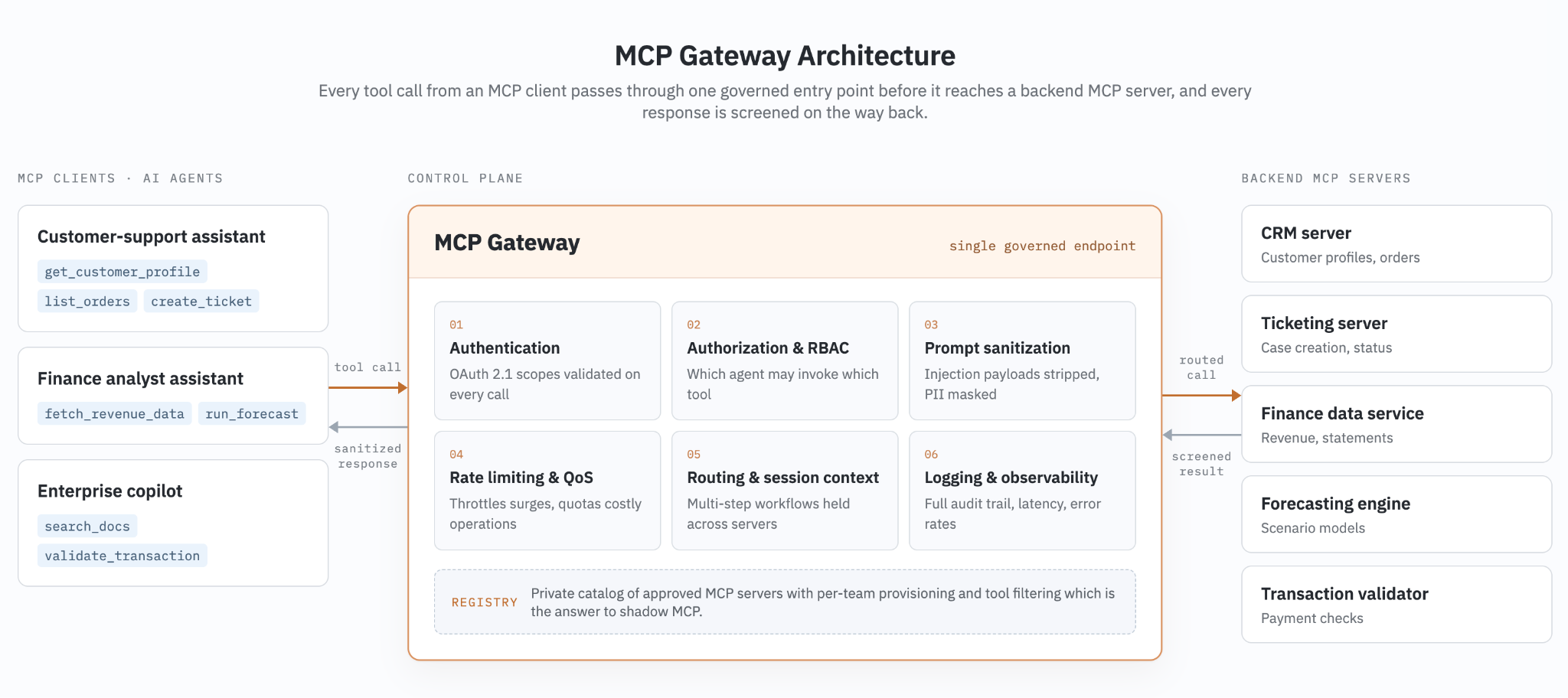
The above figure shows the MCP clients (AI agents) sending tool calls to a central MCP gateway that applies authentication, authorization, RBAC, rate limiting, prompt sanitization, and logging before routing to multiple backend MCP servers, then returns sanitized responses.
Request/response flow
Take a customer-support assistant that needs to look up a profile, fetch order history, check refund eligibility, and open a ticket. Through MCP it discovers tools like get_customer_profile, list_orders, check_refund_status, and create_ticket. Here's what the gateway does with each call:
- The agent sends the tool call to the gateway's single endpoint, not to four separate backends.
- The gateway validates the OAuth scopes and applies RBAC: is this agent allowed to invoke this tool?
- It sanitizes the request by masking PII before the call moves downstream.
- It enforces rate limits and routes the call to the correct MCP server, holding session context if the workflow spans servers.
- The server responds; the gateway screens and sanitizes the response for malicious or sensitive content.
- It logs the full interaction with metadata for audit, then returns a clean response to the agent.
Every step is a control the agent's own code no longer has to implement, and that individual backend teams don't have to reinvent.
The same machinery adapts to far more sensitive work. A finance analyst assistant might discover fetch_revenue_data, run_forecast, validate_transaction, and download_statement. Here the gateway applies strict finance-grade access controls, masks sensitive figures and identifiers before they reach the model, enforces quotas on expensive operations like forecasting, routes each call to the right backend (data service, forecasting engine, transaction validator), and logs every interaction for compliance. The finance team gets to introduce these tools without duplicating business logic or hand-building connectors, and without widening its audit surface. That uniformity — the identical control path whether the tool reads an order or moves money — is central to why gateways sit in front of MCP in the first place.
This also explains why remote MCP matters. MCP servers can run locally over stdio or remotely over streamable HTTP, but the moment a server is remote and shared across teams, ad-hoc trust stops scaling. Centralizing that access behind a gateway is what makes remote, multi-team MCP practical to operate securely.
Benefits of an MCP Gateway
Security: The gateway is one of the most effective places to contain MCP-specific attack vectors: tool poisoning, prompt injection, data leaks, and unauthorized access. Centralizing OAuth flows and tool-registry change detection means a server that silently alters a tool definition is far more likely to be caught, rather than trusted by default.
Reliability: Retries, throttling, and payload shaping stabilize agent behavior. A malformed response gets rejected at the gateway instead of confusing the agent downstream.
Performance: Filtering and structuring data reduces token usage and response size, and tool filtering keeps agents from thrashing through options they can't use.
Governance and Oversight: One control panel for tool access, policy, and usage across the whole MCP ecosystem, so calls are held to consistent organizational rules for formats, methods, and data handling.
Observability: Latency, error rates, invocation counts, identities, and rate-limit violations in one place, which is what lets ops teams find bottlenecks and spot anomalies before they become incidents.
MCP Gateway vs. AI Gateway vs. API Gateway
These three gateways are complementary, not competing, and large AI deployments increasingly run all three. The difference is what each gateway governs.
| Gateway | What it governs | Primary use case | Unit of control |
|---|---|---|---|
| API Gateway | Traffic between clients and backend services (REST, GraphQL, gRPC) | Traditional API management, routing, security | Requests, routes |
| AI Gateway | Outbound calls from your apps to LLMs and AI models | LLM cost control, guardrails, multi-model routing | Tokens, prompts |
| MCP Gateway | Inbound calls from AI agents to your tools and systems | Governing agent access to enterprise capabilities | Tool calls, sessions |
The clean mental model: an API gateway governs how clients reach your services, an AI gateway governs how your applications reach models, and an MCP gateway governs how agents reach your tools. These sit on separate, parallel traffic paths (inbound agent-to-tool calls, outbound app-to-model calls, and general client-to-service traffic) rather than a chain a single request must pass through in sequence. They share DNA with the API gateway pattern, which is why platforms that already do API management are extending into all three rather than treating MCP as a separate world.
Build vs. Buy: Implementing an MCP Gateway
You can build your own MCP gateway. Whether you should is a harder question than it looks. Building an MCP gateway requires meaningfully more investment than building an API gateway, for one reason above all: the MCP specification is still moving fast. The authorization model changed substantially in 2025, transports evolved, and a version you hard-code against today may be superseded within a quarter. A build means owning that churn indefinitely.
The honest trade-off:
- Build: If MCP governance is core to your product, you need deeply custom behavior, and you can staff continuous spec-tracking. Expect a multi-month effort before you reach parity with off-the-shelf governance.
- Buy (or adopt open source): If you want faster time-to-safe-deployment and would rather inherit spec updates than chase them. A managed or platform gateway typically deploys in a fraction of the time a ground-up build takes.
There's a third path that's easy to miss. If you already run API management, your existing platform may already front MCP servers without a separate build or a new vendor. That's where the buy-vs-build question often collapses into "extend what I have."
How WSO2 Approaches MCP Governance
Most MCP gateways on the market come from MCP-native startups founded in the last year or two. WSO2 takes a different approach: it provides MCP gateway-specific capabilities through the AI Gateway in WSO2 API Platform, the same open platform that already governs enterprise APIs and outbound LLM traffic. Instead of a siloed MCP tool, MCP governance becomes an extension of the API lifecycle discipline teams already run.
To get MCP servers into production, the WSO2 platform allows you to proxy an already-existing remote MCP server, adding rate limiting and tool management without touching that server's code.
Then you publish it in MCP Hub, a searchable catalog for AI developers and agents that doubles as the approved-server registry, and it enforces authentication, authorization, throttling, and rate limiting on every agent call. One analytics view, and one identity layer cover APIs, AI, and agents together. You can deploy self-hosted, hybrid, or as SaaS, and WSO2 was named a Leader in The Forrester Wave: API Management Software, Q3 2024.
The balanced view: MCP-native vendors like Docker's MCP Gateway (container-isolated server execution) and Solo.io's Agent gateway project, welcomed into the Linux Foundation's open source portfolio, offer focused, MCP-first depth, and they're credible choices. WSO2's differentiator is unifying MCP with existing API and AI governance rather than adding a fourth control plane to operate. If you're already invested in API management, that consolidation is the argument.
Conclusion
MCP handles connectivity between agents and tools. An MCP gateway is what puts that connectivity under control: authenticating agents, enforcing which tools they can call, sanitizing data in both directions, throttling abuse, and logging actions for audit. As agents move from pilots to production and start making real changes in real systems, that operational layer stops being optional.
If your team already runs API management, the fastest path is often to extend it rather than stand up something new. See how the WSO2 API Platform governs MCP, AI, and API traffic from one control plane, or start with the AI Gateway to see how outbound model governance fits alongside inbound agent governance.
Frequently Asked Questions
What is an MCP gateway? A control layer that sits between AI agents and the MCP servers they call, adding the authentication, authorization, rate limiting, and oversight that the base protocol leaves out. It's what turns agent-to-tool traffic into governed, auditable infrastructure instead of an open pipe into backend systems.
How is an MCP gateway different from an MCP server? An MCP server exposes tools, resources, or prompts an agent can use. An MCP gateway governs how agents interact with those servers. The server is the capability provider; the gateway is the policy, security, and control layer.
Does MCP handle security on its own? MCP introduced an OAuth 2.1 authorization framework in 2025, enabling secure remote servers, but it doesn't provide authorization rules, organizational policy enforcement, data protection, or audit trails. Security is foundational in the protocol; governance lives in the gateway.
Can I put multiple MCP servers behind one gateway? It is the common enterprise pattern. One gateway can front many MCP servers for many agents under a single policy layer, instead of leaving each agent to reach backends on its own.
Who needs an MCP gateway? Any team deploying agents that touch sensitive systems, modify data, invoke high-cost tools, rely on multiple MCP servers, or fall under compliance and audit requirements. Support automation, finance assistants, and enterprise copilots built on OpenAI or Claude are common examples.
Which MCP gateways are available today? Options include the WSO2 MCP Gateway (part of the WSO2 API Platform), Docker MCP Gateway (Docker ecosystem), and Agent Gateway (welcomed into the Linux Foundation's open source portfolio), among others.