API-First Architecture: Why Design Before Code Wins
An API team ships a new service, and three weeks later the mobile team says the response shape doesn't match what they were told to expect. Nobody wrote anything down that both sides could check against, so the backend team's code became the de facto contract, and every mismatch surfaced as its own integration bug instead of a single design conversation. API-first architecture exists to stop that pattern before it starts: agree on the interface first, in a format both sides can validate against, and let the code catch up to a decision that's already been made.
This guide walks through what API-first architecture actually means, how it differs from building the API around code that already exists, the concrete workflow that takes a team from a written contract to running code, and where it pays off most, including the parts of API governance that only work if the contract came first.
What Is API-First Architecture?
API-first architecture is an approach to building software that treats an API as a product interface in its own right, designed for the teams and applications that will consume it, rather than as a side effect of whatever a particular application happens to expose. In practice, that commitment usually shows up as design-first (or contract-first) development: the interface contract, typically an OpenAPI or AsyncAPI specification, is designed and agreed on before any implementation code is written. Consumers, whether that's a frontend team, a partner, or another internal service, review and validate against the contract before a single endpoint is built.
That sounds like a sequencing rule, and design-first, mechanically, is one. But the reason teams adopt it isn't about the order of operations for its own sake. It's about giving every consumer of an API something concrete to build against on day one, instead of a moving target that only stabilizes once the backend team finishes writing code. The next section covers where API-first and design-first actually part ways.
API-First vs. Code-First: The Core Difference
The difference comes down to which artifact is the source of truth. In a code-first approach, sometimes called "bottom-up," a team writes the implementation, and the API documentation or specification gets generated from that code afterward. The contract is a byproduct.
In an API-first approach, the specification is the source of truth from the start, and the implementation is built to satisfy it. That distinction matters more than it sounds like it should, because it changes who gets to weigh in and when. A code-first team can still generate a spec from its code and review it in a pull request before release, so the risk isn't that a code-first spec can't be reviewed. It's that the interface shape has usually already been decided by the time the code exists, so review becomes a compatibility check on a decision already made instead of a design conversation.
It's worth separating two terms that get used almost interchangeably: API-first and API design-first. API-first is the broader organizational commitment: APIs are treated as products with their own lifecycle, not as incidental side effects of building an application. API design-first is the specific practice inside that commitment, namely writing the contract before the code. Most teams that say "API-first" mean the design-first practice in daily use, and that's the sense this guide uses going forward.
| Code-first | API-first | |
|---|---|---|
| Source of truth | The implementation | The specification |
| When consumers see the interface | After the code exists | Before the code exists |
| How a bad design decision surfaces | As a breaking change, post-release | As a comment on the spec, pre-release |
| Documentation | Generated after the fact, often incomplete | Written as part of the design, though it still needs CI conformance checks against the implementation to stay accurate |
Neither approach is universally correct for every situation. A single internal service with one consumer and a short lifespan doesn't need the ceremony of a formal contract review. The calculation changes once multiple teams, external partners, or long-lived integrations depend on the API staying stable, which is most of what an enterprise API estate actually looks like.
The API-First Workflow: From Spec to Code
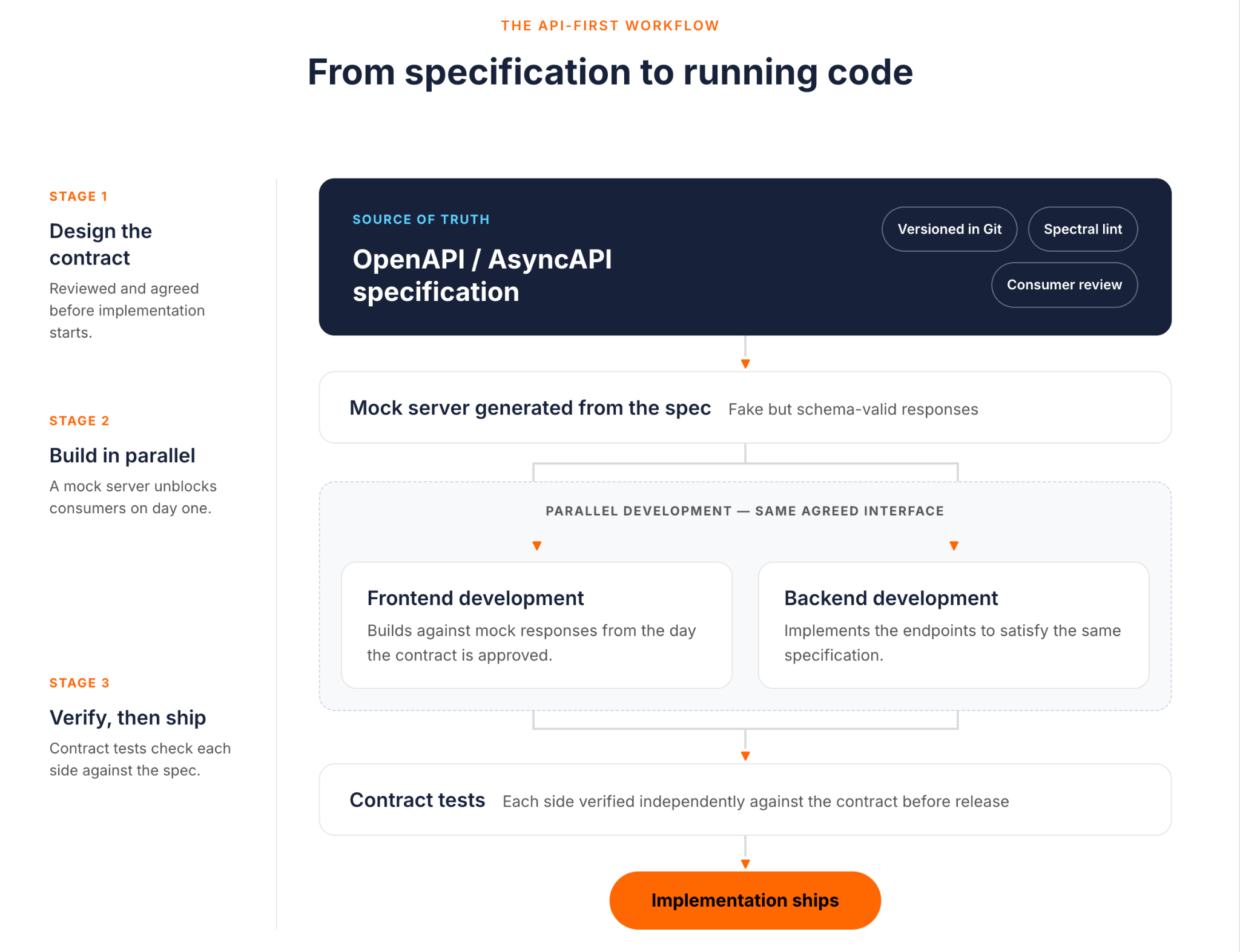
Talking about API-first in the abstract is easy. What's harder, and what most explanations skip, is what actually happens between "we agreed on a contract" and "the API is running in production." The workflow has three concrete stages, and each one produces an artifact the next stage depends on.
Design the API Contract First
The team writes the interface as a specification, an OpenAPI document for a request-response REST API or an AsyncAPI document if the interaction is event-driven and asynchronous. An AsyncAPI document works as a communication contract between senders and receivers in an event-driven system, specifying the payload a service sends and the properties a receiver should expect, the same contract role OpenAPI plays for a synchronous HTTP request and response. Not every event carries a reply the way an HTTP request does, so an AsyncAPI document describes the channels and messages actually in play rather than assuming a request/response pair.
This is also the point where a linter like Spectral earns its keep. Spectral is a JSON/YAML linter with built-in rulesets for OpenAPI and AsyncAPI, and teams use it to enforce naming conventions, required error responses, and security requirements automatically, catching a style violation in a pull request rather than in a code review three sprints later.
Mock Servers and Parallel Development
Once the contract is agreed, a mock server generates fake but schema-valid responses directly from the specification. This is where the API-first payoff actually shows up: the frontend team can start building against the mock server's responses the same day the contract is approved, instead of waiting for the backend implementation to exist. Backend and frontend work run in parallel against the same agreed interface, not sequentially with the frontend blocked on the backend finishing first.
Contract Testing Before Implementation
Contract testing is the practice of testing an integration point by checking each side, independently, to confirm the messages it sends or receives match what's written in the contract. A common variant, consumer-driven contract testing, splits into two steps: the consumer defines its expected interactions early, typically by running its own tests against a mock provider that records them, and that recording becomes the contract. The provider then verifies its real implementation against that same contract before release, a step that has to wait until the implementation actually exists.
The distinction worth keeping straight: an OpenAPI document is a static description of everything a resource could look like, while a contract test is enforced by actually running a specific request and checking the specific response. They're complementary, not interchangeable. The spec tells you what's allowed; the contract test tells you whether a particular implementation actually behaves the way it claims to.
Put together, the sequence is: write the contract, generate a mock from it so both sides can build in parallel, then verify the real implementation against contract tests before it ships, with each stage producing the artifact the next one depends on.
Key Principles of API-First Design
A handful of principles show up across teams that do this well, independent of tooling:
- The contract is versioned like code: Changes to the spec go through pull requests, review, and approval, the same as any other source artifact, not as an informal Slack thread.
- Consumers review before the backend team commits to an implementation: At least one actual consumer of the API, not just the team building it, should look at the contract before implementation starts.
- Consistency matters more than cleverness: A predictable, boring API design that follows the same conventions as every other API in the estate is worth more than one clever endpoint that nobody else's client library expects.
- The specification stays the single source of truth for the life of the API: This is not just for the initial release. Documentation generated from a stale spec is worse than no documentation, because it looks authoritative.
Benefits of an API-First Approach
The benefits mostly follow directly from moving the contract earlier:
- Parallel development: Frontend, backend, and any third-party integrators can build against the same mock-backed contract simultaneously instead of waiting in a queue.
- Faster time to a working integration: Because the interface doesn't change out from under a consumer mid-build, integration work doesn't stall on late-breaking API changes.
- Better developer experience: A consumer gets a documented, testable contract to build against from day one, instead of reverse-engineering behavior from whatever the code happens to do.
- Reduced risk of late-stage failure: Design problems (an inconsistent field name, a missing error case) surface as a comment on a specification, which is cheap to change, rather than as a production incident, which isn't.
Common Challenges When Adopting API-First
None of this is free. API-first design takes real time upfront: writing a contract that a reviewer can actually critique is slower than writing code and letting the shape fall out of the implementation. Teams that skip stakeholder review to save time on that step lose the main benefit and are left with the process overhead instead.
Tooling maturity is uneven across styles. REST tooling built around OpenAPI is mature. AsyncAPI tooling for event-driven systems, while functional, has fewer mock server and contract-testing options than the REST ecosystem does, so an event-driven team adopting API-first should expect to build more of that scaffolding itself.
Cultural resistance is common in teams that have always shipped code first. Writing a specification and waiting for review before touching an IDE feels like a delay to engineers used to the code being the design process. That resistance tends to fade once a team hits its first integration bug that a contract review would have caught, but getting there takes a real incident, not just a policy memo.
There's also a coordination cost that shows up only at scale. A single team writing a contract for its own consumer is a lightweight review. An enterprise with dozens of teams publishing APIs against a shared set of conventions needs someone actually enforcing those conventions, not just documenting them, or the specifications drift apart the same way undocumented code does. That's the point where manual spec review stops scaling and teams start looking for a governance layer that checks contracts automatically instead of relying on a reviewer remembering every house rule.
API-First and API Governance
API-first design isn't only a development-speed decision. It also changes when automated API governance can act. Governance policies that check naming conventions, required security schemes, or documentation completeness need something structured to check against, and that's true whether the specification was hand-designed or generated from code. A governance tool doesn't care where a spec came from.
The difference is timing: a specification written and reviewed before the code exists gives a governance tool something to evaluate before implementation starts, so a violation shows up as design feedback. A specification generated from finished code can be governed the same way, but by then the interface is already built, so the same violation means reworking code that's already shipped internally instead of editing a draft.
WSO2's API Platform builds on that same sequencing. Its API design tooling supports contract-first design starting from an OpenAPI or AsyncAPI specification, with built-in mocking so consumers can start building before the implementation exists. WSO2's governance capability then lets a team define Spectral-based rulesets, attach them to policies, and track adherence through a compliance dashboard, so violations get caught and corrected as part of the normal development flow instead of during an after-the-fact audit. None of that replaces judgment: a governance framework enforces the rules a team decided on, and the value shows up only if the rules and the contract they check against are both worth trusting.
Conclusion
API-first architecture is a sequencing decision with real downstream consequences: it changes who reviews an interface, when they review it, and how expensive a design mistake is to fix. The workflow (contract first, then a mock so consumers can build in parallel, then contract tests before the real implementation ships) is what actually delivers on the promise, not just the decision to write a spec before code exists. Teams weighing whether it's worth the upfront cost should look at how many consumers depend on the API staying stable; the more that number grows, the more a contract written in advance pays for itself.
If you're evaluating how to bring that discipline into an existing API estate, WSO2's API Platform supports contract-first design and design-time governance as part of the same workflow described here, rather than as a separate step bolted on afterward.
Frequently Asked Questions
Is API-first the same as API design-first?
API-first is the broader commitment to treating APIs as products with their own lifecycle. API design-first is the specific practice inside that commitment: writing and agreeing on the interface contract before writing implementation code.
Does API-first slow down development?
Not necessarily, though it does shift time earlier. Writing and reviewing a contract takes longer upfront than jumping straight into code, and for a one-off internal API with a single consumer, that upfront cost can end up as pure overhead. For an API with multiple consumers or a long lifespan, the earlier review usually prevents more expensive rework later, since a design problem caught in a spec review is cheaper to fix than one caught in a production incident.
What is API-first architecture?
It's an approach to building software where an API's interface, typically expressed as an OpenAPI or AsyncAPI specification, is designed, reviewed, and agreed on before the implementation is written, so the specification acts as the source of truth for every consumer of the API.

