API Security Governance: A Practical Framework
A partner API ships on a Friday. Its OpenAPI file declares OAuth at the top level, so the review checklist passes. One operation, though, carries security: [], a line someone added while testing. In OpenAPI, an empty security array on an operation removes the top-level requirement for that operation. The contract now declares unauthenticated access for that operation. If the gateway configuration is generated from the contract, the change can also remove runtime protection. If it is not, the contract and the runtime now disagree. Either way, the written policy said this should never happen.
Nobody broke a rule on purpose, because the rule existed only in a document. API security governance closes that gap by turning written security standards into checks that run on every API, every time something changes. This guide covers how to model threats, encode them as policy, enforce that policy, and prove it is working.
What Is API Security Governance?
API security governance is the set of policies, standards, and enforcement mechanisms that keep every API secure, compliant, and consistent across its lifecycle. It is the security-focused layer of API governance. It defines what "secure" means for your organization and checks each API against that definition automatically, from design through retirement.
It is not a separate discipline from the broader API governance framework. Design consistency, versioning, and documentation rules live in the same program. Security governance narrows the focus to authentication and authorization requirements, transport security, data exposure, and traffic limits. It also sets who owns each control when a check fails.
Why API Security Governance Matters
Most API security risks are not exotic. They come from inconsistency across a large estate, where one team enforces token scopes and another forgets. A new version ships, and the old one keeps taking traffic because nobody owned its retirement.
The OWASP API Security Top 10 makes this visible. Broken object level authorization (BOLA) sits at API1. OWASP's guidance is that object-level checks belong in every function that accesses a data source using an ID supplied by the client. A governance program cannot write those checks for you. It can make sure every API is reviewed for them and that the gateway-level controls around them are in place.
Shadow and zombie APIs are the other recurring problem. A shadow API is one that runs without appearing in any inventory. A zombie API is a deprecated version that was never switched off. Both fall under API9, Improper Inventory Management, where OWASP points to deprecated API versions and exposed debug endpoints as typical issues. Neither can be governed until it is found.
Regulatory exposure depends on more than the data type. Whether GDPR, CCPA, or HIPAA applies also depends on who processes the data, whose data it is, and where they are. Your compliance and legal teams make that call. Governance is how you show an auditor that access controls exist and are applied consistently.
AI traffic adds two new flows
Applications now make outbound calls to model providers. Agents make inbound calls to MCP servers. These are separate paths with separate risks. On the outbound path, prompts can carry sensitive data to an external provider. On the inbound path, an agent may reach tools it should not see. WSO2 AI Gateway handles both as capabilities of one gateway. It applies guardrails such as PII masking to LLM traffic. It applies MCP authentication, per-tool authorization, access control lists, and rate limits to MCP traffic. The governance model is the same one you apply to APIs: define the requirement once and enforce it at a known point.
The Three Pillars of API Security Governance
Most programs settle on three pillars, and each one catches failures the others miss. The split mirrors NIST SP 800-228 (June 2025, updated March 2026), which organizes API protections into pre-runtime and runtime controls and recommends an incremental, risk-based approach to adopting them. A third pillar keeps both honest over time.
Standardized, Secure-by-Default Design
Security requirements belong in the API contract before code exists. That means a required security scheme, HTTPS-only server URLs, consistent error formats that do not leak internals, and response schemas that return only the fields a client needs. When the contract is the source of truth, a linter can check it. A reviewer no longer has to remember every rule.
Policy Enforcement at Runtime
A compliant contract does not guarantee compliant traffic. Runtime controls at the API gateway handle token validation, rate limiting, and mutual TLS to backends. These controls apply whether or not the design-time checks ran, so they form the floor every request has to clear. For OAuth-protected APIs, governance should name a reference for how tokens are issued and validated. RFC 9700, the OAuth 2.0 Security Best Current Practice, is a sound baseline because it updates the original OAuth threat model with lessons from production use.
Continuous Monitoring, Testing & Audit
Policies drift as new threats appear and new APIs get created outside the usual path. Continuous monitoring re-checks the estate as it changes, and security testing confirms that controls behave as written. An audit trail records who changed what and which violations remain open.
Threat Modeling for APIs: Where Governance Starts
Governance rules work best when each one traces back to a specific threat. Threat modeling supplies that link. The OWASP Threat Modeling Cheat Sheet frames the process around four questions from the Threat Modeling Manifesto:
- What are we working on?
- What can go wrong?
- What are we going to do about it?
- Did we do a good enough job?
Applied to an API estate, the process has three working steps.
- Map the attack surface: List authentication flows, token types, and where each API trusts a caller's identity. Mark data exposure points, such as endpoints that return full objects or accept object IDs in the path. Add third-party integrations, since data returned from them is input too.
- Map likely attack patterns: For each surface, name the realistic attack. Object IDs in paths invite BOLA. Login and token endpoints attract credential stuffing. Endpoints that return entire records invite excessive data exposure, which OWASP now groups under broken object property level authorization (API3).
- Translate findings into policy requirements: Each finding becomes a requirement with an owner and an enforcement point.
The third step is where most programs stall. The table below shows how findings become enforceable requirements. The enforcement points are independent of each other. A request does not pass through them in sequence, and some requirements live in only one place.
| Threat finding | Policy requirement | Primary enforcement point |
|---|---|---|
| Operation can opt out of authentication | Every operation must inherit or declare a security requirement | Design-time rule on the API definition |
| API served over plain HTTP | Server URLs must use HTTPS | Design-time rule, plus TLS configuration at the gateway |
| Object IDs accepted in paths | Ownership check on every object read and write | Application code, verified through security testing |
| Token endpoint open to automated guessing | Per-client rate limits on authentication endpoints | Runtime gateway policy |
| Deprecated versions still reachable | Every version has an owner and a retirement date | Inventory review and monitoring |
For a full layer-by-layer mapping of the OWASP list, see this guide to API security architecture. Threat modeling for governance is narrower, because it asks which of those risks your rules must catch automatically. Revisit the model when the estate changes in ways that shift the attack surface. Typical moments include adding a new identity provider, exposing an internal API to partners, or connecting agents to existing services.
How Policy Enforcement Actually Works
A written security policy becomes enforceable when it is expressed as a rule a machine can evaluate. For API definitions, that usually means a linting ruleset. Spectral is a common choice because it reads OpenAPI and AsyncAPI documents and supports custom rules.
Here is a small security ruleset that encodes the first two rows of the table above:
rules:
  root-security-required:
    description: The API must declare a default security requirement.
    severity: error
    given: "$"
    then:
      field: security
      function: truthy
  root-security-not-empty:
    description: The default security requirement must not be an empty list.
    severity: error
    given: "$.security"
    then:
      function: length
      functionOptions:
        min: 1
  operation-security-no-opt-out:
    description: Operations must not remove security unless approved as public.
    severity: error
    given: "$.paths[*][?(@property.match(/^(get|put|post|delete|options|head|patch|trace)$/) && @['x-public'] !== true)].security"
    then:
      function: length
      functionOptions:
        min: 1
  security-no-anonymous-alternative:
    description: Security requirements must not include an anonymous {} option.
    severity: error
    given:
      - "$.security[*]"
      - "$.paths[*][?(@property.match(/^(get|put|post|delete|options|head|patch|trace)$/) && @['x-public'] !== true)].security[*]"
    then:
      function: length
      functionOptions:
        min: 1
  servers-required:
    description: The API must declare at least one server.
    severity: error
    given: "$"
    then:
      field: servers
      function: truthy
  servers-https-only:
    description: Server URLs must be absolute HTTPS URLs, at every level.
    severity: error
    given:
      - "$.servers[*].url"
      - "$.paths[*].servers[*].url"
      - "$.paths[*][*].servers[*].url"
    then:
      function: pattern
      functionOptions:
        match: "^https://"
The severity on each rule is a governance decision. Here every rule is an error. That covers a missing or empty security requirement, an anonymous {} alternative, an unapproved operation-level opt-out, and a non-HTTPS server URL at the root, path, or operation level. A genuinely public endpoint, such as a health check, is approved by adding x-public: true to the operation after a security review. The exception then stays visible in the contract instead of being silently allowed. These rules check the contract, not the deployed gateway. The example policy requires absolute HTTPS server URLs, so it also rejects relative URLs. Relax that rule if your gateway assigns the host, because a missing or relative URL does not by itself mean traffic runs over plain HTTP.
Blocking vs. non-blocking enforcement
Severity decides what happens on a violation. A blocking check stops a change from moving forward. A non-blocking check records the violation and lets work continue. With the Spectral CLI, only findings at or above the --fail-severity level produce a failing exit code, and the default level is error. So the same ruleset gives you both behaviors in a CI pipeline.
| Mode | Typical trigger | Effect | Good fit |
|---|---|---|---|
| Blocking | Error-severity rule fails in CI | Build or deployment stops until fixed | Missing authentication, plain HTTP, leaked secrets |
| Non-blocking | Warn or info rule fails | Change proceeds, violation is reported for follow-up | Documented exceptions, style issues, early adoption of a new rule |
Roll out new style and consistency rules as non-blocking, then promote them to blocking once the existing estate is clean. That keeps a noisy new rule from stalling every team on the day it ships. A newly discovered, exploitable gap such as a missing authentication requirement is different. Block it from the start and route any legitimate exceptions through the documented allowlist. A staged rollout is a migration strategy, not a reason to leave a known critical exposure open.
Design time and runtime are separate enforcement points
Design-time checks evaluate the API definition, while runtime policies evaluate live traffic at the gateway. They run independently and catch different failures. A linter cannot stop a stolen token, and a gateway cannot tell that a response schema exposes a field it should not. Neither check depends on the other having run, so treat them as two controls rather than two steps in one pipeline.
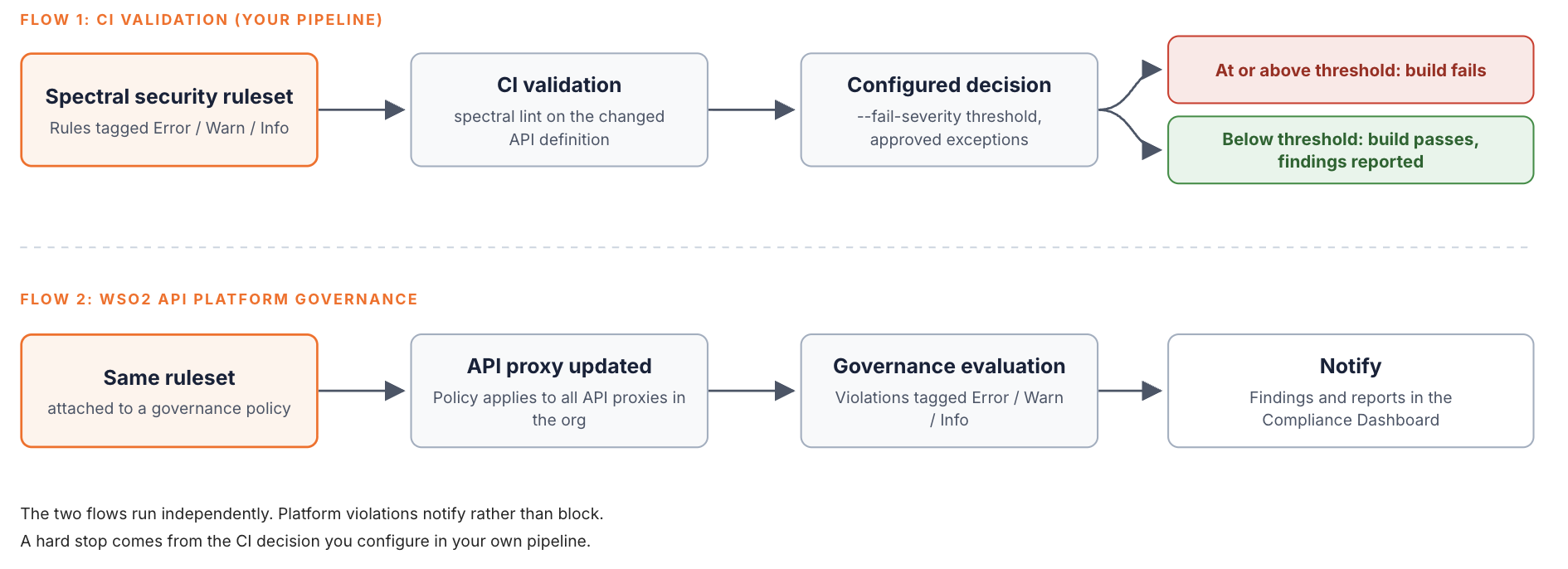
CI validation and platform governance run independently. Platform violations notify rather than block, and the hard stop comes from the CI decision you configure.
A worked example on WSO2 API Platform
WSO2 API Platform's governance model follows the same structure. Rulesets are written in Spectral YAML, and they can validate the API definition, the API metadata, and the API documentation. A policy groups rulesets and applies them to all existing and new API proxies in an organization. The catalog also offers default rulesets, including one based on the OWASP Top 10, so teams can start from a known baseline.
Policies are evaluated when an API proxy is updated. Each violation carries a severity of Error, Warn, or Info. Today the platform's action on a violation is Notify, which surfaces the finding in the compliance dashboards. Teams that want a hard stop on error-severity findings run the same Spectral ruleset in their CI pipeline as well. One ruleset then drives both the blocking gate and the platform's compliance view.
Runtime enforcement sits with the gateways. WSO2 API Platform manages WSO2, Kong, AWS, Azure, and Envoy gateways from one control plane. Through gateway federation, APIs discovered on third-party gateways can be brought under the same governance policies. That matters for most estates, which rarely run on a single gateway technology.
This is one way to operationalize the model. Dedicated API security platforms and other management products structure it differently. The pattern to look for is the same: rules as code, severity-based outcomes, and one place to see results.
Audit, Compliance & Governance Dashboards
Enforcement without a record is hard to defend. An auditor usually asks two questions: which controls apply to this API, and can you show they were applied at a given time? A governance dashboard should answer both without a spreadsheet exercise.
Useful dashboards surface a small set of views:
- Violation history per API, with severity, the rule that fired, and when it was resolved.
- Policy adherence trends across teams or projects, so drift shows up before an audit does.
- Re-evaluation after rule changes. When a ruleset changes, existing APIs should be checked again, not only new ones.
- Ownership. Every open violation needs a named owner, or it stays open.
In WSO2 API Platform, the Compliance Dashboard works at organization, project, and component levels. The organization view lists each project with its compliance status and violation counts. The component view breaks results down by policy and ruleset adherence, with a detail view of individual rule violations. Teams can also upload governance standards as PDF documents and run an AI compliance analysis at the project level. The docs note that this analysis can produce inaccurate or incomplete results, so treat it as review input rather than evidence.
Violation history shows what was wrong. It does not show who changed the API to fix it, or who changed it to break it. That second record comes from audit logs. In WSO2 API Platform, organization-level audit logs capture API proxy creation, updates, deletion, and version creation, along with the timestamp and outcome of each action. Pairing those logs with compliance results lets you reconstruct a timeline: the rule that fired, the change that resolved it, and the person who made that change. By default, only organization administrators can view these logs, and access for others is granted through a role. That is a sensible starting point for evidence that auditors will rely on.
Mapping these controls to specific regimes such as GDPR, HIPAA, or SOC 2 is its own exercise. The governance program supplies the evidence. Your compliance team decides which controls satisfy which clauses.
KPIs to Measure API Security Governance Health
Pick a few measures that show whether governance is changing outcomes. Track the trend over time rather than chasing a fixed target.
- Coverage of automated evaluation. The share of APIs that are evaluated against security rulesets on every change. Gaps here usually point to gateways or teams outside the main path.
- Shadow API trend. APIs found by traffic or gateway discovery that were not already in the inventory. A falling count means inventory is keeping up with delivery.
- Open error-severity violations by age. Old critical findings matter more than total counts. They show where ownership has broken down.
- Mean time to remediate. Time from a violation being raised to being resolved, split by severity.
- Inventory completeness for critical APIs. The share of APIs handling sensitive data that have an owner, a classification, and a retirement plan for old versions.
Avoid setting universal thresholds for these. A regulated payments estate and an internal tooling estate will have very different baselines.
How to Build an API Security Governance Program
A program does not need to start large. It needs a sequence that turns each stage into the input for the next. If you are building a governance framework from scratch, run security governance as part of it rather than beside it.
- Inventory: Find every API, including those behind third-party gateways and older versions still taking traffic. Record an owner and a data classification for each.
- Define policies: Run a threat modeling session on your highest-risk APIs. Turn the findings into a short list of rules. Agree on severities with security and platform teams together.
- Automate enforcement: Put the rules in a linting ruleset that runs in CI and in your API platform. Configure runtime gateway policies for authentication and rate limiting. Start new rules as non-blocking.
- Monitor and audit: Review the compliance dashboard on a regular cadence. Assign every open violation an owner. Promote stable rules to blocking.
- Iterate: Revisit the threat model when the estate changes. Add rules when new risks appear and retire rules that no longer apply.
Who owns what between dev and security teams
Governance fails quietly when ownership is vague. A split that works in many organizations gives the security team ownership of the rules and their severities. The platform team owns the tooling that runs those rules in CI, in the API platform, and at the gateways. API teams own their violations and the fixes. Exceptions go through a short review with security, and each one is recorded against the API with an expiry date. This keeps security from becoming a ticket queue. It also stops API teams from quietly disabling a rule that slows them down, because any opt-out is visible in the same dashboard as every other finding.
The right time to move from manual review to automated enforcement depends on operational triggers, not API counts. Common triggers include running more than one gateway technology and moving regulated data through APIs. Others are a need to attribute access or AI spend to specific teams, and the arrival of agents or LLM-backed features. Any one of these makes manual review hard to sustain.
Conclusion
API security governance only works when policies are enforced automatically and re-evaluated as the estate changes. Written standards alone do not stop shadow APIs, quiet opt-outs like security: [], or drift between teams. Start with a threat model and encode its findings as rules with clear severities. Enforce them at design time and runtime as separate controls. Then keep an audit trail that shows the rules are working.
This is not a one-time project. Rules, threats, and APIs all change, so the program has to keep checking. For the wider governance picture, the API governance hub linked earlier covers the full framework. To put rulesets, policies, and compliance dashboards to work across your gateways, explore WSO2 API Platform.
Frequently Asked Questions
What is API governance?
API governance is the set of standards, processes, and automated checks that keep APIs consistent across an organization. It covers design, documentation, versioning, security, and retirement. API security governance is the part focused on security controls.
What are the three pillars of API security?
Secure-by-default design, policy enforcement at runtime, and continuous monitoring with audit. Design rules catch problems in the contract, while runtime policies protect live traffic. Monitoring confirms both keep working as the estate changes.
Why is API security governance important?
It makes security consistent across teams and gateways. Without it, controls depend on each team remembering every rule, and gaps such as unauthenticated endpoints or forgotten API versions reach production.
Is API security governance the same as API security testing?
No. Testing checks whether a specific API behaves securely at a point in time. Governance defines the required controls, checks every API against them automatically, and records the results. Testing is one input to a governance program.
Does API security governance apply to AI and MCP traffic?
Yes. Outbound calls to LLM providers and inbound agent calls to MCP servers need the same discipline: defined requirements, enforcement at a gateway, and an audit record. The controls differ, for example PII masking on prompts and per-tool authorization for MCP.

