Federated vs. Centralized API Governance: Which Fits?
Your platform team reviews every new API before it ships. That worked when a few teams were publishing. Now many more squads file review tickets, the queue spans sprints, and some teams have quietly started exposing endpoints without asking. Nobody decided to abandon the standards. The review process just stopped keeping up.
This guide is about that decision: who owns API policy, who enforces it, and how much of that work should sit with a central team. It covers governance as an operating model, not the gateways that run your traffic.
What Is API Governance, and Why Does the Operating Model Matter?
API governance is the set of standards, decision rights, and checks that keep an organization's APIs secure, consistent, and discoverable. For the full definition and framework, start with the fundamentals of API governance.
Governance and management are related but separate. Management is about tooling: which gateways, portals, and pipelines run your APIs. Governance is about authority: who sets the rules, who checks them, and who answers when an API breaks them. You can run one gateway and still distribute governance across many teams. You can also run several gateways under one central rulebook. The infrastructure side has its own trade-offs, which are covered at the end of this guide.
The operating model matters because it decides where the friction lands. Put every decision with one team and the friction is a queue. Push every decision to individual teams and the friction shows up later, as drift that security finds during an audit. There are three common governance models: centralized, federated, and hybrid. The rest of this guide compares them.
Centralized API Governance: How It Works
In a centralized model, a central function holds governance authority over the rules, the exceptions, and how approvals work. That function is usually an API platform team or an architecture review board. Reviews can be automated, delegated, or manual. In the most manual form, product teams submit each spec and wait for sign-off before publishing. The central team maintains the style guide, the security baseline, the versioning policy, and the catalog of approved APIs.
A typical review covers naming, authentication scheme, error formats, pagination, and documentation completeness. The central team can also say no to an API that duplicates one that already exists.
Pros of Centralized Governance
- Consistency by construction. One function sets the rules and decides the exceptions, so consumers see one style of authentication, errors, and versioning across the estate.
- A simpler audit story. When a regulator or customer asks how APIs are approved, there is one process, one owner, and one record. That is the strongest argument for centralization in regulated industries.
- One source of truth. The central team holds the catalog. It can spot duplicate APIs and retire unused ones before they become forgotten attack surface.
Cons of Centralized Governance
- The platform team becomes a chokepoint. When the central function reviews changes by hand, review capacity grows with headcount, not with demand. As more teams ship APIs, the approval queue can grow faster than the team that clears it. Delivery dates start to depend on reviewer availability.
- Reviewers lose context. A central reviewer sees the spec, not the domain. They can check that a payments API uses OAuth 2.0. They are less able to judge whether its resource model fits how the payments team actually works.
- Teams route around the process. When approval takes longer than building, some teams expose endpoints without registering them. These shadow APIs fall under what OWASP calls improper inventory management, which it lists as API9 in its 2023 API Security Top 10. A model meant to increase control can end up reducing visibility.
Federated API Governance: How It Works
Federated governance moves decision rights to the teams that build and run the APIs. A central group still exists, but it publishes a framework rather than approving individual APIs. Domain teams interpret that framework, make their own design calls, and answer for their APIs in production.
The central group in a federated model often looks like an API guild. Engineers from several domain teams meet regularly to agree on shared conventions and document them. The platform team provides tooling and templates but does not sit in the release path.
Data teams went through the same shift earlier. Zhamak Dehghani's data mesh principles list federated computational governance as one of four core principles. Global standards are agreed jointly, while domains own how they meet them. The API version of the idea is the same: shared rules, local ownership.
Pros of Federated Governance
- Domain teams ship without waiting. Design decisions are made by the people closest to the API. A team can publish a new version on its own schedule instead of booking a review slot.
- Accountability stays with the owner. The team that builds an API also answers for its uptime, its breaking changes, and its security issues. Ownership is clear because nobody else signed off on it.
- It scales with the organization. A new product team adds no load to a central queue. Each team carries its own share of the governance work.
Cons of Federated Governance
- Consistency drifts. Two teams can read the same guideline and implement it differently. Over time, consumers face different pagination styles, error shapes, and auth flows across APIs from the same company.
- Audits get harder without tooling. If each team keeps its own records, a simple audit question becomes a project. Answering "which APIs handle personal data, and who approved them?" means surveying every team by hand, then trusting that each answer is complete and current.
- Security posture becomes uneven. A well-resourced team may follow the baseline closely. A team under deadline pressure may skip rate limiting or ship with weak authentication. A review of 114 industry articles on data mesh found a similar tension in data governance. That evidence comes from data teams, not API programs, so it applies here by analogy. Balancing central and domain control is one of the hard parts of federated governance.
Federated vs. Centralized: Side-by-Side Comparison
The table below compares the two models, plus the hybrid pattern described in the next section, by where authority sits. It is an explanatory model, not evidence that one structure performs better than another.
| Dimension | Centralized governance | Federated governance | Hybrid governance |
|---|---|---|---|
| Decision authority | A central function holds the relevant governance authority | Authority is divided between shared governance and accountable domains | A central team owns the shared baseline. Domains hold authority over everything else |
| Shared baseline | May be centrally defined and automatically enforced | May be jointly defined and automatically enforced across domains | Centrally defined and automatically enforced |
| Domain discretion | Depends on delegated authority and exception policy | Explicitly reserved for decisions assigned to domains | Covers decisions outside the baseline |
| Reviews | Can be automated, delegated, or manual | Can be automated, local, or escalated to shared governance | Automated for the shared baseline, with manual sign-off reserved for designated high-risk changes |
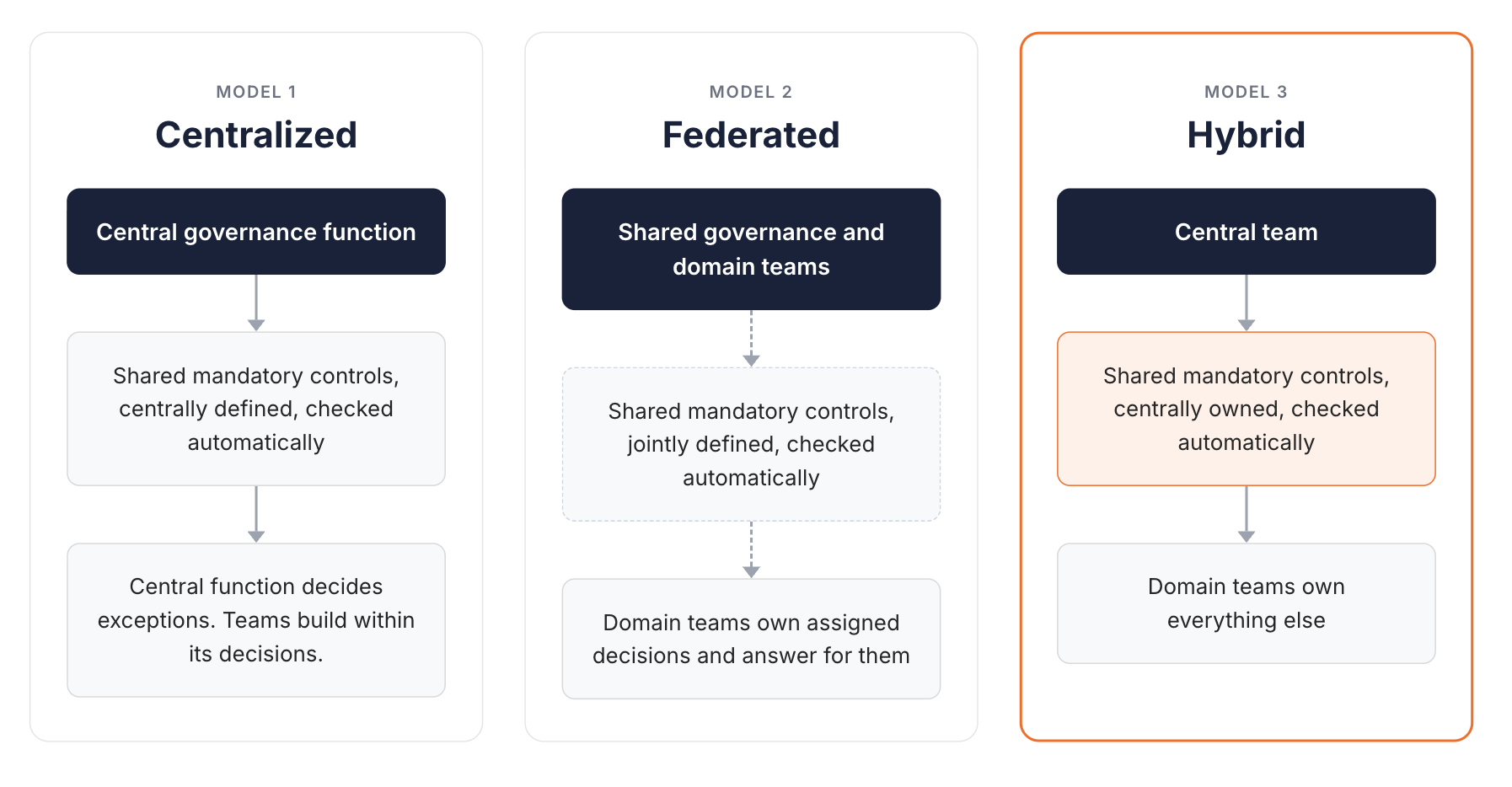
Where decision authority sits in the centralized, federated, and hybrid models.
The figure shows where decision authority sits in each model. All three models can enforce shared mandatory controls automatically. The difference is who holds authority and who is accountable. In the centralized model, a central function defines the controls and decides exceptions. In the federated model, shared governance and accountable domain teams define the controls jointly and divide the remaining decisions. In the hybrid model, a central team owns the baseline, and domain teams decide everything else.
The Hybrid Model: Central Policy, Federated Execution
A practical pattern is a hybrid: central policy, federated execution. A central platform team defines a small set of org-wide governance policies that no team can opt out of. Domain teams own day-to-day design and shipping inside those guardrails.
The non-negotiable list should stay short. A practical baseline covers the authentication scheme, the security baseline, and the versioning and deprecation policy. It also covers the metadata every API must carry, such as an owner and a data classification. Everything else, from resource naming to pagination style, is guidance that an API guild maintains and teams can adapt.
The key change is that the central team owns the rule, not the review. In a model built on manual review, a person checks every spec. In a hybrid model, the rule is written once as a machine-checkable check, and every API is evaluated against it automatically. Reviewers only step in for exceptions.
Hybrid programs also separate two kinds of rules:
- Hard gates stop a change from reaching production until it complies. These are reserved for issues with real consequences, such as missing authentication on an external API.
- Advisory rules flag a problem without stopping delivery. A missing example in the docs or a naming inconsistency shows up in a report for the owning team to fix on its own schedule.
That split is what gives domain teams real autonomy. They are blocked only by rules the organization has deliberately chosen to block on. Consider a payments team and an internal tooling team. Both must meet the same authentication baseline. Only the payments team's production releases go through an approval gate, because only its APIs touch regulated data.
How to Choose the Right Model for Your Organization
No model is correct in general. The right one depends on how your organization is built and where it carries risk. These factors tend to decide it:
- Number of teams shipping APIs: With a handful of producing teams, a central review is manageable and keeps things consistent. As the count grows, the queue becomes the constraint, and hybrid starts to pay off.
- Regulatory exposure: Some APIs carry payment, health, or personal data. That data may fall under regulations such as HIPAA or GDPR, or under industry standards such as PCI DSS. Auditors may ask for evidence of authorization and change control. These frameworks do not require a central committee to approve every API change. Map each applicable control objective to how your organization implements it. For some APIs, that may mean stronger central rules, even if the rest of the estate is federated.
- Platform team capacity and maturity: Federation needs a platform team that can write and maintain automated checks. If that capability does not exist yet, federating mostly means losing visibility.
- Organization structure: Multiple business units, regional subsidiaries, or recent acquisitions usually mean teams with their own stacks and habits. Forcing them through one review queue rarely works. A shared baseline with local ownership usually does.
- AI traffic in the estate: Watch for multi-model use, a need to attribute model spend to teams, or regulated data in prompts. Each of these raises the same question. Someone has to own the baseline for guardrails and budgets, while teams keep control of their own integrations.
Two more questions help. Can your security team list every production API and its owner today? If not, your current model is already losing visibility, whatever it is called. And are teams waiting on governance more than they wait on code review? If so, the central team is doing work that automated checks could do.
Making Federated Governance Work in Practice
A hybrid model only holds if the central rules are actually enforced. A guideline in a wiki is a suggestion, while a rule that runs against every API and reports the result is governance. The tooling has to let a central team define a rule once and apply it to every team's APIs. Everyone who needs the results should be able to see them.
WSO2 API Platform structures its governance around that loop. Rulesets are Spectral-based YAML rules that validate API definitions. Administrators can also upload governance documents, which are natural-language standards in PDF form, for AI-assisted compliance analysis. The ruleset options shown in the documentation include WSO2 API design and style guidelines and an OWASP Top 10 ruleset.
A central platform team attaches rulesets to a policy. That policy then applies to every existing and newly created API proxy in the organization, so no team has to opt in. Each policy maps rule severities (error, warning, and info) to an action. Today that action is a notification, and the documentation explains how policies get enforced automatically across API proxies.
Results land in a compliance dashboard at the organization, project, and component level. The central team gets the estate-wide audit view that is usually the strongest argument for centralization. Each domain team sees its own violations and fixes them without filing a ticket. Because governance policies report rather than block, the hard gate in a hybrid model sits elsewhere. API Platform supports approval workflows for promoting components to production environments. That lets an organization reserve a human sign-off for the releases that need one.
The same control plane covers two related problems that are easy to confuse with governance:
- Gateway federation: APIs running on third-party gateways can be discovered, brought under the control plane, and checked against the same compliance policies. The control plane governs those gateways without sitting in their request path.
- AI traffic: The WSO2 AI Gateway applies the same central-policy, team-execution pattern to AI. It governs outbound calls from applications to LLM providers and, separately, inbound calls from AI agents to MCP tools. A platform team can set guardrails, token-based rate limits, and team-level token allocations from the same control plane that governs APIs.
These are separate capabilities that share a word. Infrastructure federation decides where traffic runs, and governance federation decides who owns the rules. WSO2 supports both under one control plane. The API Gateway and AI Gateway source code is published in the wso2/api-platform GitHub repository under the Apache 2.0 license. That includes the gateway and AI gateway releases tagged 2026.09.24. The license covers the code in that repository. Review the terms for the hosted service and other platform capabilities separately.
Conclusion
Federated vs. centralized API governance is rarely a binary choice. Centralized governance gives you consistency until the review queue becomes the bottleneck. Pure federation keeps teams moving until consistency drifts and audits turn into surveys. A practical pattern sits in the middle: a short list of central rules that are checked automatically, and domain teams that own everything else.
Whichever model you pick, the central rules only hold if tooling enforces them. Meetings and wiki pages do not scale with the number of teams. Start by writing down the few rules your organization will not compromise on, then decide which of them deserve a hard gate.
If your teams also run more than one gateway, treat that as a separate decision. Our guide to federating your API gateway infrastructure covers the multi-team patterns on that side. To see how rulesets, policies, and compliance dashboards work together across APIs and AI traffic, explore WSO2 API Platform.
Frequently Asked Questions
What does federated API mean?
A federated API program lets multiple teams build and operate their own APIs while shared standards and visibility apply across all of them. The term can describe gateway infrastructure or governance. Context tells you which.
What is federated governance?
Federated governance is an operating model where a central group agrees on shared standards and domain teams own how they meet them. Decisions sit with the teams closest to the work.
What does API governance mean?
API governance means the rules, decision rights, and checks that keep an organization's APIs secure, consistent, and well documented throughout their lifecycle.
What are the three models of governance?
The three common models are centralized, federated, and hybrid. They differ in who sets the rules and who enforces them.
What does centralized governance mean?
Centralized governance means one team defines the standards and approves each API before it is published. It favors consistency and auditability over delivery speed.

