API Governance: The Complete Framework & Implementation Guide
Your organization probably has an API style guide. It lives on a wiki page, it was written two reorgs ago, and the last three APIs your teams shipped don't follow it. Nobody broke a rule on purpose. The rule just had no way to reach the pull request, the gateway, or the retirement plan.
That gap between what a team agrees on and what actually runs in production is what API governance is for. This guide is for platform engineering leads, API program owners, and architects who are responsible for keeping dozens or hundreds of APIs consistent. It covers what governance includes and how it differs from API management and API security. It also covers the four layers a working framework needs, the centralized vs. federated decision, and the mistakes that turn governance into a bottleneck.
What Is API Governance?
API governance is the set of standards, policies, and processes that decide how an organization's APIs are designed, secured, versioned, published, and retired. It turns those decisions into automated checks at design time, at the gateway, and across the API lifecycle. Consistency then doesn't depend on a reviewer remembering the rules.
The definition is simple. The hard part is where the checks run. A rule such as "every public operation needs an operationId and a documented error response" can be enforced in at least three places. It can run in the editor while the OpenAPI document is written. It can run again in CI when someone opens a pull request, and in the control plane when the API is registered. A rule such as "partner APIs must validate a JWT" can only be enforced at runtime, on the gateway that receives the call.
That is why an API governance strategy is more than a style guide. It is a map of which rules belong to which stage of the API lifecycle and which system enforces each one. API management provides much of the machinery: the gateway, the catalog, the lifecycle states. Governance policies decide what that machinery should allow.
Why API Governance Matters
Most governance programs start after something goes wrong, not before. The trigger is rarely dramatic. A security review finds an API nobody can name an owner for. A partner integration breaks because two teams versioned the same resource in different ways. An auditor asks for a list of every API that handles customer data, and producing it takes weeks of manual surveying.
Shadow APIs are the clearest risk
The OWASP API Security Top 10 lists Improper Inventory Management as API9:2023, and its example is worth reading closely. A social network puts rate limiting in a separate component in front of its production API. A researcher then found a beta host running the same API, including the password reset flow, without that component. The researcher brute-forced the 6-digit reset token on the beta host, because the control was tied to one deployment's traffic path instead of to the API. The OWASP API9:2023 entry also flags two familiar conditions: no retirement plan for each API version, and a missing or outdated host inventory.
API sprawl compounds the cost of every other problem
Each new team, acquisition, or cloud region can add APIs faster than a central review team can track them. OWASP notes that running multiple versions of an API expands the attack surface. Sprawl also slows developers down. When three APIs return customers in three different shapes, every consumer writes three adapters.
Consistency is what makes an API portfolio usable at scale
Predictable naming, pagination, error formats, and authentication let a developer move between APIs without relearning each one. This matters more now that AI agents consume APIs too. An agent picks an operation based on its description, so vague summaries and missing examples cause wrong calls instead of just slower onboarding.
API Governance vs. API Management vs. API Security
The three terms overlap, and teams often use them interchangeably. They describe different layers of the same API program.
| API governance | API management | API security | |
|---|---|---|---|
| Core question | What rules should every API follow? | How do APIs get built, published, and run? | How are APIs protected from misuse and attack? |
| Primary output | Standards, rulesets, policies, compliance reports | Gateways, developer portal, lifecycle states, analytics | Authentication, authorization, threat protection, rate limits |
| Typical owner | API program owner or governance group with platform engineering | Platform engineering | Security team with platform engineering |
| When it acts | Design time, registration, runtime, and retirement | Runtime and publication | Mostly runtime, plus design-time checks for insecure definitions |
| Example | "All external APIs use OAuth 2.0 and a standard error schema" | Deploying the API to a gateway and publishing it to the portal | The gateway rejecting a call with an invalid token |
Governance is the policy layer. Management is the operational layer that carries those policies out. Security is one governed domain among several, alongside style, versioning, documentation, and lifecycle. Take a security rule such as "no API key in a query parameter." Governance writes it, a linter checks it against the OpenAPI definition, and the gateway enforces it at runtime.
The practical consequence: buying an API management platform does not give you governance. It gives you the enforcement points. Governance is the decision about what to enforce at each one.
Federated vs. Centralized Governance: The Foundational Model Decision
Before writing a single rule, a governance program has to answer who writes the rules and who enforces them. Most programs pick one of two models, and many drift into a third without choosing it.
Centralized governance: One team owns the standards, the exceptions, and the domain decisions for every API. It is consistent and easy to audit. That team can enforce its rules through automated checks, manual review, or both. When approvals depend on manual review, the governance team can become a queue once several teams ship APIs.
Federated governance: Keeps organization-wide standards and mandatory global controls central, but moves domain decisions to the teams that own the APIs. The central group writes the baseline rules, decides exceptions to them, and audits compliance. Domain teams apply those rules in their own pipelines and gateways, and can add stricter rules for their own domain.
Siloed governance: This is what happens when nobody chooses. Each team sets its own conventions, and the organization finds out about inconsistencies when a consumer complains or an audit fails.
The choice is less about philosophy than about scale and structure. Centralized authority tends to work while one team owns most APIs and the change rate is low. Federated governance becomes the realistic option once several teams publish APIs independently, or when acquisitions bring in gateways and conventions you can't migrate quickly. Automation is a separate decision from the model. Either model can enforce rules through automated checks, and either one stalls when every check waits on a person. A rule that only exists as a review comment is hard to apply consistently in any model, because it travels with the reviewer rather than with the API.
For the organizational side of this decision, including how teams split runtime ownership from organization-wide policy, see API federation patterns for multi-team API programs. A dedicated spoke in this series covers the federated vs. centralized decision in depth.
The Four Layers of an API Governance Framework
A useful way to structure an API governance framework is by where each rule gets enforced. Four layers cover most of what a program needs: standards, design-time enforcement, runtime enforcement, and lifecycle and catalog. The layers are not a pipeline that every API passes through in order. Standards feed both enforcement layers, and lifecycle and catalog span the entire life of the API.
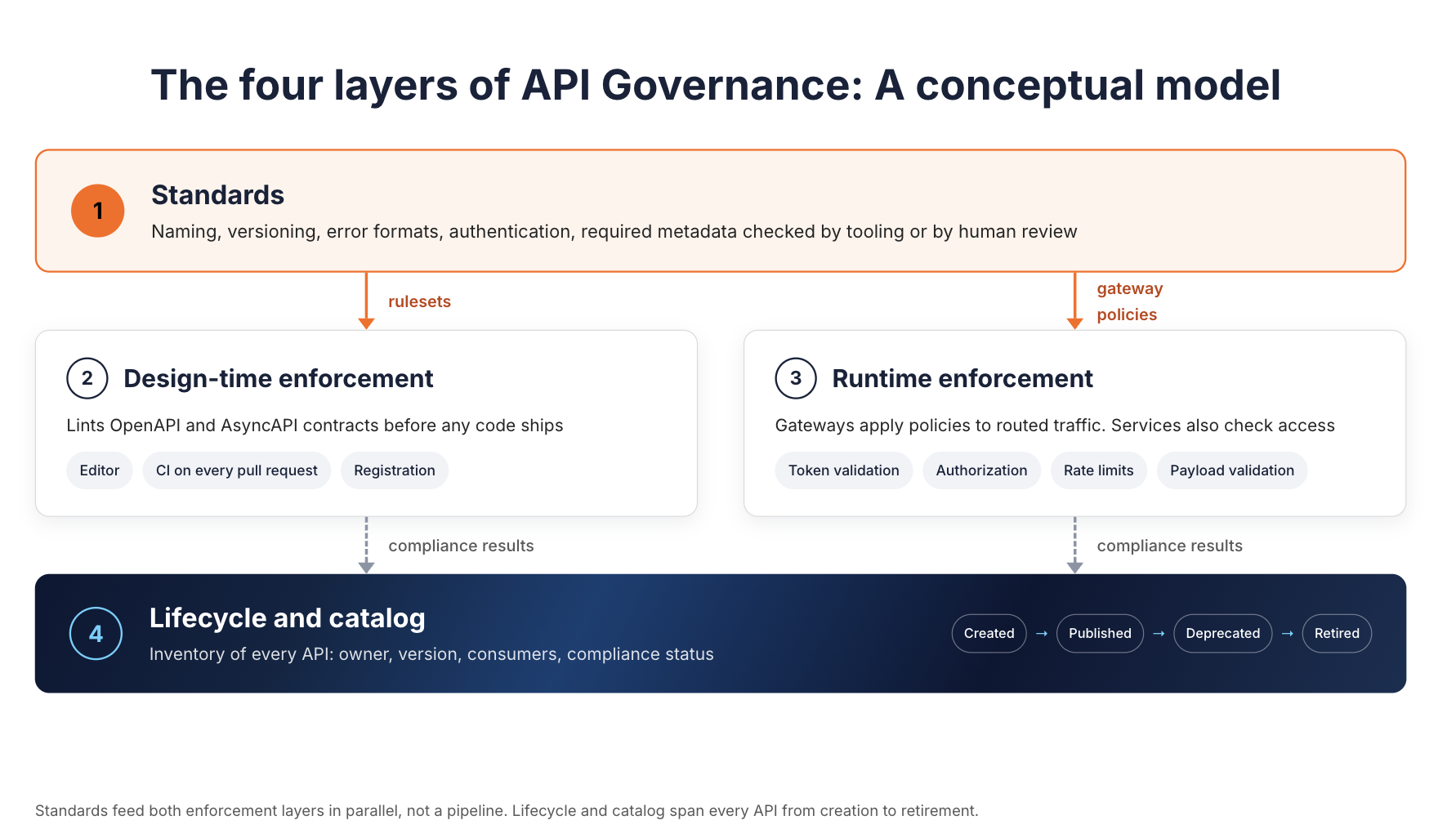
The four layers of API governance: a conceptual model.
The figure shows standards feeding two independent enforcement points. Lifecycle and catalog form the base that tracks every API from creation to retirement.
Layer 1: Standards
Standards are the written rules: naming, versioning, error formats, pagination, authentication schemes, required metadata, and documentation expectations. They are the only layer humans read directly, so they need to be short, specific, and explained. "Use kebab-case for paths" is a standard. "APIs should be well designed" is not.
The test for a good standard is whether it can be checked. Each standard should map to at least one machine-checkable rule, or carry an explicit note that it needs human review. Standards that can't be checked tend to become optional over time.
Some platforms can also evaluate APIs against natural-language standards. In WSO2 API Platform, for example, governance documents are PDFs that hold standards in natural language. The AI Compliance Analysis feature uses them as guidelines when it evaluates APIs. Treat that as a review aid that catches drift in prose-only rules, not as a replacement for deterministic checks.
Layer 2: Design-time enforcement
Design-time enforcement checks the API contract before any code ships. In practice that means linting OpenAPI and AsyncAPI documents in the editor and again in CI. The editor gives the author fast feedback. The CI check makes the rule non-optional for anything that merges.
Design time is the cheapest place to catch inconsistency. Renaming a field in a draft costs a few minutes. Renaming it after consumers depend on it is a breaking change that needs a new version, a migration window, and a deprecation plan. That is why design-time findings that require breaking changes should be routed into a versioning decision rather than fixed silently. For how to structure those decisions, see API versioning strategies for long-lived APIs.
A second checkpoint at registration time is a useful backstop. When the control plane re-evaluates a definition every time an API is updated, teams that skipped the local check still surface in a compliance report.
Layer 3: Runtime enforcement
Runtime enforcement happens on live traffic, at the gateway and in the services behind it. It covers what a contract can't guarantee on its own: token validation, authorization, rate limits, quota, payload validation, and header policies. A definition can declare that an operation requires OAuth 2.0. The gateway provides a shared enforcement point for traffic routed through it. Services must also enforce the object- and business-level permissions needed for their operations.
Runtime rules need to apply to every deployment of an API, not only to the one the governance team knows about. The OWASP beta-host example above is a runtime failure. The rule existed, but it was attached to one deployment's traffic path instead of to the API itself. Policies that attach to the API itself, and deploy with it to every gateway, close that gap.
Runtime enforcement does not require all traffic to pass through one central gateway. Teams can run separate gateways, in separate regions or clouds, as long as each gateway applies the same baseline policies. The control plane distributes and audits policy. It does not need to sit in the request path.
Layer 4: Lifecycle and catalog
The lifecycle and catalog layer answers two questions at any point in time: what APIs exist, and what state each one is in. The catalog is the inventory. It lists each API, its owner, its version, its consumers, and its compliance status. The lifecycle defines the states an API moves through and what each state allows.
Lifecycle states are where governance meets consumers. WSO2 API Platform, for instance, uses five lifecycle states: Created, Pre-Released, Published, Deprecated, and Retired. A Deprecated API stays available to existing subscribers but accepts no new subscriptions. A Retired API is no longer in use. Explicit states like these turn "we should retire v1" into an enforced transition with a defined effect on consumers.
A catalog makes registered and successfully discovered APIs visible. Reconcile it with gateway configurations, repositories, cloud inventories, and other discovery sources to identify unregistered APIs.
How to Build a Governance Framework: A Practical Walkthrough
A governance program doesn't need a long rollout before it produces value. The sequence below starts with visibility, adds rules a team can check, and only then adds enforcement. Each step produces something usable on its own.
Step 1: Inventory what you have
Start by building the API catalog you will govern against. Pull API definitions from repositories, gateways, and the developer portal. For each API, record the owner, the environment, the version, whether it is internal, partner, or public, and what data it handles.
Expect the inventory to be incomplete on the first pass. APIs on a team's own gateway, test hosts that were never shut down, and old versions still serving traffic are common gaps. Connecting existing gateways to a central catalog, rather than asking teams to re-register by hand, closes most of those gaps faster than a survey does.
The inventory also tells you which governance model fits. If one team owns most APIs, centralized review is workable for now. If ownership is spread across several teams and gateways, plan for federation from the start.
Step 2: Define a small set of governance rules
Write the first ruleset around the problems the inventory exposed, not around a complete style guide. Good starting rules are the ones that cause real consumer pain or security exposure when they are missing:
- Contract completeness: every operation has an operationId, a summary, and documented error responses.
- Security baseline: external APIs declare an authentication scheme, and no credentials appear in query parameters.
- Versioning: a single, documented versioning scheme per API type.
- Ownership metadata: every API names an owning team and a contact.
Assign each rule a severity: errors block a merge or require an exception, while warnings appear in reports without blocking. Start strict on a small set of rules and loose on the rest. Teams accept a short list of non-negotiable rules much more readily than a long list of equally weighted ones.
Step 3: Support teams with tooling, not tickets
Governance rules need to show up where developers already work. That means editor integration for fast feedback and a CI step that runs the same ruleset on every pull request. It also means one shared ruleset repository that teams reference instead of copying.
Publish the reasoning with each rule. A rule that says why it exists ("consistent error schemas let SDK generators produce typed exceptions") gets followed. A rule that only says what to do gets worked around. Provide templates and starter specs that already pass the ruleset, so the compliant path is also the easiest one.
Define an exception process early. Some APIs will have legitimate reasons to break a rule. An explicit exception with an owner and an expiry date keeps those cases visible instead of silently ignored.
Step 4: Monitor and iterate
Once rules run automatically, the output becomes a compliance report rather than a review queue. Track violations by rule, team, and API over time. Rising violations on one rule usually mean the rule is unclear, the tooling is missing, or the rule no longer fits how teams build APIs.
Review the ruleset on a regular cadence with representatives from the teams being governed. Promote warnings to errors when adoption is high. Retire rules that no longer pay for themselves. Governance leaders who treat the ruleset as a product, with users and a backlog, tend to keep it relevant.
When to formalize governance
Teams often ask when an informal style guide stops being enough. The trigger is rarely an API count. These are the operational conditions that usually force the change:
- More than one team publishes APIs independently, and conventions have started to diverge.
- Partners or customers consume your APIs, so breaking changes have contractual or revenue impact.
- APIs handle regulated data, and auditors need evidence of consistent controls.
- An acquisition or multi-cloud move has added gateways you didn't choose.
- AI agents or LLM-backed applications are starting to call your APIs or external models, and you need to attribute usage and cost.
API Governance Tools and Automation
Automated governance comes down to three kinds of tooling, mapped to the layers above. Linters enforce standards at design time. Gateways enforce policies at runtime. A control plane ties the two together with a catalog, lifecycle states, and compliance reporting.
Linters and CI
Spectral is an open-source JSON and YAML linter, released under the Apache License 2.0, that needs a ruleset to check anything. It ships built-in rulesets for OpenAPI, AsyncAPI, and Arazzo, which teams extend with their own rules. Because a Spectral ruleset is a file, the same rules can run in an editor, a CI job, and a governance platform. Design-time results stay consistent across all three.
Gateway-level policy enforcement
Gateways apply runtime policies such as authentication, rate limiting, and payload validation to each request. The governance question is not which gateway you run but whether every gateway applies the same baseline. Federation tools that discover APIs on existing gateways and apply common policies help when the estate already includes more than one vendor.
Developer portal and catalog
A developer portal is where governance becomes visible to consumers. It shows which APIs are available, which versions are current, and which are deprecated. It also gives teams a reason to register APIs, because discovery is the benefit they get in return.
A full comparison of governance tools is covered in a dedicated spoke in this series. The rest of this section uses WSO2 API Platform as a working example of the framework.
Governance in WSO2 API Platform
WSO2 API Platform ships governance as part of the platform rather than as a separate add-on. The pieces map onto the four layers like this.
At design time, the API Designer extension for VS Code runs governance checks using Spectral rulesets and AI. It bundles three reports: WSO2 REST API AI Readiness Guidelines, WSO2 REST API Design Guidelines, and OWASP API Security Top 10. Teams can point it at their own ruleset folder in a GitHub repository or on a local path. The API Designer governance guide makes a point worth adopting in any program. Some fixes, such as path renames, are breaking and should be treated as versioning decisions rather than silent edits.
In the control plane, governance is built from three concepts. Rulesets are Spectral YAML-based rule definitions. They validate the API definition, the API metadata, and the API documentation. Policies group rulesets and currently apply globally to every existing and new API proxy in the organization. Each policy is evaluated when an API proxy is updated, and violations at Error, Warn, or Info severity raise notifications. Results appear in a compliance dashboard at the organization, project, and component levels, so platform owners and API developers see the same findings at different scopes. The guide to configuring rulesets and governance policies walks through setting them up.
At runtime, the API Gateway applies policies from the Policy Hub. Each policy attaches to an API or a single operation and runs on the request phase, the response phase, or both. For estates that already run other gateways, gateway federation discovers APIs on AWS, Azure, Kong, and Envoy gateways and applies the same governance compliance policies to them. The APIs stay on their existing gateways.
For lifecycle and catalog, the platform's lifecycle states control what consumers see in the Developer Portal. The portal also serves as the API catalog, searchable by name, type, version, and description.
Extending governance to AI and MCP traffic
AI workloads add two new kinds of traffic that need the same governance discipline as APIs. They are separate flows, so it helps to map each one before writing policy.
The first is LLM traffic. An application sends an inbound call to the gateway, and the gateway makes an outbound call to an external model provider. Policy can act on both legs: which models a caller can reach, what data goes into prompts, what comes back in responses, and who pays for each call. The second is MCP traffic. An AI agent calls tools on an MCP server, which may be one you run or one a third party runs. Here the questions are which agents can connect and which tools each one can use. The two flows carry separate policies. An MCP tool call does not pass through an LLM provider, and an LLM call does not pass through an MCP server.
WSO2 handles both in the AI Gateway, which manages LLM APIs and MCP servers, and also governs A2A agent cards. For LLM traffic, administrators configure an LLM Provider with credentials, access control, budgets, and organization-wide guardrails. Developers then create an LLM Proxy for each application, which inherits those provider-level policies. Cost policies attach at the provider for a shared budget, or at the proxy for one application's budget. A per-application budget is what makes spend attributable to the team that owns that application. For MCP traffic, MCP Proxy policies handle authentication, per-tool authorization, access control lists, and per-tool rate limits.
The detail that matters for governance is shared enforcement. Guardrails use the same policy engine as API Gateway policies. In the open-source gateway code, both gateways share two components: an Envoy Proxy router that carries traffic and Go-based policies that process requests and responses. A team that already manages gateway policies for APIs applies AI guardrails through the same policy model. For the operating model behind governing agent tool access, see governing third-party MCP tools.
The qualitative triggers for extending governance to AI traffic mirror the ones for APIs. They include multi-model usage, the need to attribute LLM spend to teams or products, regulated data in prompts, and agent pilots moving into production.
Common Governance Pitfalls
Governance as a bottleneck
A central team that reviews every change by hand becomes the slowest step in delivery. Teams respond by shipping around it, which produces exactly the inconsistency governance was meant to prevent. The fix is to automate the routine checks and reserve human review for exceptions and new patterns.
Governance theater
A program that publishes standards but never checks them gives the appearance of control without the effect. Dashboards full of warnings nobody acts on are a version of the same problem. Every rule needs an owner, a severity, and a consequence, even if the consequence is only a visible report that a team lead reads.
Governing only at design time
A clean OpenAPI document says nothing about what is deployed. Definitions drift from implementations, old versions keep running after a replacement ships, and test hosts get exposed. Runtime policy, a current catalog, and enforced retirement close the gap between the contract and production.
Writing rules nobody can check
Rules such as "use clear names" generate debate rather than compliance. Rewrite each one as a checkable rule, or move it into guidance and stop calling it a rule.
Treating every rule as equally important
A ruleset with dozens of errors on day one gets disabled. Start with a short list of blocking rules tied to real risk, and expand the list as teams adapt.
Leaving AI traffic out of scope
LLM calls and agent tool calls often start as side projects outside the API program. By the time they reach production, they often carry customer data and real spend without the controls the API program already applies.
Conclusion
API governance works when every rule has a place to run. A standard that lives only on a wiki page depends on people remembering it, and that stops working once several teams ship APIs on their own schedules. The four layers give each rule a home. Standards define it, and design-time checks catch it in the contract. Gateway policies hold it on live traffic, while the lifecycle and catalog track every API it applies to.
The model decision matters as much as the rules. The model decides who owns standards, exceptions, and domain decisions. Automation decides whether those decisions hold up as more teams publish. Manual review becomes a queue in either model, so automate the routine checks whichever model you choose.
Start with what you can see and check. Inventory the APIs you run, enforce a short list of rules tied to real risk, and widen the scope as teams adopt them. That scope now includes LLM calls and agent tool calls, which need the same controls your APIs already have.
To put the framework into practice, WSO2 API Governance brings rulesets, policies, compliance monitoring, lifecycle management, and the API catalog together under one control plane. The same control plane manages AI traffic through the AI Gateway, so API and AI policies are governed from the same platform.
Frequently Asked Questions
What does API stand for?
API stands for application programming interface. It is a defined contract that lets one piece of software request data or actions from another.
What is the difference between API governance and API management?
API governance defines the rules APIs must follow. API management provides the gateways, portal, and lifecycle tooling that apply those rules to running APIs.
What is an API governance framework?
An API governance framework is a structured model for writing standards and enforcing them. A common structure has four layers: standards, design-time checks, runtime policies, and lifecycle and catalog management.
What tools are used for API governance?
Most teams combine an API linter such as Spectral with a CI job that runs it. They add gateways for runtime policies and a control plane for the catalog and compliance reporting.
Who owns API governance?
Ownership usually sits with an API program owner or a small governance group, with platform engineering running the tooling. In federated models, domain teams own enforcement for their own APIs within shared standards.
Does API governance apply to AI and MCP traffic?
Yes. LLM calls and MCP tool calls need the same controls as APIs: authentication, authorization, rate limits, data protection, and usage attribution. Many teams apply them through an AI gateway that shares policies with their API gateway.

